A TMF expected document list is the statement of what each site and each party should have filed into the trial master file by a given date — and it is what every completeness figure is divided by. Neither ICH E6(R3) nor the EMA guideline publishes one, and none could: it is a derivation, not a template. A trial has a small, closed set of event classes — the sample study below uses nine — and each triggers a rule written in your own TMF plan, and each rule produces named documents with a date they are due by. That is why a list typed into a spreadsheet is wrong from the first staff change onward, and why the documents most easily missed are the ones whose triggering event was recorded inside another document instead of in a tracker. eTMF Quality Check, the Botminds agentic solution for trial master file quality, re-derives the expected document list for every site each morning from the site milestones and from events its agents read inside the documents themselves.
The screens below are from a fictional sample study, VLT-302 — forty-six sites in twelve countries, with invented sites, sponsor and people. Figures tagged demo are what the solution shows on that sample study; everything attributed to a regulator is linked where it appears.
One event, four documents: how eTMF Quality Check derives what a site owes
Agent
Read the eventThe Visit 3 monitoring report names Dr Pieter Janssen as sub-investigator from 15 September, performing assessments for two participants. No tracker held that fact.
Agent
Find the ruleSection 6.3 of the study’s own TMF plan: a change in site staff requires the delegation log to be updated within 14 days, with the person’s qualifications and disclosures filed.
Agent
Make them due, and date themDelegation log v2, the sub-investigator’s curriculum vitae, training certificate and financial disclosure become expected at Site 114 — each dated from the event in the document, not from the day the file noticed it.
Agent
Open the gap with its evidenceGap G-1052 cites page 3 of the visit report, the delegation log it checked and the plan section it applied, so the site can be told why each document is wanted.
Never: decide on its own that a document is not required
A person decides
Assign, and sendThe TMF lead confirms the owner the zone rules suggest, sets the due date and sends the request. Nothing reaches a site until a person presses Send.
One morning’s derivation across forty-six sites
38,655
documents expected by today, across 46 sites
demo
1,214
more that become due at milestones still ahead
demo
9
rules from the study’s TMF plan and its filing procedure
demo
37
gaps open this morning, each with the passage that made it due
demo
What is a TMF expected document list?
It is the list of documents a trial master file should contain at a point in time, broken down by site and by party, with a date against each one. Two things distinguish it from the other lists in this discipline. It is dated: a document that will be due at first patient is not missing today. And it is derived: nobody decides directly that Site 114 owes eighteen documents, they decide the rules, and the eighteen follow from the site’s milestones.
The nearest thing to official recognition it has is in ICH E6(R3), which allows a sponsor to identify essential records ahead of time rather than judge them one by one: “The assessment of whether a record is essential and has to be retained should take into account the criteria below. Such assessment, whilst important, is not required to be documented. A structured content list for storage repository(ies) may be used to prospectively identify essential records.” A structured content list used prospectively is exactly what an expected document list is. The TMF Reference Model’s implementation guide names the artefact — organisations are told to give their extended team the current TMF procedures and the TMF expected document list — without saying how to build one. That gap is the subject of this page.
Note what it is not. It is not the TMF index, which is the structure documents are filed into; the EMA expects “a suitable overall index or table of contents to enable the location of essential documents in the TMF to be traced”, which is about finding, not about owing. And it is not the section 8 list of the earlier ICH GCP guideline, E6(R2), which the same guideline warns is neither definitive nor exhaustive.
Why a list kept in a spreadsheet goes stale the day a site changes staff
A spreadsheet is a snapshot of a set of rules as somebody understood them on the morning they typed it. It cannot go wrong slowly; it goes wrong at an event. Four events break it hardest, and all four are ordinary.
A staff change adds a person and therefore a delegation log version, a curriculum vitae, training evidence and a financial disclosure — four rows that did not exist yesterday, at one site out of forty-six. A protocol amendment multiplies: each approving committee, each consent document, each site’s re-approval. A site activation starts eight or ten clocks at once. And a deviation from plan — a visit held early, a shipment that arrives at the wrong temperature — creates documents nobody predicted when the list was written.
The failure is not that the spreadsheet is inaccurate. It is that the site still looks green. A score computed against a stale list reports the list’s health, not the file’s, which is the first of the four denominators examined in the completeness guide.
Nine kinds of event that make documents due
Across trials, the events that create expected documents fall into a small number of classes. The sample study uses nine, taken from its TMF plan and its filing procedure. Your plan may use seven or fifteen; what matters is that the list is closed and written down, because an event class nobody named produces documents nobody expects.
Nine events, the documents they make due, and whose deadline applies
| Event | What becomes due | By when | Whose deadline |
|---|---|---|---|
| A site is activated | Initiation visit report, signed agreement, the approved consent documents in use, insurance, the site’s regulatory references | Set by the TMF plan, usually within days of the visit | Yours. The plan sets the figure. |
| A staff member is added | Delegation log version, curriculum vitae, training evidence, financial disclosure | 14 days of the change on the sample study | Yours — but the underlying duty to keep a record of delegated activities is in ICH E6(R3) section 2.3.3. |
| An investigator signs a Form FDA 1572 | The signed form, and the updated subinvestigator list it carries | Set by the TMF plan | Yours for filing. Separately, FDA must be notified of a new investigator within 30 days under 21 CFR 312.30(c). |
| An amendment is approved | The amendment, each committee’s opinion, re-approved consent documents, site acknowledgements | Per committee and per site, as the plan sets | Yours, downstream of each committee’s own timetable. |
| Investigational product kits expire | Quarantine and segregation evidence, the return or destruction record | From the expiry date in the accountability documents | Yours, from a date the product itself fixes. |
| A monitoring visit is held | The visit report, and the follow-up letter to the investigator | Set by the monitoring plan, commonly a few weeks | Yours. |
| A month of enrolment closes | Screening and enrolment logs for that month | Monthly, while the site is enrolling | Yours. |
| Investigational product ships | Shipment and receipt records, temperature records for the journey | On receipt at site | Yours, from the shipment record. |
| A site closes out | Close-out visit report, final accountability and reconciliation, the site’s archiving arrangements | Set by the TMF plan | Yours. |
The rule behind each due date, and where that rule is written
Almost every filing deadline in a trial master file is the sponsor’s own. That surprises people, so it is worth stating precisely: neither ICH E6(R3) nor the EMA guideline names a number of days for getting a document into the file — E6(R3) asks for “a timely manner”. What the EMA requires is that you name one. “The timelines for submission and filing of all documents to the TMF in procedural documents or TMF plans should be defined,” the guideline says, adding that this matters most where several parties are involved.
Underneath the sponsor’s deadlines sit a smaller number of duties that genuinely are regulatory, and the discipline is to keep them apart. The investigator must maintain a record of the persons and parties to whom trial-related activities have been delegated, proportionate to the significance of those activities — that is ICH E6(R3) section 2.3.3, and it is what makes the delegation log essential rather than administrative. Section 6 of the Form FDA 1572 requires the subinvestigators who will assist in the investigation to be listed, under 21 CFR 312.53(c)(1)(viii). And a sponsor adding a new investigator must notify FDA: “The sponsor shall notify FDA of the new investigator within 30 days of the investigator being added.”
That thirty days belongs to FDA, not to your file. The thirty-day figure in eTMF Quality Check is a different thing entirely — a timeliness target the sponsor sets, which can be changed to fourteen or sixty days; how it is measured is the subject of the timeliness guide. Confusing the two produces procedures that chase the wrong deadline and reports that claim a regulatory basis they do not have.
“The sponsor and investigator/institution should ensure that the essential records are collected and filed in a timely manner, which can greatly assist in the successful management of a trial. Some essential records should generally be in place prior to the start of the trial and may be subsequently updated during the trial.”
ICH E6(R3), Appendix C.2.5
How do you know which documents a site should have today?
You read the site’s milestones, apply each rule the milestone triggers, and compare the result with what is in the file. Done properly it is a calculation with four inputs and one output.
The inputs are the milestones (selected, activated, first participant, visits, shipments, amendments, close-out), the rules from the TMF plan, the events read inside documents that no milestone system holds, and the exclusions a person has approved. The output is a dated list per site. Re-run it and the list moves on its own: a visit held yesterday adds a report due in two weeks, and an amendment approved in Poland adds documents at eleven sites and none at the other thirty-five.
One site’s milestones, and what each one made due
- Selected 9 Mar — feasibility and selection documents113 days
- Activated 30 Jun — initiation report, agreement, consent in use14 d
- First participant 14 Jul — local laboratory ranges, enrolment logs63 d
- Sub-investigator added 15 Sep — delegation log v2, CV, training, disclosure
- Visit 3 on 22 Sep — visit report, follow-up letter56 d
- Visit 4 on 17 Nov, then close-out — nothing is owed until these happenahead
The derivation, on screen: nine rules against forty-six sites
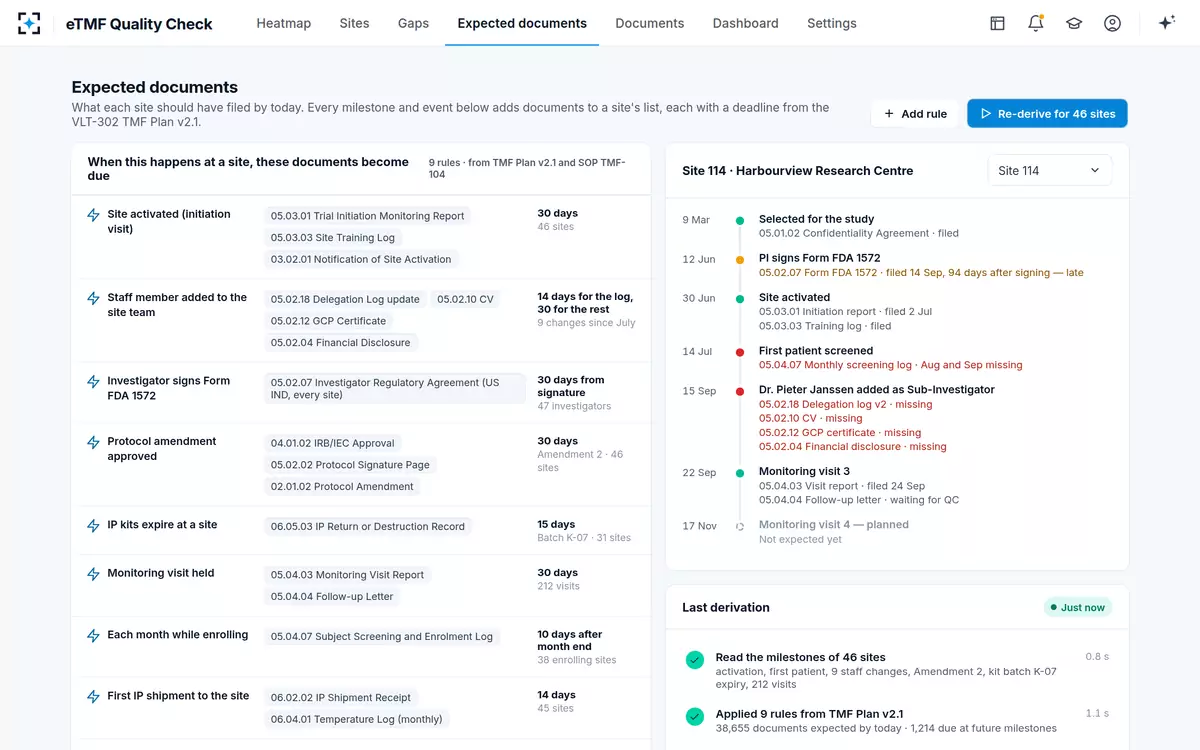
Nine rules, forty-six sites: the list is recomputed, not maintained.
Blank is not missing: documents that are not due yet
The most consequential design decision in a completeness score is what to do with a cell that has nothing in it. A site activated last week has empty zones everywhere, and scoring them as gaps produces a red wall that teaches people to ignore red.
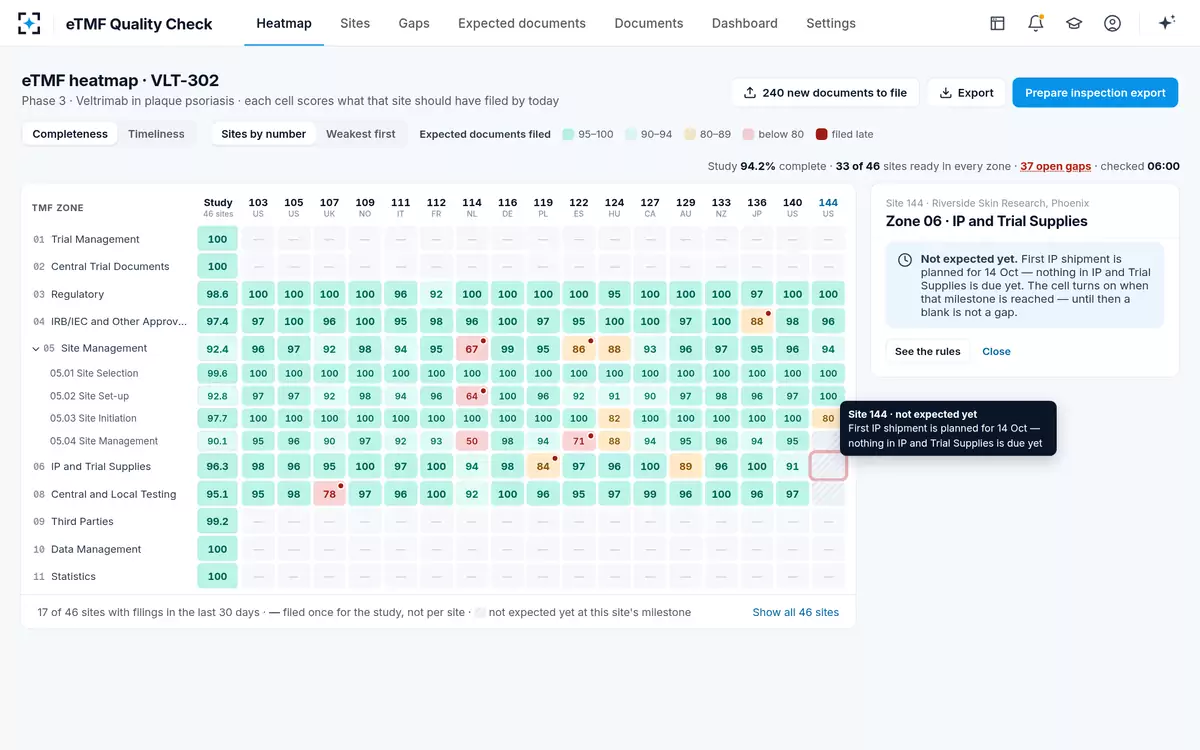
On the sample study, Site 144 in Phoenix was activated on 29 September. Its investigational product zone is hatched rather than red: the first shipment is planned for 14 October, so nothing is owed there yet. Local laboratory documents become due at first participant, planned for 27 October; visit reports after the first monitoring visit on 3 November. The cell turns on when the milestone is reached. Until then a blank is a blank.
Two cells on the same morning: how much of each is not due yet
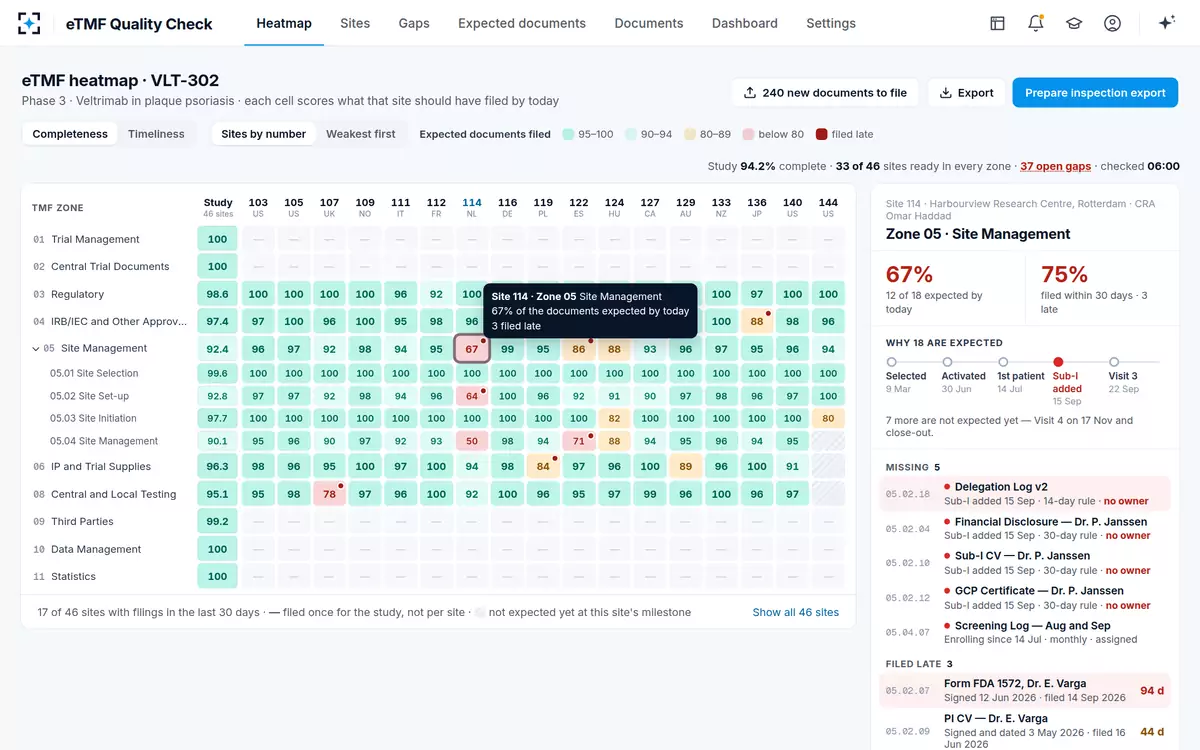
Site 114, Rotterdam · Zone 05 Site Management · 25 documents in view
- Expected by today — 18, scored · 72%
- Not due yet — 7, hatched · 28%
Site 144, Phoenix · Zone 06 IP and Trial Supplies · activated 29 September
- Not due yet — the first shipment is planned for 14 October · 100%
At study level the proportion is small enough to vanish: 38,655 documents are due today across the forty-six sites and 1,214 more are queued behind milestones still ahead, about three per cent. That is exactly why a single trial-wide average is the wrong instrument. The three per cent is not spread evenly — it sits almost entirely in the newest sites, which are the ones a trial-wide figure would quietly condemn.
A hatched cell, and the milestone that will turn it on
The events hidden inside documents rather than in the tracker
This is where hand-kept lists lose, and it is not a matter of diligence. Many of the events that create expected documents are first recorded inside another document, not in any system that feeds a tracker. A monitoring visit report names a new sub-investigator. A temperature excursion report implies a quarantine record. A letter from an ethics committee carries a condition that creates a document at every site in that country.
FDA’s own guidance on the Form FDA 1572 shows how the obligation travels by narrative rather than by system: where there are other changes to the information on a signed form — the guidance gives an IRB address change, the addition of new subinvestigators, the addition of a clinical research laboratory — “the investigator should document the changes in the clinical study records and inform the sponsor of these changes, so that the sponsor can appropriately update the IND”, and the form itself need not be re-signed. The information moves in a communication. Whether it reaches the expected document list depends entirely on whether anybody read it.
Reading each document for the events it contains, and treating those events as triggers, is the part a person cannot do at the volume a Phase 3 trial produces. On the sample study, that is how a staff change recorded on page 3 of a visit report turned into four expected documents and an open gap within the same morning — and why the evidence passage is attached to the gap, so the site can be told why each document is wanted. What the agents may and may not decide on their own is set out in the QC review guide.
Who may take a document off a site's list?
Only a person, with a reason and an approval. This is the one place where an expected document list can be quietly falsified, because removing a row raises the score. A document marked not required is a judgement about the trial — that this site never used central randomisation, that this country has no local laboratory — and it has to be made by someone accountable, recorded with its reason, and visible afterwards.
In eTMF Quality Check the agents never mark a document not required; the TMF lead can, with a written reason, and the clinical trial manager approves. The useful consequence for an inspection is that the exclusions become a short, legible list with names against them rather than an absence nobody can explain.
What a TMF plan rule has to state before it can be derived at all
- The trigger
The event in the trial’s life that starts the clock — stated as something that happens, not as a document. “A sub-investigator is added”, not “delegation log”.
- The evidence that proves the trigger
Where the event will be recorded: a milestone, a signed form, or a passage in another document. A trigger nobody can observe produces documents nobody expects.
- The documents
Named by artifact, with the party that owes each one. One event usually creates several, and they rarely belong to the same person.
- The owner
Who collects it. Owner rules by zone and country turn a list of gaps into a set of assignments.
- The deadline
A number of days and the date it counts from. State whose rule it is — your plan’s, or a regulator’s — because the two behave differently when challenged.
- Who may waive it
The person who may mark the document not required, and who approves them. Without this the list cannot be corrected except by editing it quietly.
Re-deriving the list: how often, and what moves when you do
How often you can re-derive decides what the list is for. Quarterly, it is a reporting artefact. Weekly, it is a work queue. Daily, it becomes the thing that tells a monitor what to ask for before the visit rather than after it.
What moves on a re-derivation is smaller than people expect and more concentrated. Most sites do not change at all on a given day. The movement is at the sites that had an event: a visit, an activation, a staff change, a shipment. On the sample study the morning’s re-derivation across forty-six sites produced 38,655 expected documents and 1,214 queued behind future milestones — and the material change sat at the handful of sites that had an event since the day before.
One caution worth carrying into any design. Re-deriving a list changes the denominator, so a completeness figure can fall overnight without a single document going missing: four new rows at Site 114 took a cell from one score to a lower one, which is honest and looks like a regression. Report the denominator alongside the percentage, always, and the question answers itself.
The cell the derivation produced: twelve of eighteen, and five gaps
An expected document list is the least glamorous artefact in trial master file management and the one everything else rests on. Get it derived rather than typed, and completeness, timeliness and QC all become measurable; what a trial master file is and who has to keep one sets out the obligations it serves. To see the rules, the milestones and the gaps on one screen, start from eTMF Quality Check.
Questions people ask
What is a TMF plan?
The document that says how a trial’s file will be run: its structure and index, who files what, the timelines for submission and filing, the quality checks, the access arrangements and the archiving. The EMA guideline expects filing timelines to be defined in procedural documents or a TMF plan, and makes the point that this matters most where several parties — sponsor, contract research organisation, vendors — are involved. The expected document list is derived from the plan’s rules.
How do you build a TMF expected document list?
Start from the events, not the documents. Write down the closed set of events in your trial’s life that create obligations, and for each one state the trigger, where the trigger will be observed, the documents it makes due, the owner, the deadline and who may waive it. Then apply that set to each site’s milestones. Building it the other way round — listing artifacts and guessing dates — produces a list that cannot be recomputed when something changes.
Does every site in a trial need the same documents?
No, and treating sites as identical is a common source of false gaps. Sites differ by country, by committee, by whether they use a local laboratory, by how many people have been delegated activities and by how far through the trial they are. A site activated last week legitimately owes a fraction of what a site that has enrolled for a year owes, which is why a defensible score is per site and per date rather than a single trial-wide fraction.
How often should the expected document list be updated?
As often as events occur, which in a multi-site trial is daily. The reason is not neatness: between re-derivations the list is wrong in one direction only — it understates what is owed, because new events can only add. A list refreshed quarterly is, on average, six weeks behind the trial, and every completeness figure taken from it is correspondingly flattering.
What is the difference between a TMF index and an expected document list?
The index is the structure — zones, sections and artifacts — that documents are filed into, so that anything in the file can be located; the EMA guideline asks for a suitable overall index or table of contents for exactly that purpose. The expected document list is dated and conditional: it says which of those artifacts this site owes by today. One answers “where does this go”, the other answers “what is missing”.
Who decides that a TMF document is not required?
A named person, with a written reason, under an approval rule set in the plan — never an automatic process and never silently. In eTMF Quality Check the agents may open gaps but may not remove an expected document; the TMF lead marks it not required with a reason and the clinical trial manager approves. The resulting list of exclusions is itself inspection material, because it explains the difference between what the rules produced and what the file was scored against.