A TMF QC review is the check that the trial master file is up to date and that each document in it is filed in the right place with the right details — and the usual way of running it, a quarterly review of a sample, has a structural problem: it can only ever tell you what was wrong a quarter ago. Read the European Medicines Agency’s own list of what such a review should look at and the mismatch is obvious; its six areas are a daily list wearing a quarterly schedule. So the question worth asking is not how many documents you sample but which documents your sampling can never reach. eTMF Quality Check, the Botminds agentic solution for trial master file quality, answers it by inverting the work: agents read and score every document as it arrives, the filings they are unsure of and the document classes that always need a person go to a QC reviewer, and that reviewer confirms and signs.
The screens below are from a fictional sample study, VLT-302, with invented sites, sponsor and people; figures tagged demo are what the solution shows on that sample data, not a customer’s measured result. The research is published and linked where it appears.
The six areas a TMF quality check has to cover, and the test that proves each one
- All essential documents generated are available in the file
Needs a denominator: what should be here by today at this site. Without an expected document list this area cannot be tested at all, only looked at.
- Documents are filed in the appropriate locations
Test by re-deriving the filing decision, not by reading the folder name. The question is whether this document is what its artifact says it is.
- Documents were added to the file in a timely manner
Compare each document’s own date with the date it was filed. A review that looks only at today’s contents cannot see this at all.
- Documents are correctly indexed
Check the metadata against the document: site, version, dates, signatures, people named. This is the area that silently fails, because a wrong value still looks like a value.
- Documents are only accessible according to the assigned roles and permissions
An access test, not a document test — and one a sampled document review will never perform.
- The audit trail has been reviewed
For an electronic file, the record of who did what and when. It is where late assembly and unexplained changes become visible.
What is a TMF QC review?
It is quality control applied to the file: the operational check that what the filing process produced is what it was supposed to produce. ICH E6(R3) defines the term exactly, and the definition is worth holding on to because it rules out a good deal of what gets called QC.
“The operational techniques and activities undertaken to verify that the requirements for quality of the trial-related activities have been fulfilled.”
ICH E6(R3), Glossary, Quality Control
Verify, against requirements. That means a QC review needs a written statement of what “right” is before it starts — which artifact a document should be filed to, which metadata values are mandatory, which documents must be signed. A review that consists of a reviewer looking at documents and forming an impression is an inspection of a different kind, and will not reproduce.
The duty sits in the EMA guideline, which asks the sponsor and the investigator or institution to implement risk-based quality checks or review processes so that the file stays up to date and all essential documents are properly filed. Two words in that sentence do most of the work: risk-based, which licenses you to look harder at some documents than others, and processes, which permits the check to be continuous rather than an event.
The six things a TMF QC review has to look at
The checklist above is the EMA’s list, and reading it as a schedule rather than a scope is instructive. Area one needs a current expected document list — an artefact that is itself derived daily, as the expected document list guide sets out. Area three, timeliness, is historical: a reviewer looking at the file in October cannot recover how it looked in June except through the audit trail. Area five, access, is a system test rather than a document test. Only areas two and four — right location, right metadata — are things a person can usefully check by opening a document.
So a quarterly sampled document review, which is what many organisations mean by TMF QC, addresses two of six areas directly, one of them indirectly, and three of them not at all. That is not a criticism of the people doing it. It is a mismatch between the shape of the check and the shape of the work.
Document-level QC and TMF-level QC are two different jobs
The guideline separates them, and conflating them is a common design fault in a TMF procedure. “In addition to TMF-level QC above, there should be an adequate risk-based document-level QC, as described in section 5.1 for certified copies. The sponsor should also undertake routine QA measures, e.g. system audits of TMF-management processes.”
Three distinct activities, then. File-level QC asks whether the file as a whole is current, complete and correctly organised. Document-level QC asks whether this document is what it claims to be; the guideline’s own list of quality features for certified copies gives the shape of it — “congruency of the information contained between original and certified copy; accuracy of the metadata attributed to the document (when applicable); accuracy of file name; including that it is marked as an updated version of an already existing document”. And quality assurance is the audit of the process itself, done by people who do not run it.
A review that does the second and calls it the first leaves the file itself unwatched. One of the critical findings in the MHRA’s inspection metrics lists, among its observations, exactly that gap: “There was a lack of effective oversight QC of an eTMF by the sponsor.” The same finding also recorded missing, misfiled, misnamed and duplicated documents — document-level errors that file-level oversight exists to surface.
A quarterly sampled review and a daily scored one, on the same trial
Quarterly, sampled: Filing and metadata errors in the documents that happen to be sampled.
Daily, scored — with a person on the doubtful few: Every filing decision and every extracted detail, because each is scored as the document arrives.
Quarterly, sampled: Up to a quarter after the event; on average about six weeks.
Daily, scored — with a person on the doubtful few: The same morning. A wrong filing is corrected before anything is built on it.
Quarterly, sampled: Whole batches, most of which are routine, to reach the few that are not.
Daily, scored — with a person on the doubtful few: The filings the agents were unsure of, the document classes that always need a person, and a weekly sample of the rest.
Quarterly, sampled: Everything outside the sample, and the three areas a document review cannot address at all.
Daily, scored — with a person on the doubtful few: Anything the rules were never written to look for — which is why the rules themselves need periodic audit.
Quarterly, sampled: A review report per quarter, and a sample size.
Daily, scored — with a person on the doubtful few: A record per document: who confirmed it, when, what they were shown and what their signature meant.
How big should a TMF QC sample be?
Sampling is detection, and detection obeys arithmetic that most TMF procedures never write down. If errors occur independently at some rate, the chance that a sample contains at least one of them depends on the sample size and the rate — and at the rates a reasonable filing process produces, small samples are far weaker than they feel.
The chance of catching at least one error in a 240-document batch, at a 2% error rate
Read the second bar carefully. A ten per cent sample of a batch with a two per cent error rate misses the batch’s errors entirely about three times in five. That is not an argument that sampling is useless — it is an argument that a sample is a measure of the process, not a safety net for the documents. If you sample to estimate how well filing is going, ten per cent is a reasonable instrument. If you sample hoping to catch the delegation log that was filed to the wrong artifact, it is the wrong instrument altogether.
The way out is not a bigger sample. It is to make the population that needs human attention smaller and better chosen, so that a person can see all of it. On the sample study a batch of 240 documents arrived at 08:12 from the site upload portal, a vendor file drop and monitor email — 612 pages. 228 were filed automatically at or above the confidence threshold, six were held for a QC reviewer, and six were set aside: four duplicates found by comparing content and two that were not trial documents at all. The reviewer’s queue is six, not 240, and it is the six where judgement was actually required.
A batch of 240, read and sorted into what needs a person
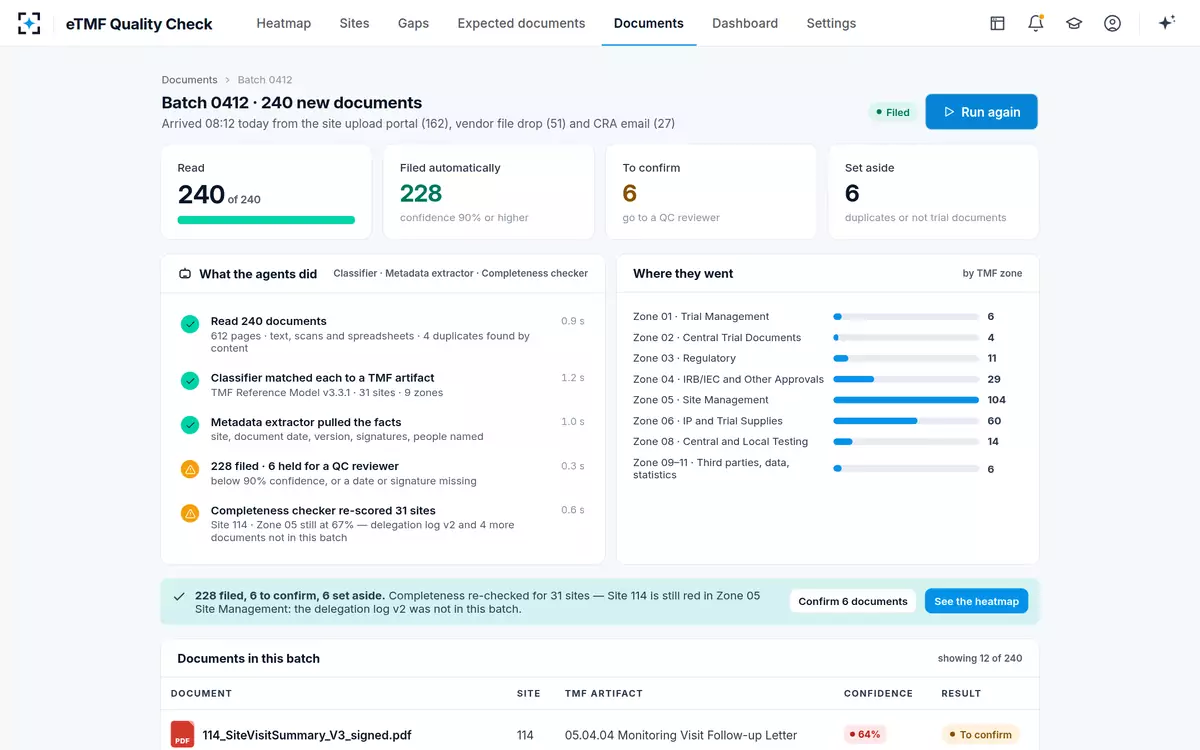
240 in, six to a person — chosen by confidence, not by lottery.
Sampling by impact rather than by count
The second half of the design follows from the published risk work. Hecht and colleagues’ method for ranking document types turns on a formula that is worth reading twice: a risk priority number of “(impact of missing process)² × effort to replace the document”. Impact is squared; replaceability is not. A document whose absence matters still ranks high even when it would be easy to get again.
Their conclusion is the design instruction: they “generated a list of document types of very high and high importance which should be focused on in order to assure an adequate high-quality TMF, while on the other hand identifying lower risk areas which require less emphasis and attention during quality control steps without endangering the integrity of the entire TMF.” ICH E6(R3) says the same thing in the language of risk control: it “should be proportionate to the importance of the risk to participants’ rights, safety and well-being and the reliability of trial results.”
Four populations, four rules — what gets checked, how much, and who signs
| Population | How much is checked | Why | Who signs it off |
|---|---|---|---|
| Stand-alone documents — the protocol and its like | Every one | The 2015 published proposal put the tolerance for missing stand-alone documents at 0%. With one copy in existence there is no sample to draw and nothing to average against. | QC reviewer |
| Always-check classes — consent forms, delegation records, ethics approvals, product accountability logs | Every one, whatever the confidence score | These are the documents that permit activity. An error in one is an error about what was allowed to happen, not about filing. | QC reviewer |
| Filings the agents were not sure of — below the confidence threshold, 90% on the sample study | Every one | Uncertainty is the cheapest possible selector: it finds the hard cases without a person reading the easy ones. | QC reviewer |
| Everything filed automatically | A weekly sample — 10% on the sample study, with 5%, 20% and every document as the alternatives | This sample measures the process rather than guarding the documents, which is what a sample is good for. On the sample study 97.4% of the filings checked this way were kept as filed. | QC reviewer, on the sampled filings |
What a TMF QC record has to show
The output of a review is not a clean file. It is a record that the review happened, which is the thing an inspector can actually test — and the requirements for it are more specific than most procedures assume. Where the confirmation is an electronic signature, 21 CFR part 11 states what the signed record must carry: it has to show clearly three things about the signing — the signer’s printed name, the date and time the signature was executed, and the meaning attached to it, such as review, approval, responsibility or authorship (21 CFR 11.50).
The third item is the one organisations skip, and it matters more than the other two. A signature with no stated meaning is ambiguous between “I have read this”, “I agree with this” and “I am accountable for this”, and the three carry very different weight when someone asks about a document three years later. On the sample study the meaning is written on the screen as the reviewer signs — “Reviewed — filing and details are correct” — and the name, the time and the meaning go to the audit trail together and cannot be changed afterwards.
A useful record also carries what the reviewer was shown. If a filing was confirmed, an inspector may ask what the alternatives were and why this one was chosen; a record that stores the candidates, their scores and the passages behind each reason answers that in seconds, and a record that stores only the outcome cannot answer it at all.
What the reviewer sees before confirming: candidates, reasons, passages
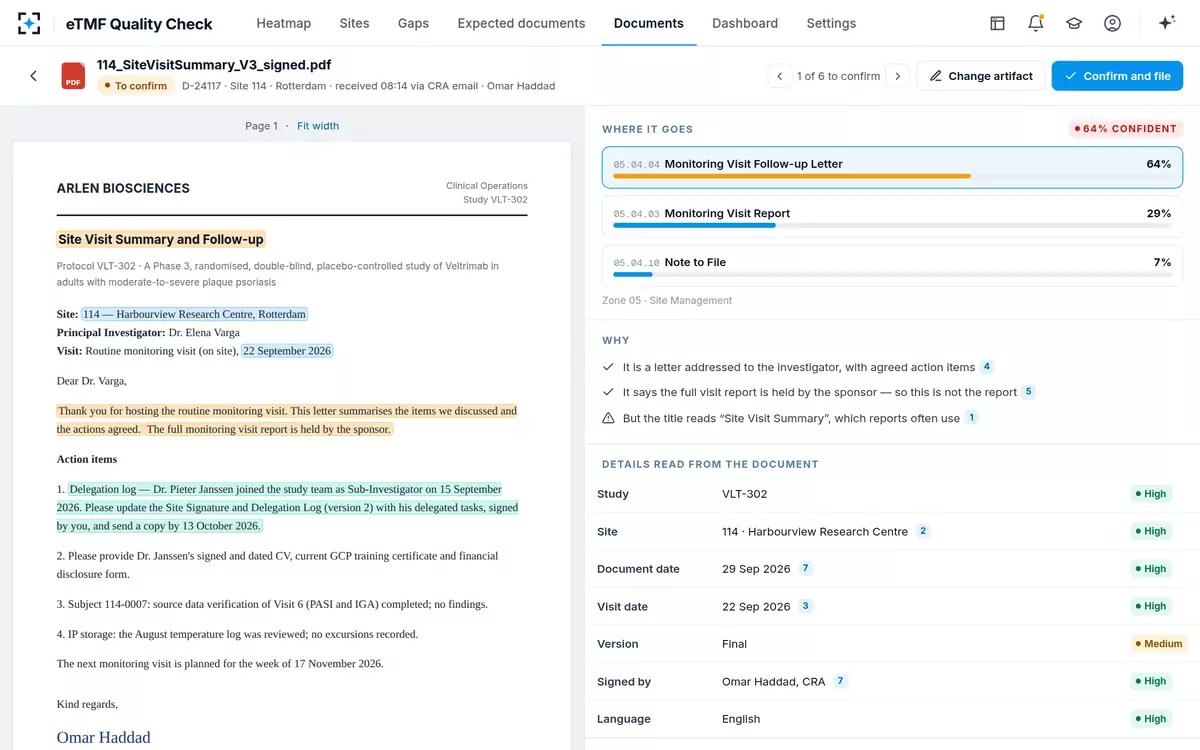
Who may confirm a filing, and what the signature means
Separating the person who makes a decision from the person who confirms it is a long-standing control in document management, and in a trial master file it has a specific shape, because one of the parties is not a person.
Maker and checker when the maker is an agent
The agents
Read each document, propose the artifact it belongs to with the three best candidates, a confidence and the passages behind each reason, and read every detail — site, dates, version, signatures, people named.
May not confirm their own filing, and may never mark a document not required.
The QC reviewer
Confirms or corrects the filing where the agents were unsure, and on a weekly sample of the rest. Signs with a stated meaning.
Does not set the rules that decide which filings reach them.
The TMF lead
Owns the plan’s rules, the confidence threshold, the sample size and the list of documents that always go to a reviewer.
Should not be the only person who may sign, or the review stops when they are on leave.
The clinical trial manager
Approves decisions that remove an obligation — a document marked not required — and approves what leaves the organisation for an inspection.
Does not confirm individual filings; approving and reviewing are different acts.
Two rules make the separation real rather than decorative. An agent may propose a filing and may score it, but the confirmation is a person’s act, recorded in that person’s name. And only a person may decide that a document is not required at all — with a written reason and the clinical trial manager’s approval — because that decision removes a row from the denominator and therefore raises the score, which is the one change in this whole discipline that nobody should be able to make quietly.
The signature, with its meaning on the record
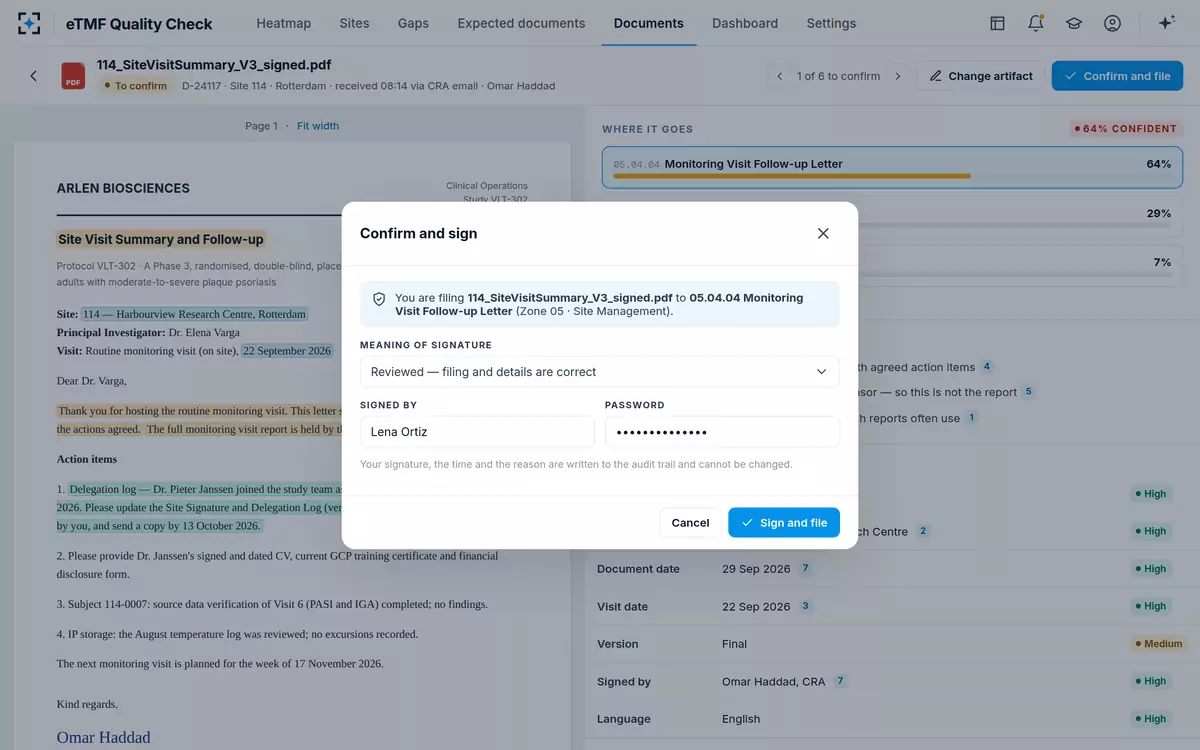
Quarterly, weekly, or on every document
The frequency question is usually argued as a resource question and is really a design question: what is a person being asked to do?
If the answer is “look at documents”, then frequency trades directly against volume and quarterly is the only affordable option on a large trial. If the answer is “decide the cases that need judgement, and sign them”, the volume is set by how many hard cases the trial produces rather than by how many documents it produces, and daily becomes affordable — because 240 documents a batch yields six decisions, not 240.
The same three people, before and with the agents reading
Today
Works through whole batches when she wants only the doubtful few: “Give me the ones the agents weren’t sure of — not all 240.”
With agents
Gets the six filings held below the confidence threshold, each with its candidates, the reasons and every detail read, plus a weekly sample of the rest.
Still theirs: The decision, and the signature on it.
Today
Finds out what was missing at the last quarterly review, and works a backlog of thousands by hand.
With agents
Sees what is missing today, site by site and zone by zone, and confirms only the filings that need judgement.
Still theirs: The rules, the thresholds and who may sign.
Today
Has to answer before every inspection: “If an inspector asks for Site 114 tomorrow, what will they find?”
With agents
Approves every “not required” decision and every inspection export — a read-only copy with the index, metadata, quality records and audit trail.
Still theirs: Approval, which is not the same act as review.
There is a second argument for frequency that has nothing to do with cost. A filing error found the same morning is corrected before anything is built on it; one found a quarter later may have been relied on — by a monitor, by a report, by another document that cites it. The cost of an error is a function of how long it sat there, and that is the variable a review schedule actually controls.
What a TMF QC review cannot find
Three categories, and a review that claims otherwise is overselling itself.
It cannot find a document nobody sent. No amount of checking what arrived will reveal what did not; that is the job of the expected document list and the completeness score described in the completeness guide. It cannot find an error in the rules: if your plan says a class of document is not required and it is, every check will pass and the file will still be wrong, which is why the rules themselves need periodic audit by someone who did not write them — the quality assurance the EMA guideline asks for separately. And it cannot repair history: a document confirmed today was still absent for the months before, and the audit trail will show it, which is the point made at length in the timeliness guide.
What a well-designed check does give you is narrower and more valuable than a clean bill of health: evidence that every filing decision was made against written criteria, that the doubtful ones were seen by a competent person, and that the record of who decided what — and what their signature meant — exists for each one. That is what an inspection tests. To see the queue, the candidates and the signature together, start from eTMF Quality Check.
Questions people ask
What should a TMF QC checklist include?
At file level, the EMA guideline’s six areas: all essential documents generated are available, documents are filed in the right locations, documents were added in a timely manner, documents are correctly indexed, access matches the assigned roles and permissions, and the audit trail has been reviewed. At document level, the quality features the same guideline lists for certified copies — congruency with the original, accuracy of the metadata, accuracy of the file name, and whether it is marked as superseding an existing version.
What is risk-based TMF QC?
Checking harder where the consequence of an error is greater, rather than checking a flat percentage of everything. ICH E6(R3) states the principle: risk control should be proportionate to the importance of the risk to participants’ rights, safety and well-being and to the reliability of results. In practice that means every copy of a document class that permits activity — consent, delegation, approvals, product accountability — and a sample of the routine classes.
Who should do the TMF QC review?
Someone who did not make the filing decision, and who is competent to judge it. The separation matters more than the job title: whoever classified or uploaded a document should not be the person who confirms it. Where part of the file is held by a provider, the sponsor still needs its own oversight of the file — one critical finding in the MHRA’s inspection metrics lists a lack of effective oversight quality control of an electronic file by the sponsor among its observations.
How often should a trial master file be QC reviewed?
As often as documents arrive, if the review is designed so that a person handles only the cases needing judgement. Where a review means a person reading whole batches, frequency is limited by volume and quarterly is common — but then the delay is the metric that matters, because the cost of a filing error grows with how long it went unnoticed. State the frequency per population rather than for the file as a whole.
What should a TMF QC record show?
Who confirmed the filing, when, and what their confirmation meant. Where it is an electronic signature, 21 CFR 11.50 requires the printed name of the signer, the date and time, and the meaning associated with the signature — review, approval, responsibility or authorship. A useful record goes further and keeps what the reviewer was shown: the candidate artifacts, the scores and the passages behind each reason, so that the decision can be re-examined rather than merely trusted.
How big should a TMF QC sample be?
Large enough to measure the process, and never relied on to catch individual errors. On our own arithmetic, a ten per cent sample of a 240-document batch with errors occurring independently at two per cent contains at least one of them under four times in ten. Sample to estimate the error rate; use selection by uncertainty and by document class, not sampling, to decide which documents a person actually looks at.