A trial master file is the file of documents and data that lets someone who was not there verify how a clinical trial was run and whether its data can be trusted. Both the sponsor and the investigator must keep one, and under the EU Clinical Trials Regulation it has to contain the essential documents at all times, not merely by the end. That phrasing is the whole difficulty: the law describes the file by what it must make possible rather than by a list of what goes in it, so the honest test of a trial master file is never “is it tidy” but “could a stranger rebuild this trial from it without asking us anything”. On a Phase 3 trial of forty-six sites that means tens of thousands of documents arriving from sites, contract research organisations and vendors, each due on a date nobody wrote down. eTMF Quality Check is the Botminds agentic solution for that problem: agents file each document to the TMF Reference Model, work out from each site’s milestones which documents that site owes by today, and score every zone at every site for completeness and timeliness, for a TMF lead to confirm and sign.
The screens and figures tagged demo below come from a fictional sample study, VLT-302, with forty-six sites in twelve countries; its sponsor, its sites and every person named in it are invented. Figures tagged typical are published, and each is linked where it appears.
What one trial master file holds, and how long it has to outlive the trial
38,655
documents expected by today across 46 sites, from each site’s milestones
demo
94.2%
of those scored complete on the sample study this morning
demo
249
artifacts in the TMF Reference Model, in 48 sections and 11 zones
typical
25yrs
the minimum the EU Clinical Trials Regulation sets for archiving the file
typical
What is a trial master file?
The definition that matters is the statutory one. Article 57 of Regulation (EU) No 536/2014 gives it in three sentences, and every argument about trial master files comes back to them.
“The sponsor and the investigator shall keep a clinical trial master file. The clinical trial master file shall at all times contain the essential documents relating to that clinical trial which allow verification of the conduct of a clinical trial and the quality of the data generated… It shall be readily available, and directly accessible upon request, to the Member States.”
Regulation (EU) No 536/2014, Article 57
Read it as a specification and three obligations fall out. The file must exist and be kept by two parties, not one. It must be current — “at all times”, which is a continuous duty rather than a deadline. And it must be usable by a stranger on request, which is why access arrangements and indexing are inspection subjects in their own right.
What it must contain is defined by purpose: documents that “allow verification of the conduct of a clinical trial and the quality of the data generated”. The European Medicines Agency’s guideline for inspectors turns that purpose into the sentence most TMF procedures quote: the documentation “should be sufficient to adequately reconstruct the activities undertaken in conducting the trial, along with decisions and justifications made concerning the trial” (EMA/INS/GCP/856758/2018, section 2). Reconstruction, not tidiness, is the standard. A file can be beautifully indexed and still fail it, and a file can have an ugly folder tree and pass.
What goes in a trial master file, and what does not?
There is no closed list, and the authority that is usually treated as the list says so itself. On section 8 of the earlier ICH GCP guideline, E6(R2), which E6(R3) replaced with its Appendix C, the EMA guideline is explicit: that section “defines the documents that are considered essential (as appropriate to the trial) and which documents should be filed in the investigator/institution or sponsor TMF, or both; however, this list should not be used as a definitive checklist for TMF content. It is not an exhaustive list.” It goes on to say that many trials need documents the section never mentions, and that the sponsor and investigator should include anything that helps reconstruct and evaluate the trial’s conduct.
So the working rule is a question, not a checklist: if this document disappeared, would a reader still be able to tell what was done, by whom, under what approval, and why? If not, it belongs in the file. Four kinds of document get missed under that test more than any other — the ones that record a decision rather than a result. Correspondence that settles a protocol question. The note to file that explains why a visit happened late. The superseded version of a document that was in force when something was done. And the documentation of who was allowed to do what, which inspectors use to test whether the right people did the work.
What does not belong is almost as useful to state. Unnecessary duplication is called out in the same guideline, and duplication is not harmless: two copies of a consent form with different dates is a question an inspector will ask and someone will have to answer. Nor does every working draft belong; the final document and the versions that were in force do.
Essential documents became essential records — and why that widens the file
ICH E6(R3), the revision of the Good Clinical Practice guideline that reached Step 4 on 6 January 2025, stopped using “essential documents” and now says essential records. The change is not cosmetic. Its definition covers “the documents and data (and relevant metadata), in any format, associated with a clinical trial that facilitate the ongoing management of the trial and collectively allow the evaluation of the methods used, the factors affecting a trial and the actions taken during the trial conduct to determine the reliability of the trial results produced…”.
Three words in that sentence widen the file. Data, because a dataset held in a system can be essential and cannot be printed into a binder. Metadata, because an audit trail that shows when a value changed is part of what makes the data evaluable. And any format, which removes the last argument that something in a validated system is somehow outside the file.
The second change in E6(R3) is where the file lives. Appendix C.2.3 says essential records “should be maintained in or referred to from repositories held by the sponsor and by the investigator/institution for their respective records. These repositories may be referred to as a trial master file (TMF). The repository held by the investigator/institution may also be referred to as the investigator site file (ISF).” The guideline now points at the storage place, and allows records to be referred to from it rather than copied into it — which makes the index of where everything is a deliverable rather than a convenience.
One trial, two files: the sponsor TMF and the investigator site file
This is a common confusion, and the rule is simpler than the practice. There is one trial master file for a trial, in two parts. The EMA guideline puts it plainly: “There should only be one TMF for a clinical trial, comprising the sponsor and investigator parts.” The investigator’s part is what the industry calls the investigator site file.
The sponsor part and the investigator site file, in eTMF Quality Check and in the rules
Sponsor TMF: The sponsor, or a contract research organisation acting for it under a written agreement.
Investigator site file (investigator/institution part): The investigator or the institution, at the site.
Sponsor TMF: The sponsor remains responsible for the whole file, including the part a provider holds.
Investigator site file (investigator/institution part): The investigator/institution “is responsible for all essential documents generated by the investigator/institution and should therefore have control of them at all times”.
Sponsor TMF: The master randomisation list.
Investigator site file (investigator/institution part): The subject identification code list, which links a code to a named person.
Sponsor TMF: The sponsor TMF.
Investigator site file (investigator/institution part): May be referred to as the investigator site file, under ICH E6(R3) Appendix C.2.3.
Sponsor TMF: The sponsor, its providers under agreement, and inspectors on request.
Investigator site file (investigator/institution part): The site, the monitor, and inspectors — but a monitor’s access to participants’ medical records is itself a recorded arrangement.
Sponsor TMF: The sponsor, for at least 25 years after the end of the trial in the EU.
Investigator site file (investigator/institution part): The investigator, for the same minimum period; participants’ medical files follow national law.
Sponsor TMF: Trial-level zones are filed once for the study, so their cells show a dash rather than a score.
Investigator site file (investigator/institution part): Site zones are scored per site, which is where a staff change turns a green cell red.
Two practical consequences follow. The segregation is deliberate: the sponsor must not hold the subject identification code list, and the site must not hold the master randomisation list, because each would break the blind or the participants’ confidentiality. And the sponsor’s responsibility does not shrink when a provider holds the documents — which is why a sponsor that cannot see its contract research organisation’s half of the file has an oversight problem rather than a reporting problem.
The eleven zones: how the TMF Reference Model organises a file
Neither the EU Regulation, ICH E6(R3) nor the EMA guideline prescribes a folder structure. What the industry uses instead is the TMF Reference Model, maintained under CDISC since 2024, and summarised at the 2024 US CDISC + TMF Interchange as “11 Zones / 48 Sections / 249 Artifacts / 607 Sub-Artifacts”. A zone is a subject area; a section narrows it; an artifact is a document type you can actually file something into.
The eleven zones of the TMF Reference Model, and who owes each one
01
Trial Management
The TMF plan, the monitoring plan, the trial team’s training documents
Once for the trial
02
Central Trial Documents
The protocol and every amendment, the investigator’s brochure, the case report form design
Once for the trial
03
Regulatory
The application to the competent authority, its decision, and later notifications such as a new investigator
Once per country
04
IRB or IEC and Other Approvals
The ethics committee’s favourable opinion, the approved consent documents, the committee’s composition
Per committee, so per site or per country
05
Site Management
The delegation log, each person’s CV, training and financial disclosure, the monitoring visit reports
Per site — and again for every person added
06
IP and Trial Supplies
Shipment and receipt records, accountability logs, temperature excursions, returns and destruction
Per site, and per shipment
07
Safety Reporting
The safety management plan, expedited reports of suspected unexpected serious adverse reactions, annual safety reports
Once for the trial, with site correspondence
08
Central and Local Testing
The local laboratory’s accreditation and normal ranges, the central laboratory manual, equipment calibration
Per site for the local laboratory
09
Third Parties
Qualification and oversight of each vendor and service provider, and the agreements with them
Per vendor
10
Data Management
The data management plan, the system validation documents, the database lock checklist
Once for the trial
11
Statistics
The statistical analysis plan, the randomisation documentation, the outputs behind the final report
Once for the trial
Read the right-hand column and the arithmetic of a trial master file appears. A zone filed once for the trial has one state: in place, or not. A zone filed once per site has forty-six states on a forty-six-site trial. And Zone 05, Site Management, is filed again for every person who joins a site team — which is why one new sub-investigator can open four gaps at once, and why the expected document list, and how a site’s documents fall due, is the artefact the rest of this discipline rests on.
One trial master file, eleven zones down the side and forty-six sites across
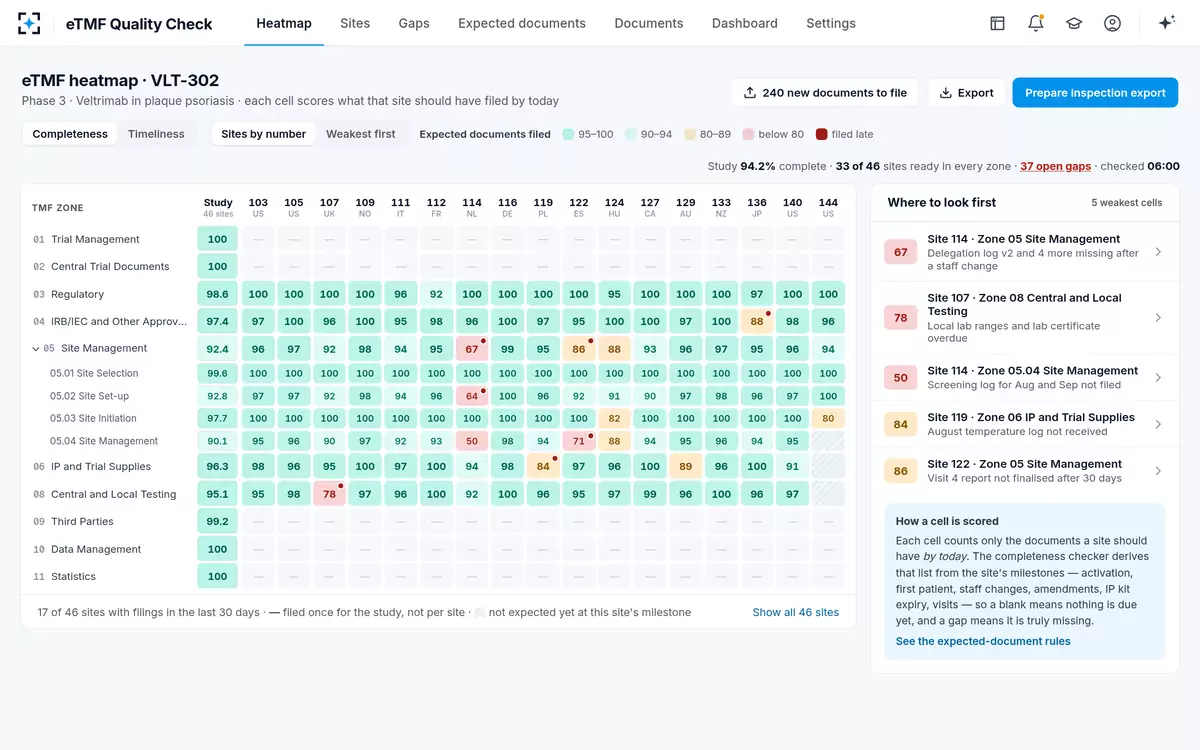
Zones down, sites across: the dash is the sponsor half of the file, the percentages are the site half.
What makes a trial master file electronic, and what the law does not care about
An electronic trial master file is a trial master file kept in a computer system rather than in binders. The legal content does not change: the same documents, the same “at all times”, the same archiving minimum. What changes is that four things which are self-evident on paper now have to be demonstrated — that the system is fit for the purpose it is used for, that its audit trail shows who did what and when, that access is restricted to the right people, and that what comes out at the end is still readable in twenty-five years.
Two things the law is indifferent to are worth saying out loud, because vendors are not. It does not care how many folders you have: the EMA guideline asks only for “a suitable overall index or table of contents to enable the location of essential documents in the TMF to be traced”. And it does not demand that the file sit in one system: the EMA guideline asks for a primary TMF system, with the number of other systems kept to a minimum, and for you to be able to say where every essential record is. A trial with documents in an electronic file, a safety database and a monitoring system can be compliant. A trial whose index does not mention the last two cannot. The controls an inspector will actually test are set out in the eTMF system requirements guide.
How long must a trial master file be kept?
There is no single answer, and writing one number on a slide is a common mistake in this area. The period depends on the jurisdiction the trial was run under, and the three main ones differ by more than twenty years.
Retention of the trial master file, by jurisdiction
| Where | The rule | How long | What it is counted from |
|---|---|---|---|
| European Union | Regulation (EU) No 536/2014, Article 58 | At least 25 years | The end of the clinical trial. Longer if other Union law requires it; participants’ medical files follow national law. |
| United Kingdom | S.I. 2004/1031, regulation 31A(7) | At least 25 years | The day after the conclusion of the trial, for documents that are or have been in the trial master file, including electronic ones. A duty on the sponsor and the chief investigator. |
| United Kingdom, extended | S.I. 2004/1031, regulation 31A(7A), in force from 28 April 2026 | At least 2 years from the grant | The day after a UK marketing authorisation is granted — but only if the trial’s data is still being used to support that application when the 25 years expire. |
| United States | 21 CFR 312.57(c) | 2 years | Approval of a marketing application; or, if none is approved, 2 years after shipment for investigational use is discontinued and FDA has been notified. |
The practical reading: if a trial touches the European Union or the United Kingdom, plan for twenty-five years, and plan for the file to outlive the system it was built in. If it is United States only, two years after approval is the federal floor, and institutional and contractual requirements often set a longer one. The governance panel in eTMF Quality Check states twenty-five years because the sample study runs in Europe; that is the European and United Kingdom rule, not a global one.
A trial master file’s working life is the short part
- Article 57≈ 30 months
- Article 58 — readily available and accessible to the authorities throughout≥ 300 months
What an inspector actually does with your trial master file
An inspection of the file is not a spelling check. The EMA guideline describes the file’s purpose as enabling “the operational staff as well as monitors, auditors and inspectors to evaluate compliance with the protocol, the trial’s safe conduct and the quality of the data obtained”. In practice an inspector picks a thread and pulls it: a participant, a visit, a staff member, an amendment — and asks the file to account for it end to end.
That is why access and location are tested first. The Good Clinical Practice Inspectors Working Group’s 2023 annual report lists among its recurring findings “Lack of inspection readiness: limitations in eTMF access” and “Deficiencies in maintaining essential documents: missing documents, location of documents (including source data) not defined” (EMA/INS/GCP/164938/2024). Only one of those is about documents being absent. The rest is about access and location — can an inspector get in, and does anyone know where each record lives — and all of it is findable before an inspector arrives.
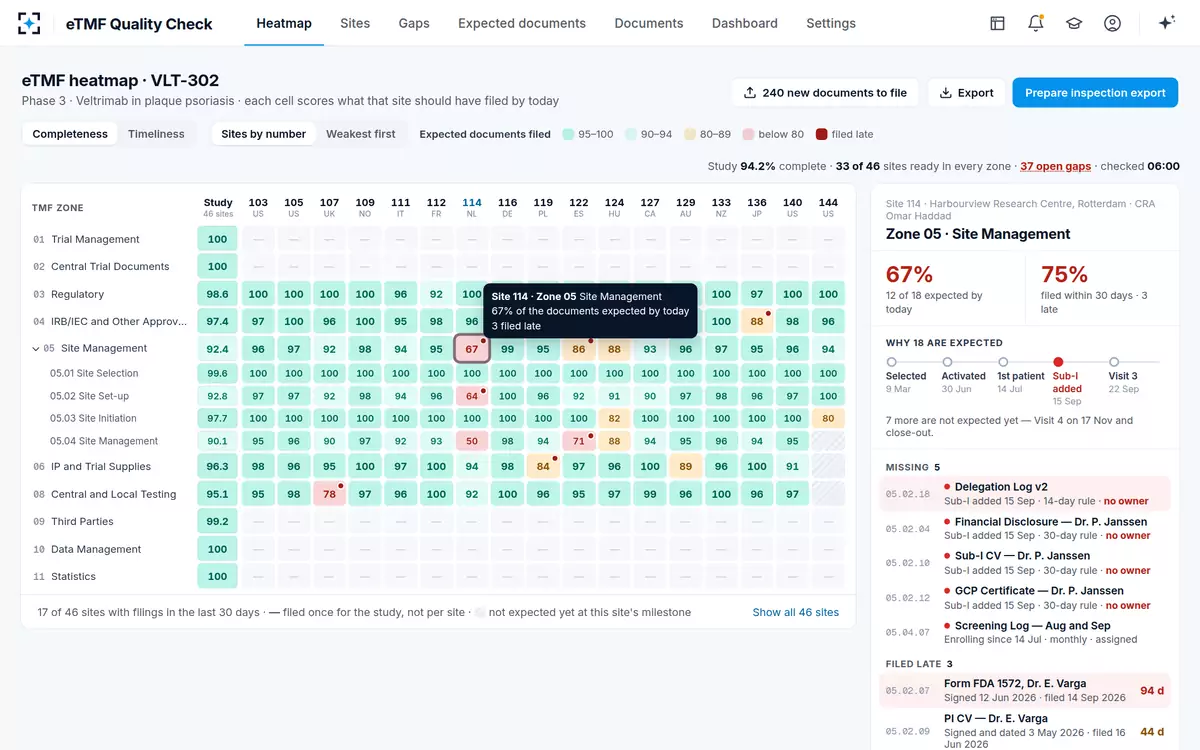
One cell opened: what the file can account for at a single site
The three questions a trial master file has to answer every day
Strip the discipline back and a trial master file has to be able to answer three questions about itself, at any hour, without a project being started to find out. Is it complete — are the documents that should be here, here? Was it filed on time — did each document reach the file while it still meant something? Is it right — is each document filed in the correct place, with the correct details, and confirmed by someone competent?
Many TMF teams answer those three questions at a quarterly review, from a list kept by hand. That is where the trouble starts: the list goes stale the day a site changes staff. On the sample study a sub-investigator joined Site 114 on 15 September and did assessments; nobody updated the spreadsheet, and the site stayed green while his delegation log entry, CV, training certificate and financial disclosure were all missing. Scoring the same three questions every morning instead turns each of them into a number with a denominator you can defend — which is the subject of the completeness guide and the timeliness guide, and of the quality check underneath them both.
Four phrases in the rules that decide everything about a trial master file
- “at all times” — Article 57
A continuous duty, not a deadline. The EMA’s inspectors read it as requiring documentation to be added in a timely manner during the trial, which is why a file assembled before an inspection is a finding rather than a recovery.
- “readily available, and directly accessible upon request” — Article 57
Someone outside your organisation must be able to find a named document without your help. That makes the index, the naming and the access rights part of compliance, not housekeeping.
- “any alteration… shall be traceable” — Article 58
Every change to the content of the file has to leave a trail: who, what, when. On paper that was a signature and an initialled correction; electronically it is an audit trail you can produce.
- “sufficient to adequately reconstruct the activities undertaken” — EMA guideline, section 2
The test the other three serve. If a stranger cannot rebuild what happened, when and on whose authority, the file is incomplete however full it looks.
Where the expected documents come from: rules, not a spreadsheet
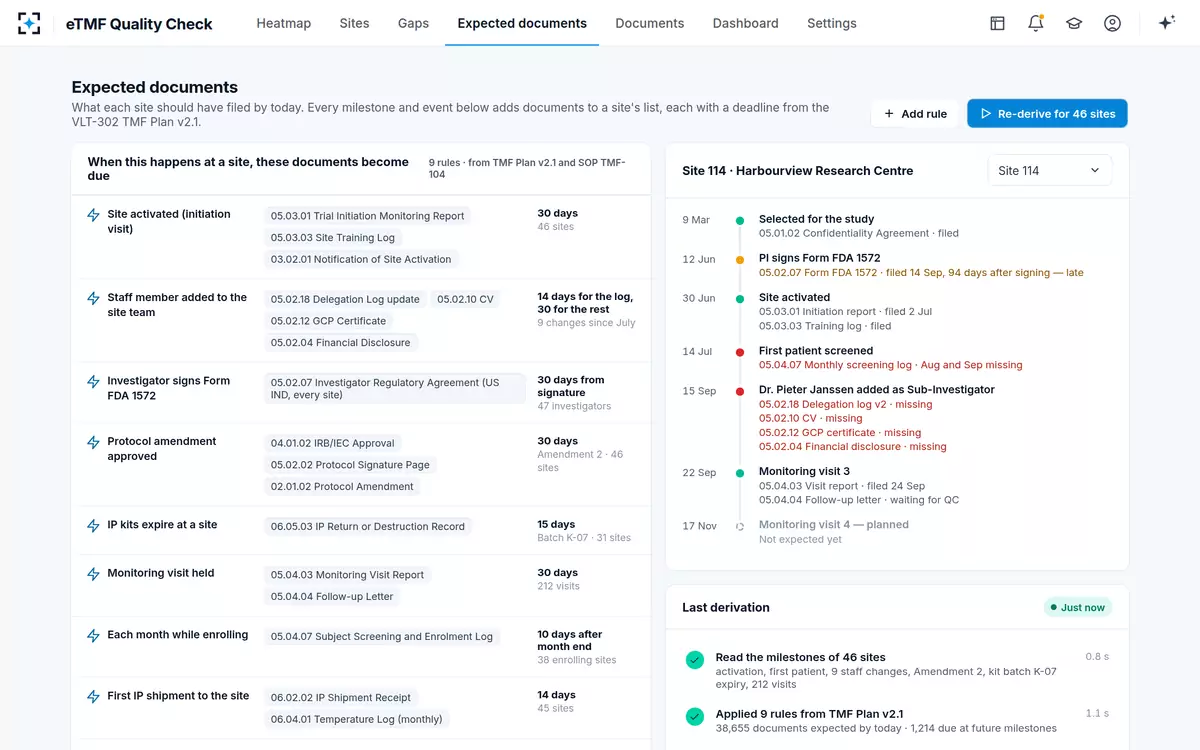
None of this is a software argument. It is the observation that three questions asked once a quarter produce answers that are, on average, six weeks out of date, and that the same three questions can be asked every morning from the documents themselves. To see the zones, the sites and the gaps on one screen, start from eTMF Quality Check.
Questions people ask
Is a trial master file a legal requirement?
In the European Union and the United Kingdom, yes, in those words. Article 57 of Regulation (EU) No 536/2014 requires both the sponsor and the investigator to keep one; in the United Kingdom, regulation 31A of S.I. 2004/1031 requires the sponsor to keep one and the sponsor and chief investigator to retain it. The United States does not use the phrase in its regulations, but 21 CFR part 312 requires the sponsor and the investigator to keep and retain the equivalent records, and ICH E6(R3) calls the sponsor’s and investigator’s repositories of essential records a trial master file.
What is the difference between a trial master file and an investigator site file?
They are two parts of one file. The EMA guideline states that there should only be one trial master file for a trial, comprising the sponsor and investigator parts; the investigator’s part is commonly called the investigator site file, and ICH E6(R3) Appendix C.2.3 endorses that name. Some documents sit in one part only — the master randomisation list with the sponsor, the subject identification code list with the site — and the investigator must have control of the documents the site generates at all times.
What is an electronic trial master file?
A trial master file kept in a computer system instead of binders. The legal duties are identical; what is added is the need to show that the system is fit for purpose, that its audit trail records who changed what and when, that access is restricted by role, and that the content stays complete and legible for the whole retention period. Nothing in the rules requires a single system: the EMA guideline asks for a primary one and as few others as possible, and a trial may keep essential records in several places so long as the file’s index says where each one is.
What are the 11 zones of the TMF Reference Model?
Trial Management; Central Trial Documents; Regulatory; IRB or IEC and Other Approvals; Site Management; IP and Trial Supplies; Safety Reporting; Central and Local Testing; Third Parties; Data Management; Statistics. Beneath them the model carried 48 sections and 249 artifacts when it was presented at the 2024 US CDISC + TMF Interchange. It is an industry standard, not a regulatory requirement — a company index is equally acceptable if it lets a document’s location be traced.
Who is responsible for the trial master file?
The sponsor, for the file as a whole, including any part a contract research organisation holds on its behalf; and the investigator or institution, for the part it generates, which it must control at all times. Delegating the work does not delegate the responsibility. In day-to-day terms a TMF lead or TMF specialist usually runs the file, with monitors collecting from sites and a clinical trial manager accountable for inspection readiness.
What are essential documents in a clinical trial?
The documents that, individually and together, let someone evaluate how the trial was conducted and how reliable its data are. ICH E6(R3) now calls them essential records and includes data and metadata in any format. The list in section 8 of the earlier ICH GCP guideline, E6(R2), is the usual starting point, but the EMA guideline warns in terms that it is neither a definitive checklist nor exhaustive: anything needed to reconstruct and evaluate the trial’s conduct belongs in the file.