AI in credit underwriting, as banks are deploying it in 2026, moves the work of finding and computing to software and keeps the decisions with named people. The OCC reports that banks are taking "a measured approach" to generative and agentic AI, "with usage generally limited to specific use cases with guardrails and human-in-the-loop accountability to manage risk" (OCC Semiannual Risk Perspective, Spring 2026). For a commercial credit department the useful question is not whether to use it but where the line falls: locating the policy section in force, reading past memos and reviewers' comments, and applying ratio tests to stated figures can move to agents; judging the borrower, structuring, recommending, grading and approving cannot. Botminds' Credit Policy & Precedent Search sits on that line, answering an analyst's policy question beside the deal with every sentence cited, so seniors spend their time on the exceptions that are theirs to decide.
The department used as the example throughout is a fictional sample bank's commercial credit team: nine analysts, six of them hired this year, and two senior credit officers who approve exceptions. Research and supervisory sources are linked where they appear.
Where AI sits in bank lending today: around the decision, rarely in it
11%
of US banks used AI on average, 2017–2022, in Census Bureau survey microdata
1 in 10
banks have a scoring system that can automate some non-card underwriting
<1 in 100
banks will auto-approve a $250,000 business loan
How are banks using AI in credit underwriting today?
Mostly around the credit decision rather than inside it. A Census Bureau working paper built on confidential survey data found that 11% of US banks used AI on average between 2017 and 2022, and that banks with greater AI use lent "significantly more to distant borrowers, about whom they have less soft information", with lower default rates on those loans (Census Bureau, 2025). That is a finding about reach and pricing, not about who underwrites.
Automated approval remains rare for loans of the size a commercial credit analyst writes up. The FDIC found that "less than one in thirty banks use a credit-scoring system to auto-approve loans, and less than one in one hundred banks will auto-approve a loan of $250,000" (FDIC Small Business Lending Survey). Where generative AI has arrived, the OCC observed that "use cases are primarily productivity and customer experience enhancement tools". For a credit department, that is where the opportunity is: not in the decision, but in the hours spent getting the decision ready.
Which underwriting tasks can move to agents, and which stay with people?
A task can move when its output can be checked against a source; it stays when its output is a decision someone must answer for. Finding §4.3.4 of the credit policy can be checked against the policy. Computing leverage at 3.43x with no synergies can be checked against the memo's figures. Deciding that a borrower's management can deliver an integration plan cannot be checked against anything; it is a judgement, and the person who makes it signs.
A commercial analyst's tasks, sorted by who does them with agents
| Task | Who does it | What makes it so |
|---|---|---|
| Find the policy section in force, and its version | Agents | Checkable against the policy text; the answer quotes it with section and page |
| Find past memos on the same question, and how those loans performed | Agents | Checkable against the memo archive and the loan history |
| Surface what reviewers wrote on similar deals | Agents | Checkable against the reviewers' own comments |
| Apply the policy's ratio tests to the deal's stated figures | Agents | Arithmetic on sourced numbers; never changes a deal figure |
| Draft a cited paragraph for the memo | Agents draft; the analyst owns | Every clause cited; the analyst decides whether it says the right thing |
| Choose which precedent fits and which is a warning | The analyst | A judgement about similarity the archive cannot make |
| Structure around a weakness: covenant, equity, guarantee | The analyst | Negotiated with the relationship manager and the borrower |
| Assign the risk grade and recommend | The analyst | The bank's rating system names a person accountable for it |
| Approve an exception to policy | The senior credit officer | Policy delegates the authority to a named role |
The middle rows are where a credit department changes most. An agent can draft the leverage paragraph for a memo with six citations; whether that paragraph is right is still the analyst's call. The analyst's work moves from assembling a paragraph to deciding whether it is true, which is a better use of the person and a harder skill to teach.
Where the capacity comes from: the questions that wait on seniors
In most commercial credit departments, the scarce resource is not analyst hours but senior hours. A new analyst's policy questions go to the few senior credit officers who know the answer and the history, and every question waits on the same few people. The sample bank's own estimate is one to two days of waiting for a single answer; its real estate credit officer spends half the week on questions the policy already answers.
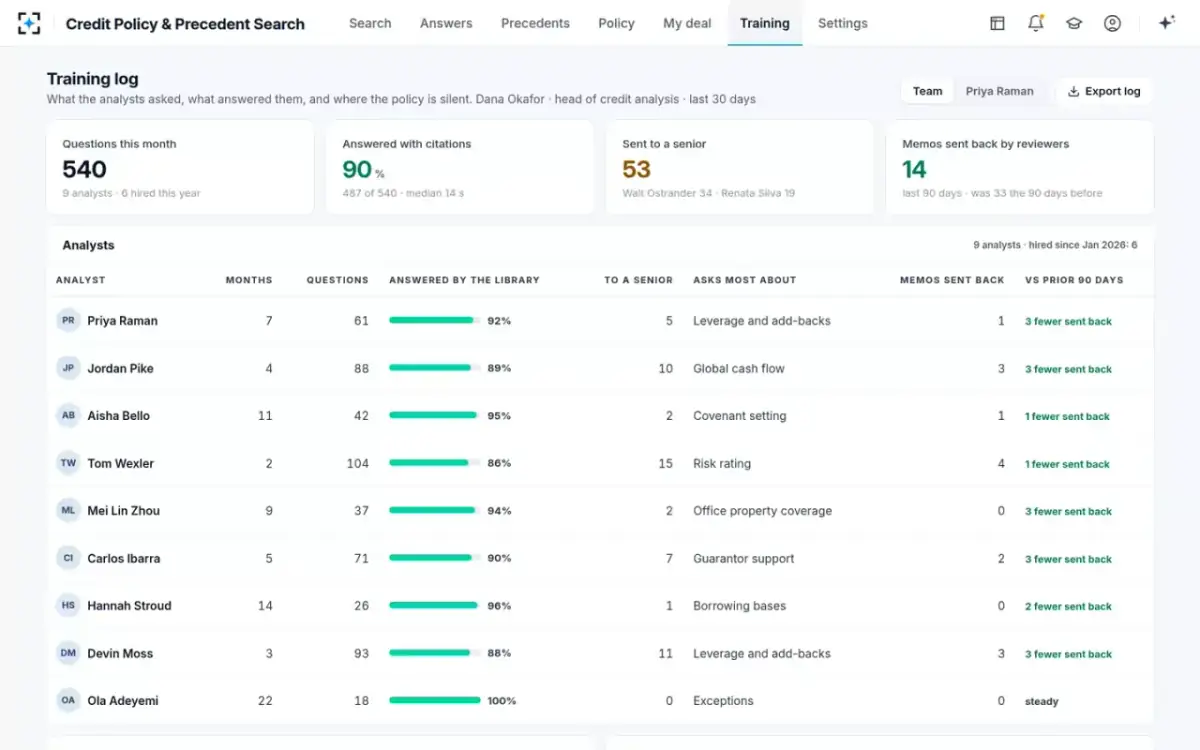
The sample team asked 64 questions about one section of the policy, §4.3 on leverage, in 90 days, from nine analysts. Each of those questions has an answer in the policy text, the memo archive or a reviewer's past comment. Answering them from those sources, beside the deal, in seconds, is capacity returned to the two people whose time is the department's real constraint, and it is capacity the head of credit can see: the sample bank's reviewers sent back 14 memos in the last 90 days, down from 33 in the 90 days before.
What each analyst asked, what answered it, and where the policy is silent
Who gains most: what the research says about novices
The best evidence on AI assistants at work says they help the least experienced people most, by carrying senior practice to them. In a study of 5,179 customer support agents, access to a generative AI assistant raised productivity "by 14% on average, including a 34% improvement for novice and low-skilled workers but with minimal impact on experienced and highly skilled workers", and the authors found "suggestive evidence that the AI model disseminates the best practices of more able workers and helps newer workers move down the experience curve" (Brynjolfsson, Li and Raymond, NBER w31161).
No comparable study of credit work has been published, and a credit memo is not a support ticket. The mechanism is still the one that matters to a credit department with six new analysts. Much of a bank's lending knowledge is soft information; Berger and Udell wrote that "the loan officer is the repository of this soft information" (Federal Reserve FEDS 2001-36). In a credit department it sits in reviewers' comments and in the memory of the senior people who wrote them. A system that surfaces a senior's past comment beside a new analyst's deal transfers that practice without the senior in the room.
The credit department, before and after the lookups move
Today
Writes three to four memos a week and waits on a senior for each question the binder does not answer.
With agents
Gets the rule, the precedents and the test on the deal's own numbers beside the deal, and writes the cited paragraph the same morning.
Still theirs: The recommendation, the structure and the risk grade.
Today
Learns where analysts struggle when memos come back.
With agents
Sees what each analyst asked, what answered it and where the policy is silent.
Still theirs: Training, memo quality and who reviews what.
Today
Answers the same synergy question many times and reviews memos without the zero-synergy case.
With agents
Past comments answer the next analyst; memos arrive with the exception labelled and the likely questions answered.
Still theirs: Every exception approval within delegated authority.
Today
Hears of gaps in the policy anecdotally, if at all.
With agents
Receives each question the policy could not answer, with the memos that treated it differently.
Still theirs: Drafting and the board approval of policy changes.
Why the approval stays with a named person
Because the supervisory texts on commercial credit are written around a human approver with delegated authority. The Federal Reserve's examination manual says the reason for a policy exception "should be detailed in writing and submitted for approval to a designated authority", and that "the directors' loan committee or a similar body should review and approve all exceptions at reasonable intervals" (Commercial Bank Examination Manual, §2010.1). It adds that "the frequency of exceptions granted may indicate a lessening of underwriting standards".
The Federal Reserve's Vice Chair for Supervision drew the line in July 2026 for consumer credit: AI used "in a way that has more direct impact on credit decisions affecting individual customers—presents more substantial legal compliance challenges than other AI use cases" (Bowman, 14 July 2026). Commercial credit is not covered by those consumer rules, but the direction of supervision is the same, and a credit officer who has to explain an approval to an examiner will want to explain a person's reasoning, supported by sources, not a model's output.
How do model risk and third-party rules apply to AI in underwriting?
Unevenly, and a credit officer should know where the gaps are. The 2026 revised model risk guidance states that "generative AI and agentic AI models are novel and rapidly evolving. As such, they are not within the scope of this guidance" (OCC Bulletin 2026-13). An agent that finds and quotes policy is therefore governed by the bank's general risk management and its own controls rather than by the model validation programme, at least for now.
Buying the capability does not move the accountability. The interagency third-party guidance is explicit that "the use of third parties does not diminish or remove banking organizations' responsibilities to ensure that activities are performed in a safe and sound manner and in compliance with applicable laws and regulations" (Interagency Guidance on Third-Party Relationships, 2023). For a credit tool, that means the bank must be able to see what the tool read, what it said and who acted on it.
Six controls a credit officer should require before agents touch underwriting
- Every sentence cited to a passage the analyst can open
Policy section and version, memo and page, reviewer and date. An uncited answer is a rumour with good grammar.
- The current policy version, with superseded ones labelled
An answer from last year's §4.3 is worse than no answer, because it looks authoritative.
- No figure changed, no grade assigned, no exception approved
Hard limits in the tool, set by the chief credit officer, not conventions the team is asked to follow.
- Questions the policy cannot answer routed to a person
By topic, to the senior who owns it, and to the policy owner as a gap, rather than answered by inference.
- A trail of what was asked, answered and used
So the bank can show an examiner, or its own internal audit, how a memo paragraph was built.
- A measure of quality, not only of speed
Memos returned by reviewers, exceptions labelled on page one, questions routed to seniors, tracked over time.
The citation requirement deserves its own guide, because it is the control that most often fails in general-purpose tools; it is in AI hallucination and credit policy citations. How a team learns when to rely on a cited answer and when to open the policy anyway is in building trust in a credit knowledge assistant.
The apprenticeship risk, and how to manage it
If junior analysts no longer assemble memos from scratch, they also stop absorbing the bank's practice by doing it, and the senior people who carry that practice still retire. Research on loan officers suggests how much that practice is worth: Drexler and Schoar found that borrowers fared measurably worse when their loan officer went on leave, and less so where officers had reasons to hand information on (Drexler and Schoar, Management Science, 2014).
The answer is to make the transfer deliberate rather than accidental. A senior's reviewer comment, attached to the deal it was written on and shown to the next analyst who faces the same question, is knowledge transfer that does not depend on who sits next to whom. Liberti and Petersen note that decision makers "need the information to be boiled down to what is important" (NBER w25075); a credit department that has agents do the finding should judge its analysts on what they choose to put in front of the committee and why. The month this changes most is described in a new credit analyst's first month.
Running a credit department with and without agents on the lookups
Lookups by people: Answering the same policy questions for each new analyst.
Lookups by agents, decisions by people: Deciding the exceptions that are theirs, with the rule and precedents attached.
Lookups by people: Slowly, from the memos a senior happens to mention.
Lookups by agents, decisions by people: Every decision on the same question, with how each loan performed.
Lookups by people: Sometimes unlabelled, found by the reviewer.
Lookups by agents, decisions by people: Labelled on page one, with the authority that may approve it.
Lookups by people: Memos that come back.
Lookups by agents, decisions by people: What each analyst asked, what answered it, and where the policy is silent.
Lookups by people: Gaps reported anecdotally.
Lookups by agents, decisions by people: Each unanswered question, with the memos that treated it differently.
What should a credit department measure after adoption?
Quality first, then time. The measures that tell a chief credit officer whether agents are helping are the ones a reviewer already notices: memos returned, exceptions that arrive unlabelled, questions that still reach seniors, and the age of the policy version cited. Time to answer matters, but a fast wrong answer is the failure an examiner finds.
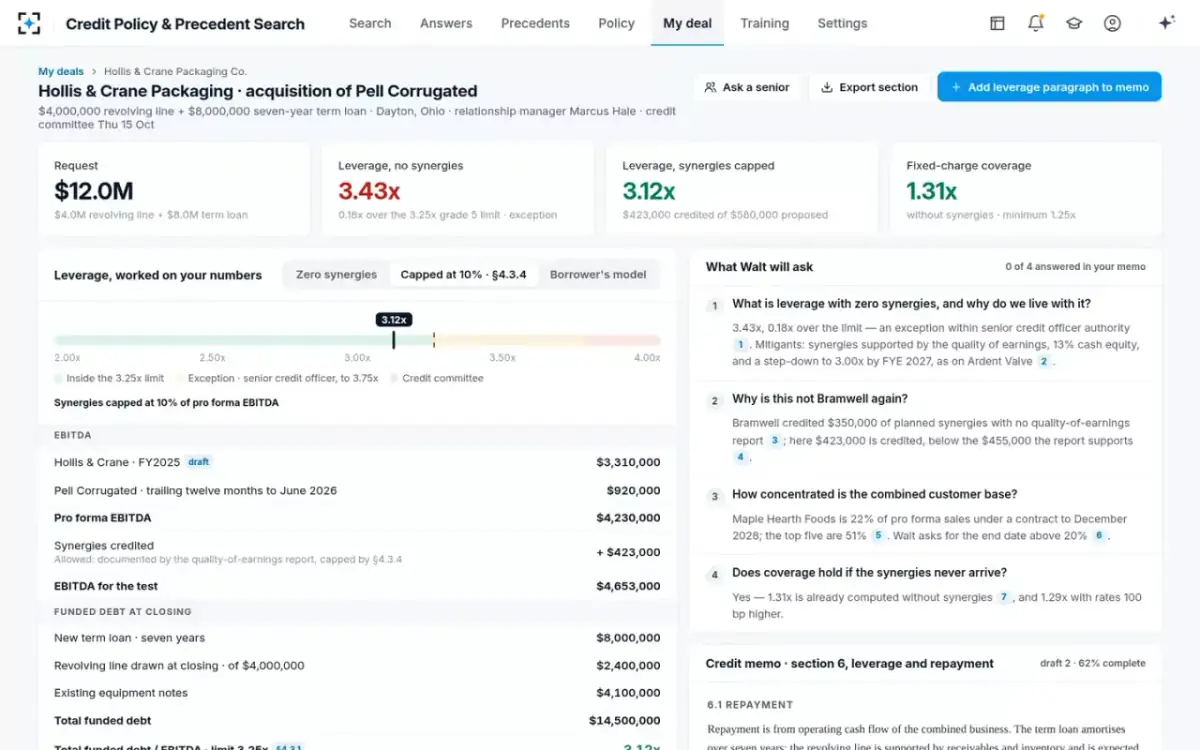
At the sample bank a relationship manager's loan-to-value question was answered in 12 seconds by six agents from eleven sources, each sentence cited; on the analyst's synergy question the checker confirmed 11 sentences against their passages and removed none, and would have removed any it could not match. Those are results on fictional sample data, not a customer's measured outcome. The number the head of credit watches is the other one, memos returned by reviewers, because it measures whether the analyst wrote a better memo, not whether the tool answered quickly.
The answer beside the deal in Credit Policy & Precedent Search: rule, precedents, and the test on the deal's numbers
How should a credit department pilot AI in underwriting?
Narrowly, on real questions, with a measure chosen before the pilot starts. A pilot that asks a tool general questions about lending will look impressive and prove nothing; one that runs a quarter of real analyst questions on one part of the policy, against the archive the bank actually has, shows whether the answers would have survived a reviewer.
The section to start with is the one analysts ask about most and reviewers return memos over. At the sample bank that is §4.3 on leverage: 64 questions from nine analysts in 90 days, and the synergy treatment that turned one approved loan into a grade 7 downgrade when only $80,000 of a promised $350,000 arrived. A pilot on that section has enough volume to measure, a known failure to look for, and two senior credit officers who can judge every answer against what they would have said.
Three readings decide the result. Whether every answer cited the current version of the policy and the right passage, checked by a senior on a sample; whether memos written with the tool came back from review less often than the quarter before; and whether the questions the policy could not answer reached the policy owner as gaps rather than being answered by inference. Speed is worth recording but should not decide anything, because a tool that answers quickly and occasionally from last year's policy has made the department's risk worse while making its week better. Cost over three years, including the people who maintain the archive, is set out in what credit policy software costs over three years.
Where Credit Policy & Precedent Search fits
The solution reads the bank's credit policy in every version, its underwriting guides, its memo archive with annual reviews and the comments senior credit officers wrote on past memos. Asked a question beside a deal, its agents quote the rule in force, rank past decisions on the same question with how each loan performed, work the policy's tests on the deal's own numbers, and draft a cited paragraph the analyst can edit. What the policy does not answer goes to the senior who owns the topic and to the policy owner as a gap.
It does not underwrite. The analyst recommends and grades, the senior credit officer approves exceptions, and committee decides what committee decides; the limits that keep the agents out of those roles are settings the chief credit officer holds. To see the split on your own policy and archive, start from Credit Policy & Precedent Search.
Questions people ask
Can AI approve commercial loans?
Technically some systems can, but almost no bank lets one approve a loan of commercial size. The FDIC found fewer than one in one hundred banks will auto-approve a $250,000 business loan, and examination guidance expects exceptions to be approved by a designated authority with written reasons.
Does model risk guidance cover generative AI in underwriting?
Not the 2026 revision. OCC Bulletin 2026-13 states that generative and agentic AI models are not within its scope, so a bank governs such tools through its general risk management, third-party oversight and its own controls on what the tool may do.
Which credit team members gain most from AI assistants?
The evidence points to newer staff. In the NBER study of customer support agents, novices gained 34% in productivity against 14% on average, with minimal change for the most experienced; the mechanism was senior practice reaching juniors, which is the problem a credit department with many new analysts has.
How should exceptions drafted with AI be approved?
Exactly as any other exception: written reasons, submitted to the authority the policy names, and reported with the bank's other exceptions. The draft can come from an agent; the approval and its accountability cannot.
What is the biggest risk of AI in a credit department?
An answer that looks authoritative and is wrong: the superseded policy version, a precedent from a different structure, or a figure the tool changed. Citations to the passage, current-version labelling and a hard rule that no deal figure is altered are the controls that address it.
Will a vendor's tool shift responsibility away from the bank?
No. The 2023 interagency third-party guidance says the use of third parties does not diminish or remove a bank's responsibility to operate safely and in compliance with law, so the bank must be able to show what the tool read, said and who acted on it.