DDQ automation is software that does the mechanical part of a due diligence questionnaire review: collecting the questionnaire, extracting each answer with its page, checking the answers against outside sources, and drafting the memo and the follow-up questions. In correspondent banking the questionnaire is usually the Wolfsberg CBDDQ, and the review it feeds is a Section 312 file a US bank must keep for every foreign respondent. Automation can take over the reading and the comparisons, including the one most teams skip, the respondent's answers against its own payments. It cannot take over the decisions, and a team will trust it only if every value is traceable and no agent can rate, send or close anything. Botminds' Correspondent Banking Due Diligence is built that way: seven agents rebuild each respondent's file every cycle, and the analyst, the BSA Officer and a two-member committee make every decision. This guide is for the team deciding whether to buy, and what to check first.
Which parts of a CBDDQ review can be automated, and how far
| Step | Automate? | What a person still does |
|---|---|---|
| Requesting the questionnaire and certification | Yes: calendars, reminders and batches by rating cadence | Approves each batch; only the BSA Officer extends a due date |
| Extracting answers with their page | Yes, with a confidence score per answer | Answers the agent is unsure of, below a set threshold |
| Flagging unchanged answers and missing attachments | Yes | Decides whether an unchanged answer needs a test |
| Licence, ownership, certification, screening | Mostly: registers, licensed data, the bank’s screening service | Resolves conflicts between sources; confirms by exception |
| Activity against expected; who really sends the payments | Yes, on every respondent at every review | Decides whether a new sender is explained |
| Rating proposal and memo | Drafts only, every sentence cited | The analyst proposes; the BSA Officer approves or returns |
| Request for information | Drafts, tied to each gap, deadline tracked | Edits; the BSA Officer approves before it is sent |
| Referral, restriction, exit | No | The analyst refers; investigators decide on reports; two committee members sign any restriction or exit |
What is DDQ automation, and which parts of a review can be automated?
DDQ automation covers everything in a review that is retrieval, extraction or comparison, which is most of the hours. Botminds' own estimate for one periodic review is 8.5 analyst days by hand, of which reading the questionnaire, checking registers and screening, comparing activity and drafting take 7.5; with the solution the same review is estimated at 1.6 days, of which half a day is questions, approval and quality control that stay with people. These are estimates for planning, not measured customer results, and a bank should measure its own.
The time is not the main argument. The part of a review that automation adds, rather than speeds up, is the test of the respondent's answers against its payments. A team reading questionnaires by hand compares totals with expected activity because it cannot read thousands of messages; an agent can read all of them and say who ordered each payment. That is where the US rule points, a periodic review of activity against what the bank was told about the account (31 CFR 1010.610(a)(3)), and where questionnaire answers are most often wrong.
Can DDQ review be automated end to end?
No, and a vendor that says otherwise is selling the wrong thing. The industry's own standard-setters said as much about a neighbouring task. The Wolfsberg Group, the ICC and BAFT, in their joint trade finance principles, wrote that elements such as list screening can be automated, but the review of trade documents as a whole, by its nature, cannot (Wolfsberg Group, ICC and BAFT, Trade Finance Principles, 2019 amendment; quoted in how technology can assist in combating TBML). A correspondent review has the same shape: the evidence can be gathered by machine, but deciding whether an explanation is credible, whether a gap is tolerable and whether a relationship stays is judgement the regulation puts on the bank.
What the statement does not say is that automation has no place. It says the overall review cannot be handed over. The useful question is the one the table above answers step by step: which steps are retrieval and comparison, which are judgement, and whether the system is built so that judgement cannot be skipped. BIS staff describe the cost of doing all of it by hand across the industry: "The burden of performing these checks is placed on individual banks, who follow a sequential process that takes time and involves significant duplication of effort" (BIS Bulletin No 87, 2024).
Will KYC analysts trust AI? Only if every value shows its source
Analysts trust a file they can check faster than they could rebuild it. That means every value opens the passage it came from, the agent says when it is unsure, and nothing the respondent said is ever marked verified because an agent read it. The Wolfsberg principles allow a correspondent to rely on public information "obtained either from the Respondent or reliable third parties (regulators, exchanges, shared utilities, Wolfsberg Correspondent Bank Due Diligence Questionnaire (CBDDQ), etc.)" (Wolfsberg Correspondent Banking Principles, 2022). Reliance on a source is not the same as verification of it, and the file has to show which is which.
Six conditions under which analysts trust an agent-built file
- Every value opens its source
The questionnaire page, the attachment, the register extract, the payment message, or the rule text. An uncited sentence in a memo is not written.
- No answer is ever “verified” by an agent
Answers are marked as matching evidence, contradicted, declared elsewhere or self-declared only. Agreement is with a named source.
- Agents ask when unsure
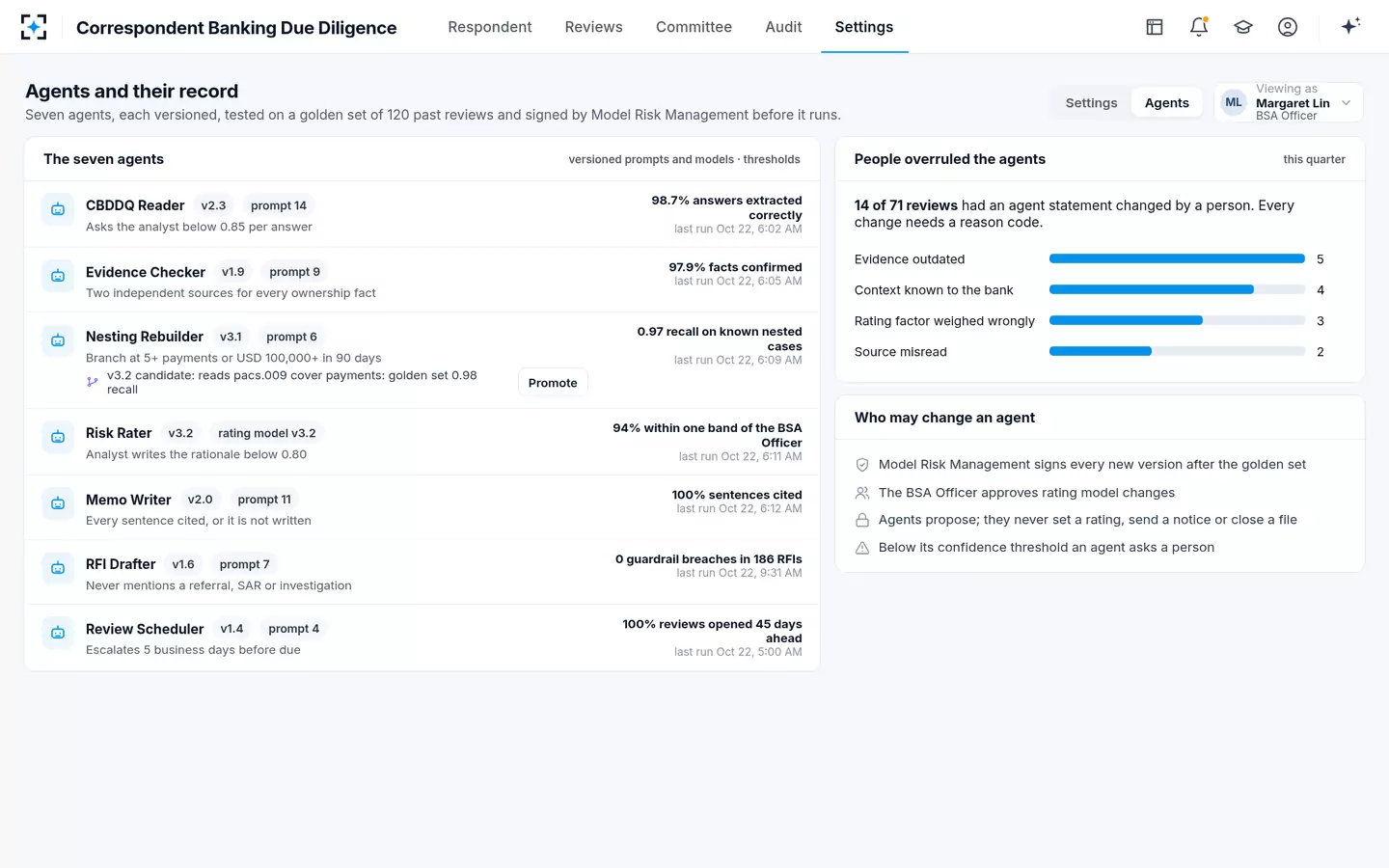
In the sample bank, the questionnaire reader asks the analyst about any answer below 0.85 confidence; below 0.80 the analyst writes the rating rationale.
- Two sources for ownership
Every ownership statement needs two independent sources before it counts as confirmed.
- People can overrule, with a reason
A person who changes an agent’s statement picks a reason code, and the change is on the audit trail.
- Agents are versioned and tested
Each agent has a version, a prompt, a threshold and a result on past files; a new version runs only after Model Risk signs it.
Trust also needs evidence that people use their power to overrule. In the sample bank's last quarter, a person changed an agent's statement in 14 of 71 reviews. The reasons are the useful part, because each is a lesson for the next version of an agent.
Why people changed an agent’s statement, in one quarter
What should an AI agent never decide in correspondent KYC?
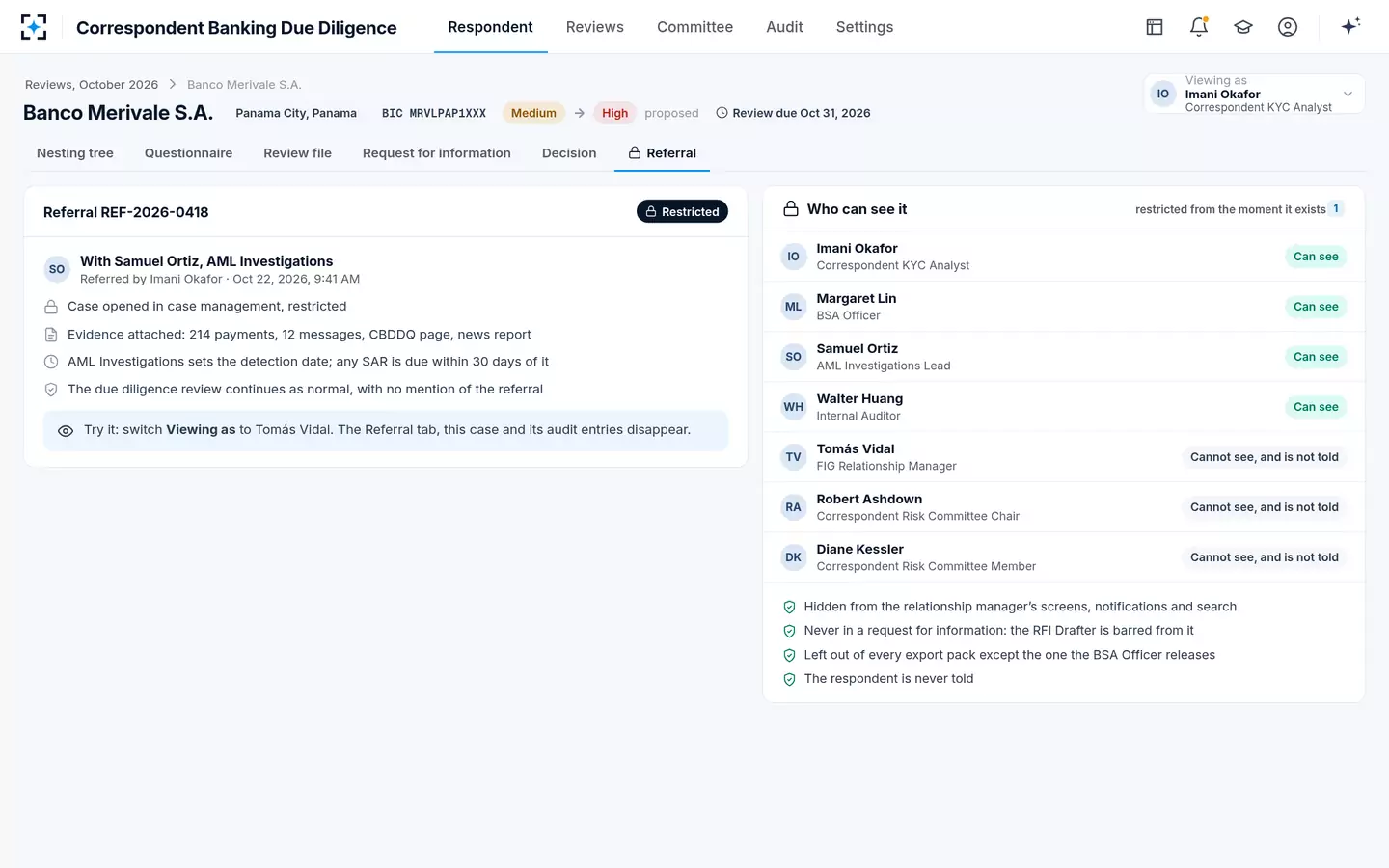
Anything that changes the relationship, reaches the respondent or could reveal a report. The list is short and should be enforced by the system, not by a policy document. Ratings, requests for information, referrals, restrictions, exits and deadline extensions each belong to a named role, and the person who prepares a file cannot approve it.
Decisions an agent may draft but never make
| Decision | Who makes it in the sample bank | Why it stays with a person |
|---|---|---|
| The risk rating | The BSA Officer approves, changes or returns the analyst’s proposal | It sets review frequency and controls; the bank answers for it |
| Sending a request for information | The BSA Officer approves; the analyst cannot send it | It speaks to the respondent on the bank’s behalf |
| Referring activity to AML Investigations | The analyst refers; investigators decide on any report | Suspicious activity decisions belong to the people accountable for them |
| Mentioning a referral to anyone outside it | Nobody; the request-for-information agent is barred and checked | Information that would reveal a suspicious activity report is confidential under 31 CFR 1020.320(e) |
| Restricting or exiting a respondent | Two Correspondent Risk Committee members must sign | It ends or limits a relationship and affects the respondent’s customers |
| Extending a review’s due date | Only the BSA Officer | A missed review is a program failure, not a scheduling detail |
A referral the relationship side never sees, enforced by the system
Is an AI agent a model under SR 26-2?
Not under that guidance's scope, which leaves the governance to the bank. The Federal Reserve, OCC and FDIC issued revised model risk guidance on April 17, 2026 (Federal Reserve SR 26-2). It supersedes SR 11-7 and also SR 21-8, the 2021 interagency statement on model risk for BSA/AML systems. Its definition of a model excludes simple arithmetic and deterministic rule-based processes, and a footnote places generative and agentic AI models outside the guidance's scope, saying a banking organization's own risk management and governance practices should determine the controls for tools it does not cover. Whether a customer risk rating model is a model after SR 26-2 quotes the guidance on both points.
For a buyer that is not a gap to exploit. It means the bank must write its own controls for agents, and an examiner will ask to see them. In practice they look like model risk management applied by analogy: an inventory of agents with versions, a test set of past files with results, sign-off before a new version runs, monitoring of overrides, and limits on what each agent may do. In the sample bank, Model Risk signs every new agent version after it runs on a golden set of 120 past reviews.
How do you test DDQ automation before go-live?
Test it on your own closed files, where you already know the answer. Replay a set of past reviews, compare what the agents extract and conclude with what your analysts found, plant known errors, and measure each agent separately, because a good memo writer can hide a poor nesting reader. The results below are the sample bank's, on fictional data; they show the kind of numbers to ask for, not numbers to expect.
What a golden set of 120 past reviews measured, agent by agent
98.7%
questionnaire answers extracted correctly
0.97
of known nested cases found by the nesting agent
94%
of proposed ratings within one band of the BSA Officer’s
0of 186
requests for information that broke the referral guardrail
Five tests to run on your own files before trusting DDQ automation
- Replay closed reviews
Run the agents on 50 to 150 past respondent files and compare extraction, evidence and conclusions with what your analysts recorded.
- Plant contradictions
Change answers in copies of real questionnaires, such as a No on downstream relationships against payments that show one, and count how many the system catches.
- Use known nesting
Include respondents where nesting was found by other means, and measure how many the payment reading finds without being told.
- Try to break the guardrails
Ask the drafting agent to mention a referral or to send without approval; it should refuse, and the attempt should be logged.
- Measure disagreement, not just accuracy
How often would your BSA Officer have rated differently, and why? The reasons tell you which agent to fix.
What to ask a DDQ automation vendor
Ask questions whose answers you can check in a demonstration on your own data. A vendor that cannot show the source of a value, or cannot say what its system will refuse to do, is asking for trust it has not earned.
Eight questions for a DDQ automation vendor
- Does it read the payments, or only the questionnaire?
Without the payments, it can only tell you what the respondent said, faster.
- Which message types and fields does it read?
MT103, MT202 COV, pacs.008, pacs.009; ordering, intermediary and debtor agents; and how it handles a name with no identifier.
- Can every value be traced to its page?
Click a number in the memo and see the questionnaire page, register extract or message it came from.
- What does it never do?
Set a rating, send to a respondent, close a file, extend a deadline, mention a referral. Ask to see these enforced, not described.
- Who can change its settings?
Thresholds, cadence and rating bands should be versioned and approved by a named officer.
- How is each agent tested and versioned?
Ask for per-agent results on a test set, and what happens when a new version performs worse.
- What does the examiner get?
An export of the review, its evidence and the audit trail, produced inside the 120-hour window, with restricted items excluded.
- What stays in your systems?
Screening, case management and transaction monitoring should keep their roles; the tool should write to them after approval, not replace them.
Where Correspondent Banking Due Diligence fits, and where it does not
The solution fits a US correspondent bank with a book of foreign respondents, a payments hub or SWIFT gateway it can read, and a team that wants each file rebuilt every cycle with nesting tested against real payments. It works beside the systems a review already runs on: document imaging for questionnaires, the customer due diligence system for ratings, the screening service, case management for restricted referrals and transaction monitoring for the scenarios a decision switches on. It writes to them only after approval.
It is not a respondent-side tool for filling in questionnaires, not a KYC utility that shares files between banks, and not a replacement for screening, monitoring or case management. It will not be useful where payment messages cannot be made available, because the payment test is the point. And it does not make the hard decisions easier; it makes sure they are made on evidence. For the payment test in detail, see a nested correspondent banking example worked from 90 days of payments; for the regulatory clocks a tool must track, the questionnaire's validity period and the clocks that bind. To see it on sample respondents, start from Correspondent Banking Due Diligence.
Seven agents on the record in Correspondent Banking Due Diligence: versions, thresholds, results
Questions people ask
Can AI complete a CBDDQ for a respondent bank?
This solution works on the correspondent's side, reviewing questionnaires respondents send. A respondent's answers are its own statements, and the Wolfsberg FAQs expect each completed CBDDQ to be signed by two senior people at the respondent, the head of correspondent banking or equivalent and the group's money laundering reporting officer or head of financial crime compliance.
Does automating DDQ review change what the regulation requires?
No. 31 CFR 1010.610 and 1010.630 apply in full whatever tools a bank uses, and the bank remains responsible for the risk assessment, the periodic review and every decision. Automation changes how much of the required comparison actually gets done.
What data does DDQ automation need?
For a correspondent review: the questionnaire and its attachments, 90 days or more of the respondent's payment messages, access to licence and company registers and licensed ownership data, the bank's screening service, and the last review and rating. Without the payment messages it can check what the respondent said, but not what its account does.
Do examiners accept memos drafted by AI?
Examiners assess the program: whether risk assessments are adequate, reviews happen, and decisions are made by accountable people with evidence. A drafted memo in which every sentence cites its source and a named officer approves the conclusion gives them more to check than a hand-written one, provided the bank can show how the drafting agent is governed.
How many reviews should a golden set hold?
There is no regulatory number. The sample bank uses 120 past reviews; what matters is that the set covers each rating band, includes known nesting and known contradictions, and is kept fixed so each new agent version is measured against the same files.