A nested correspondent banking example: a respondent bank in Panama holds a US dollar account at a US bank, and a money exchange house in a free zone, which the respondent never mentioned, starts sending payments through that account, 214 of them in ten weeks. That is nesting, also called downstream correspondent clearing: another financial institution using a bank's correspondent relationship through the bank's direct respondent. It is hard to see because the respondent is the account holder on every message, so account-level totals look normal; the institution that really ordered each payment appears only in one field of each message. Botminds' Correspondent Banking Due Diligence gives the job to one agent, the Nesting Rebuilder, which reads 90 days of a respondent's payment messages, draws the tree of who actually sends through the account, and marks every branch the respondent did not declare.
The respondent, its senders and the US bank on this page are fictional, taken from the solution's sample data: Banco Merivale S.A. of Panama City, a respondent of Corvane National Bank since 2009, at its October 2026 periodic review.
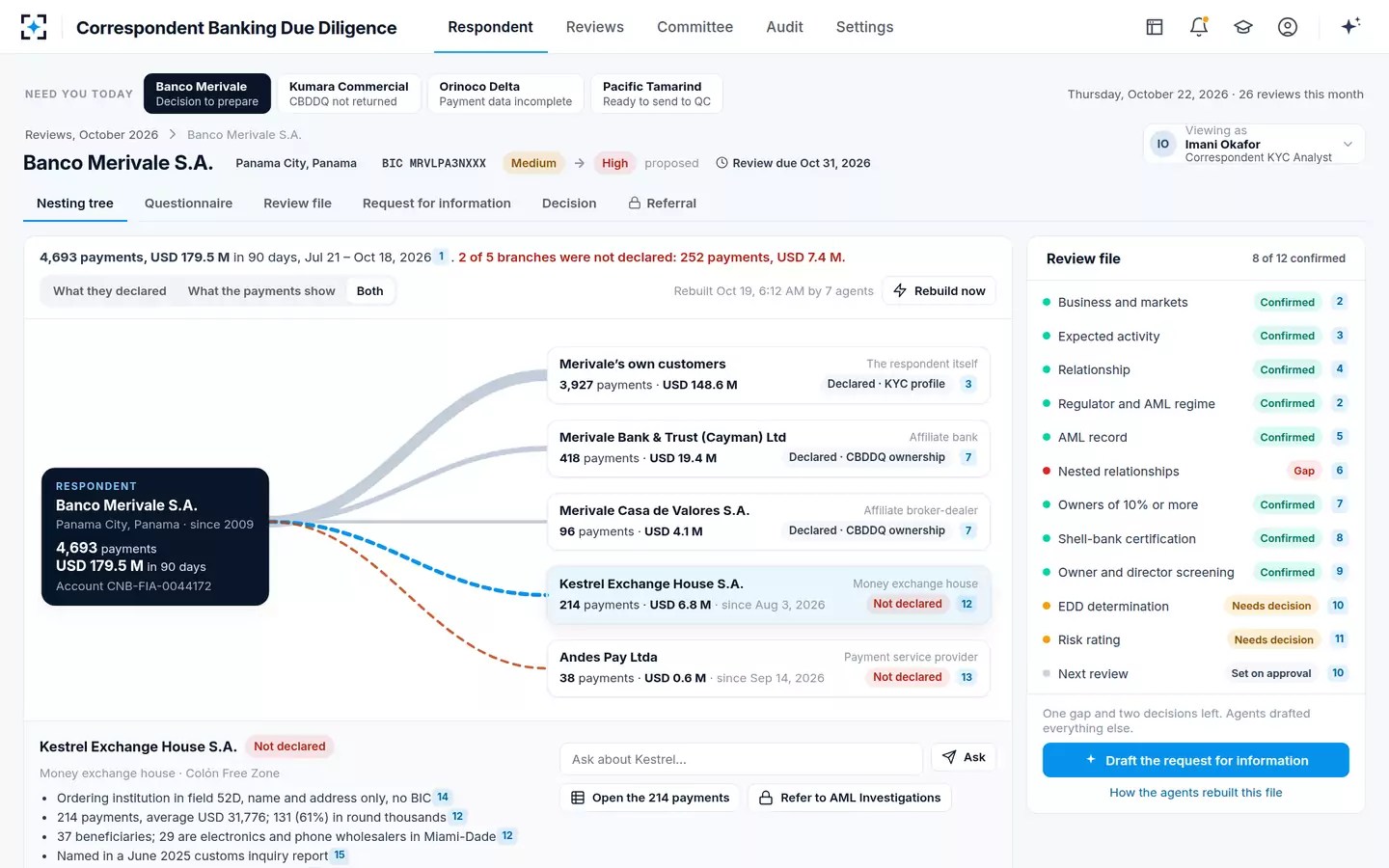
Declared against observed in Correspondent Banking Due Diligence: one nesting tree from 4,693 payments
Respondent
Banco Merivale S.A.
Panama City · US dollar account since 2009
4,693 payments · USD 179.5M in 90 days
Merivale’s own customers
The respondent itself
3,927 payments · USD 148.6M
Declared · its customer profile
Merivale Bank & Trust (Cayman)
Affiliate bank
418 payments · USD 19.4M
Declared · ownership section
Merivale Casa de Valores
Affiliate broker-dealer
96 payments · USD 4.1M
Declared · ownership section
Kestrel Exchange House
Money exchange house · Colón Free Zone
214 payments · USD 6.8M
Not declared · since Aug 3
Andes Pay
Payment service provider · Bogotá
38 payments · USD 0.6M
Not declared · since Sep 14
What is nested correspondent banking? An example from one dollar account
Nested correspondent banking is the use of a correspondent account by financial institutions that are not the account holder, reaching it through their own relationship with the respondent. The respondent becomes a conduit for the US bank's services, and the US bank serves institutions it has never assessed. Nesting is not unusual and not, by itself, wrong. The Wolfsberg Group's correspondent principles give an everyday case: nesting happens "when a regional savings bank offers correspondent services to local savings banks in its area" (Wolfsberg Correspondent Banking Principles, 2022). The FFIEC examination manual notes that nested relationships "may be a way for smaller foreign financial institutions to obtain access to the international financial system" (FFIEC BSA/AML Examination Manual, July 2023).
The problem is nesting nobody knows about. In the tree above, three branches are explained. Merivale's own customers are the business the account was opened for. Its Cayman bank and its broker-dealer are affiliates the respondent listed in the ownership section of its questionnaire, so their payments are declared, if not necessarily low risk. The last two branches are a money exchange house and a payment service provider. The respondent's questionnaire answered No to the question on downstream relationships with money services businesses, money or value transfer services and payment service providers. The payments say otherwise.
Which payment message fields show nesting?
Nesting shows in the fields that name the ordering institution and any intermediary, which differ from the account holder when a third institution is behind the payment. In a SWIFT MT103 that is field 52a, the ordering institution, and 56a, the intermediary. In an ISO 20022 pacs.008 it is the debtor agent and the intermediary agents. In a cover payment the same parties travel inside the underlying customer credit transfer. The respondent, meanwhile, appears as the sender or as the account being debited, exactly as it does for its own customers' payments.
Where the real sender appears in each message the agent reads
| Message | Where the respondent appears | Where a nested institution appears | What often goes wrong |
|---|---|---|---|
| MT103 (customer credit transfer) | Sender, or the account in field 53a | Field 52a, ordering institution; field 56a, intermediary | Option D: a name and address with no BIC, which has to be matched by name |
| MT202 COV (cover payment) | Sender of the bank-to-bank cover | Field 52a inside the underlying customer credit transfer (sequence B) | The underlying details are incomplete or abbreviated |
| pacs.008 (ISO 20022 customer credit transfer) | Instructing agent, or the debited account | Debtor agent; intermediary agents 1 to 3 | Agents filled with free text instead of a BIC or LEI |
| pacs.009 COV (ISO 20022 cover) | Instructing agent | Debtor agent inside the underlying customer credit transfer | The same gaps as MT202 COV, in structured form |
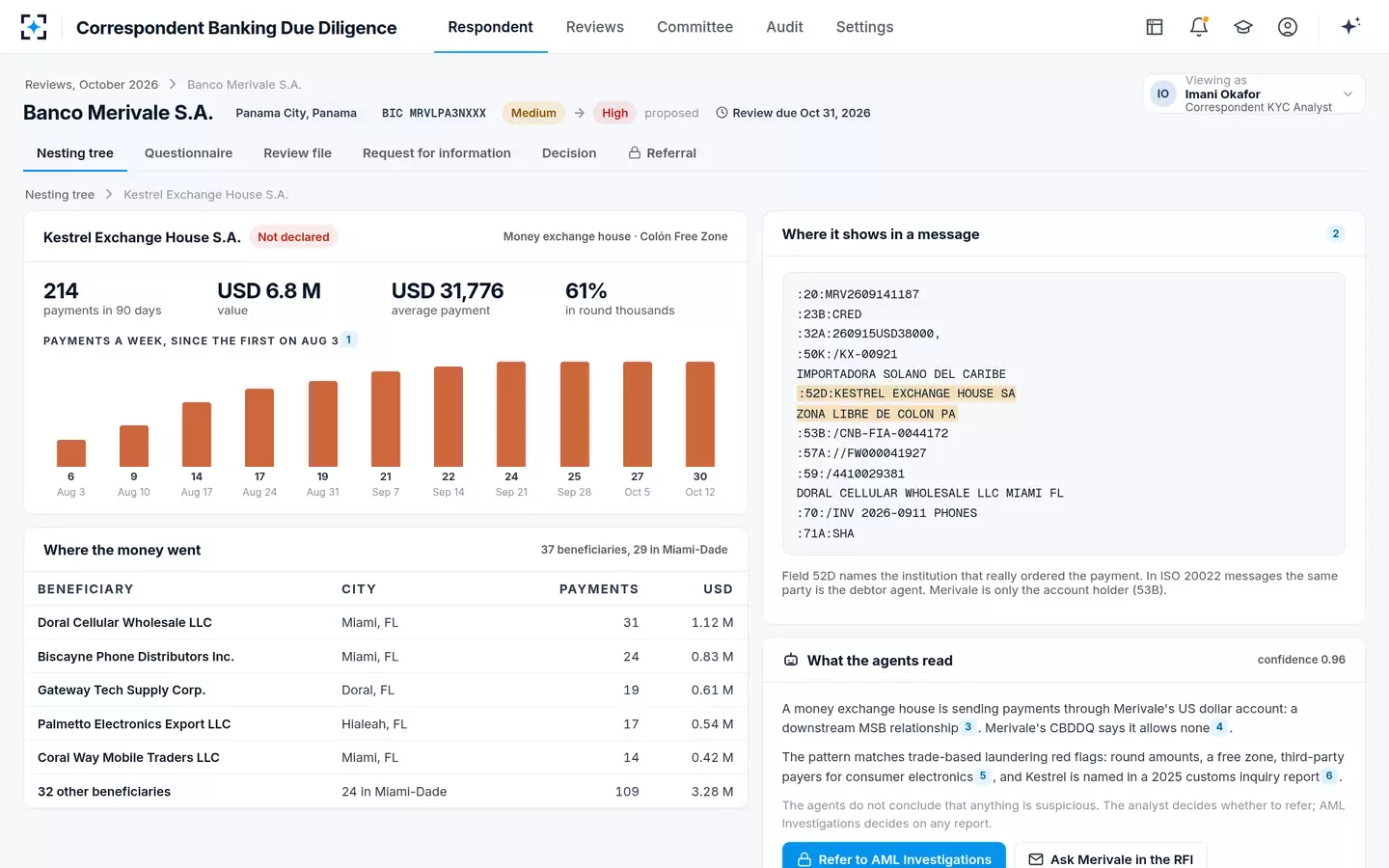
The Kestrel payments show the commonest version of the problem. Each carries field 52D, which holds a name and an address, KESTREL EXCHANGE HOUSE SA, ZONA LIBRE DE COLON, and no bank identifier code. An analyst sampling twenty messages might read that as Merivale's customer. Grouped across 90 days, it is one institution ordering 214 payments.
How do you detect nested accounts? The FFIEC's indicators, made testable
You detect nested accounts by reading the parties in the payments rather than the totals on the account, and by testing the indicators examiners name. The FFIEC manual gives them in one sentence: "Indicators of nested activity may include transactions to or from jurisdictions in which the bank's foreign financial institution customer has no known business activities or transactions and in which the total volume and frequency significantly exceed expected or usual activity for the foreign financial institution customer."
FATF's guidance asks for something more active than reading disclosures. A correspondent should have "measures in place to detect potential, undisclosed nested relationships provided by the respondent and takes appropriate follow-up action when a respondent does not disclose the existence of a nested relationship" (FATF, Guidance on Correspondent Banking Services, 2016). A questionnaire answer is a disclosure. A measure that detects undisclosed nesting has to start from the payments.
FinCEN has already written that test into one rule. Its 2025 special measure against Huione Group requires covered institutions to take reasonable steps to identify any use of their foreign correspondent accounts by Huione, "to the extent that such use can be determined from transactional records maintained in the covered financial institution's normal course of business" (31 CFR 1010.664). That is a nesting search across every foreign correspondent account, run on the bank's own message archive.
The rule the agent applies: five payments or USD 100,000 in 90 days
The Nesting Rebuilder turns the indicators into one repeatable rule. Any ordering or intermediary institution other than the respondent becomes a branch of the tree once it reaches five payments or USD 100,000 in the 90-day window. Each branch is then compared with what the respondent declared, in its answers on downstream relationships and in the ownership section where affiliates are listed. A branch with no declaration behind it is marked Not declared and carries its messages.
The thresholds are the sample bank's settings, and the reasons for them are practical. One payment from an unfamiliar institution is noise: a correspondent's customer may pay through a sister bank once. Five payments, or six figures, is a pattern worth a question. A bank with smaller respondents may lower the value threshold; one with very large ones may raise the count. What matters for an examiner is that the rule is written, versioned and applied to every respondent at every review, not to a sample when someone has time.
The tree as the analyst opens it, with the review file beside it
Kestrel Exchange House: 214 payments nobody declared
Opened, the Kestrel branch shows why totals hide nesting. The first payment ordered by Kestrel arrived on August 3. Volume grew every week, from 6 payments to 30. The average was USD 31,776, and 131 of the 214, 61%, were round thousands. They went to 37 beneficiaries, 29 of them electronics and phone wholesalers in Miami-Dade, and a June 2025 news report names Kestrel in a customs inquiry.
Payments ordered by one undeclared exchange house, week by week
Nothing at account level moved. Merivale's monthly volume, USD 59.8 million and 1,564 payments, sat inside the range it declared at its last review. A review that compares totals with expectations, which is what most periodic reviews do, would have passed this account. The indicator that fired was the second half of the FFIEC sentence applied to a party rather than an account: volume and frequency from an institution with no expected activity at all.
One branch opened: the payments, where the money went, and field 52D
Is nested correspondent banking allowed?
Yes, with conditions; what is prohibited is serving shell banks and sanctioned or designated institutions through it. A US bank must take reasonable steps so that a respondent does not use its account "to indirectly provide banking services to a foreign shell bank" (31 CFR 1010.630(a)(1)(ii)), and special measures under Section 311 can forbid access for a named institution. For a respondent that falls under enhanced due diligence, the bank must determine whether it maintains correspondent accounts for other foreign banks that use the US account, and if so obtain information about them, "including, as appropriate, the identity of those foreign banks" (31 CFR 1010.610(b)(2)).
For everyone else, the expectation comes through risk assessment. The FFIEC manual says a similar determination of nested activity "may also be a relevant factor" under the general program, and the Wolfsberg principles ask the correspondent to "take reasonable steps to understand the types of FIs to whom the Respondent offers the downstream correspondent services". An undeclared branch is therefore not automatically a breach. It is a gap between what the respondent said and what its account does, and the respondent owes an explanation.
What the Nesting Rebuilder in Correspondent Banking Due Diligence does, and what it leaves to people
The agent's work ends at a marked branch with its evidence; everything that follows is a decision for a person. The steps below are the ones the sample review went through on October 19 and 22, 2026.
From 4,693 messages to a decision, and who does each step
Agent
Read the windowReads 90 days of the respondent’s MT103, MT202 COV and pacs.008 messages from the payments hub.
Never: skips a gap in the data; it pauses and says so
Agent
Extract the partiesPulls every ordering and intermediary institution, by identifier where there is one and by name and address where there is not.
Agent
Group and apply the ruleMakes a branch of any institution other than the respondent at five payments or USD 100,000.
Never: calls a branch nested from one message
Agent
Compare with what was declaredMatches each branch to the questionnaire’s downstream answers and ownership section, and marks it Declared or Not declared with its messages.
A person decides
Decide what it meansThe analyst reads the branch and decides whether it is explained, whether to ask the respondent, and whether to refer the activity to AML Investigations.
A person decides
Approve the consequenceThe BSA Officer approves the rating, the request for information and any interim monitoring; a restriction or exit needs two committee signatures.
The limits are not ornament. An agent that called every new sender nested would bury the analyst. One that resolved branches itself, deciding that Kestrel was really Merivale's customer, would be making the judgement the regulation leaves to the bank. The sample bank also checks the agent against past files: on a set of 120 past reviews it found 0.97 of the known nested cases, a figure from sample data that each bank has to re-measure on its own respondents.
Where rebuilding nesting from payments is blind
Payment data shows who ordered a payment only when someone filled in the field. Four gaps matter in practice. A respondent that books a money exchange house as an ordinary customer and sends its payments as its own will show them as its own customers' traffic, with the exchange house nowhere in the message; that is a payment transparency failure, and it surfaces as a concentration of unusual beneficiaries rather than as a branch. Name-only fields have to be matched by name, which fails when the name changes. Cover payments carry the underlying parties only as well as the originating bank populated them; in the sample bank, extending the agent's reading of ISO 20022 cover payments is the change being tested in its next version. And a gap in the data, such as the nine missing days in another sample respondent's feed, makes any count unreliable, which is why the agent stops rather than guessing.
None of this makes the method optional. It makes it a floor. When the tree shows an undeclared branch, the follow-up is the request for information, and how one questionnaire answer is tested against the payments follows question 19 from the respondent's form to the file. For the scenarios that keep watching between reviews, see correspondent banking transaction monitoring scenarios, and for the whole review on the sample respondent, Correspondent Banking Due Diligence.
Questions people ask
What is downstream correspondent clearing?
It is another name for nesting: a respondent bank providing correspondent services to other financial institutions through the account it holds with its own correspondent. The Wolfsberg CBDDQ asks about it in question 19, sub-questions a1b to a1i, separately for domestic banks, foreign banks and money services or payment providers.
Is an affiliate of the respondent a nested relationship?
It can be, if it uses the respondent's account rather than its own. In the sample review, the respondent's Cayman bank and broker-dealer were listed in the questionnaire's ownership section, so their 514 payments counted as declared. The Wolfsberg principles treat branches, affiliates and subsidiaries that are direct customers as customers in their own right, with their own risks.
Does the FFIEC require a bank to find nested accounts?
For respondents subject to enhanced due diligence, yes: the regulation requires the bank to determine whether the foreign bank serves other foreign banks through the account. For others, the FFIEC manual treats nested activity as a relevant risk factor and lists its indicators. A bank may also ask the respondent to disclose nested relationships, but disclosure alone does not detect undisclosed ones.
What happens after an undeclared branch is found?
The analyst decides. In the sample review the request for information asked the respondent five questions with a 30-day deadline, the Kestrel activity was referred to AML Investigations, and the BSA Officer raised the rating from Medium to High. Across the sample bank's 310 respondents, undeclared nesting found in 2026 at 17 ended with 11 explained and accepted, 3 restricted, 1 exited and 2 still open.
Does ISO 20022 make nesting easier to see?
It gives every agent in the chain its own structured element, with room for a BIC or LEI, so a debtor agent that differs from the account holder is easier to read than free text in field 52D. It does not help when the respondent leaves the element empty or books the nested institution as its own customer.