De-risking in correspondent banking means a bank ending, refusing or restricting relationships with whole categories of respondent banks instead of managing the risk of each one, and it has shrunk the network by about a quarter: the CPMI counted a contraction of about 25% in correspondent relationships between 2011 and 2020, while cross-border payments kept growing. The losses are not spread evenly. The US Treasury's 2023 strategy found that profitability is the main driver and that small foreign banks with low volumes in small economies lose access first, and research on emerging Europe shows their customers then export less. One reason is structural: correspondent banking due diligence costs about the same for a respondent that brings little revenue as for one that brings a lot. Botminds' Correspondent Banking Due Diligence was built for that cost line, rebuilding each respondent's file from its questionnaire, evidence and payments so that keeping a small relationship is a decision about risk rather than about analyst time.
Fewer relationships, more payments
25%
contraction in correspondent banking relationships worldwide, 2011 to 2020
4%
fall in relationships in 2020 alone
+2%
growth in cross-border payment volume in 2020
+7%
growth in cross-border payment value in 2020
What is de-risking in correspondent banking?
In US law de-risking has a definition. Treasury's April 2023 strategy gives it as Section 6215 of the Anti-Money Laundering Act of 2020 frames it: actions taken by a financial institution "to terminate, fail to initiate, or restrict a business relationship with a customer, or a category of customers, rather than manage risk associated with that relationship consistent with risk-based supervisory or regulatory requirements" (US Treasury, The Department of the Treasury’s De-risking Strategy, 2023). Treasury narrows it further: its concern is "wholesale, indiscriminate decisions that lump together broad categories of customers without careful consideration of their risks".
That distinction matters to anyone who runs a correspondent book. Closing an account because a respondent cannot answer for an undeclared money exchange house is due diligence working. Closing every account in a country because the reviews cost more than the fees is de-risking. From the outside the two look the same, which is why the reasons and the evidence for each exit carry so much weight.
How much have correspondent banking relationships declined?
By about a quarter in a decade, on the only consistent global series. The CPMI's December 2021 release reported that correspondent relationships "declined by 4% from the previous year, taking their total contraction to about 25% between 2011 and 2020" (CPMI (BIS), 13 December 2021). Over the same period the payments themselves grew; in 2020, cross-border payment volume rose 2% and value 7%. A May 2024 BIS Bulletin by BIS staff reports that "The number of active correspondents and corridors decreased between 2011 and 2022" (BIS Bulletin No 87, 2024).
Fewer relationships carrying more value means concentration: more dollars through fewer, larger corridors. Treasury reads the pattern as evidence about motive, observing that such consolidation into "a smaller number of higher volume corridors" makes sense as a response to profitability concerns and is harder to explain as a response to illicit finance.
Why are banks cutting correspondent banking relationships?
Mostly because small relationships do not pay for their compliance. Treasury's review, based on interviews with more than three dozen public- and private-sector participants and on CPMI data, named profitability as the leading factor, while noting that profitability itself is shaped by the cost of AML compliance and the perceived risk of fines. Its comparison is blunt: "the correlation between lack of potential profit and de-risking appears stronger than the correlation between AML/CFT compliance and de-risking".
The mechanism is described in the same report. Large banks "often consider revenue and profit thresholds for onboarding or maintenance of new customers", may apply them "broadly, without a targeted analysis of individual customers", and that analysis "is separate from bank scrutiny of AML/CFT risks". FATF's 2016 guidance had already listed the mix of drivers, profitability and reputational and liability risks among them, and noted cases in which "banks will exit the relationship solely on the basis of profits" (FATF, Guidance on Correspondent Banking Services, 2016).
Which countries lost correspondent banks?
Small ones with low volumes, whatever their risk. Treasury examined data on the most de-risked jurisdictions and found that low financial volumes and low likely profitability were "a more significant risk factor for de-risking than high illicit finance risk".
“the list of de-risked jurisdictions consists almost exclusively of small countries with low volumes and does not include any highly profitable countries regardless of AML/CFT risk.”
US Treasury, De-risking Strategy, April 2023
Its example is the Pacific: "small Pacific Island nations tend to be heavily de-risked while larger, richer countries in the same region do not, despite well-known AML/CFT risks in those countries". The report concludes that correspondent loss "is particularly acute for smaller and more isolated economies, as well as for smaller institutions and customers". Among its recommendations is to "consider creative options, such as regional consolidation projects" to address the decline, "especially for small foreign banks".
Does de-risking hurt trade?
The best evidence says yes, for the respondent's customers. A December 2023 EBRD working paper by Lea Borchert, Ralph De Haas, Karolin Kirschenmann and Alison Schultz used confidential information on severed correspondent relationships and firm-level export data from emerging Europe. It finds that "when local respondent banks lose access to correspondent banking services, their corporate borrowers start to export less", and that those firms only partly make up the lost exports at home, so revenue and employment shrink (EBRD Working Paper 285, 2023). It is a working paper, not yet a peer-reviewed article, but its direction matches what the CPMI release warned in 2021: that a critical loss of relationships "could hurt financial inclusion, raise the cost of payments and push payments activity into less regulated areas".
A due diligence file costs the same, whatever the respondent earns
The cost of a correspondent file is set by the rule, not by the revenue. Every foreign correspondent account needs the same risk assessment, the same certification and a periodic review of activity against expectations, and a higher risk rating means more frequent reviews. A small respondent in a small jurisdiction is often rated higher, so it can cost more analyst time a year than a large, low-risk one, while bringing a fraction of the fees.
Analyst days a year to keep one respondent’s file, by hand and with Correspondent Banking Due Diligence
The bars are the argument in one picture. If a high-rated respondent costs seventeen analyst days a year, a bank needs that respondent's fees to cover them, and many small respondents' fees do not. Cut the assembly to a fraction and the same respondent can be kept on the merits: its risk, its controls and its explanations. The decision does not get easier, but it stops being a staffing decision.
Can a bank exit all correspondent accounts in a region?
It can close accounts, but supervisors expect each decision to rest on the respondent's own risk. The OCC's 2016 guidance lists as a practice lacking appropriate risk assessment "terminating entire categories of foreign correspondent account relationships without regard to the risks presented by individual foreign financial institutions, unless specifically required by law" (OCC Bulletin 2016-32). Its best practices ask banks to tell senior management when closures may cut off access for "an entire geographic location", to give respondents time to find alternatives, and to ensure "a clear audit trail of the reasons and method used for account closure".
Two ways to leave a corridor
Exit by category: A country, region or type of bank falls below a revenue or risk-appetite line.
Exit by evidence: One respondent cannot explain activity, answer a request, or meet the program’s standards.
Exit by category: A portfolio decision, applied to every account in the category.
Exit by evidence: The respondent’s own gaps, the requests sent, the replies and the deadlines missed.
Exit by category: Lacks appropriate risk assessment unless specifically required by law.
Exit by evidence: Based on analysis of the individual institution and the bank’s ability to manage the risk.
Exit by category: Often a standard letter on a standard timetable.
Exit by evidence: Sufficient time to find alternatives, unless that would be contrary to law or reveal law-enforcement activity.
Exit by category: Cuts off small banks and their customers regardless of their controls.
Exit by evidence: Keeps respondents that can show their controls; exits the ones that cannot.
The regulation also writes in the fallback. A bank's program must include procedures for when it should refuse to open an account, suspend activity, file a suspicious activity report or close the account if it cannot perform appropriate due diligence (31 CFR 1010.610(d)). An exit grounded in that paragraph, for one respondent with its evidence, is the opposite of de-risking.
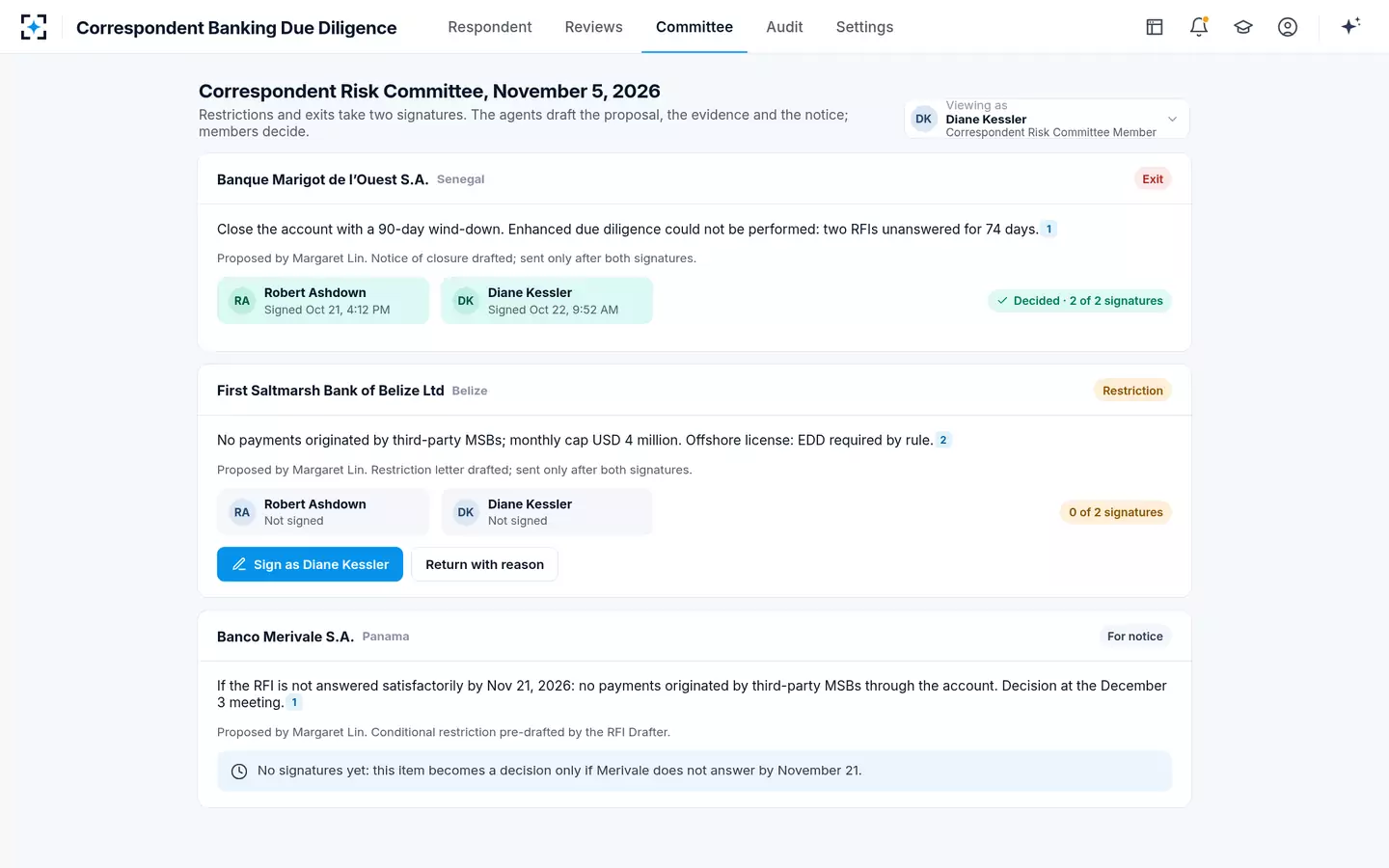
Exits and restrictions in Correspondent Banking Due Diligence, one respondent at a time
What can a small respondent bank do to keep its correspondent?
Make itself cheap to know and easy to verify. Treasury's consultations found that "a bank seeking a correspondent relationship is more likely to attain and maintain that relationship if the customer has a strong internal program to mitigate risks", and that the quality of the respondent's home supervision weighs too: "the better the supervision they expect a potential customer to receive from the customer's local authorities, the better the chances that the potential customer can receive and maintain access to banking services" (US Treasury, De-risking Strategy, 2023). A respondent cannot change its country's size, but it controls most of what makes its file expensive.
In practice that means four things. A current, complete questionnaire, updated within the eighteen months its own declaration promises. Downstream relationships disclosed before the payments reveal them. Payment messages that carry the full ordering customer and ordering institution, so the correspondent can see what it is clearing. And requests for information answered on time, because an unanswered request is the clearest signal a correspondent gets. In the sample bank's committee, the one exit of the month was a respondent that had left two requests for information unanswered for 74 days; enhanced due diligence could not be performed, and the regulation's fallback applied.
Where cheaper review changes the arithmetic, and where it does not
Cheaper review solves the part of de-risking that comes from the cost of knowing a respondent. It does not solve the parts Treasury also found: a respondent whose home supervision is weak, sanctions exposure, a bank's own appetite, or a corridor whose fees would not cover even an efficient file. Nor should it make a bank keep a respondent that cannot explain its traffic. What it changes is the middle: small respondents with adequate controls, rated higher because of where they are, whose files were too expensive to keep current.
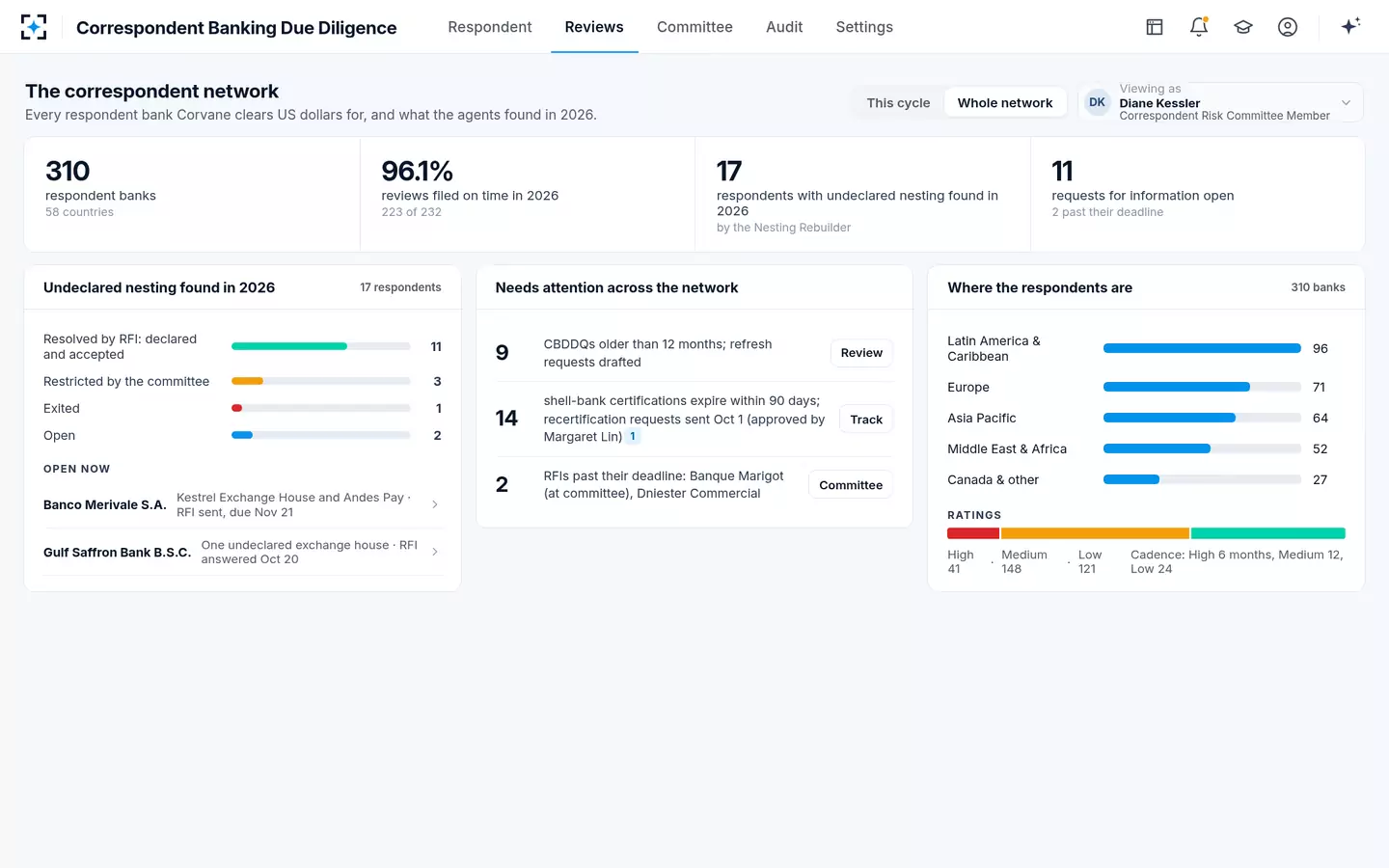
The sample bank's network shows what that middle looks like in practice. Of its 310 respondents in 58 countries, 96 are in Latin America and the Caribbean. In 2026 its agents found undeclared nesting at 17 respondents; 11 explained it and were kept, 3 were restricted and 1 exited, with the reasons on file. The restriction is the tool category exits skip: an exchange-house corridor can be closed without closing the bank. Testing a respondent's answers is the subject of one CBDDQ answer tested against the payments, and what agents can safely take over is in DDQ automation a correspondent KYC team can trust. The whole review runs on sample respondents in Correspondent Banking Due Diligence.
A network kept by evidence: 310 respondents and what happened to each finding
Questions people ask
Is de-risking illegal?
No. Banks choose their customers, and US agencies say they generally do not direct banks to open or close particular accounts. What the agencies discourage is closing whole categories of accounts without assessing the individual risk; the OCC calls that a practice lacking appropriate risk assessment unless the law requires it.
What did Treasury recommend about correspondent banking?
Its April 2023 strategy, required by Section 6215 of the Anti-Money Laundering Act of 2020, recommended consistent supervisory expectations, stronger AML regimes abroad through international engagement, and creative options such as regional consolidation projects to address the decline in correspondent relationships, especially for small foreign banks. It said no single recommendation was likely to be transformative on its own.
Do correspondent relationships still fall after 2020?
The CPMI's last published release of this series covered 2020, when relationships fell 4%. A May 2024 BIS Bulletin by BIS staff reports that active correspondents and corridors kept declining to 2022. We found no official global count after that.
Does a regional consolidator count as nesting?
Usually, yes: a regional bank that clears for smaller banks through its own correspondent account is the textbook downstream relationship. It is legitimate when the US correspondent knows about it and understands the downstream banks, which is why such arrangements are declared in the questionnaire and tested against the payments.
Does keeping a high-risk respondent increase the bank's own risk rating?
It increases the bank's exposure, which its BSA/AML risk assessment has to reflect, and the controls must match it. That is the trade the OCC describes: decisions should rest on the respondent's risk and the bank's ability to manage it, documented respondent by respondent.