The Wolfsberg questionnaire template is the Correspondent Banking Due Diligence Questionnaire, the CBDDQ, published by the Wolfsberg Group as a PDF and an Excel file; the current version is 1.4, dated 2023, and every earlier version has been retired. It runs to fourteen sections and 132 numbered questions, is answered for a single legal entity, and ends with a declaration signed by the respondent's head of correspondent banking and its money laundering reporting officer or equivalent. Correspondents use it to collect most of what correspondent banking due diligence needs from a respondent, but a US bank still has to map its answers to 31 CFR 1010.610 and 1010.630 and test the ones it relies on. Botminds' Correspondent Banking Due Diligence reads a returned CBDDQ answer by answer with its page, ties each answer the file relies on to the rule it serves, and tests it against registers, attachments and the respondent's own payments.
The current Wolfsberg template in five numbers
v1.4
the current CBDDQ, 2023; all earlier versions retired
14
sections, from Entity & Ownership to Fraud
132
numbered questions, many with sub-questions
2
signatures on the declaration
1
legal entity per questionnaire
Where is the Wolfsberg questionnaire template, and which version is current?
On the Wolfsberg Group's correspondent banking resources page, which offers the CBDDQ as a PDF and as an Excel file, both dated 2023, alongside the FCCQ, the CBDDQ Guidance v2.0, a glossary v3.0 and FAQs v3.0 (Wolfsberg Group, Correspondent Banking and Payments resources). The same page describes the questionnaires as representing "the global standard for due diligence between financial institutions in establishing a correspondent relationship". Version 1.4 is current; the FAQs, asked whether it replaced the previous questionnaire, answer: "Yes and all versions prior to v1.4 have been retired" (Wolfsberg CBDDQ/FCCQ FAQs v3.0, 2023).
Version 1.4 added a new section on fraud and strengthened the questions on higher-risk customers, transaction monitoring, whistleblowing and data quality, according to the FAQs. The questionnaire was first released in October 2017, and FATF's 2016 guidance had already pointed to its predecessor, noting that "One of the tools that could be used as a starting point is the Wolfsberg questionnaire" when a correspondent assesses a respondent's controls (FATF, Guidance on Correspondent Banking Services, 2016).
Is there a CBDDQ v1.5?
No. People search for a version 1.5, but as of October 27, 2026 the Wolfsberg Group's resources page lists the 2023 questionnaire, version 1.4, and no later one. When a new version does appear, it will not invalidate completed questionnaires. The FAQs say: "The fact that the Group publishes an updated version of the Questionnaires does not invalidate already completed CBDDQs or FCCQs or serve as a trigger to update an FI's due diligence on its customers." Each correspondent decides, and should write down, when its respondents must move to a new version.
The fourteen sections, and what each feeds in a US file
Read with a US file in mind, the questionnaire divides into two halves. Sections 1 and 2 describe the respondent and how it uses correspondent services, and they feed the risk factors and enhanced-due-diligence tests in the regulation directly. Sections 3 to 14 describe the respondent's own controls, and they feed the assessment of its AML program, which the regulation requires for respondents under enhanced due diligence and which the risk rating uses for everyone.
The CBDDQ v1.4, annotated for a US correspondent file
- 1
Entity & ownership questions 1–18
Ownership and 10% owners, offshore licence, regulator, non-resident customers
1010.610(a)(2), (b)(3), (c)
- 2
Products & services questions 19–21
Downstream relationships, payable-through accounts, payment services for non-banks
1010.610(b)(1)(iii), (b)(2)
- 3
AML, CTF & sanctions programme questions 22–29
Who runs the program, board oversight, outsourcing
1010.610(a)(2)(v), (b)(1)(i)
- 4
Anti bribery & corruption questions 30–45
ABC policy, risk assessment, training
Program quality; corruption risk
- 5
Policies & procedures questions 46–53
Prohibitions, including shell banks and Section 311 designations
1010.630(a); special measures
- 6
Risk assessment questions 54–61
Enterprise-wide AML and sanctions risk assessments and their dates
1010.610(b)(1)(i)
- 7
KYC, CDD and EDD questions 62–82
Beneficial ownership threshold, refresh frequency, EDD for respondent banks
Controls over downstream customers
- 8
Monitoring & reporting questions 83–91
How transactions are monitored, when last calibrated, reporting
1010.610(b)(1)(i)–(ii)
- 9
Payment transparency questions 92–97
Wolfsberg payment transparency standards; party details in messages
Whether nesting will be visible
- 10
Sanctions questions 98–110
Sanctions policy, screening method and lists, evasion controls
Sanctions controls; OFAC exposure
- 11
Training & education questions 111–116
Who is trained, on what, how often
Program quality
- 12
Quality assurance / compliance testing questions 117–120
Second-line testing
Program quality
- 13
Audit questions 121–126
Independent audit coverage and frequency
Evidence for the AML program
- 14
Fraud questions 127–132
Fraud policy, team, real-time monitoring
Added in version 1.4
Each section ends the same way: a question asking the respondent to confirm that its answers hold for all branches covered by the questionnaire, and a box for any difference. Those closing questions are easy to skip and important to read. The questionnaire's instructions say it "should not cover more than one LE", but it does cover the legal entity's branches, and a branch whose business is materially different can be given a questionnaire of its own (Wolfsberg CBDDQ v1.4).
What is the difference between the CBDDQ and the FCCQ?
The CBDDQ is the full questionnaire for a bank receiving correspondent services; the FCCQ, the Financial Crime Compliance Questionnaire, is a short, high-level summary of a firm's financial crime program that can be completed for a whole group. The FAQs are direct about which to use: "The FCCQ is not intended for use by FIs receiving cross-border or higher risk correspondent banking activity which must be addressed through the CBDDQ."
CBDDQ vs FCCQ, from the Wolfsberg FAQs
CBDDQ v1.4: A comprehensive set of questions for cross-border and other higher-risk correspondent relationships.
FCCQ v1.2: High-level information about a firm’s financial crime compliance program.
CBDDQ v1.4: Any financial institution that receives, or may receive, correspondent banking services.
FCCQ v1.2: Banks or other financial institutions describing their program in summary.
CBDDQ v1.4: One legal entity, with its branches; a materially different branch can have its own.
FCCQ v1.2: Can be completed at group level, covering all entities in the group.
CBDDQ v1.4: Two: the head of correspondent banking or equivalent, and the group money laundering reporting officer or head of financial crime compliance.
FCCQ v1.2: One: the money laundering reporting officer or an equivalent senior financial crime compliance manager.
CBDDQ v1.4: Through a KYC utility or directly; many banks do not post it publicly.
FCCQ v1.2: Some firms publish it on their websites.
CBDDQ v1.4: Yes, as the basis for due diligence; more questions may be needed.
FCCQ v1.2: No; correspondent banking activity must be addressed through the CBDDQ.
Who must complete the CBDDQ, and who signs it?
"Any FI that receives, or may receive, correspondent banking services should complete and submit the CBDDQ", according to the FAQs, which add that central banks acting as correspondent providers should complete it too and identify themselves as such. The declaration at the end is signed by two people: the global head of correspondent banking or equivalent, and the group money laundering prevention officer, head of AML, chief compliance officer, head of financial crime compliance or equivalent. Each certifies that the answers are complete and correct to their honest belief.
The declaration also carries the respondent's commitment on how current the answers stay, which is where the questionnaire's practical validity comes from; that, and the legal clocks around it, are set out in the Wolfsberg questionnaire validity period. For a correspondent, the signatures matter for a simpler reason. They make the answers the respondent's formal statement, which is what gives a contradiction its weight when the payments disagree.
What does CBDDQ question 19 ask?
Question 19 asks which products and services the respondent offers, and its first branch, 19 a1, is the one a correspondent reads most closely: it asks, separately for domestic banks, foreign banks and money services businesses, whether the respondent offers them correspondent services, whether it lets them provide downstream relationships, and whether it has processes to identify those relationships. Other lines cover cross-border remittances, bulk cash, payable-through accounts, payment services to non-banks, private banking, trade finance and virtual assets.
Question 19, the lines a US correspondent reads first
| Line | What it asks | What it serves in a US file |
|---|---|---|
| 19 a1a, a1d, a1g | Does the respondent offer correspondent services to domestic banks, foreign banks, regulated money services businesses? | Nature of the business and markets, 1010.610(a)(2)(i) |
| 19 a1b, a1e, a1h | Does it allow those customers to provide downstream relationships (for a1h, with money services, value transfer or payment providers)? | Nested banks, 1010.610(b)(2); nested activity as a risk factor generally |
| 19 a1c, a1f, a1i | Does it have processes to identify downstream relationships? | Whether undeclared nesting is likely; the CBDDQ guidance calls the lack of such processes an unknown level of risk |
| 19 h | Payable-through accounts | Who can direct the account, 1010.610(b)(1)(iii) |
| 19 i | Payment services to non-bank entities that offer third-party payment services, such as payment providers, virtual asset service providers and e-commerce platforms | Third parties in the payment chain |
| 19 b, c, d | Cross-border bulk cash delivery, cross-border remittances, domestic bulk cash delivery | Higher-risk services; cash and remittance flows |
The questions that carry the most weight in a US review
A handful of questions outside section 2 decide most of a US file. Question 6 asks how the respondent is owned, and for a privately owned bank asks for "details of shareholders or ultimate beneficial owners with a holding of 10% or more", the same threshold the US enhanced-due-diligence rule uses. Note the template's own definition of publicly traded in question 6 a, 25% of shares publicly traded, which is not the US test; for the regulation what counts is whether the shares trade on a regulated exchange or over-the-counter market. Question 8 asks whether the entity or any branch operates under an offshore banking licence, which by itself triggers enhanced due diligence under 31 CFR 1010.610(c)(1).
Question 15 asks whether 10% or more of customers or revenue come from non-residents, and for the top five countries if so. Section 5 asks whether the respondent's policies prohibit accounts for shell banks, dealings with entities that serve shell banks, and accounts for Section 311 designated entities, all of which map onto 1010.630 and the special measures. Question 74 asks how often the respondent renews its own customers' due diligence, which tells the correspondent how current the information behind any downstream relationship is likely to be. And question 84 asks how the respondent monitors transactions and when it last calibrated its system.
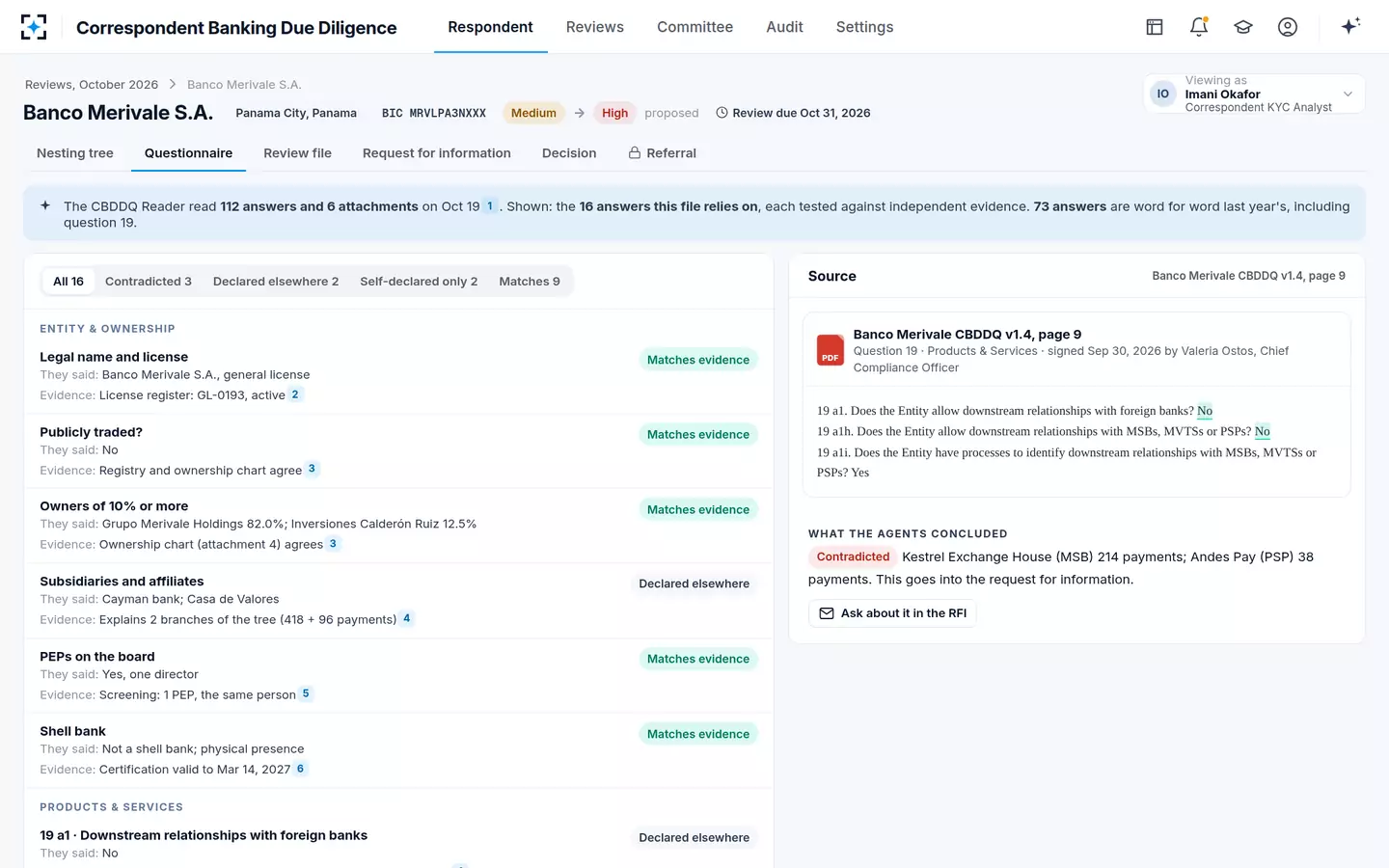
A returned CBDDQ in Correspondent Banking Due Diligence, each answer with its page and evidence
What the template cannot do
It cannot tell a correspondent whether the answers are true, and the Wolfsberg Group does not claim it can. The FAQs describe the CBDDQ as the basis for a conversation, not its end: "While the Questionnaire will be sufficient in most circumstances, it is possible that the nature of the relationship, products used and geographies served may necessitate a broader conversation and additional questions may have to be asked." Those additional questions belong outside the template; the FAQs say they "should not be added to the CBDDQ or FCCQ template as they are not endorsed by the Wolfsberg Group".
For a US bank that leaves three jobs the questionnaire does not do. Map each answer to the rule it serves, since the template is written for a global audience and its thresholds do not always match US definitions. Test the answers the file relies on against evidence the respondent does not control, above all the payments. And ask the follow-up questions in a separate request, tied to the gaps. How a single answer goes through those steps is followed in CBDDQ guidance in practice, and the US obligations it feeds are listed in correspondent bank KYC requirements.
How Correspondent Banking Due Diligence reads a returned template
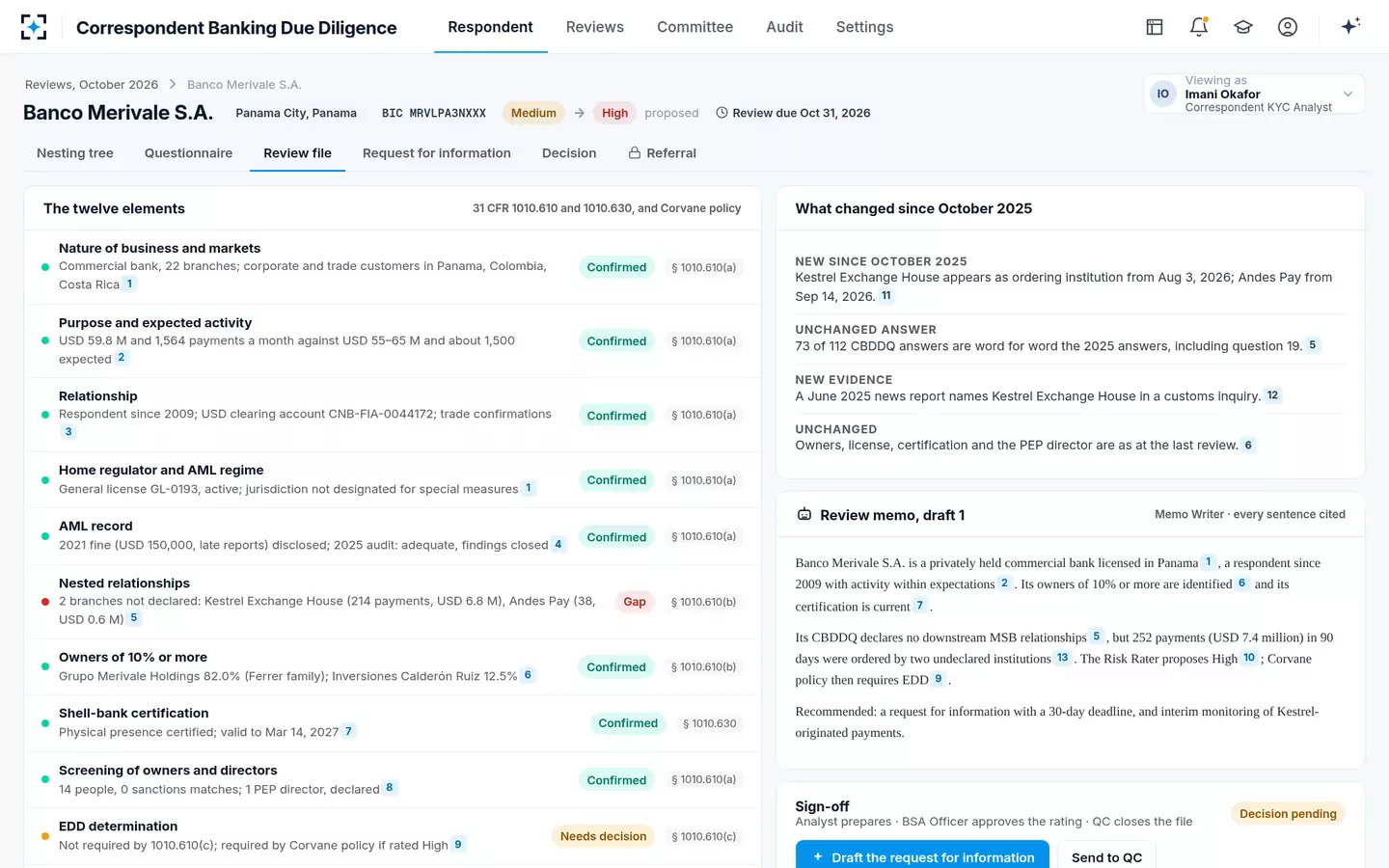
The solution treats the CBDDQ as the respondent's statement and builds the file around it. The questionnaire reader extracts every answer with its page and flags missing attachments and answers copied from the previous year, asking the analyst wherever it is unsure. The evidence checker and the nesting rebuilder then test the answers the file relies on: the licence against the regulator's register, owners against two independent sources, the certification, screening, and the downstream answers against 90 days of the respondent's payments. Each answer ends up with a verdict and a citation, and each feeds one of the twelve elements of the review file with the rule it serves.
It does not complete questionnaires for respondents, add questions to the template, or treat an answer as verified. Where an answer is contradicted, it drafts a request for information for the analyst to edit and the BSA Officer to approve. To see it on the sample respondent, start from Correspondent Banking Due Diligence.
The answers, mapped to the twelve elements of a Section 312 review file
Questions people ask
Where can I download the CBDDQ in Excel?
The Wolfsberg Group's correspondent banking resources page offers the CBDDQ v1.4 as both a PDF and an Excel file, dated 2023, with the FCCQ, the guidance, the glossary and the FAQs alongside. Translations of the guidance, glossary and FAQs are listed in several languages.
Can a correspondent add its own questions to the CBDDQ?
Not to the template itself. The Wolfsberg FAQs say each institution may ask additional questions, but those should not be added to the CBDDQ or FCCQ template because the Wolfsberg Group does not endorse them. Most correspondents send them separately, in a request tied to the respondent's answers.
Should a bank publish its CBDDQ on its website?
It may choose not to. The FAQs note that, because of the extensive information it contains, banks may not post completed CBDDQs publicly, so correspondents obtain them from a KYC utility or directly from the respondent. Some firms do publish their FCCQ.
Does completing the CBDDQ make a respondent high risk?
No. The FAQs say the questions were designed to collect enough information to assess the entity's financial crime risk, and completing them does not by itself mean the entity should be classified as high risk. The rating comes from the answers and the evidence, not from the form.
Is the CBDDQ required by US regulation?
No. US rules require a risk-based due diligence program for foreign correspondent accounts and the FinCEN certification for foreign banks, but they do not prescribe a questionnaire. The CBDDQ is the industry's standard way to gather much of the information; a US bank still maps it to 31 CFR 1010.610 and 1010.630 and tests what it relies on.