The CBDDQ guidance is the Wolfsberg Group's companion to its Correspondent Banking Due Diligence Questionnaire: a February 2023 document, version 2.0, written for version 1.4 of the questionnaire, that explains question by question what the respondent should disclose and why a correspondent cares. It is the best short statement of the risks behind each answer. It is not a method for testing whether the answer is true, and in correspondent banking due diligence that is the harder half. The questionnaire is the respondent's own account of itself, and many answers are copied from one year to the next. Botminds' Correspondent Banking Due Diligence reads every answer with its page, then tests the answers the file relies on against registers, attachments and the respondent's own payments. This page follows one of them, from the form to the decision.
The answer belongs to a fictional respondent, Banco Merivale S.A. of Panama, reviewed by a fictional US bank, Corvane National Bank, in October 2026, using the solution's sample data.
Of the 16 answers one file relied on, 7 did not simply match the evidence
The 16 answers tested
- Matches evidence · 9 · 56%
- Contradicted · 3 · 19%
- Declared elsewhere · 2 · 13%
- Self-declared only · 2 · 12%
All 112 answers read
- Word for word last year’s · 73 · 65%
- Changed or new · 39 · 35%
What is the CBDDQ guidance, and what does it add to the questionnaire?
The guidance is a question-by-question commentary, with a "Guidance" note on what to disclose and "Points for Consideration" on the risk behind the question. It is selective by design. In its own words it "covers the questions that the Wolfsberg Group believes would benefit most from additional background (so not all questions are covered)" (Wolfsberg CBDDQ Guidance v2.0, February 2023). It is addressed mostly to the respondent filling the form, which is why its value to a correspondent is indirect: it tells the reviewer which answers carry risk and what a good answer should contain.
Its opening note also records the questionnaire's standing. It cites four standard-setters, the Basel Committee, the CPMI, the FATF and the FSB, as having recognised the CBDDQ as one of the industry initiatives that help address the decline in correspondent relationships by facilitating due diligence. Recognition as a format is not endorsement of any respondent's answers. US rules put the risk assessment on the correspondent, and the questionnaire is one input to it.
What does CBDDQ question 19 a1f ask, and why does it carry so much weight?
Question 19 a1f asks: "Does the Entity have processes and procedures in place to identify downstream relationships with foreign banks?" (Wolfsberg CBDDQ v1.4). Its neighbours ask whether the respondent offers correspondent services to domestic banks, foreign banks and money services businesses, whether it allows those customers to provide downstream relationships, and whether it can identify them. Question 19 a1h asks the same of money services businesses, money or value transfer services and payment service providers, and that is the answer this page follows.
The guidance explains the weight in two sentences. On a respondent with no way to identify downstream relationships: "Lack of processes to identify and manage this type of relationship would generate an unknown level of risk which most Correspondent Banks would not be able to accept." And on nesting it does disclose: "Downstream activity also raises the question of 'why' and there should be a reasonable explanation of why such relationships exist." An answer of No to question 19 a1h is the one that removes the question of why. It is also the answer a respondent has the least incentive to revisit.
One answer, followed from the form to the file in Correspondent Banking Due Diligence
The life of an answer is mostly waiting. Merivale's answer to question 19 a1h spent three weeks being completed, two weeks in a queue, three days being tested, and then thirty days on a deadline for the respondent's explanation.
Seventy-four days in the life of question 19 a1h
- Refresh requested to signed (Sep 8–30)22 d
- Received and filed (to Oct 6)6 d
- Waiting for the review (to Oct 19)13 d
- Read, tested, decided (Oct 19–22)3 d
- Respondent’s deadline to explain (to Nov 21)30 d
In those three days the answer passed through five hands. The CBDDQ Reader extracted it with its page, page 9, and flagged that it was word for word last year's answer. The Nesting Rebuilder found two institutions of exactly the kind the question names, a money exchange house and a payment service provider, ordering 252 payments through Merivale's account in 90 days. The answer was marked Contradicted, with both sets of payments attached. The file's nested-relationships element turned to Gap. And in the rating proposal, the factor for answers contradicted by evidence moved from 0 to 6, one reason the proposed rating rose from Medium to High. The analyst confirmed the finding on October 21; the BSA Officer approved the consequences on October 22.
The CBDDQ read answer by answer in Correspondent Banking Due Diligence, page and evidence beside each
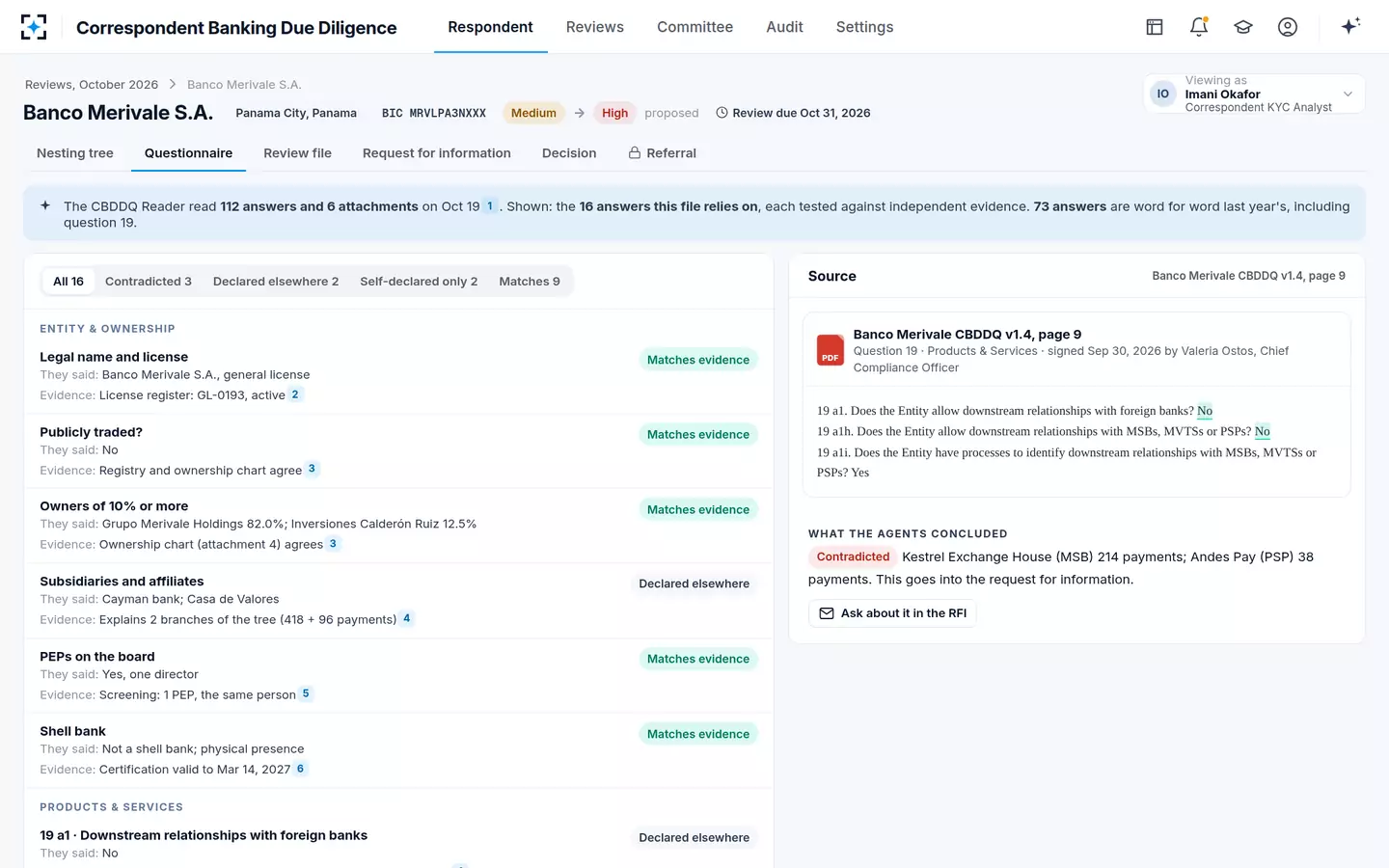
How do you review a CBDDQ? Four verdicts for every answer that matters
Review a CBDDQ by deciding which answers the file relies on, then giving each a verdict based on evidence from outside the questionnaire. Reading all 132 numbered questions with equal care is neither possible nor useful; the answers that feed the US risk factors, the enhanced-due-diligence test and the certification are the ones that need a source. Four verdicts cover what can happen to them.
Four verdicts for a CBDDQ answer, and what closes each
| Verdict | What it means | Example in the sample file | What the analyst does |
|---|---|---|---|
| Matches evidence | An independent source says the same thing. | Licence active on the regulator’s register; owners as on the ownership chart and registry. | Nothing beyond citing the source. |
| Contradicted | An independent source says something different. | Question 19 a1h: No downstream MSBs or PSPs; 252 payments ordered by one of each. | Asks the respondent, and decides whether to refer the activity. |
| Declared elsewhere | The answer looks incomplete, but the respondent disclosed the point in another section. | Affiliate bank and broker-dealer listed under ownership, not under downstream relationships. | Treats it as declared; notes where. |
| Self-declared only | No outside source can confirm or contradict it. | Statements about internal procedures, such as how often policies are reviewed. | Weighs it by risk; may ask for the audit or policy behind it. |
The fourth verdict deserves the most honesty. Some answers cannot be tested from outside, and a file that marks them as confirmed overstates what the bank knows. The FFIEC manual's section on correspondent accounts expects a bank's due diligence standards to say how analysts resolve issues "when insufficient, contradictory, or inaccurate information is obtained" (FFIEC BSA/AML Examination Manual, July 2023). An answer that nobody can test is insufficient information, and saying "self-declared only" is that standard applied.
What evidence should support CBDDQ answers?
Each answer that carries a US risk factor has a natural independent source, and most of them are not the respondent. The licence is on the supervisor's register. Ownership is in a registry or a filing, and the regulation's enhanced test needs every owner of 10% or more where the shares are not publicly traded. The shell-bank status is in the FinCEN certification, which the US bank must hold anyway. The respondent's AML history is in enforcement actions and the news. And everything about how the account is used, including downstream relationships, is in the payments.
The payments are the source most files skip, and the one the regulation points at. Its periodic review is a comparison of account activity with what the bank was told about the account's purpose and expected use (31 CFR 1010.610(a)(3)). The Wolfsberg principles go further and make the questionnaire itself the object of the test: "Comparison between what the Respondent stated about its FCC programme at onboarding/the last periodic review and how that programme is observed in practice should also be considered" (Wolfsberg Correspondent Banking Principles, 2022).
Can you rely on the Wolfsberg questionnaire?
You can rely on it as the respondent's statement, collected in a standard form; you cannot rely on it as proof. The distinction is not academic. The Wolfsberg principles allow an institution to use publicly available information, the CBDDQ among it, in its due diligence. US rules still place the risk assessment on the US bank, and nothing in them treats a questionnaire as verification. The practical rule in the solution is simple: no agent ever marks an answer verified, and every value in the file carries a citation to the page or the evidence it came from, so an examiner can see which statements the bank tested and which it took on trust.
What are red flags in a CBDDQ?
The strongest red flags are not unusual answers. They are answers that do not move when the business has, and answers the evidence contradicts. The checklist below is what the CBDDQ Reader flags before any outside evidence is consulted.
Red flags in a returned CBDDQ, before any evidence is checked
- Answers identical to last year’s
In the sample file, 73 of 112. Identical is not wrong, but an unchanged No on downstream relationships deserves a test.
- Missing attachments
An ownership chart, a branch list or an AML policy the form says is appended and is not.
- Branch differences not explained
Each section ends by asking whether the answers hold for every branch. A No without detail leaves the file covering a different entity from the one using the account.
- Correspondent services offered, downstream denied
A respondent that serves money services businesses (19 a1g) but says it allows no downstream relationships (19 a1h) needs to explain how it stops them.
- A significant non-resident customer base
Question 15: 10% or more of customers or revenue from non-residents. The guidance asks the correspondent to understand why.
- Unsigned or wrongly signed
The Wolfsberg FAQs expect two signatures, the head of correspondent banking or equivalent and the group money laundering reporting officer or head of financial crime compliance.
What happens if CBDDQ answers are false?
A contradicted answer starts a conversation, then, if it is not resolved, a decision. FATF describes the first step: where monitoring raises a concern, "the correspondent institution will follow up with the respondent institution by making a request for information (RFI) on any particular transaction(s)" (FATF, Guidance on Correspondent Banking Services, 2016). In the sample file, the request went to Merivale's Chief Compliance Officer with five questions, the second of them on question 19 a1h itself, and a 30-day deadline set by the BSA Officer.
The contradiction becomes question 2 of the request for information
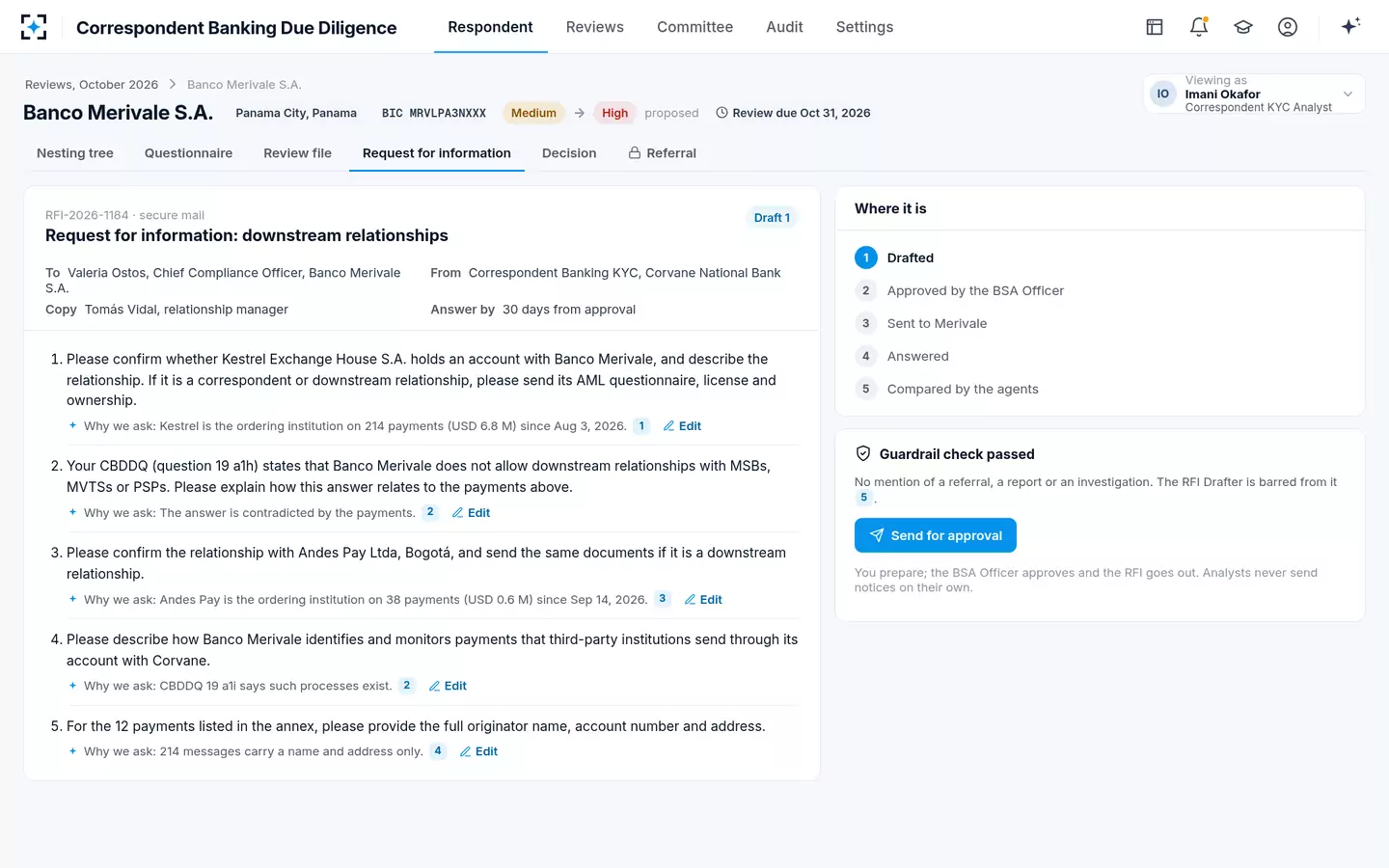
If the answer stays unexplained, the regulation's fallback applies. A bank's program must say when it will refuse to open an account, suspend activity, file a suspicious activity report or close the account where it "cannot perform appropriate due diligence" (31 CFR 1010.610(d)). For the shell-bank certification there is a separate clock: when a bank has reason to suspect the information in a certification is no longer correct, it must ask the respondent to verify or correct it, and close the account if it cannot get verification within 90 calendar days (31 CFR 1010.630(c) and (d)(3)). At the far end is deliberate deception, which the Danske Bank correspondent banking case shows was answered with a criminal plea.
The point of testing answers is not to catch respondents out. Most contradictions have explanations: a new partnership, a misread question, a branch the head office forgot. Testing turns those into documented explanations instead of unexamined risk. The same method extends to every answer in the form, and the CBDDQ template, section by section maps each part of it to the US rule it serves. To see the full review on the sample respondent, start from Correspondent Banking Due Diligence.
Questions people ask
Who is the CBDDQ guidance written for?
Mainly the respondent completing the questionnaire: it explains what to disclose for each covered question and the risk behind it. Correspondents use it to understand what a complete answer looks like. It is based on CBDDQ version 1.4 and does not cover every question.
Should a correspondent accept an answer that has not changed in years?
It can, if the evidence still supports it. The risk is that an unchanged answer was never re-read. In the sample file, question 19 had been copied from the previous year while two downstream institutions had started using the account since that review.
What is the difference between question 19 a1h and 19 a1i?
Question 19 a1h asks whether the respondent allows downstream relationships with money services businesses, money or value transfer services and payment service providers. Question 19 a1i asks whether it has processes to identify them. A respondent answering No and Yes is saying it forbids such relationships and can detect them, which is the claim the payments test.
How many CBDDQ answers should be tested against evidence?
There is no regulatory number. Test the answers that feed the US risk factors in 31 CFR 1010.610(a), the enhanced-due-diligence categories, ownership and the certification. In the sample file that was 16 of 112, about one in seven.
Is a contradicted answer a reason to file a suspicious activity report?
Not by itself. A contradiction is a gap in due diligence, handled by a request for information and a rating decision. If the activity behind it looks suspicious, that is a separate referral to the people who investigate and decide on reports, kept away from the relationship manager and never mentioned to the respondent.