Correspondent banking transaction monitoring scenarios are the written rules a US bank uses to watch the accounts it keeps for foreign banks and other foreign financial institutions between due diligence reviews: who is sending payments through each respondent, from where, in what amounts, and whether that matches what the respondent declared. No regulator publishes a scenario library for them. The obligations are in 31 CFR 1010.610, which requires risk-based controls and a periodic review of account activity against expectations, and the indicators are in the FFIEC examination manual, which names transactions with jurisdictions where the respondent has no known business, volumes beyond what is expected, and third-party institutions using the account. Correspondent banking due diligence is where those indicators get tested and where scenario results are meant to land. Botminds' Correspondent Banking Due Diligence rebuilds each respondent's senders from its payments at every review, and a decision in it can switch on a scenario in the bank's monitoring system.
Nine correspondent monitoring scenarios, each traced to the rule or indicator behind it
| Scenario | Built from | Data it reads | Example threshold |
|---|---|---|---|
| New ordering or intermediary institution on the respondent’s traffic | FFIEC nested indicators; 31 CFR 1010.610(b)(2); FATF on undisclosed nesting | MT103 fields 52a and 56a; pacs.008 debtor and intermediary agents | 5 payments or USD 100,000 in 90 days (the sample bank’s rule) |
| Activity outside the declared range | 1010.610(a)(3), periodic review against expected activity | Monthly volume and value by respondent against its declaration | Outside the declared range two months running |
| Jurisdictions with no known business | FFIEC indicator of nested activity | Originator and beneficiary countries against the respondent’s stated markets | A new country above 2% of the month’s value |
| Money services businesses or payment providers in the chain | CBDDQ questions 19 a1g to a1i; FFIEC on non-bank foreign financial institutions | Party names and identifiers matched to licensing registers | Any undeclared, at 5 payments |
| Customers, industries or products outside the respondent’s market | FFIEC on ongoing monitoring | Beneficiary and originator sectors and names | A sector new to the respondent above 5% of value |
| Round or patterned amounts | Enforcement actions (Lone Star, 2017) | Amounts and their structure | Round thousands well above the respondent’s own baseline |
| Missing or name-only originator details | FATF on transactions lacking required originator and beneficiary information | Completeness of ordering customer and institution fields | Any repeated gap from one sender |
| A prohibited or designated institution | 31 CFR 1010.630(a)(1)(ii) on shell banks; Section 311 special measures | All parties against Section 311 designations and any institution found to lack a physical presence | Any single payment |
| A dormant account wakes up | OCC Bulletin 2016-32 on dormant accounts | Activity after the bank’s defined dormancy period | First activity after dormancy |
What are correspondent banking monitoring scenarios?
They are monitoring rules whose unit is the respondent and the parties inside its traffic, not an individual customer. A retail scenario asks whether a customer's behaviour has changed; a correspondent scenario asks whether the respondent's account is being used the way the respondent said, and by whom. The FFIEC manual makes the link explicit: a bank's controls for these accounts may include "Incorporation of the bank's assessment of the ML risk presented by these accounts into the suspicious activity monitoring system(s)" (FFIEC BSA/AML Examination Manual, July 2023). The general case, with scenario examples for customer accounts, is covered in transaction monitoring scenarios examples; this page is about what changes when the customer is a bank.
How do you monitor correspondent bank accounts?
In two layers: ongoing monitoring of transactions, and a periodic review of the whole account against what the respondent declared. The first runs every day in a monitoring system. The second runs on the bank's review cadence and is required by 31 CFR 1010.610(a)(3). The FFIEC is clear about how deep the second has to go: "The periodic review may not ordinarily involve scrutiny of every transaction taking place within the account. However, the review must be sufficient for the bank to determine whether the nature and volume of account activity is consistent with information obtained" about the account's purpose and expected use.
The two layers fail in different ways. Ongoing monitoring sees transactions one at a time, so a new sender that never breaks a single-payment threshold can go unnoticed for months. The periodic review sees the whole account but, done by hand, compares totals, so it misses who is sending. The scenarios on this page are designed to cover the gap: rules that look at the parties across the respondent's traffic, not only at amounts.
What does the FFIEC say about nested activity?
That it is a transparency problem first. The manual's section on nested correspondent banking says: "Providing access to third-party foreign financial institutions that are not customers of the bank, and so are not necessarily known, can obscure financial transparency and increase ML/TF and other illicit financial activity risks." It names the indicators, transactions with jurisdictions where the respondent has no known business and volumes that significantly exceed what is expected, and says the level of risk depends on the nested institutions' size, location, products, customers and "the degree of transparency (e.g., in format of payment transactions)".
For ongoing monitoring, the manual describes procedures that follow up on activity "inconsistent with the foreign financial institution's business and the market it serves (i.e., transactions involving customers, industries, or products that are not generally part of that foreign financial institution's customer base or market)". Each clause is a scenario: an unexpected country, an unexpected sector, an unexpected kind of party. The first row of the table above is the one most monitoring systems lack, because it needs the ordering and intermediary institution fields, not just the account. How the nesting rule works on one respondent is shown in a nested correspondent banking example.
What are correspondent banking red flags? Three worked examples
Enforcement actions give the clearest red flags, because they show what a bank missed. FinCEN's 2017 assessment against Lone Star National Bank describes a Mexican respondent whose US-dollar deposits ran at two to three times the amount it declared, and which "followed each bulk cash deposit with an immediate request for an outgoing wire transfer to an account in the Foreign Bank's name at other U.S. financial institutions" (FinCEN, Assessment No. 2017-04). Volume against declaration, and money in followed at once by money out to the respondent's other accounts, are both scenario material.
The same assessment found many outgoing wires whose amounts ended in the day of the month they were sent, a pattern the bank's monitoring did not catch and could not explain. A scenario that tests amounts only against a threshold will never see a pattern like that; one that looks at the structure of amounts can. The third example is from the sample data on these pages: a money exchange house ordering payments through a respondent that declared none, 61% of them round thousands, growing from 6 a week to 30, mostly to electronics and phone wholesalers. Each element is a scenario in the table; together they made a branch worth a question.
What is the feedback loop in correspondent banking?
It is the rule that monitoring results change the due diligence, and due diligence changes the monitoring. The Wolfsberg principles say that "the results of suspicious activity monitoring shall be factored into the periodic review of the customer relationship, particularly when the results of transaction monitoring indicate elevated risk levels", and add: "This is commonly referred to as the feedback loop" (Wolfsberg Correspondent Banking Principles, 2022). In practice the loop has to run both ways: an alert should reach the next review, and a review's findings should change which scenarios run on the respondent.
The feedback loop in Correspondent Banking Due Diligence, from a scenario to the review and back
Agent
Rebuild the senders at reviewAt each periodic review, the respondent’s payments are read and every undeclared branch is marked, with its messages.
A person decides
Decide on the findingThe analyst asks the respondent, refers suspicious activity to AML Investigations, and proposes a rating.
A person decides
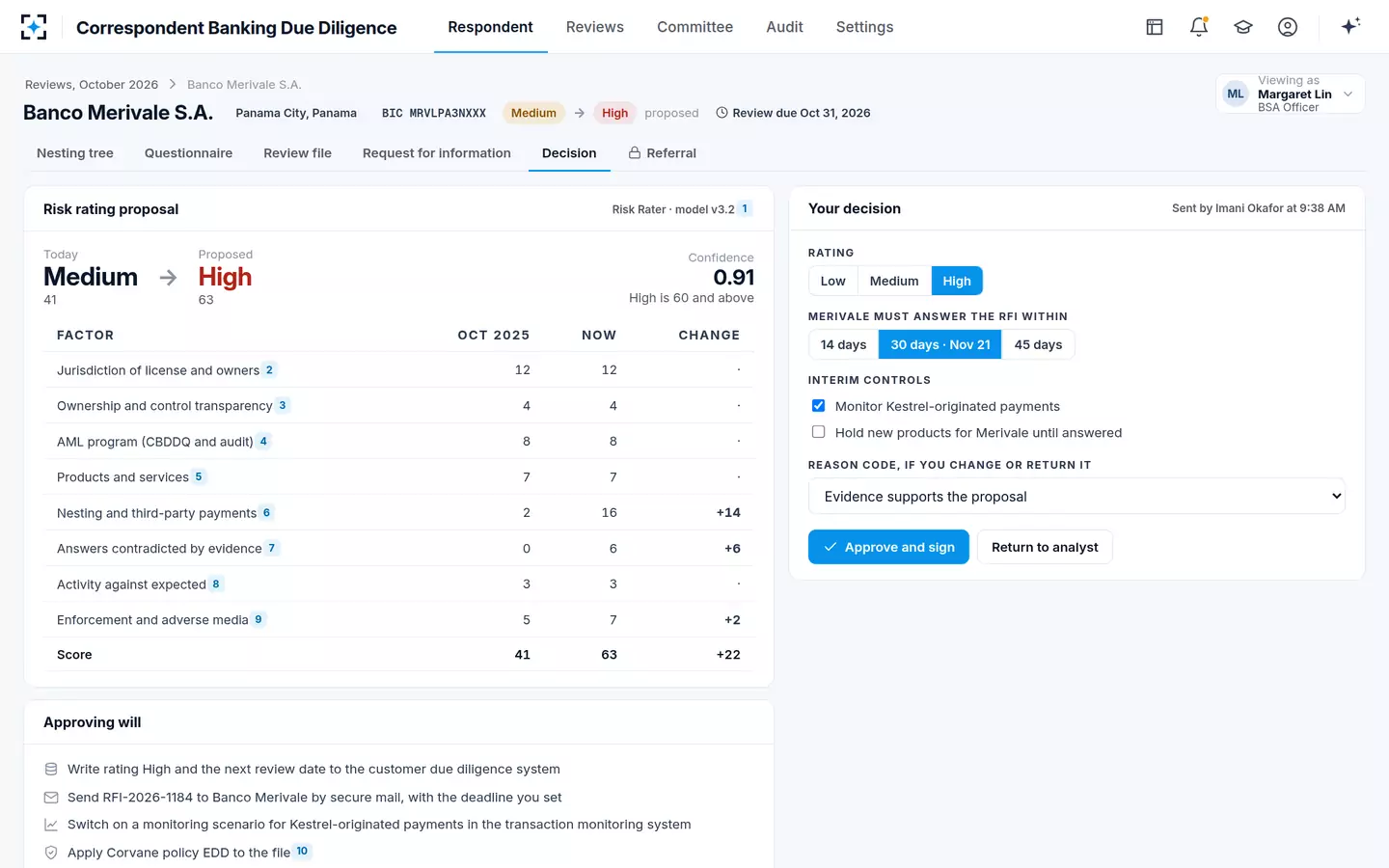
Approve the controlsThe BSA Officer approves the rating and any interim monitoring, such as a scenario on one sender’s payments.
Agent
Switch the scenario onAfter approval, the decision is written to the transaction monitoring system, which runs the scenario daily.
Never: switches on monitoring without an approved decision
Agent
Bring the results backAt the next review, alerts and the respondent’s replies are part of the rebuilt file, and the comparison runs again.
A decision that switches on monitoring for one undeclared sender
How often should monitoring scenarios be tuned?
Periodically, and whenever a respondent's behaviour gives a reason. FATF's guidance asks correspondents to "put in place and periodically review risk-based procedures specifying the applicable monitoring techniques and the criteria triggering their adoption", and to consider "the respondent's past behaviour in the course of the correspondent relationship, in particular any failures to satisfy previous requests for information" (FATF, Guidance on Correspondent Banking Services, 2016). No US rule fixes a tuning interval for correspondent scenarios; the bank sets one and keeps the evidence.
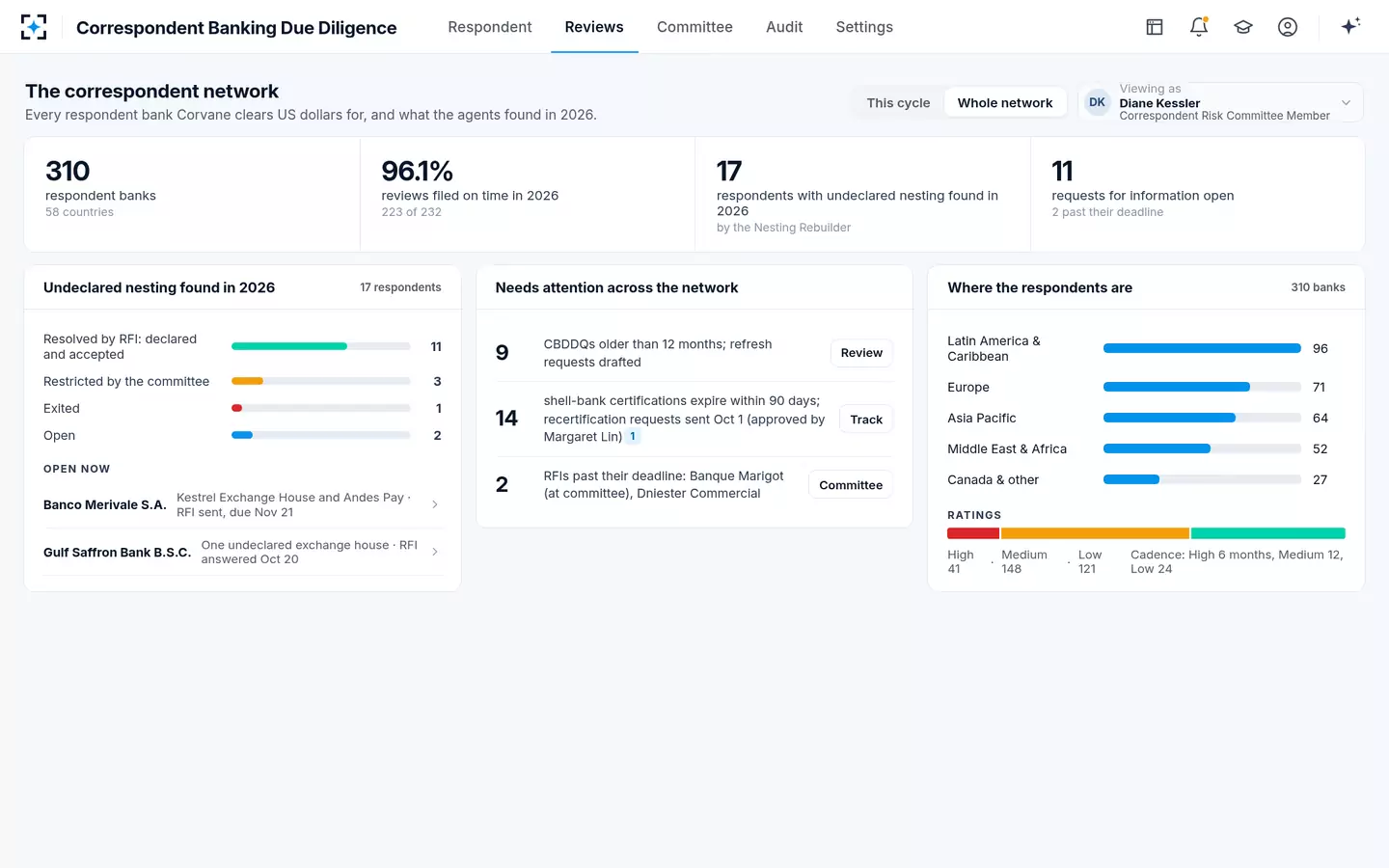
The outcome data that tuning needs comes from the reviews. In the sample bank, the nesting rule found undeclared branches at 17 respondents in 2026. Eleven explained them and were kept, which says the threshold was catching real relationships; three were restricted and one exited, which says it was catching real risk. A rule that only ever produced explanations, or only ever produced exits, would need retuning.
What happened after the nesting scenario fired at 17 respondents
What data does correspondent banking monitoring need?
The full payment messages, with every party field, and the respondent's declarations in a form a machine can compare. Most failures of correspondent monitoring are data failures: an archive that keeps amounts and account numbers but drops field 52, a declared expected activity written as prose, a downstream list kept in an email. The checklist below is what the scenarios in the table depend on.
The data correspondent scenarios cannot run without
- Every party field, kept
Ordering customer and institution, intermediaries, beneficiary and its institution, from MT103, MT202 COV and ISO 20022 messages alike.
- Identifiers where they exist
BICs and LEIs for institutions; where a field holds only a name and address, a consistent way to match it.
- Expected activity in numbers
Volumes, values, currencies and markets from the respondent’s declaration, by month, not a sentence in a memo.
- The declared downstream list
Which banks, money services businesses and payment providers the respondent says use its account, and its affiliates.
- Licensing and designation lists
Registers of money services businesses and payment providers, shell-bank and Section 311 designations, alongside the bank’s sanctions screening.
- Gaps flagged, not filled
A missing week of messages has to stop a count, not lower it. In the sample bank, one respondent’s review paused on a nine-day gap.
- Results from earlier reviews
Previous findings, requests for information and their replies, so the scenarios start from what is already known.
Where Correspondent Banking Due Diligence fits beside a monitoring system
Beside it, not in place of it. The bank's transaction monitoring system runs scenarios daily and produces alerts for investigators; it is good at amounts and thresholds, and usually weak at reading who is in a correspondent's traffic. Correspondent Banking Due Diligence does the party-level work at each review: it rebuilds the respondent's senders from 90 days of messages, compares them with what the respondent declared, and turns the result into a file, a request and a decision. When the decision calls for monitoring, it writes that to the monitoring system after approval, and the next review reads back what the monitoring found.
It does not dispose of alerts, file reports or replace an investigator's judgement, and it depends on the bank making its payment messages available, with their party fields. For the rules the scenarios rest on, see correspondent bank KYC requirements; for how the payment test applies to the questionnaire, one CBDDQ answer tested against the payments. The sample book, its reviews and its decisions are in Correspondent Banking Due Diligence.
Monitoring outcomes across the network, one respondent at a time
Questions people ask
Does US regulation require specific monitoring scenarios for correspondent accounts?
No. 31 CFR 1010.610 requires risk-based procedures and controls reasonably designed to detect and report known or suspected money laundering, including a periodic review of activity, and for respondents subject to enhanced due diligence, monitoring of transactions to, from or through the account. Which scenarios achieve that is the bank's choice, documented and tested.
Should a correspondent monitor its respondent's customers?
It monitors the transactions that pass through the account, which include the respondent's customers' payments, but it is not required to perform due diligence on each of those customers. When a transaction raises a question, the tool is a request for information to the respondent about that transaction.
What is the difference between ongoing monitoring and the periodic review?
Ongoing monitoring looks at transactions as they happen and raises alerts. The periodic review looks at the whole account on the bank's cadence and asks whether its activity matches what the respondent declared. The FFIEC says the review need not scrutinise every transaction but must be sufficient to judge whether the nature and volume of activity are consistent with the account's purpose.
Can a monitoring system find undeclared nesting on its own?
Only if it reads the ordering and intermediary institution fields and compares them with the respondent's declarations, which many account-level scenarios do not. A threshold on account totals will not see a new sender whose payments stay inside the respondent's declared volume, as the sample exchange house's did.
Do correspondent scenarios need model risk governance?
Simple threshold rules are deterministic, which the 2026 interagency model risk guidance excludes from its definition of a model. Scenarios that use statistical scoring may fall within it. Either way, examiners expect thresholds to be documented, justified and tested against outcomes.