The Wolfsberg questionnaire has no expiry date, but it has a ceiling: the declaration a respondent signs at the end of the CBDDQ commits it to keep the answers current and to update them at least every eighteen months, and the Wolfsberg Group's FAQs recommend a review and update every 12 to 18 months, with material changes made as soon as reasonably possible. A new version of the form does not invalidate completed ones. The clocks that actually bind a US correspondent bank are legal ones: a shell-bank certification at least every three years and within 30 days of opening an account, 120 hours to answer a federal banking agency, 7 days to answer law enforcement, and 10 business days to end a relationship when Treasury or the Attorney General says so. Keeping every one of them running for every respondent is the scheduling half of correspondent banking due diligence. Botminds' Correspondent Banking Due Diligence opens each review on time, requests questionnaires and certifications ahead of their dates, and tracks the regulator's clock when a request arrives.
The numbers people search for, and where each comes from
18months
at most between CBDDQ updates, in the respondent’s own signed declaration; the FAQs recommend 12 to 18
3years
at most between shell-bank certifications, 31 CFR 1010.630(b)
120hours
to give a federal banking agency the information it asks for, 31 U.S.C. 5318(k)(2)
10business days
to end a relationship on written notice from Treasury or the Attorney General
How long is the Wolfsberg questionnaire valid?
As long as it is still true, and no longer than eighteen months by the respondent's own promise. The questionnaire ends with a declaration, signed by the respondent's head of correspondent banking and its money laundering reporting officer or equivalent, which states: "The information provided in this Wolfsberg CBDDQ will be kept current and will be updated no less frequently than every eighteen months" (Wolfsberg CBDDQ v1.4, declaration statement). The Wolfsberg Group itself stops short of a validity period. Asked "What is the validity/expiry date of the completed CBDDQ or FCCQ?", its FAQs answer: "While not prescribing any particular review period, it is recommended that the questionnaires be reviewed and updated on a 12–18-month basis. Any material changes, however, should be updated as soon as reasonably possible" (Wolfsberg CBDDQ/FCCQ FAQs v3.0, 2023).
Two things follow for a correspondent. A questionnaire older than 18 months is outside both the recommendation and the respondent's own signed commitment, and a reviewer should ask why before relying on it. And a questionnaire younger than 12 months can still be wrong, because the recommendation is a ceiling on staleness, not a guarantee of accuracy. In the sample review on these pages, the respondent's questionnaire was signed three weeks before the review, and its answer on downstream relationships was still contradicted by the payments.
Is there a CBDDQ expiry date?
No. A completed CBDDQ does not expire on a date, and the Wolfsberg FAQs add that publishing a new version of the questionnaire neither invalidates completed ones nor obliges a bank to refresh its due diligence. They ask correspondents instead to write down their own policy for when respondents must move to a new version. That makes the questionnaire's age a policy choice the bank owns: a refresh cycle tied to the rating, plus a refresh whenever something material changes, is the common answer.
The sample bank requests a fresh questionnaire at each periodic review, which its policy sets at 6, 12 or 24 months by rating, and flags any questionnaire older than 12 months on its network view. The flag matters most for low-rated respondents: reviewed every 24 months, their questionnaires would otherwise pass the 18 months their own declarations promise, so the refresh request goes out between reviews. That keeps files inside the Wolfsberg range without pretending the range is law.
How often must a USA PATRIOT Act certification be renewed?
At least once every three years. The certification is the form FinCEN publishes under 31 CFR 1010.605(b), which a foreign bank completes for its US correspondents and renews on a schedule. The regulation treats a bank as complying with the shell-bank and records requirements "if the covered financial institution obtains, at least once every three years, a certification or recertification from the foreign bank" (31 CFR 1010.630(b)).
For a new account the first clock is shorter. If a bank has not obtained a certification, or other documentation of the same information, "within 30 calendar days after the date the account is established", and at least every three years after, it must close all correspondent accounts with that foreign bank within a commercially reasonable time and allow no new positions in the meantime (31 CFR 1010.630(d)(2)). The sample bank asks for recertification 90 days before expiry, so the request never starts on the deadline.
What is a shell bank, and what does the certification cover?
"Foreign shell bank means a foreign bank without a physical presence in any country" (31 CFR 1010.605(g)). Physical presence has a precise meaning: a place of business the bank maintains at a fixed address, not only an electronic address or a post-office box, in a country where it is licensed, where it employs at least one person full time, keeps operating records, and is subject to inspection by its licensing authority. The prohibition has one exception: a regulated affiliate, a shell bank affiliated with a bank that has a physical presence and supervised by that bank's regulator.
The certification is how a bank meets the whole of 1010.630(a) in one document: the shell-bank prohibition, the step against indirect service to shell banks, and the records of owners and of a US agent for legal process. It does not cover anything else in a correspondent file. A current certification says nothing about downstream relationships, expected activity or AML controls, which is why it sits beside the questionnaire rather than replacing it.
The clocks in a correspondent file, to scale
Drawn on one calendar, the clocks show where the work bunches. Over a three-year certification cycle, a medium-rated respondent is reviewed three times and a high-rated one six times, each review opening with a questionnaire refresh. The certification renewal lands once, and its 90-day request window is the only part of the cycle where the shell-bank clock needs attention.
Three years of one respondent’s clocks, drawn in months
- Valid safe harbor33 mo
- Recertification requested90 d
- Questionnaire 112 mo
- Questionnaire 212 mo
- Questionnaire 312 mo
- Review 16
- Review 26
- Review 36
- Review 46
- Review 56
- Review 66
The short clocks do not fit on that calendar, which is the danger: they start when someone else acts. Each is set out below with what starts it and what happens if it is missed.
Every clock in a US correspondent file: what starts it and what follows if it is missed
| Clock | Starts when | Rule | If missed |
|---|---|---|---|
| 120 hours | A federal banking agency requests AML-compliance information or account documents | 31 U.S.C. 5318(k)(2) | A violation of the statute; the request is usually part of an examination |
| 7 days | A federal law enforcement officer requests the owner and agent records in writing | 31 CFR 1010.670(c) | A violation of the regulation |
| 10 business days | Written notice from Treasury or the Attorney General that a foreign bank failed to comply with a subpoena | 1010.670(d); 5318(k)(3)(E) | Civil penalty up to $10,000 a day under the regulation; not more than $25,000 a day under the statute |
| 30 calendar days | A new correspondent account for a foreign bank is established | 1010.630(d)(2) | Close all accounts with that bank within a commercially reasonable time |
| 90 calendar days | The bank starts verifying certification information it has reason to doubt | 1010.630(c) and (d)(3) | Close all accounts with that bank |
| 3 years | The last certification or recertification | 1010.630(b) and (d) | The safe harbor lapses; close if not obtained |
| 5 years | The bank no longer keeps any correspondent account for the foreign bank | 1010.630(e) | Certification documents must be kept at least that long |
| 18 months | The respondent last updated its questionnaire | The CBDDQ’s signed declaration; the FAQs recommend 12 to 18 | Nothing in law; the respondent is outside its own commitment, a reason to ask before relying on it |
When must a correspondent account be closed?
In three situations the regulation sets the clock for closing. The first two concern the certification: no certification within 30 calendar days of opening, or none at least every three years after (1010.630(d)(2)); and no verification within 90 calendar days of starting to check information the bank has reason to think is wrong (1010.630(d)(3)). In each case the bank must close all correspondent accounts with that foreign bank within a commercially reasonable time and may not let it open new positions meanwhile. A closed account cannot be reopened until the certification arrives.
The third is a government notice. A bank "shall terminate any correspondent relationship with a foreign bank not later than 10 business days after receipt of written notice from the Secretary or the Attorney General" that the foreign bank failed to comply with, or contest, a summons or subpoena for records (31 CFR 1010.670(d)). Beyond these, closure is a risk decision, made under the bank's own procedures for when due diligence cannot be performed.
What is the 120-hour rule?
The 120-hour rule is 31 U.S.C. 5318(k)(2): "Not later than 120 hours after receiving a request by an appropriate Federal banking agency for information related to anti-money laundering compliance by a covered financial institution or a customer of such institution, a covered financial institution shall provide to the appropriate Federal banking agency, or make available at a location specified by the representative of the appropriate Federal banking agency, information and account documentation for any account opened, maintained, administered or managed in the United States by the covered financial institution" (31 U.S.C. 5318(k)(2)). It counts hours, not business days, and it applies to any account, not only correspondent ones.
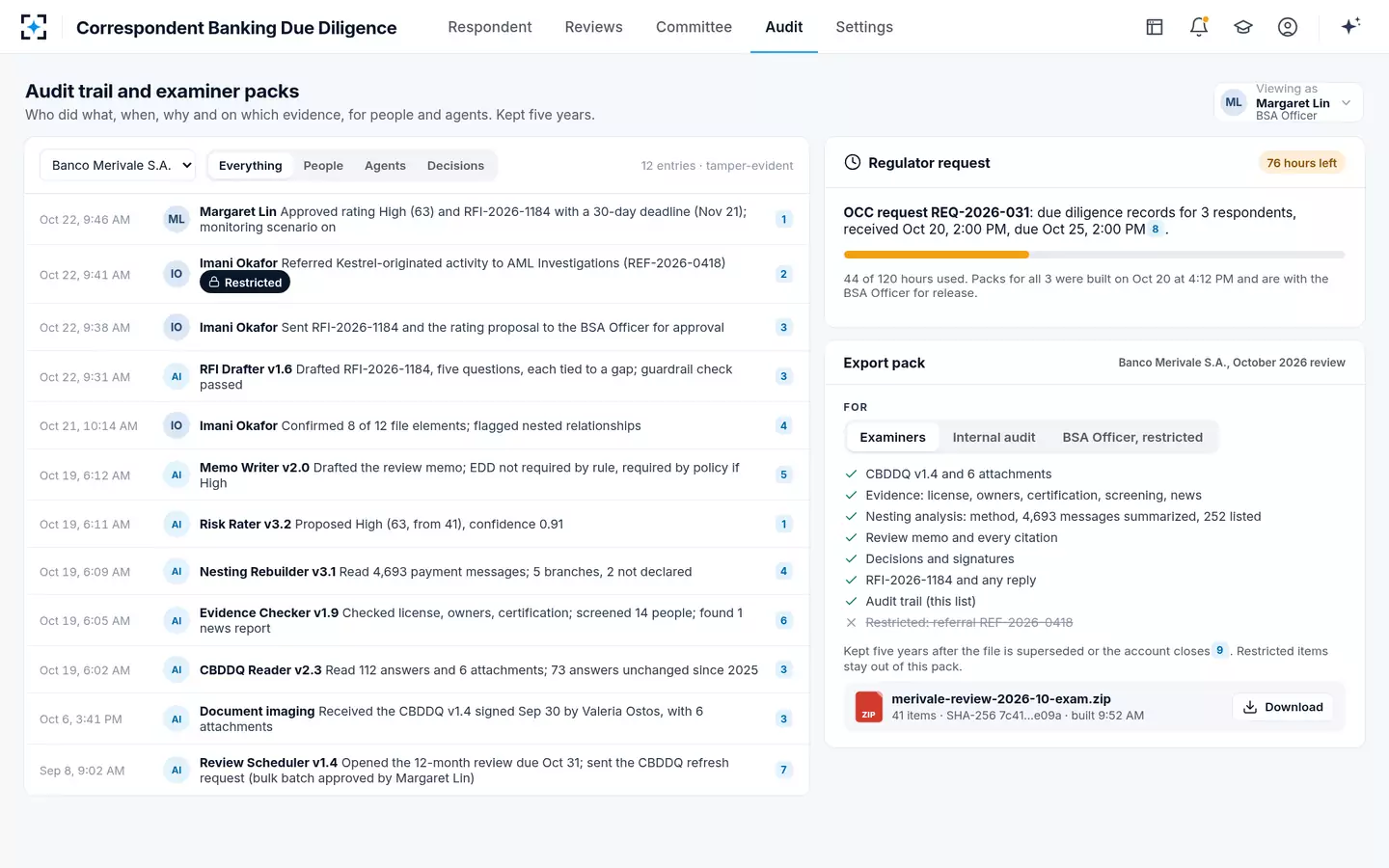
For a correspondent team, 120 hours is enough only if the file already exists. A review assembled by hand from email threads and shared drives can take most of that window just to find. In the sample bank, an OCC request for three respondents' due diligence arrived on a Tuesday afternoon, and the examiner packs were built the same day; the clock on screen tracked the hours used against the 120.
A regulator’s request tracked against 120 hours in Correspondent Banking Due Diligence
The clock nobody sets for you: the periodic review
The periodic review has no fixed interval in US rules; the bank sets it by risk, and then has to keep to it. That is the clock most often missed, because no outside event starts it. FinCEN's 2026 consent order against Canaccord Genuity, a broker-dealer also covered by the correspondent rule, found that the firm "failed to implement a procedure for conducting ongoing periodic reviews of correspondent account activity", among other failures, in a matter that ended with an $80 million civil money penalty (FinCEN, Consent Order No. 2026-01).
Supervisors expect the program to define its own clocks, including for accounts that go quiet. The OCC's 2016 guidance asks that a bank's processes "specify the length of time that foreign correspondent accounts can remain dormant before being subject to closure" (OCC Bulletin 2016-32). A dormant account with a valid certification and an old questionnaire is a door left open; a written dormancy period closes it on schedule. How the review cadence fits the wider obligations is set out in correspondent bank KYC requirements for a small team.
Running every clock across a network of respondents
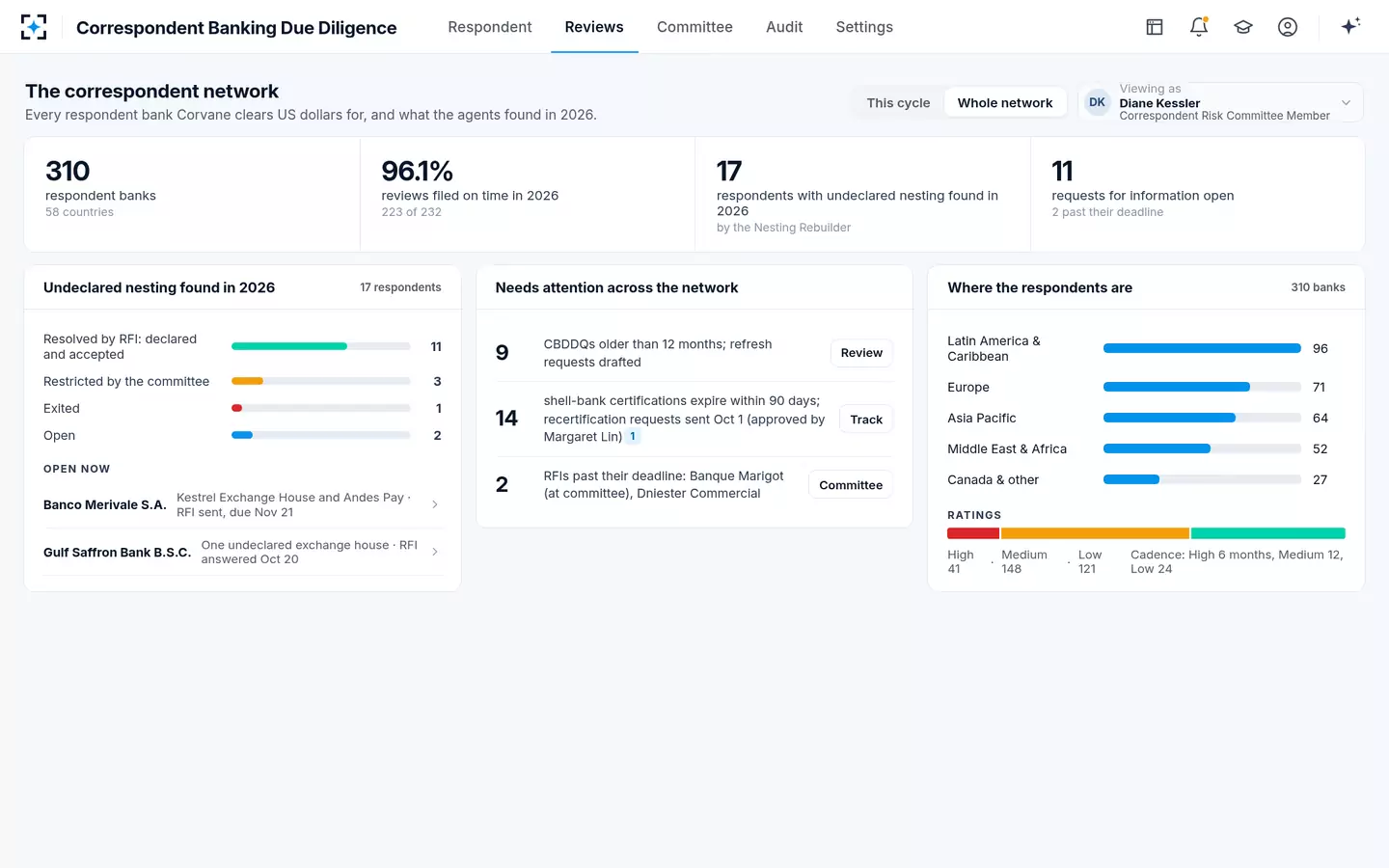
Across a network, the clocks become a queue. In the solution, the review scheduler opens each periodic review 45 days before its due date, sends questionnaire refreshes and certification requests in batches the BSA Officer approves, alerts the team lead five business days before a due date and escalates an overdue review to the BSA Officer the same day. Only the BSA Officer can extend a due date. The network view then shows what is coming due, so nothing depends on someone remembering a renewal three years after the last one.
Every respondent’s clocks on one screen in Correspondent Banking Due Diligence
The clocks only measure whether the file is current. Whether it is true is a separate test, which one CBDDQ answer, followed against the payments works through. To see the scheduling and the review together on sample respondents, start from Correspondent Banking Due Diligence.
Questions people ask
Does US law require the Wolfsberg questionnaire?
No. US rules require a risk-based due diligence program and, for foreign banks, the FinCEN certification; they do not name a questionnaire. The CBDDQ is the industry's standard way to collect much of the information; its 18-month update promise is the respondent's own declaration and the 12 to 18 months the Wolfsberg Group's recommendation, neither of them a legal period.
Is the FinCEN certification the same as the CBDDQ?
No. The certification is a short regulatory form covering shell-bank status, owners and a US agent for legal process, renewed at least every three years under 31 CFR 1010.630. The CBDDQ is a long industry questionnaire covering the respondent's products, controls, ownership and downstream relationships, refreshed by policy.
What happens if a respondent will not recertify?
The bank must close all correspondent accounts with that foreign bank within a commercially reasonable time and allow no new positions except those needed to close. It may not reopen or open any correspondent account for that bank until the certification arrives.
How long must a bank keep certifications?
At least five years after it no longer maintains any correspondent account for that foreign bank, and longer if the Secretary of the Treasury directs, under 31 CFR 1010.630(e). The rule covers the originals of documents the foreign bank provided and copies of anything else the bank relied on.
Does a new version of the CBDDQ restart the clock?
Not by itself. The Wolfsberg FAQs say a new version does not invalidate completed questionnaires and is not a trigger for immediate updates; each correspondent should document when its respondents must move to the new version. Version 1.4, published in 2023, is still the current one.