The Danske Bank correspondent banking scandal is the case of a respondent that lied to its correspondents. According to the US Justice Department, between 2008 and 2016 Danske Bank's Estonian branch served a business line of customers who lived outside Estonia, including in Russia, and needed US dollars; it reached the US financial system through dollar accounts at US banks, and it kept those accounts by giving the US banks false information about its anti-money laundering controls, its transaction monitoring and its customers. Danske Bank Estonia processed $160 billion through US banks for those customers. In December 2022 Danske Bank pleaded guilty to conspiracy to commit bank fraud and agreed to forfeit $2.059 billion. For a correspondent, the lesson is about method: due diligence that rests on what a respondent says cannot catch a respondent willing to lie. Botminds' Correspondent Banking Due Diligence tests a respondent's answers against its own payment messages at every review, the one control in a file that does not depend on the respondent's honesty.
Everything said here about Danske comes from the Justice Department's press release of December 13, 2022. Where the release is silent, for example on which US banks held the accounts, this page says so rather than filling the gap.
The Danske case in four numbers
$160B
processed through US banks on behalf of the Estonian branch’s non-resident customers
8years
of conduct, 2008 to 2016, at Danske Bank Estonia
$2.059B
criminal forfeiture agreed in the plea
~$850M
credited for payments to the SEC and Danish authorities
What happened in the Danske Bank scandal?
Danske Bank, Denmark's largest bank, ran a branch in Estonia that built a lucrative business with customers who did not live there. The Justice Department's account is specific about how. Danske Bank Estonia "attracted NRP customers by ensuring that they could transfer large amounts of money through Danske Bank Estonia with little, if any, oversight", and its employees "conspired with NRP customers to shield the true nature of their transactions, including by using shell companies that obscured actual ownership of the funds" (US Department of Justice, December 13, 2022). NRP was the bank's name for that business, its non-resident portfolio.
The case was not prosecuted as money laundering by Danske. It was prosecuted as fraud on the US banks. The Assistant Attorney General put it in one line: "Danske Bank lied to U.S. banks about its deficient anti-money laundering systems, inadequate transaction monitoring capabilities, and its high-risk, offshore customer base in order to gain unlawful access to the U.S. financial system". The victims, in the government's framing, were the correspondents.
How did Danske Bank use correspondent banks?
As its route to US dollars. The non-resident customers needed to move dollars, and dollar payments clear through US banks, so Danske Bank Estonia needed US correspondent accounts. The Justice Department notes that "Access to the U.S. financial system via the U.S. banks was critical to Danske Bank and its NRP customers, who relied on access to U.S. banks to process U.S. dollar transactions." It also says that Danske misled the US banks "in order to maintain and in one case open U.S. dollar accounts". The respondent, in correspondent terms, was a branch of a major European bank, which is the kind of respondent a correspondent tends to rate low.
What did Danske Bank tell U.S. banks?
What the US banks asked for was ordinary due diligence. "U.S. banks required Danske Bank and Danske Bank Estonia to provide information to open and maintain accounts, including information related to anti-money laundering (AML) controls, transaction monitoring, and customers." Danske knew the US banks expected honest, complete and accurate answers, and knew they would not keep the accounts without them. What it gave them, from at least February 2014, contradicted what it knew.
What Danske Bank knew, and what it told its US correspondents
What the DOJ says Danske knew: From at least February 2014, through internal audits, regulators and a whistleblower, that some non-resident customers were engaged in highly suspicious and potentially criminal transactions, including through US banks.
What it told the US banks: False information about the Estonian branch’s customers and their risk profile.
What the DOJ says Danske knew: That the branch’s AML program and procedures did not meet Danske’s own standards and were not appropriate to the risks of the non-resident business.
What it told the US banks: False information about the state of the branch’s AML compliance program.
What the DOJ says Danske knew: That its transaction monitoring was inadequate.
What it told the US banks: False information about its transaction monitoring capabilities.
What the DOJ says Danske knew: The accounts were critical to the business.
What it told the US banks: The accounts were kept, and one was opened, while $160 billion went through.
How much did Danske Bank forfeit?
$2.059 billion. Danske Bank pleaded guilty to one count of conspiracy to commit bank fraud, and "the company has agreed to criminal forfeiture of $2.059 billion". The Justice Department credited about $850 million in payments Danske made to resolve related matters with the Securities and Exchange Commission and Danish authorities, and noted the appointment of an independent expert selected by Danske's regulator. Danske received full credit for cooperation and remediation, the release says, but not for disclosure: the department cited "the bank's failure to voluntarily and timely disclose the conduct".
Eight years of conduct, and when the industry questionnaire arrived
- Conduct, 2008 to early 20146 yrs
- Conduct after Danske knew, Feb 2014 to 20163 yrs
- To the guilty plea, Dec 20226 yrs
- No standard questionnaire yetto Oct 2017
- CBDDQ in use (v1.4 since 2023)Oct 2017 on
The one control that does not depend on the respondent's honesty
Every element of a correspondent file but one starts with something the respondent provides: the questionnaire, the policies, the audit report, the list of customers it serves. A respondent prepared to lie can make all of them consistent with each other. The exception is the account itself. The payments a respondent sends through its correspondent are generated by its business, not by its compliance department, and the correspondent already holds them.
US rules point at that comparison. The periodic review in 31 CFR 1010.610(a)(3) is a review of account activity to determine whether it is consistent with what the bank was told about the account's purpose and expected use (31 CFR 1010.610). In practice, most periodic reviews compare totals, which a respondent can keep inside a declared range. The stronger test reads who is in the payments, and asks whether the respondent's description of its customers, markets and downstream relationships matches the parties that actually appear.
Where a file built on answers stops, and the step Correspondent Banking Due Diligence adds
Agent
Read what the respondent saysExtracts every questionnaire answer with its page: customer base, non-resident share, downstream relationships, AML controls.
Never: treats an answer as verified
Agent
Read what the account doesReads 90 days of the respondent’s payment messages: ordering customers and institutions, countries, beneficiaries, values.
Agent
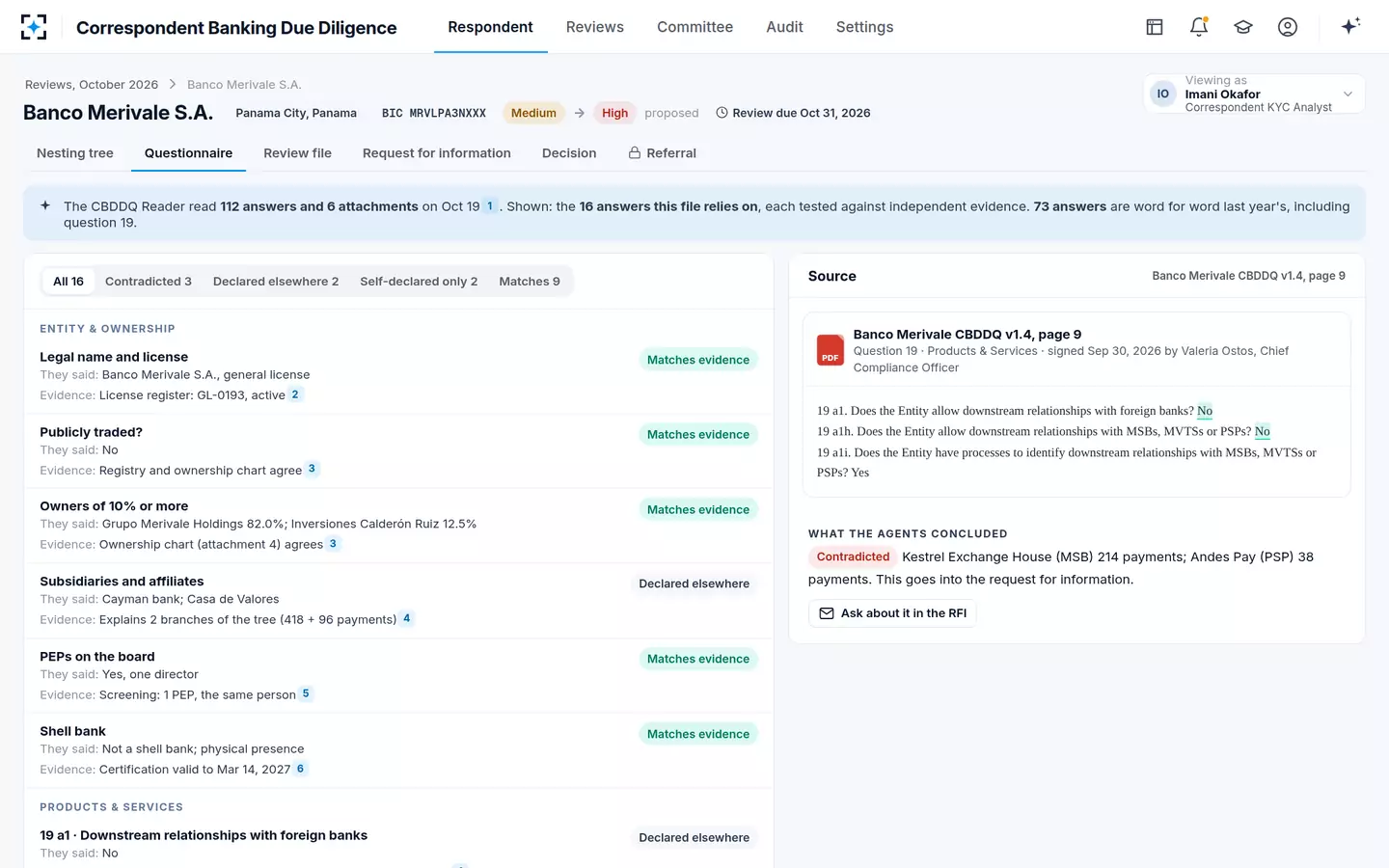
Compare the twoMarks each tested answer as matching, contradicted, declared elsewhere or self-declared only, with the messages that support the verdict. This is the step a file built on answers never reaches.
A person decides
Ask the respondentThe analyst drafts a request for information on each contradiction; the BSA Officer approves it and sets the deadline.
A person decides
DecideRating, restriction or exit, by the BSA Officer and, for restrictions and exits, two committee members; any referral goes to investigators and stays restricted.
What could correspondent banks have checked?
The Justice Department's release does not say what the US banks saw in their accounts, and hindsight makes every signal look obvious. What can be said is which questions a payment-based test asks of a respondent like the one the Justice Department describes: a branch in a small market whose dollar business came largely from customers who did not live there, using companies whose real owners were hidden.
Questions a payment-based review asks of a respondent’s dollar traffic
- Where are the ordering customers?
The share of payments whose originators sit outside the respondent’s home market, against what the respondent says about its customer base.
- Who are they?
Recurring companies with addresses in third countries and no visible link to the respondent’s market, the profile shell companies tend to leave in payment fields.
- How big is this branch’s dollar flow against its size?
Volume and value set against the branch’s declared business, not only against last year’s figure.
- Do the jurisdictions fit?
The FFIEC treats transactions with jurisdictions where the respondent has no known business, at volumes beyond expectation, as an indicator to follow up.
- Does anything contradict the controls described?
Patterns an effective monitoring program would have stopped or explained, repeated over months.
None of these questions proves deception. Each produces a gap between the respondent's account of itself and its traffic, and a gap produces a request for information. A respondent that is lying then has to lie again, in writing, about specific payments, which is a harder lie to sustain than a tick in a questionnaire box. That is the value of the test: it moves the conversation from the respondent's description to the respondent's transactions.
Would the CBDDQ have caught Danske Bank?
Not on its own, and not in time. The Wolfsberg CBDDQ was originally released in October 2017, according to the Wolfsberg FAQs, after the conduct the Justice Department describes (Wolfsberg CBDDQ/FCCQ FAQs v3.0, 2023). More to the point, a questionnaire is a set of answers, and the Danske case is about false answers. A standard form makes lying more specific; it does not make it harder.
The current version does ask the question that matters most here. Question 15 asks whether the respondent has "a significant (10% or more) portfolio of non-resident customers" or derives more than 10% of its revenue from them, and question 15 a asks for the top five countries where they are (Wolfsberg CBDDQ v1.4). The guidance tells the correspondent to understand why. A respondent can answer No; the payments then either agree or they do not. How one answer is followed through that test is worked step by step in CBDDQ guidance in practice.
Answers against evidence in Correspondent Banking Due Diligence: the test Danske’s case argues for
How Danske differs from the other landmark correspondent cases
Most correspondent banking enforcement is about a correspondent that did not look. In 2012 HSBC Bank USA admitted, among other things, failing to conduct due diligence on its own foreign correspondent affiliates; from 2006 to 2009 it rated Mexico as "standard" risk, its lowest category, and as a result "failed to monitor over $670 billion in wire transfers and over $9.4 billion in purchases of physical U.S. dollars from HSBC Mexico" (US Department of Justice, December 11, 2012). Danske is the reverse case: correspondents that asked, and a respondent that lied.
Together they define the two failure modes a correspondent program has to close. Not asking is fixed by process: every respondent, every review, every required element. Being lied to is fixed only by evidence the respondent does not control, which in correspondent banking means the payments. A file that holds both, with every value linked to its source, is the one that would still stand if the respondent's answers turned out to be false. The nesting test that applies this to downstream relationships is followed in a nested correspondent banking example; the full review on a sample respondent is in Correspondent Banking Due Diligence.
Questions people ask
What was Danske Bank's non-resident portfolio?
NRP was Danske Bank Estonia's business line serving customers who lived outside Estonia, including in Russia. The Justice Department calls it lucrative and says the branch attracted those customers by letting them move large amounts with little, if any, oversight, while employees helped shield their transactions using shell companies.
Was Danske Bank charged with money laundering in the United States?
No. It pleaded guilty to one count of conspiracy to commit bank fraud, for deceiving US banks to obtain and keep dollar accounts. The Justice Department said the scheme funnelled billions of dollars in suspicious and criminal transactions through the United States.
Which US banks were Danske's correspondents?
The Justice Department's release does not name them. It describes them as US banks that required information on AML controls, transaction monitoring and customers to open and maintain accounts, and that would not have kept the accounts without it.
When did Danske Bank know about the problems?
According to the Justice Department, by at least February 2014, through internal audits, information from regulators and an internal whistleblower. The conduct at the Estonian branch ran from 2008 to 2016, and the plea came in December 2022.
Can a correspondent rely on a respondent's audit report?
As evidence of what the auditor found, yes; as proof that the respondent's controls work, only so far. The Danske case shows a respondent whose internal audits had identified problems while it told correspondents otherwise. The payments are the check that does not pass through the respondent's hands.