Payable-through accounts and nesting are the two ways people other than the respondent bank get into a correspondent account. In a payable-through account, the respondent lets its own customers use the US account directly, by cheque or through sub-accounts; in nesting, also called downstream correspondent banking, the respondent lets other banks, money services businesses or payment service providers send payments through its account. Both mean the US bank is serving parties it never onboarded, which is why both are treated as higher risk, but US rules ask different questions about each. Telling them apart, and finding the ones a respondent never mentioned, is a core part of correspondent banking due diligence. Botminds' Correspondent Banking Due Diligence reads each respondent's payment messages to show who is really using the account, and compares that with what the respondent declared.
Three ways a respondent can use a US correspondent account
Traditional
- Respondent’s customer
- Respondent bank
- US correspondent
The customer instructs its own bank; only the respondent touches the US account.
Nested (downstream)
- Customer of a second bank
- Nested bank
- Respondent bank
- US correspondent
Another financial institution sends through the respondent’s account; the US bank has not assessed it.
Payable-through
- Respondent’s customer
- US correspondent
Account holder: the respondent bank
The respondent’s customers draw on the US account directly, with cheques or sub-accounts.
What is a payable-through account?
A payable-through account is a correspondent account through which a foreign bank lets its own customers carry out ordinary US banking business directly, either on the account itself or through sub-accounts. The US regulation defines it for enhanced due diligence in 31 CFR 1010.610(b)(1)(iii)(B), and the CPMI's 2016 report describes the same arrangement under its other names: payable-through accounts, "also known as “pass-through” or “pass-by” accounts, are similar to nested correspondent banking but, in this case, the respondent bank allows its customers to directly access the correspondent account to conduct business on their own behalf" (CPMI, Correspondent banking, July 2016).
The Wolfsberg CBDDQ guidance gives the practical picture. A payable-through account "involves a Respondent Bank opening an account with a Correspondent and then providing its customers with cheque books or other means of drawing directly on the respondent's account with the Correspondent" (Wolfsberg CBDDQ Guidance v2.0, 2023). The CBDDQ asks about it in its own line, question 19 h, among the products and services the respondent offers.
What is the difference between a payable-through account and a nested account?
Who reaches the account, and how. In a payable-through account the respondent's own customers, individuals or companies, transact on the US account directly. In a nested relationship other financial institutions route their business through the respondent, which stays in the chain and sends each payment itself. The CBDDQ guidance draws the line in one sentence: "This direct access differs from downstream activity where the Respondent are routing the transaction to the Correspondent."
Payable-through accounts vs nesting, row by row
Payable-through account: The respondent’s own customers.
Nested (downstream) relationship: Other financial institutions: banks, money services businesses, payment service providers.
Payable-through account: Directly, with cheques, sub-accounts or other drawing rights.
Nested (downstream) relationship: Through the respondent, which sends their payments as account holder.
Payable-through account: 31 CFR 1010.610(b)(1)(iii): identify who can direct transactions, and the sources and beneficial owner of the funds.
Nested (downstream) relationship: 31 CFR 1010.610(b)(2): determine whether the respondent serves other foreign banks through the account, and assess them.
Payable-through account: 19 h, payable through accounts.
Nested (downstream) relationship: 19 a1b to a1i, downstream relationships by type of institution.
Payable-through account: Many end customers acting on the account, often without a bank in between.
Nested (downstream) relationship: An institution other than the respondent as ordering or intermediary party.
Payable-through account: Who holds drawing rights, and how the respondent vets them.
Nested (downstream) relationship: Who the downstream institutions are, why they need the access, and the respondent’s controls over them.
The examiners' definition of nesting makes the same distinction from the other side. "Nested, or downstream, correspondent banking refers to the use of a bank's correspondent relationship by one or more financial institutions through their relationship with the bank's direct customer (i.e., the bank's direct respondent bank) to conduct transactions and obtain access to other financial services" (FFIEC BSA/AML Examination Manual, July 2023). The users are financial institutions, and they come through the respondent. In a payable-through account the users are the respondent's customers, and they come straight in.
Why is correspondent banking high risk?
Because the correspondent processes payments for parties it does not know, on the strength of another bank's controls in another legal system. FATF puts cross-border correspondent banking in a category of its own: such relationships "are seen to be inherently higher risk than domestic correspondent customer relationships. Consequently, simplified CDD measures are never appropriate in the cross-border correspondent banking context" (FATF, Guidance on Correspondent Banking Services, 2016). Nesting and payable-through accounts each add a layer of strangers on top.
US examiners resist the shortcut of calling every correspondent account high risk. The FFIEC manual says that "Not all correspondent accounts for foreign financial institutions automatically represent a uniformly higher risk", and that the risk depends on the facts of each relationship. The CPMI found in 2016 that the arrangements seen as higher risk, "nested correspondent banking, payable-through accounts", were the ones being scaled back, so that traditional correspondent banking "clearly predominates in the remaining relationships". A correspondent that keeps either arrangement needs to know it is there.
Are payable-through accounts high risk?
They carry more risk than a traditional account because the US bank's customer is not the one transacting. The CBDDQ guidance explains that the arrangement "is less transparent and imposes heightened risk", because the respondent does not directly oversee its customers' transactions on the account. The US rule reflects that in what it asks: for a respondent subject to enhanced due diligence, the bank must take reasonable steps toward "Obtaining information from the foreign bank about the identity of any person with authority to direct transactions through any correspondent account that is a payable-through account, and the sources and beneficial owner of funds or other assets in the payable-through account" (31 CFR 1010.610(b)(1)(iii)(A)).
That is the one place the US correspondent rule reaches through the respondent to its customers by name. It does so because, in a payable-through account, those customers are effectively using the US bank's services themselves.
What enhanced due diligence applies to payable-through accounts and to nesting?
Enhanced due diligence is required for respondents with an offshore licence, a licence from a jurisdiction designated non-cooperative, or a licence from one under Treasury special measures; for those respondents each arrangement has its own step. For others, the FFIEC manual says a bank may apply any of the enhanced elements to accounts it judges high risk, and that a determination of nested activity can be a relevant factor under the general program.
Enhanced due diligence by arrangement, for respondents that require it
| Arrangement | What the rule requires | Where it is | What evidence closes it |
|---|---|---|---|
| Every account of such a respondent | Enhanced scrutiny reflecting the risk assessment, information on the respondent’s AML program, and monitoring of transactions to, from or through the account | 31 CFR 1010.610(b)(1)(i)–(ii) | AML program documents and audit; a monitoring plan for the account |
| Payable-through account | Identity of each person with authority to direct transactions, and the sources and beneficial owner of the funds | 1010.610(b)(1)(iii) | A list of sub-account holders and signatories from the respondent, with the respondent’s own due diligence on them |
| Nested foreign banks | Whether the respondent keeps correspondent accounts for other foreign banks that use the US account; if so, information to assess and mitigate their risk, including their identity as appropriate | 1010.610(b)(2) | The respondent’s list of downstream banks, tested against the payments |
| Ownership | Identity and holdings of each owner of 10% or more if the respondent’s shares are not publicly traded | 1010.610(b)(3) | Ownership chart and registry, two independent sources |
The nested-bank rule says foreign banks. A respondent's downstream money services businesses and payment service providers are not foreign banks, but they are exactly what the CBDDQ's question 19 a1h asks about, and they are often the higher-risk users of the account. A program that stops at the regulation's wording will miss them; the sample review on these pages found a money exchange house and a payment provider, not a bank.
When Section 311 shuts both doors to one institution
Special measures under Section 311 of the USA PATRIOT Act can bar a named institution from a US bank's correspondent accounts, directly and through other banks. FinCEN's 2016 final rule on FBME Bank imposed "a prohibition on U.S. financial institutions from opening or maintaining a correspondent account for, or on behalf of, FBME Bank Ltd." (FinCEN, March 25, 2016). The current rule on Huione Group goes further into the nesting question. Besides prohibiting a correspondent account for Huione, it requires special due diligence on every foreign correspondent account, starting with "Notifying those foreign correspondent account holders that the covered financial institution knows or has reason to believe provide services to Huione Group that such correspondents may not provide Huione Group with access to the correspondent account maintained at the covered financial institution" (31 CFR 1010.664).
That is a ban on one institution nesting through anyone. Complying with it depends on the same capability as the enhanced-due-diligence rule: seeing which institutions actually appear in each respondent's payments, rather than relying on each respondent to say. A bank that can rebuild its respondents' senders from the message archive can check a new special measure against its whole book from data it already holds; one that relies on questionnaires has to write to every respondent and wait for the answers.
Do we need KYC on the respondent bank's customers? What is KYCC?
No general obligation exists, and KYCC, "know your customer's customer", is the name for the misunderstanding that it does. FATF wrote its 2016 guidance partly to correct it: "the FATF Recommendations do not require financial institutions to conduct customer due diligence on the customers of their customer (i.e., each individual customer)" (FATF, Guidance on Correspondent Banking Services, 2016). The CPMI had found that uncertainty about "to what extent banks need to know their customers’ customers – the so-called KYCC" was among the main reasons banks gave for cutting relationships.
What is required sits between the two. The correspondent must understand the respondent's business and markets, monitor the account, and ask about specific transactions when monitoring raises a question. Payable-through accounts and nesting are where that middle ground narrows: the rule asks who directs a payable-through account, and who the nested banks are, because in each case strangers are using the account in their own right.
How each arrangement shows up in the payments, and how Correspondent Banking Due Diligence reads them
A questionnaire tells you which arrangements a respondent says it offers; the payments tell you which ones it runs. A nested institution appears as an ordering or intermediary party other than the respondent, in field 52a or 56a of an MT103 or as a debtor or intermediary agent in a pacs.008. A payable-through arrangement looks different: many end customers acting on the account, cheques drawn by people who are not the respondent, sub-account references, and no other bank between them and the US account. The Nesting Rebuilder in Correspondent Banking Due Diligence groups every institution other than the respondent that reaches five payments or USD 100,000 in 90 days into a branch, and marks it declared or not declared against the questionnaire.
Nesting found in the payments by Correspondent Banking Due Diligence: two undeclared branches
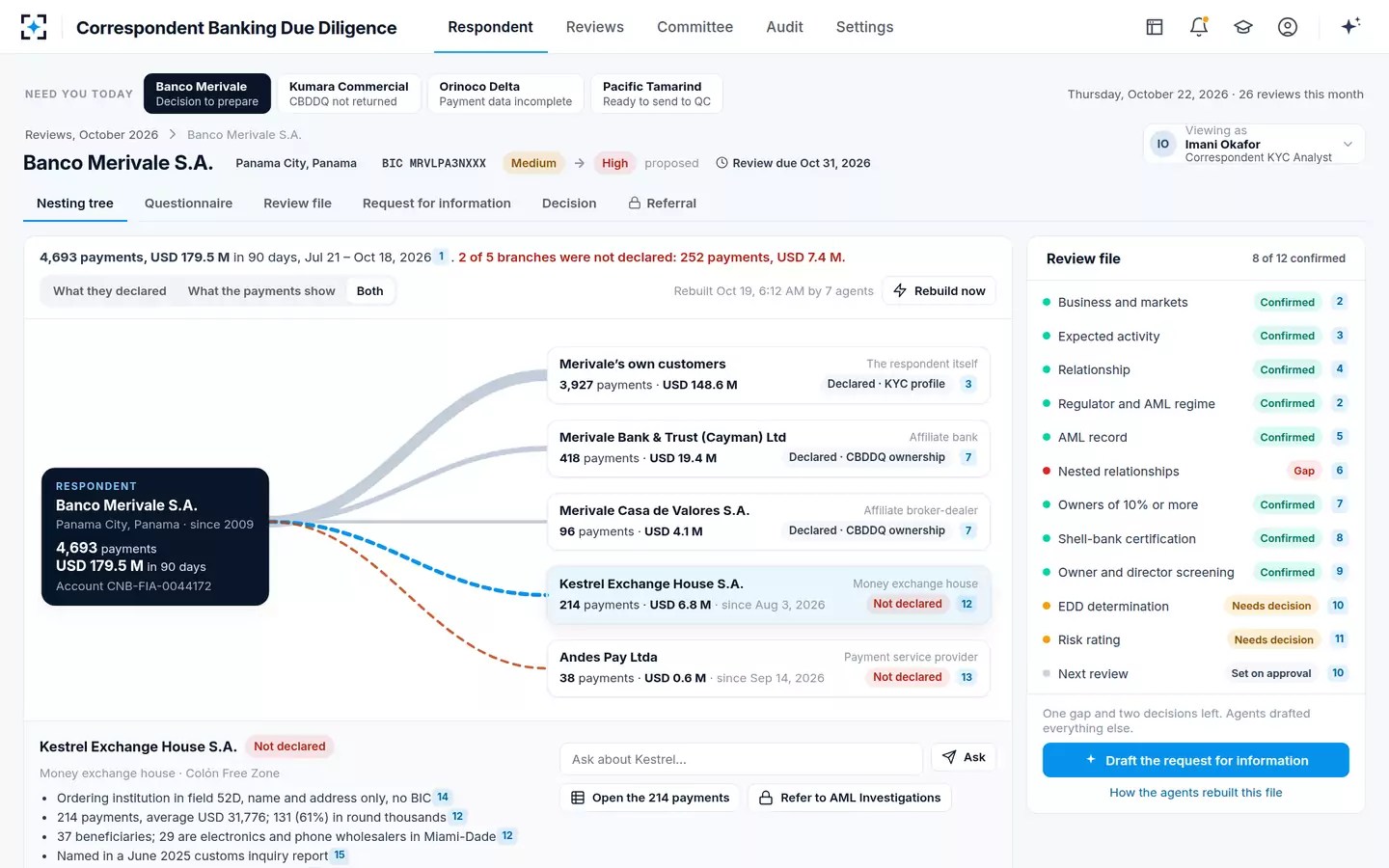
Finding the arrangement is the start; the follow-up is a set of questions to the respondent. The checklist below is what a correspondent typically needs before it can decide whether either arrangement is acceptable.
What to ask a respondent about payable-through accounts and downstream relationships
- Which arrangements do you offer, and to whom?
Payable-through access, downstream services to banks, to money services businesses, to payment providers: named, with volumes.
- Why does each need access through you?
The CBDDQ guidance expects the respondent to be able to explain each downstream relationship, for example a client too small to justify its own correspondent.
- Who can direct transactions on the account?
For payable-through access: every signatory and sub-account holder, and the source of their funds.
- How do you vet and monitor them?
The respondent’s due diligence on each downstream institution and its monitoring of their payments.
- Do your payments carry the full parties?
Ordering customer and ordering institution filled in, not left blank or replaced by the respondent’s own name.
- What changed since your last questionnaire?
New downstream institutions or new payable-through clients, before the payments reveal them.
The same review on the sample respondent is followed in a nested correspondent banking example, and the rules that frame it are set out in correspondent bank KYC requirements. To see how the agents read a respondent's payments, start from Correspondent Banking Due Diligence.
Questions people ask
Are payable-through accounts legal in the United States?
Yes. They are a recognised kind of correspondent account, defined in 31 CFR 1010.610(b)(1)(iii)(B), and the FFIEC manual lists them among correspondent services. Section 311 special measures can prohibit or condition them for a named jurisdiction or institution, and banks subject to enhanced due diligence must identify the people who can direct them.
Is a payable-through account the same as a pass-through account?
In correspondent banking, the CPMI treats the terms as names for the same arrangement, alongside “pass-by” accounts. In US anti-money laundering usage, “pass-through” is also used for other patterns, so a correspondent file should describe the arrangement rather than rely on the label.
Can a nested relationship be with a money transmitter rather than a bank?
Yes. The CBDDQ asks separately about downstream relationships with money services businesses, money or value transfer services and payment service providers in question 19 a1h. The US enhanced-due-diligence rule names other foreign banks, but a respondent's downstream money transmitters are a risk factor the general program must weigh.
Does a respondent's affiliate using its account count as nesting?
It can. What matters is whether it is declared and understood. In the sample review, an affiliate bank and a broker-dealer listed in the questionnaire's ownership section were treated as declared, while two unrelated non-bank institutions were not declared at all.
Should a bank refuse all nested relationships?
No rule requires it, and the OCC warns against ending whole categories of foreign correspondent relationships without regard to each respondent's risk. Many nested relationships are legitimate, such as a regional bank clearing for smaller local banks. The requirement is to know they exist, understand them, and act when one cannot be explained.