Correspondent bank KYC requirements in the United States come from Section 312 of the USA PATRIOT Act, written into 31 CFR 1010.610, and from its neighbours: a risk-based due diligence program for every account a bank keeps for a foreign financial institution, enhanced due diligence for three named kinds of foreign bank, a ban on shell banks backed by a certification renewed at least every three years under 1010.630, and clocks of 120 hours, 7 days and 10 business days for producing information or ending a relationship. None of it scales down. A community bank with four foreign respondents owes the same program as a dollar-clearing bank with four hundred, and often one BSA officer prepares, monitors and defends every file. Botminds' Correspondent Banking Due Diligence is a solution in which agents rebuild each respondent's file every cycle, from its questionnaire, independent evidence and its own payments, so the officer's time goes to judgement while the approvals stay with people.
The sample files on this page are fictional: a US bank called Corvane National Bank and its respondents, as they run through the solution. The rules come from the regulations, the FFIEC examination manual and published enforcement actions, linked where they are used.
One BSA officer, five jobs in every correspondent file
Today
Chases the questionnaire, the licence, the ownership chart and the certification, then types the risk factors into a memo.
With agents
Opens a file the agents assembled overnight, every value linked to the page it came from, and confirms by exception.
Still theirs: deciding whether an answer is good enough
Today
Compares last quarter’s totals with the expected-activity line, because reading thousands of messages is not possible.
With agents
Sees who actually sent the payments, branch by branch, against what the respondent declared.
Still theirs: judging whether a difference is explained
Today
Raises or keeps the rating on a summary.
With agents
Gets a proposed rating with each factor’s change and its source.
Still theirs: proposing; the approver signs
Today
Writes requests for information from scratch and tracks replies in email.
With agents
Edits drafted questions, each tied to a gap and its evidence, with the deadline tracked.
Still theirs: what to ask and when to escalate
Today
Assembles files by hand when a federal banking agency asks, against a 120-hour clock.
With agents
Exports the review, its evidence and its audit trail as one pack.
Still theirs: releasing the pack
What are correspondent bank KYC requirements? Eight obligations in one file
The requirements are eight obligations spread across two regulations and one statute, and a correspondent file has to show each of them. The base rule applies to any correspondent account for a foreign financial institution, a term that reaches beyond banks: 1010.605(f) includes foreign money transmitters and dealers in foreign exchange. An account here means a formal relationship for regular services, and the FFIEC manual says the word "regular" was chosen to exclude "isolated or infrequent transactions" (FFIEC BSA/AML Examination Manual, July 2023).
The eight obligations behind a US correspondent file
| Obligation | Where it is | What the bank must do | Which respondents |
|---|---|---|---|
| Due diligence program | 31 CFR 1010.610(a) | Assess money laundering risk on five factors: the respondent’s business and markets, the account’s purpose and expected use, the history of the relationship, the home country’s AML and supervisory regime, and the respondent’s AML history. Apply controls, including a periodic review of activity against what was expected. | Every foreign financial institution account |
| Enhanced due diligence | 1010.610(b) and (c) | Enhanced scrutiny of the account, find out whether the respondent serves other foreign banks through it, and identify each owner of 10% or more if its shares are not publicly traded. | Banks with an offshore licence, a licence from a country designated non-cooperative, or one under Treasury special measures |
| When diligence cannot be done | 1010.610(d) | Written procedures for when to refuse the account, suspend activity, file a suspicious activity report or close it. | All |
| Shell-bank prohibition | 1010.630(a)(1) | No account for a foreign bank with no physical presence anywhere, and reasonable steps so a respondent does not serve one indirectly. | Every foreign bank |
| Certification | 1010.630(b) and (d) | Obtain the certification at least once every three years; for an account opened after October 28, 2002, within 30 calendar days of opening, or close it. | Every foreign bank |
| Owner and agent records | 1010.630(a)(2) | Keep the owners of a foreign bank whose shares are not publicly traded, and a US agent for service of legal process. Owner here means 25% or control of the board (1010.605(j)). | Every foreign bank; owner records are not needed for a bank that files form FR Y-7 |
| Law-enforcement request | 1010.670(c) | Produce the owner and agent records within 7 days of a written request. | Every foreign bank |
| Regulator request and termination | 31 U.S.C. 5318(k) | Provide AML-compliance information and account documents within 120 hours of a federal banking agency’s request; end the relationship within 10 business days of a Treasury or Attorney General notice. | Every account; every foreign bank |
Two details in the table catch small programs out. The first is the owner threshold. A respondent's 10% owners are an enhanced-due-diligence step, owed only for the three categories of bank in 1010.610(c); the owner records every bank keeps under 1010.630 use a 25% test. A file that applies 10% everywhere is conservative and defensible; one that applies 25% to an offshore-licensed bank is short. The second is that enhanced due diligence is required by category, not by rating. A respondent rated low that holds an offshore licence still needs it, and the FFIEC manual adds that a bank may choose any of the enhanced steps for other accounts it judges high risk.
Do community banks need a correspondent due diligence program?
Yes. The rule covers any bank required to have an anti-money laundering program, with no asset threshold, and it starts with the first foreign correspondent account. What changes with size is how the program is built, not whether it exists. The OCC's 2016 guidance on periodic risk reevaluation says so directly: "Community banks and federal savings associations that engage in foreign correspondent banking and have relatively small portfolios may have different risk considerations than banks with larger correspondent banking portfolios" (OCC Bulletin 2016-32). Different considerations, the same obligations.
Smallness also changes where the risk sits. A large correspondent spreads its attention across hundreds of respondents and has a dedicated team for each region. A small bank may have one foreign respondent that brings a large share of its dollar volume, and one person who knows the file. When that respondent changes how it uses the account, nobody else is watching.
Lone Star: $100 million over the anticipated amount
The case regulators point to is a community bank. FinCEN's 2017 assessment against Lone Star National Bank of Pharr, Texas, describes a bank with "over $2.2 billion in assets, 28 branches, and over 655 employees" that opened a bulk-cash and correspondent relationship with a large Mexican bank in May 2010 (FinCEN, Assessment No. 2017-04). The respondent said it would deposit $8 million to $9 million of US currency a month. Deposits came in at two to three times that. "Lone Star noted the difference but conducted no investigation into the cause."
One foreign respondent, eighteen months, and a file nobody re-read
$260M
deposited by the foreign bank in 18 months of activity
$100M
over the amount the respondent said to expect
63
bulk cash deposits, followed by 73 outgoing wires to the respondent’s accounts at other US banks
$2M
FinCEN penalty, partly met by a $1 million OCC penalty from 2015
FinCEN's findings read like a list of the obligations above. The bank did not verify the respondent's account of where the cash came from, even when that account changed. It did not look up public information about the respondent's principal owner. Its monitoring missed outgoing wires whose amounts ended in the day of the month, such as $1,000,003.06 sent on the 3rd. And the assessment names the condition behind it all: "Without sufficient internal controls or experienced BSA staff, the Bank engaged in high-risk foreign correspondent banking services without conducting appropriate due diligence".
The comparison that would have caught it was not sophisticated: deposits each month against the figure the respondent gave at opening. The rule requires exactly that comparison as part of the periodic review. A small bank does not fail it for lack of knowledge. It fails it because the comparison sits in a spreadsheet nobody opens between annual reviews.
What documents are needed from a respondent bank?
A respondent supplies the claims; the correspondent supplies the checks. The documents below are what a US file usually holds, with the source of each kept separate, because an examiner reads a file to see which statements came from the respondent and which the bank confirmed for itself.
What a correspondent file holds, and who supplies each piece
- The questionnaire, signed
Usually the Wolfsberg CBDDQ, answered for one legal entity and signed by two of the respondent’s officers. It is the respondent’s account of itself, not evidence.
- The FinCEN certification
The certification form named in 31 CFR 1010.605(b): not a shell bank, its owners, and its US agent for service of process. Renewed at least every three years.
- Licence and regulator, checked at the source
The licensing authority’s own register, not a copy supplied by the respondent. Note any offshore licence, which triggers enhanced due diligence.
- Ownership, with the threshold that applies
25% owners for the general records; every owner of 10% or more where enhanced due diligence applies and the shares are not publicly traded.
- AML program evidence
Policy, the latest independent audit and its findings, and any regulatory action. FATF guidance expects a deeper look, possibly an onsite visit, for higher-risk relationships.
- Expected activity, in numbers
Monthly volume and value, currencies, products and the markets served. Without numbers, the periodic review has nothing to compare against.
- Downstream relationships, declared
Whether other banks, money transmitters or payment providers use the account, and who they are.
- Independent checks
Sanctions and PEP screening of owners and directors, enforcement history and adverse media, gathered by the correspondent from public and licensed sources.
What the list leaves out matters as much. There is no requirement to run due diligence on each of the respondent's own customers. The 2016 joint fact sheet from Treasury and the federal banking agencies is plain: "Under existing U.S. regulations, there is no general requirement for U.S. depository institutions to conduct due diligence on an FFI's customers" (Joint Fact Sheet on Foreign Correspondent Banking, 2016). A request for information about the activity behind specific transactions is a different thing, and is expected when monitoring raises a question. Payable-through accounts and nested relationships are where that line is hardest to hold.
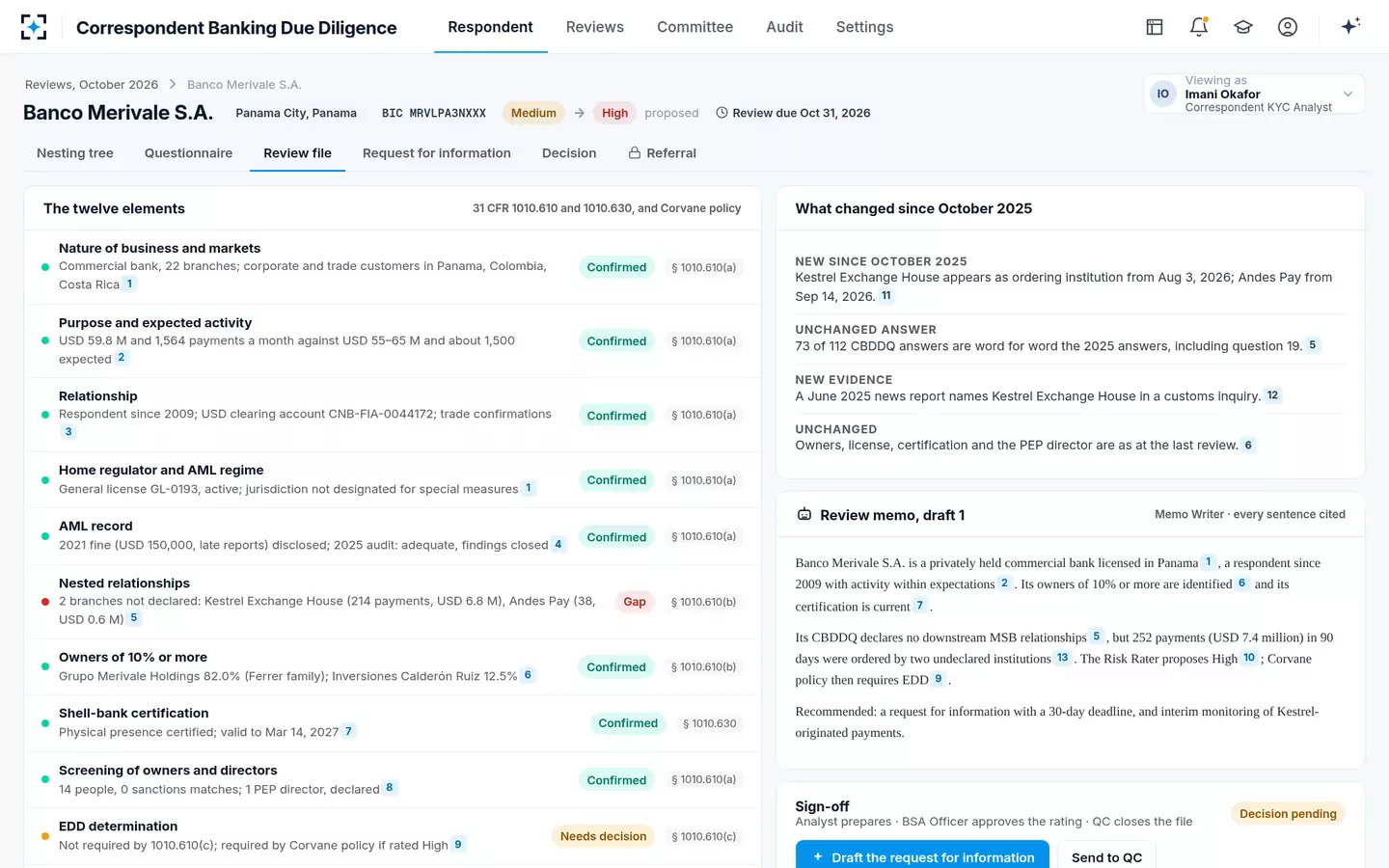
A Section 312 file in Correspondent Banking Due Diligence: twelve elements, each with its rule
Who approves a correspondent banking relationship?
US regulation does not name the approver; it requires a program with procedures and controls, and examiners test whether they work. The FATF is specific: "In all cases, the correspondent institution should obtain approval from senior management before establishing new cross-border correspondent relationships, as required by FATF Recommendation 13" (FATF, Guidance on Correspondent Banking Services, 2016). The FFIEC manual tells examiners to look at the "responsibilities, authority, and independence of staff" who open, review and close these accounts and approve changes to their risk profiles.
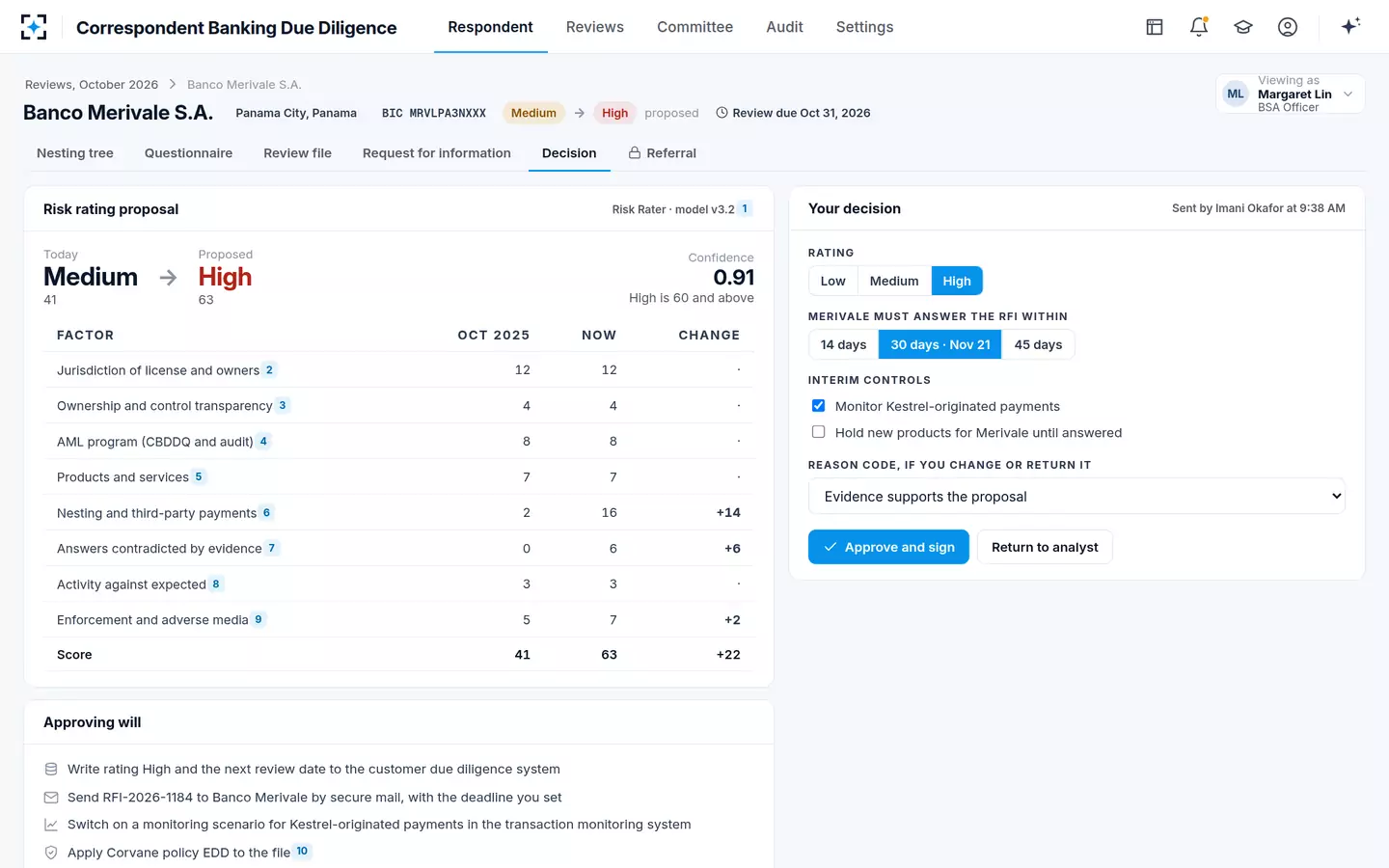
For a one-officer program, independence is the hard word. If the BSA officer prepares the file, rates the respondent and signs it, nobody has checked the work. The practical answer at a small bank is to separate the roles even when the people are few: the officer prepares and proposes, a member of senior management or a small committee approves new relationships, rating changes and exits, and the reasons are written down. In Correspondent Banking Due Diligence the separation is built in. The analyst prepares, the BSA Officer approves each rating and request for information, a quality reviewer closes the file, and a restriction or exit takes two committee signatures. The person who prepared a file cannot approve it.
The approver sees each factor’s change, then decides
How often must foreign correspondent accounts be reviewed?
No regulation sets a frequency. The periodic review is required, but its timing is the bank's to set by risk. The FFIEC manual puts it this way: "The bank's assessment of the risk presented by the foreign correspondent account should be used to determine the frequency and extent of these reviews." The OCC adds that banks should "perform periodic risk reevaluations for all foreign correspondent accounts", and should escalate recommendations for closure to appropriate levels of management.
Most programs settle on a cadence by rating and add reviews triggered by events. Corvane, the sample bank, reviews high-rated respondents every 6 months, medium every 12 and low every 24, and opens an extra review when the agents see new nesting, a change of ownership, an enforcement action or a sanctions hit. Those are its policy settings, not a regulatory floor. The fixed clocks that do exist, the three-year certification, 30 days at opening, 120 hours and 10 business days, are laid out in the validity periods and clocks a correspondent file runs on.
Where a small team's review days go, and where they can be taken back
Most of a periodic review is assembly, not judgement. The estimate below splits one respondent's periodic review into its parts. The largest single block, two days by hand, is the comparison the rule actually asks for: activity against expectations, and who is really sending the payments. It is also the block a small team is most likely to skip.
One periodic review: eight and a half analyst days by hand, about a day and a half with agents
- Reading the questionnaire1.5 d
- Licence, owners, certification, screening1.5 d
- Activity against expected2 d
- Enforcement and media1 d
- Memo and rating rationale1.5 d
- Questions, approval, QC1 d
- Reading, checking, comparing and drafting: agents assemble, the analyst confirms1.1 d
- Questions, approval, QC0.5 d
The part that does not shrink much is the last one. Questions to the respondent, approval and quality control are where people decide, and the solution leaves them there. What it removes is the reading and retyping that crowds out the comparison. For a one-person shop, that is the difference between a periodic review that tests the account and one that renews last year's memo.
What a one-officer program can hand to Correspondent Banking Due Diligence, and what it cannot
The assembly can be handed over; the conclusions cannot. In the solution, seven agents read the questionnaire and attachments answer by answer, check the licence on the regulator's register, owners, the certification and screening, rebuild who sends payments through the account from 90 days of messages, propose a rating with its reasons, draft the memo and the request for information, and keep the review calendar. Each one has limits written into it. No agent treats a respondent's answer as verified, sets a rating, sends anything to the respondent or extends a due date.
That division matters more at a small bank than a large one. An examiner reading a small program wants to see that someone other than the preparer looked at each decision, and that the comparison against expected activity happened every cycle, not when time allowed. When the agents surface something like an unexplained new sender, the next question is the one in a worked nested correspondent banking example: is this a downstream relationship the respondent did not declare? To see the whole review on a sample respondent, start from Correspondent Banking Due Diligence.
Questions people ask
What is Section 312 of the USA PATRIOT Act?
Section 312 added subsection (i) to 31 U.S.C. 5318, requiring due diligence for correspondent and private banking accounts held for non-US persons. FinCEN implemented the correspondent part in 31 CFR 1010.610: a risk-based program for every foreign financial institution account, and enhanced due diligence for banks with offshore licences or licences from designated jurisdictions. The FFIEC examination manual's section on it was last revised in July 2023.
Does 1010.610 apply to a domestic correspondent relationship?
No. The rule covers accounts for foreign financial institutions, which include foreign banks, foreign money transmitters and foreign exchange dealers, and foreign branches of certain US firms. A relationship with another US bank falls under the ordinary customer due diligence rules, although a US branch or agency of a foreign bank that keeps accounts for its foreign affiliates is covered for those accounts.
Is a single payment from a foreign bank a correspondent account?
Not by itself. An account means a formal relationship for regular services, and the FFIEC manual says isolated or infrequent transactions do not create one. FinCEN guidance from 2008 adds that presenting a negotiable instrument to the foreign bank it is drawn on, transaction by transaction, does not establish a correspondent account.
What did Lone Star National Bank pay?
FinCEN assessed a $2 million civil money penalty in October 2017, partly satisfied by a $1 million penalty the OCC had imposed in March 2015. Lone Star admitted willful violations, including failing to conduct required due diligence on a foreign correspondent account and failing to file 173 suspicious activity reports.
Do examiners sample non-bank respondents?
They are told to. The FFIEC examination procedures ask examiners to select a sample of foreign correspondent accounts that includes accounts for foreign financial institutions other than banks, such as money transmitters or currency exchangers, where the bank has them. Those accounts are covered by the general program even though the certification and enhanced rules apply only to foreign banks.
Can the BSA officer approve their own correspondent file?
Nothing in the regulation forbids it outright, but examiners assess the independence of the staff who open, review and approve these accounts, and FATF guidance expects senior management to approve new cross-border relationships. A small bank keeps the preparer and the approver apart, even if the approver is a member of senior management who signs a handful of files a year.