DEA registrant responsibilities are narrower, and heavier, than many people in a laboratory expect. The regulation puts the whole duty of accounting for every Schedule I–V substance on the registrant and mentions hardly anyone else: two employees to witness a destruction, a stated expectation that employees report diversion by a colleague, and nobody at all who is required to sign an inventory. That is what makes the question hard in practice. A real laboratory has five people around the same container, and four of their signatures exist because the institution chose them, not because 21 CFR says so. Botminds' Controlled Substance Inventory Management binds every signature to the line it approves, with its meaning written out, so the rules you must follow and the controls you chose are told apart on the records an investigator reads.
The laboratory on this page is a fictional sample: Northwind Bio, Bay Campus, Building 4, with two researcher registrations and an October count in progress. The people, registrations and container numbers are characters and sample data. The rules and the cases are real and linked where they appear.
What the regulation actually requires of people
1person
carries the duty: the registrant named on the registration
2employees
must witness a destruction, and sign the record of it
0
signatures the regulation requires on an inventory — DEA recommends one
The regulation names one person, and the laboratory has five
Read 21 CFR parts 1301 and 1304 looking for job titles and you find almost none. The duties run to "the registrant": the registrant keeps the records, takes the inventories, notifies the field office, signs the order forms, secures the stock. Where the regulation does reach past the registrant, it is to constrain whom the registrant may let near the drugs at all: "The registrant shall not employ, as an agent or employee who has access to controlled substances, any person who has been convicted of a felony offense relating to controlled substances or who, at any time, had an application for registration with the DEA denied, had a DEA registration revoked or has surrendered a DEA registration for cause" (21 CFR 1301.76(a)).
That is the shape of the law: one accountable person, and a hiring bar around the room. It is not the shape of a working laboratory, where the registrant is a principal investigator with two studies to run, the keys are held by a lab manager, the withdrawals are made by scientists, the orders are placed by a compliance office and the vivarium is a second registration under a second name. Every one of those people believes, correctly, that part of the duty is theirs. None of them can point at a paragraph that says so.
So the useful question is not "who is responsible" — the regulation answers that in one word — but which of the other signatures are worth having, and what each one is for. A signature with no stated meaning is decoration. A signature whose meaning is written on the record is evidence.
The five people who carry one October count in Controlled Substance Inventory Management
Today
Runs two studies, signs every inventory and correction, and answers to the DEA if a count is off — usually learning about it at the monthly count, weeks after the movement that caused it.
With agents
Sees a difference on its line the moment it is counted, with the records that explain it, and signs the correction or the notice with its meaning attached.
Still theirs: the decision, the signature, and the notice to the field office
Today
"Counting is easy. Finding where 0.4 mL went three weeks later is not."
With agents
Counts from a sheet prefilled with each container and its location, enters each count on its line, and has a second person sign beside it.
Still theirs: the keys, the count, and the witness line
Today
"I wrote it in my surgery notebook. I forgot the usage log."
With agents
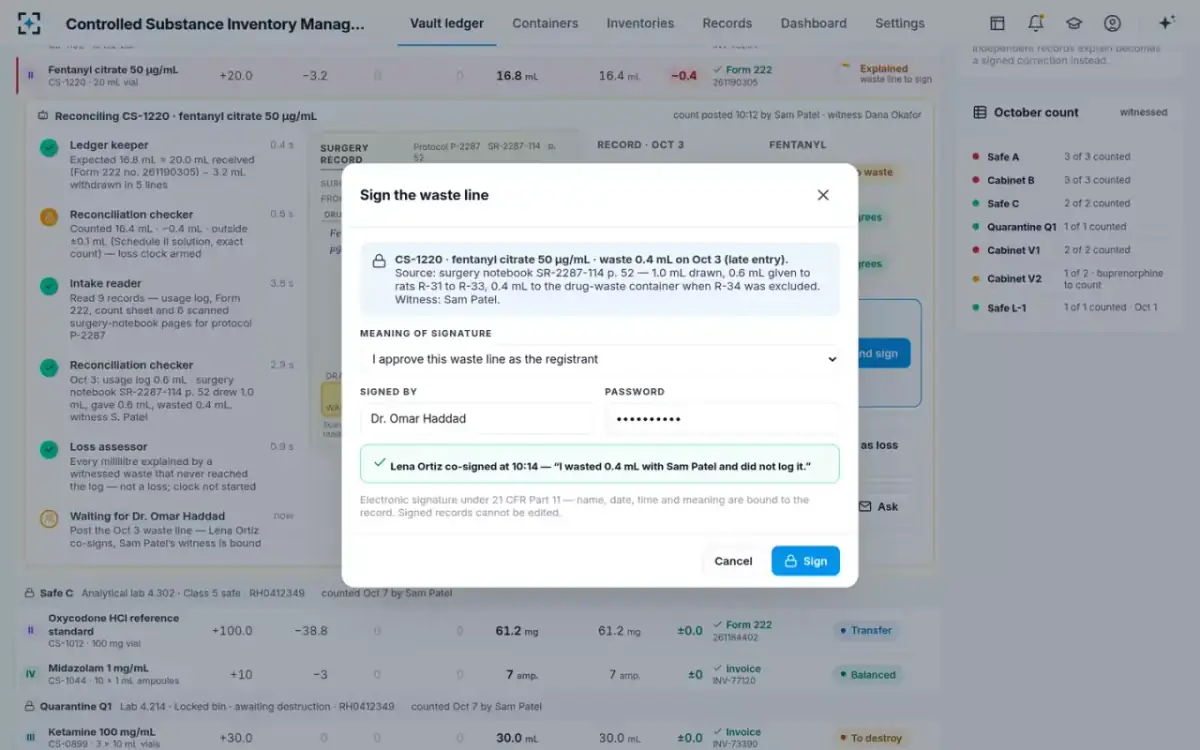
Her notebook scan is read alongside the log, so a missed line becomes a late entry she co-signs — not a shortfall with her name on it.
Still theirs: the same-day entry and the co-signature on its correction
Today
"An inspector asks for the file first. It has to exist before they arrive."
With agents
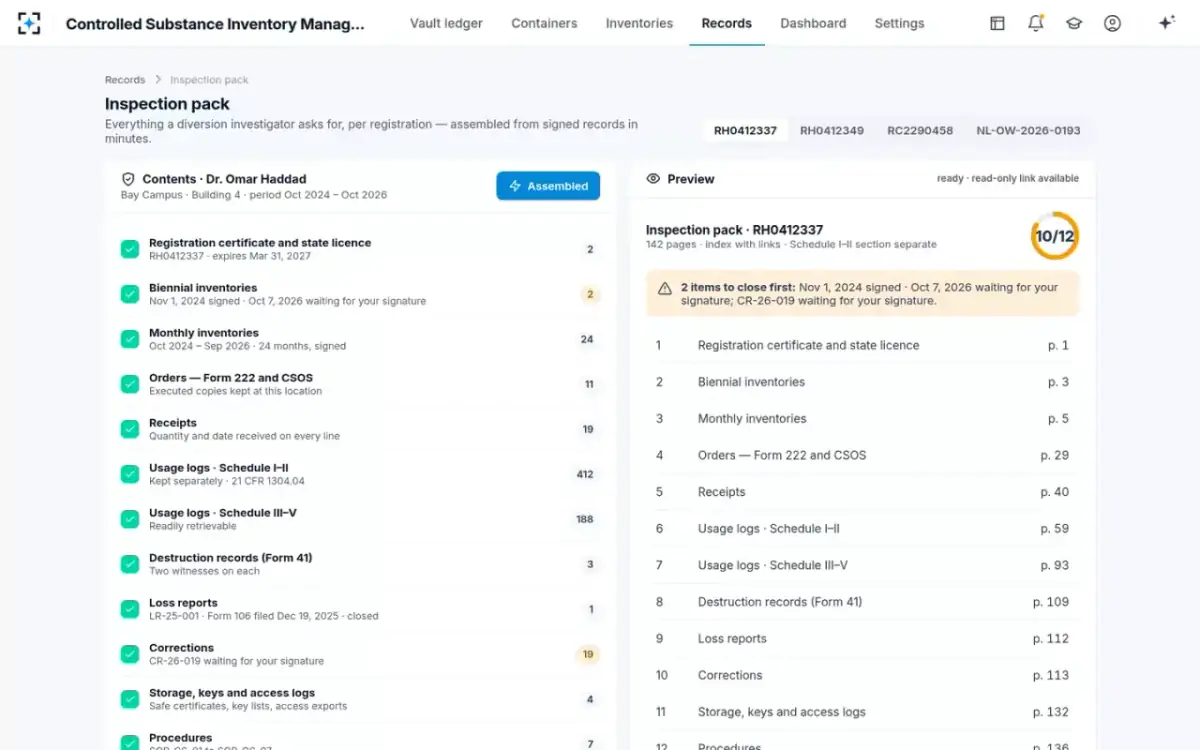
Reviews a loss notice before the registrant signs, and assembles the inspection file per registration from signed records.
Still theirs: the review, never the registrant’s decision
Today
"A shortfall in a cabinet with a shared night-shift card is my worst morning."
With agents
Every badge opening of the animal-facility cabinets is matched to a log line, and an unexplained shortfall arrives assessed, with the notice drafted.
Still theirs: her own registration’s records and signatures
What only the registrant can do
Four things in a research laboratory belong to the registrant and cannot be delegated by writing a different name on the line. The first is the registration itself, with the schedules and the research protocol it was granted for. The second is the written notice to the DEA field office when a theft or significant loss is discovered, which is due within one business day, with DEA Form 106 to follow within 45 days (21 CFR 1301.76(b)) — and what counts as a significant loss is the registrant's judgement, not a threshold anyone else can apply for them. The third is the inventory: a record of the registrant's own stock, taken under the registrant's own registration. The fourth is the order form, which authorises the receipt of a Schedule I or II substance in the registrant's name.
Here is where many laboratory procedures overreach. The signed inventory is treated as a federal requirement, and it is not. DEA's Researcher's Manual says so plainly: "DEA recommends, but does not require, an inventory record that includes the name, address, and DEA registration number of the registrant, and the signature of the person or persons responsible for taking the inventory" (Researcher's Manual, 2022 edition). The inventory must exist, be complete and accurate, be dated as of the opening or close of business, and be kept for inspection. Who signs it is DEA's recommendation and your policy.
DEA recommends, but does not require, an inventory record that includes the name, address, and DEA registration number of the registrant, and the signature of the person or persons responsible for taking the inventory.
DEA Diversion Control Division, Researcher's Manual, 2022 edition
Knowing that a signature is recommended rather than required changes how you argue for it. You are not telling a busy principal investigator that the law demands another initial; you are telling them that the signature is what turns a spreadsheet into a statement someone will stand behind. That argument survives an audit. "The DEA makes me" does not, because an investigator who knows the manual knows better.
The lab manager: keys, counts and the count sheet
The lab manager holds the part of the work the regulation never describes and every inspection turns on: the physical count. A count is only as good as the sheet it is taken from. Hand a counter a sheet that already prints the expected balance and you have invited them to write down what they were told to expect; hand them nothing and you lose the ability to reconcile until someone types the numbers up, which can be the following week.
The lab manager also owns the detail that makes the difference between a closed count and a two-week investigation: the time of the count. A difference discovered at 07:52 is a difference whose records still exist — the printout is in the drawer, the scientist is at the bench, and the notebook page is this week's. The same difference discovered when the numbers are added up at month end has lost all three. What to do when a count does not match works through the decision from there.
One container from withdrawal to signed inventory, and what each signature means
A person decides
The scientist withdraws and logsWrites the withdrawal on the usage log the same day, with the protocol, the quantity and the balance printout behind it. Her signature means: I took this quantity for this protocol.
Agent
The movement is read from its source recordReads the usage log, the balance printout, the notebook page and the receipt into movements — container, substance, quantity, person, protocol, time — quoting the passage every value came from.
Never: infers a quantity that is not printed or written
Agent
The movement is posted to the running balancePosts receipts, withdrawals, waste, transfers and destructions in time order, with Schedule I–II entries kept separately from the rest.
Never: edits a line already posted — a correction is a new signed line
A person decides
The lab manager counts, with a witnessEnters the count on the container’s own line. The witness signature means: I watched this count and the number is what I saw.
Agent
Expected and counted are compared, and the records searchedCompares the two under the tolerance for that schedule and form, then searches every source record for the explanation of any difference.
Never: closes a difference — the registrant decides
A person decides
The registrant signsApproves the correction, the waste line, the loss notice or the inventory. The signature carries its meaning, the time and the record it is bound to.
The scientist at the bench: the entry made the same day
The single most valuable discipline in a research laboratory is not the count. It is the entry made on the day of the withdrawal, by the person who made it. The regulation requires records to be maintained "on a current basis" (21 CFR 1304.21(a)), and a scientist who writes the withdrawal into a surgery notebook but not into the usage log has not broken a count — she has created a difference that will look exactly like a loss three weeks from now.
This is one of the commonest ways a laboratory produces an apparent shortfall, and it has nothing to do with dishonesty. A rat is excluded at weigh-in, 0.4 mL goes into the waste bin in front of a colleague, the surgery notebook records it, and the usage log in the safe records only the 0.6 mL that reached the animals. Two records now disagree, and the one an inspector reads first says 0.4 mL is missing. What to record for waste, breakage and spillage covers the entry itself; the point here is whose entry it is. Nobody can make it for her, and nobody else can honestly sign it.
What can be done is to make the late entry survivable. If the notebook page is read alongside the usage log, the missing line is found as a late waste entry with a named witness, and the scientist co-signs it as the person who wasted the substance. Her signature then means what it should mean — I did this, on this date, and did not log it — instead of being absent from a record that quietly blames her.
The compliance lead: the seat the rules never mention
Nothing in 21 CFR describes a controlled-substance compliance lead, and many research institutions of any size have one. The seat exists because the duties the regulation places on a registrant are impossible to discharge at scale by a principal investigator with a laboratory to run: ordering against the right registration, keeping the order forms and inventories where they must be kept, assembling what an investigator asks for, and knowing the current text of rules that are still being amended.
The useful boundary for this seat is the one the regulation implies. A compliance lead may prepare, review, chase and assemble. A compliance lead may not decide that a shortfall is not significant, and may not sign the notice — both are the registrant's. Writing that boundary into the records, rather than into a policy document nobody opens, is what keeps a well-run programme from drifting into one where the registrant signs whatever is put in front of them. In the sample laboratory the compliance lead reviews each loss notice before the registrant sees it, and the review is a step on the record with its own name on it, distinct from the approval.
Controlled Substance Inventory Management: the signature, and what it means
Who may witness a controlled substance count, and who may witness a destruction?
These two questions are asked together and have different answers, which is why laboratories get them confused. A destruction has a rule. A count does not.
For a destruction, two employees of the registrant are required, and their names and signatures go on the record. Where a registrant destroys on site, "Two employees of the registrant shall handle or observe the handling of any controlled substance until the substance is rendered non-retrievable" and "shall personally witness the destruction … until it is rendered non-retrievable" (21 CFR 1317.95(d)). The same pairing applies on the way out of the door: where substances are transferred to a reverse distributor, "two employees of the transferring registrant shall load and unload or observe the loading and unloading of any controlled substances until transfer is complete" (21 CFR 1317.95(a)). The record of destruction on DEA Form 41 must then include the names and signatures of the two employees who witnessed it (21 CFR 1304.21(e)). Two employees of the registrant: not two people who happened to be in the corridor, and not a contractor.
For a count, there is no such requirement anywhere in part 1304. A witnessed count is good practice, and in hospital pharmacy it is a published recommendation, but in a research laboratory it is a control the institution chooses. It is a good one: it is a cheap defence against the arrangement in the next section, where the same person counts and reconciles. In the sample laboratory it is a setting — a second person signs the count sheet — and it is switched on, not because a rule says so but because the registrant wanted it.
Who signs what in a research laboratory, and whether the rule or the institution asks for it
| What is being signed | Who signs | Rule, or your choice |
|---|---|---|
| A monthly or biennial inventory | The registrant, in the sample laboratory | Your choice. The inventory is required; DEA recommends the signature of the person responsible for taking it, and does not require it. |
| A count sheet | The counter, and a witness | Your choice entirely. No paragraph of part 1304 requires a witness to a count. |
| A correction to a usage log | The registrant and the person who logged the original | Your choice. What the regulation requires is a complete and accurate record kept on a current basis, so the correction and its reason must be visible. |
| A late waste entry | The person who wasted it, with the witness named | Your choice, and the one that most often decides whether a difference reads as waste or as a loss. |
| A record of destruction, DEA Form 41 | The two employees who witnessed the destruction | Rule. 21 CFR 1304.21(e) requires their names and signatures; 21 CFR 1317.95 requires both of them to be employees of the registrant. |
| The written notice of a theft or significant loss, and DEA Form 106 | The registrant | Rule. 21 CFR 1301.76(b) puts the notification on the registrant, within one business day of discovery. |
| An order form for a Schedule I or II substance | The registrant, or a holder of a power of attorney | Rule, with a narrow delegation: a Form 222 power of attorney may be executed or revoked only by a registrant, a partner or an officer of a registrant corporate entity. |
Separation of duties for controlled substances: should the person who orders ever be the person who counts?
Not if you can avoid it — as a matter of control rather than law. The regulation never mentions separation of duties, and it is a control whose absence shows up in published cases. If the same person places the order, receives the delivery, keeps the usage log and reconciles the count, then every record that could contradict them is in their hands, and the arithmetic will balance for exactly as long as they want it to.
The clearest published statement of the control comes from hospital pharmacy, where diversion has been studied hardest. The ASHP guidelines on preventing diversion of controlled substances put it in two sentences: "Separation of duties exists between the ordering and receipt of CS. Two authorized individuals count and check in CS received and confirm that the order, invoice, and product-received documentation match" (ASHP, 2022). The setting is a pharmacy, not a laboratory, and research registrants receive far less often — but the arrangement being guarded against is identical, and so is the remedy.
The cost of not having it is on the public record. At the Yale Fertility Center, according to the U.S. Attorney's announcement, "a nurse responsible for ordering and inventorying controlled substances at the Yale Fertility Center, was discovered to have tampered with vials of fentanyl" (U.S. Attorney's Office, District of Connecticut, October 4, 2022). Read that job description again: ordering and inventorying, in one person. Yale settled the civil allegations for $308,250 and the criminal matter ended in a guilty plea. The nurse's conduct was the crime; the single seat was the opening.
One person, or three: the same arrangement seen from an investigator's chair
Ordering, counting and reconciling in one seat: The person who will later count the stock it arrives in.
Three seats, three records: A compliance office, against the registration the substance is for.
Ordering, counting and reconciling in one seat: The same person, alone, signing their own receipt.
Three seats, three records: Two authorised people count it in and confirm that order, invoice and goods agree.
Ordering, counting and reconciling in one seat: The same person, usually from a sheet they prepared.
Three seats, three records: The lab manager, with a witness, from a sheet prepared by the system.
Ordering, counting and reconciling in one seat: The same person, using records only they hold.
Three seats, three records: The explanation must be supported by two independent records before it stands.
Ordering, counting and reconciling in one seat: Nothing against anything: one hand wrote every record.
Three seats, three records: Every line against a second record from a different hand.
Ordering, counting and reconciling in one seat: A nurse "responsible for ordering and inventorying controlled substances" tampering with fentanyl vials, 685 alleged recordkeeping occasions, $308,250 settled.
Three seats, three records: Not a guarantee. A control that makes the failure visible early, which is the only thing a control can do.
The separation-of-duties test: six questions you can answer today
- Can one person order, receive and count the same substance?
If yes, nothing in your records can contradict that person. This is the question that matters most.
- Does a second person sign the count?
No rule requires it. It is the cheapest control you can add, and it is a setting, not a project.
- Can the person who logged a withdrawal correct it alone?
A correction that needs only the author’s signature is not a correction; it is an edit.
- Does any explanation of a difference rest on a single record?
One record written by one hand explains nothing. Require two independent records before a difference is closed.
- Can anyone other than the registrant close a possible loss?
If the answer is yes in practice — because the registrant signs what is put in front of them — the control is already gone.
- Does cabinet access leave a record a third party keeps?
Badge and PIN openings matched to log lines are the one record the person at the bench does not write.
A correction needs two signatures, and the original stays visible
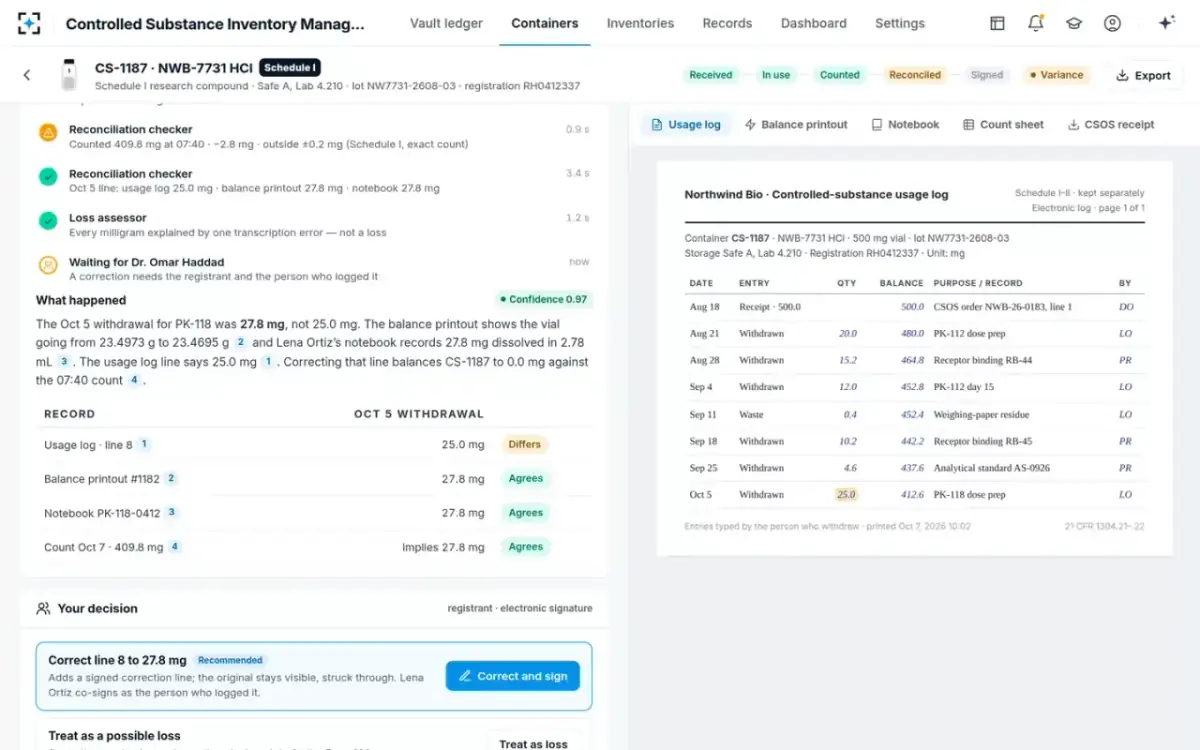
A controlled-substance record is not a working document. When a usage-log line is wrong — and a transcription error is far more often the explanation than a loss — the fix is a new line that says what was wrong, why, and what the evidence is, leaving the original where it was. In the sample laboratory a usage log says 25.0 mg of a Schedule I compound was weighed out; the balance printout shows the vial going from 23.4973 g to 23.4695 g, and the scientist's notebook records 27.8 mg dissolved in 2.78 mL. Two independent records agree on 27.8 mg against the log's 25.0 mg. The log line is corrected, the original stays visible and struck through, and the container balances.
Two signatures are the right requirement here, and the pairing matters: the registrant, because the record is theirs, and the person who logged the original, because they are the only one who knows what they meant to write. A correction signed only by the registrant is the registrant asserting something about someone else's work. A correction signed only by the author is an edit.
A correction, with the two records that justify it
The duty to report a colleague
One expectation in the regulation is addressed to employees rather than to the registrant, and few people in a research laboratory have been told about it. It sits in 21 CFR 1301.91, among the employee-screening provisions written for non-practitioner registrants such as manufacturers and distributors — so it is not addressed to research registrants in terms, but it is the clearest statement of what DEA expects of anyone working near controlled substances: "it is the position of DEA that an employee who has knowledge of drug diversion from his employer by a fellow employee has an obligation to report such information to a responsible security official of the employer. The employer shall treat such information as confidential and shall take all reasonable steps to protect the confidentiality of the information and the identity of the employee furnishing information" (21 CFR 1301.91). The same section tells employers to inform all employees of the policy, and warns that a failure to report will be considered in deciding whether an employee may continue to work in a drug security area.
Two practical consequences follow. The first is that your laboratory needs a named responsible security official and a way to reach them that is not the person a report might be about — which is, again, separation of duties, this time applied to the reporting line. The second is that the expectation is on the employee as an individual, so it has to be told to them: the section expects the employer to inform all employees concerning this policy, and a policy that exists only in a manual has not been told to anyone.
Notice what the duty is not. It is not a duty to investigate, to accuse, or to work out whether a difference is diversion. That is why the agents in the sample laboratory never name a person as responsible: an assessment that points at an individual before anyone has investigated turns a reporting duty into an accusation, and the person it names has no way to answer a system.
What happens to the records when the registrant leaves?
The records stay, and the obligation attached to them stays. Every inventory and other record required under part 1304 must be kept and be available for inspection and copying by authorised DEA employees for at least two years from its date (21 CFR 1304.04(a)), and that clock does not reset because the principal investigator took a chair at another university. The certificate of registration itself has to be kept at the registered location in a readily retrievable manner and available for official inspection — a requirement the Researcher's Manual states for DEA Form 223 under 21 CFR 1301.35(c).
This is where institutions discover whether their records were ever really the institution's. If the usage logs are in a departing researcher's filing cabinet, the balance printouts are in a drawer whose key went with the lab manager, and the only index of either is in someone's memory, then a two-year obligation has just become a two-year problem. The practical test is the one an inspection applies: can the records for a registration be produced, complete, in an order someone can follow, by a person who was not there when they were made? If the answer depends on a name, the records are not yet the registration's.
What an investigator asks for, assembled per registration
That is also the honest answer to the question this page started with. The regulation names one person because somebody has to be answerable. A laboratory assigns four more signatures because one person cannot see everything, and because an institution that loses a person should not lose its records. To see the five seats, the signatures and the records they bind to on your own usage logs and count sheets, start from Controlled Substance Inventory Management.
Questions people ask
Who is responsible for controlled substances in a research lab?
The registrant — the person named on the DEA registration. The regulation places the recordkeeping, inventory, security and reporting duties on the registrant and names almost no one else. Every other duty in a laboratory, from the lab manager's keys to the compliance lead's review, is assigned by the institution, which means it can be assigned well or badly but never transferred away from the registrant.
Can a lab manager sign the DEA inventory?
In most laboratories a lab manager signs as the person who took the count, and that is entirely consistent with the rules, because DEA recommends rather than requires a signature on an inventory. What a lab manager's signature cannot do is replace the registrant's accountability for the record being complete and accurate. If your policy says the registrant signs the inventory, that is your policy, not a federal requirement.
Does the registrant have to count the drugs themselves?
No. Nothing requires the registrant to perform the physical count personally, and in a laboratory with several storage locations it would be impractical. The inventory still has to be the registrant's record, taken as of the opening or close of business, complete and accurate. In practice the sound arrangement is that the registrant does not count but does decide — on tolerances, on cadence, and on every difference.
Who can witness a controlled substance destruction?
Two employees of the registrant. For on-site destruction both must handle or observe the handling of the substance until it is rendered non-retrievable and both must personally witness the destruction; for a transfer to a reverse distributor, two employees must load and unload or observe it until the transfer is complete. Their names and signatures go on the DEA Form 41 record of destruction. A contractor or a visitor is not an employee of the registrant.
Must an employee report diversion by a colleague?
DEA's position, stated in 21 CFR 1301.91, is that an employee who knows of drug diversion by a fellow employee has an obligation to report it to a responsible security official of the employer, who must keep both the information and the reporter's identity confidential. The section sits among provisions written for non-practitioner registrants, so a research laboratory should treat it as DEA's stated expectation and write it into its own policy, telling every employee.
Can one person both order and inventory controlled substances?
It is not prohibited, and it is the arrangement that shows up in published enforcement. A single seat that orders, receives, logs and reconciles holds every record that could contradict it. Splitting ordering from receipt and counting from reconciliation is the control the ASHP diversion-prevention guidelines describe, and it costs nothing but a second name on a line.