Controlled substance waste documentation requirements come down to a single principle that the DEA has stated twice in writing: an event the registrant can still account for is not a loss. A witnessed waste, a witnessed breakage and a witnessed spillage therefore owe a record and a signature, not a report to a federal agency — and each owes a different record. The weak point in a research laboratory is usually not the destruction itself, which tends to be done carefully by people who know the rules. It is the line that never reached the log: a millilitre that was drawn, partly used, properly discarded in front of a witness, written in a surgery notebook and never entered anywhere a reconciliation would see it. Weeks later it is indistinguishable from a shortfall. Botminds' Controlled Substance Inventory Management reads the notebooks and printouts alongside the usage log, so a waste that was witnessed but never logged turns into a late, signed entry rather than an unexplained difference.
The sample laboratory here is fictional — Northwind Bio, Building 4, 7 October 2026 — and so are its people, registrations and containers. The rules, the quotations and the forms are real, and all of this is written for a research registrant rather than a hospital pharmacy.
The witnessed breakage or spillage of a controlled substance does not constitute a loss of controlled substances because the registrant can account for the controlled substances. These types of incidents do not require notification to DEA.
DEA Diversion Control Division, Researcher's Manual, 2022 edition
Why a witnessed waste is not a loss
The reasoning is worth following, because it tells you what the record has to achieve. The reporting duty exists for substances that cannot be accounted for. If a person can say what happened to a quantity — who had it, when, where it went and who else saw it — then the account is complete, and the fact that the substance no longer exists in usable form is beside the point. The DEA put it plainly in its 2003 proposed rule and guidance on theft and loss reporting: broken, damaged or spilled substances "are not considered 'lost' because they can be accounted for" (68 FR 40576).
Everything else follows from that. The record has to name the event, the date, the quantity, the person and the witness, because those are the elements that make the account complete. A note saying "wasted, approx." does not, which is why it is the most dangerous entry in a usage log: it looks like paperwork and functions as a gap.
The word doing the most work is witnessed. A broken vial found in the morning with nobody able to say when or how is not on this page at all; it is an unexplained shortfall, and it goes through the six significant-loss factors like any other.
The four events, and the record each one owes
Four things happen to controlled substances in a laboratory that are not use and not theft. They are routinely lumped together as "waste", and they have four different answers.
Four events, four records — and none of them is a report to the DEA
Partial use at the bench
What it isA dose is drawn, part of it is given, the remainder is discarded into a waste container.
The record it owesAn entry in the records showing the quantity drawn and the quantity wasted as two figures, dated, with the person and the witness.
Who signsThe person who wasted it; a witness; the registrant on the record.
Which formNone. It is a recordkeeping entry, not a disposal under part 1317.
DEA toldNo.
Recoverable breakage
What it isA vial cracks or a container is damaged, but the substance is still there and still identifiable.
The record it owesThe circumstances, and then a disposal record for whichever route was used.
Who signsTwo employees for an on-site destruction; the reverse distributor issues its own paperwork.
Which formDEA Form 41 for an on-site destruction. A transfer to a reverse distributor is a distribution record, not a Form 41.
DEA toldNo, provided it was witnessed and recorded.
Unrecoverable spillage
What it isIt is on the floor, in the bedding, down the drain. Nobody can get it back and nobody is going to destroy it.
The record it owesThe circumstances of the event, the substance and the quantity, written up in the registrant’s records.
Who signsTwo individuals who can testify that the breakage or spillage occurred.
Which formDEA Form 41, in the DEA’s stated position, because it is the record that keeps the account complete.
DEA toldNo. The substance is accounted for.
Expired or unwanted stock
What it isA lot nobody will use again: the study ended, the compound failed, the shelf life ran out.
The record it owesAn inventory entry while it is held, then a disposal record when it goes.
Who signsTwo employees for an on-site destruction; the registrant for a transfer.
Which formDEA Form 41 for an on-site destruction; a Form 222 or its electronic equivalent where Schedule I or II goes to a reverse distributor.
DEA toldNo.
The first row is where research differs most from clinical practice, and where many laboratory shortfalls start. The other three are disposal, which is a well-defined procedure with its own part of the rules. Partial use is not disposal at all; it is arithmetic that has to be written down the same day.
Partial use at the bench: the entry that must be made the same day
A scientist draws 1.0 mL, gives 0.2 mL to each of three animals and is left with 0.4 mL when the fourth is excluded at weigh-in. Nothing has gone wrong. The only question is whether the usage log records 1.0 mL drawn and 0.4 mL wasted, or 0.6 mL drawn and nothing else — and the second version, which is what tired people write, creates a 0.4 mL difference that will surface at the next count.
The content of the entry comes from the dispensing-record rule, which requires a record of "the number of units or volume of such finished form dispensed, including the name and address of the person to whom it was dispensed, the date of dispensing, the number of units or volume dispensed, and the written or typewritten name or initials of the individual who dispensed or administered the substance on behalf of the dispenser" (21 CFR 1304.22(c)). In a research setting the recipient is a protocol and an animal identifier rather than a patient, and the principle is the same: the record says who, what, how much, and when.
Two practical rules keep this honest. Record the quantity drawn and the quantity wasted as two separate figures, never as a single net number — a net figure hides whether the waste happened at all. And make the entry the same day, because the one thing nobody can reconstruct a month later is how much of a drawn dose was actually given.
One millilitre, from the syringe to a signed record
A person decides
The scientist draws, and uses part of it1.0 mL drawn from container CS-1220 for protocol P-2287; 0.2 mL given to each of three animals; 0.4 mL left when the fourth is excluded at weigh-in.
A person decides
Somebody watches the remainder goThe 0.4 mL goes into the drug-waste container with the lab manager watching. The witness is the whole reason this will not be a loss.
A person decides
Both figures are written down, the same dayThe usage log takes 1.0 mL withdrawn and 0.4 mL wasted as two entries, with the protocol, the animals, the time and the witness named.
Agent
The records are read and posted to the containerUsage log, balance printouts, notebook pages, receipts and access records are read into movements against each container, with the passage each value came from kept beside it.
Never: infer a quantity that is not printed or written down. An unreadable value goes to a person.
Agent
The line reconciles the moment a count is enteredExpected balance against the count, under the registrant’s own investigation threshold for that schedule and form; any difference is searched for across every source record.
Never: close a difference, and never name anyone as responsible.
A person decides
The registrant signsWhere the waste was never logged, it is posted as a new dated entry, signed with the meaning of the signature bound to it, co-signed by the person who wasted it, and carrying the witness. Nothing already posted is edited.
Recoverable breakage: destroy it on site, or send it to a reverse distributor
If the substance survives the accident in identifiable form, the event stops being a waste question and becomes a disposal question, and the disposal rules are specific. A registrant in lawful possession of a controlled substance it wants to dispose of must "(1) Promptly destroy that controlled substance in accordance with subpart C of this part using an on-site method of destruction; (2) Promptly deliver that controlled substance to a reverse distributor's registered location" (21 CFR 1317.05(a)), with further routes for law-enforcement assistance and for returns and recalls.
For most research laboratories the practical choice is between the two above. On-site destruction is faster and means handling the material yourself to a defined standard; a reverse distributor moves the problem to a registrant whose business it is, at the cost of a transfer with its own paperwork. Where Schedule I or II material goes to a reverse distributor, the reverse distributor issues an order form — a Form 222 or its electronic equivalent — to the researcher, and it is the reverse distributor that files the Form 41 when it destroys the substance. The transfer itself is not recorded on a Form 41.
The mistake to avoid is treating a laboratory's drug-waste container as destruction. A sharps or pharmaceutical-waste bin collected by a contractor may well end in incineration, but unless the registrant has destroyed the substance to the required standard, or transferred it to someone registered to handle it, the disposal rules have not been satisfied. In the sample laboratory the 0.4 mL went into the drug-waste container as a witnessed waste at the bench; nothing in that record says it was rendered non-retrievable, and the page does not claim it was.
Unrecoverable spillage: a Form 41 and two people who saw it
Where the substance is gone beyond recovery, there is nothing to destroy and nothing to transfer, and the only thing left is the record. The 2003 notice set the expectation: "If the breakage or spillage is clearly observed but the controlled substances are not recoverable, then the registrant must document the circumstances of the breakage in their inventory records. Two individuals who witnessed the breakage must sign the inventory records, indicating what they witnessed" (68 FR 40576).
The Researcher's Manual takes it one step further and names the form. "It is DEA's position that, in order to maintain complete and accurate records in accordance with 21 CFR 1304.21(a), non-recoverable breakage or spillage must be recorded on a DEA Form 41 and, as with any other form of disposal under 21 CFR part 1317, must be signed by two individuals who can testify that a breakage or spillage occurred" (Researcher's Manual, 2022). Guidance of this kind is not binding in the way a regulation is — the manual says so on its own first pages — but it is the agency's stated position, and a registrant who does something else is choosing to argue about it later.
One caution about the 2003 text: it was written when disposal sat in 21 CFR 1307.21, which was replaced by part 1317 in 2014. Cite it for the principle, and take the procedure from part 1317 and the current manual.
What does "non-retrievable" actually require?
Every destruction by or on behalf of a registrant has to clear one standard: substances "shall be destroyed in compliance with applicable Federal, State, tribal, and local laws and regulations and shall be rendered non-retrievable" (21 CFR 1317.90(a)). The term has a definition of its own, and it is more demanding than "mixed with something unpleasant".
Non-retrievable means "the condition or state to which a controlled substance shall be rendered following a process that permanently alters that controlled substance's physical or chemical condition or state through irreversible means and thereby renders the controlled substance unavailable and unusable for all practical purposes", and a substance reaches it "when it cannot be transformed to a physical or chemical condition or state as a controlled substance or controlled substance analogue" (21 CFR 1300.05). The definition does not prescribe a method — it says the process "may be unique to a substance's chemical or physical properties" — which leaves the choice of an adequate one with the registrant.
In practice this is why "pour it down the drain" is the wrong answer even where a sewer authority would permit it. Dilution does not permanently alter a substance; it moves it. The defensible routes are an on-site process the laboratory can describe and justify, or a reverse distributor whose business is destroying things to this standard.
Who may witness controlled substance waste, and what are they attesting to?
The rules are stricter about destruction than about bench waste, and it is worth keeping the two apart.
For a destruction carried out by the registrant, the requirement is two people, twice over: "(1) Two employees of the registrant shall handle or observe the handling of any controlled substance until the substance is rendered non-retrievable; and (2) Two employees of the registrant shall personally witness the destruction of the controlled substance until it is rendered non-retrievable" (21 CFR 1317.95(d)). Their names and signatures go on the Form 41, which "shall be complete and accurate, and include the name and signature of the two employees who witnessed the destruction" (21 CFR 1304.21(e)).
For waste at the bench, no federal rule names a witness at all: 21 CFR 1304.21(e) says that what is left of a dose a practitioner dispensed for immediate administration at the registered location is recorded in the ordinary dispensing record, not on a Form 41. The witness is there because the account has to be complete, and a second person who saw it is the cheapest way to make it so. That means the witness requirement is the registrant's own policy — and the policy should say who may act as one. A reasonable rule, and the one the sample laboratory uses, is that the witness is a person with authorised access to the substance who actually observed the event, who is not the same person who drew it, and who signs the line rather than initialling a sheet at the end of the week.
What the witness is attesting to is narrow and should be stated on the record: that they saw this quantity of this substance discarded in this way, on this date. Not that the quantity was correct, not that the procedure was appropriate, and not that the person acted properly. Who counts, who witnesses and who signs works through the seats.
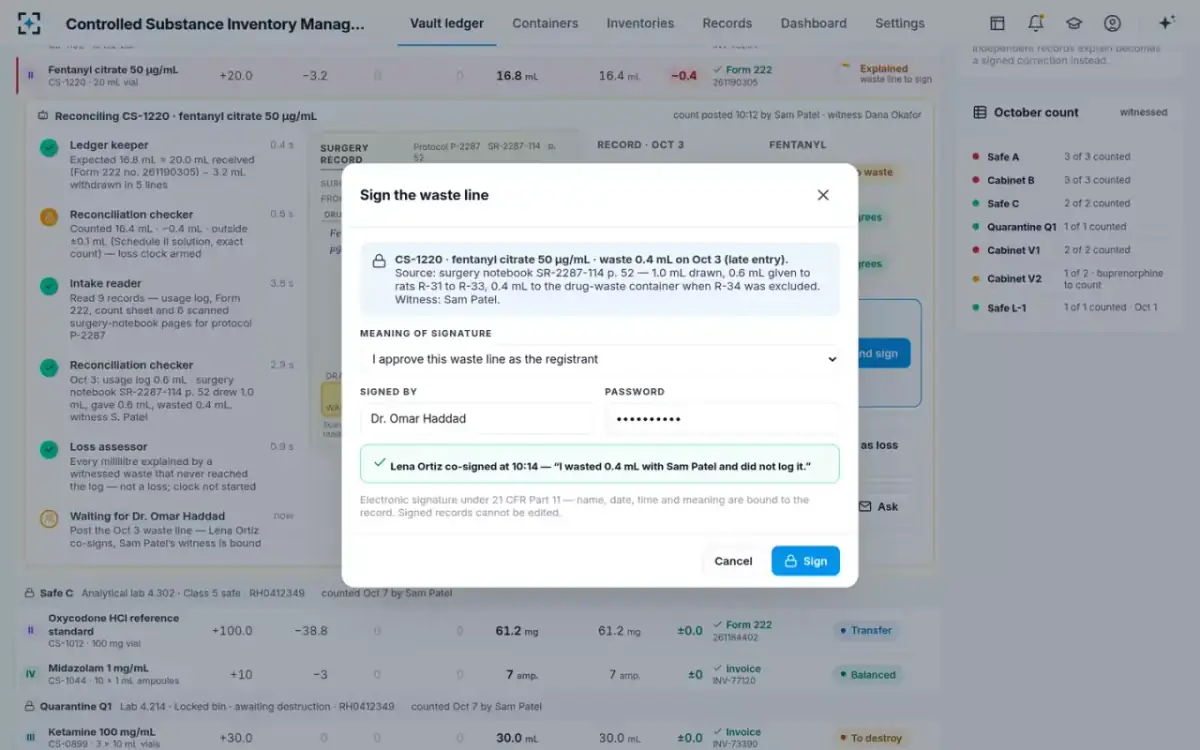
A late waste entry, with its source page, its witness and the meaning of the signature
Which form do you file: DEA Form 41 or DEA Form 106?
This is the confusion that costs most, because the two forms answer opposite questions and the wrong choice is invisible until somebody audits the file.
DEA Form 41 against DEA Form 106
DEA Form 41: This substance was accounted for, and destroyed.
DEA Form 106: This substance cannot be accounted for.
DEA Form 41: A destruction carried out by or on behalf of the registrant, and — in the DEA’s stated position — unrecoverable breakage or spillage.
DEA Form 106: A theft, or a loss the registrant has judged significant under the six factors.
DEA Form 41: The two employees who witnessed the destruction, with their names and signatures on the form.
DEA Form 106: The registrant, after a written notice to the field division office within one business day of discovery.
DEA Form 41: No federal deadline on the registrant’s own record; it is made when the destruction happens and kept in the registrant’s files.
DEA Form 106: Within 45 days of discovery, through the DEA’s secure network application.
DEA Form 41: Filing a Form 41 for an unexplained shortfall can leave a reportable loss unreported — the more expensive of the two errors.
DEA Form 106: Filing a Form 106 for a witnessed breakage reports a loss that did not occur, and puts the people involved in a file that is never unwritten.
The nine things a destruction record has to carry
- The name of the substance
As labelled, not as abbreviated in the laboratory. 21 CFR 1304.22(c).
- Its finished form and strength
A 390 mg/mL solution, a 10 mg tablet: the form the quantity is measured in.
- The number of units or the volume
The quantity destroyed, in the unit the substance is held in, with the container it came from.
- The date of destruction
The day it was rendered non-retrievable, not the day it was taken off the shelf or the day the form was typed.
- The method used
Enough detail for somebody else to judge that it met the standard. 21 CFR 1317.90(a).
- That it was rendered non-retrievable
The destination state the rules require, as defined at 21 CFR 1300.05, and the point both witnesses must have observed up to.
- Two employees who handled or observed the handling
Until the substance was rendered non-retrievable. 21 CFR 1317.95(d)(1).
- Two employees who personally witnessed the destruction
Named and signed on the DEA Form 41. 21 CFR 1304.21(e), 1317.95(d)(2).
- Kept, and retrievable, for at least two years
The record lives in the registrant’s files with every other controlled-substance record. 21 CFR 1304.04(a).
Expired and unwanted stock, before it becomes an inventory problem
Stock that nobody will use again is a quiet problem, because nothing forces a decision about it. The study finished, the compound failed, the shelf life ran out, and the vial stays in the safe because moving it takes an afternoon that nobody has. Two things then happen. It has to be counted at every inventory — and listed in the awaiting-disposal section with the reason it is being kept, which is a part of the inventory rule that is easy to leave blank. And it sits in a safe representing a quantity that has no live purpose, which makes it among the easiest material in the building to divert quietly.
The fix is procedural rather than technical: review the awaiting-disposal list at every count, and move anything on it to one of the four disposal routes within a stated period. A shelf of expired Schedule II that has been on the awaiting-disposal list for three biennial inventories is a finding waiting to happen, and the inventory rule's awaiting-disposal list is where an investigator will see it first.
The waste line that never reached the log
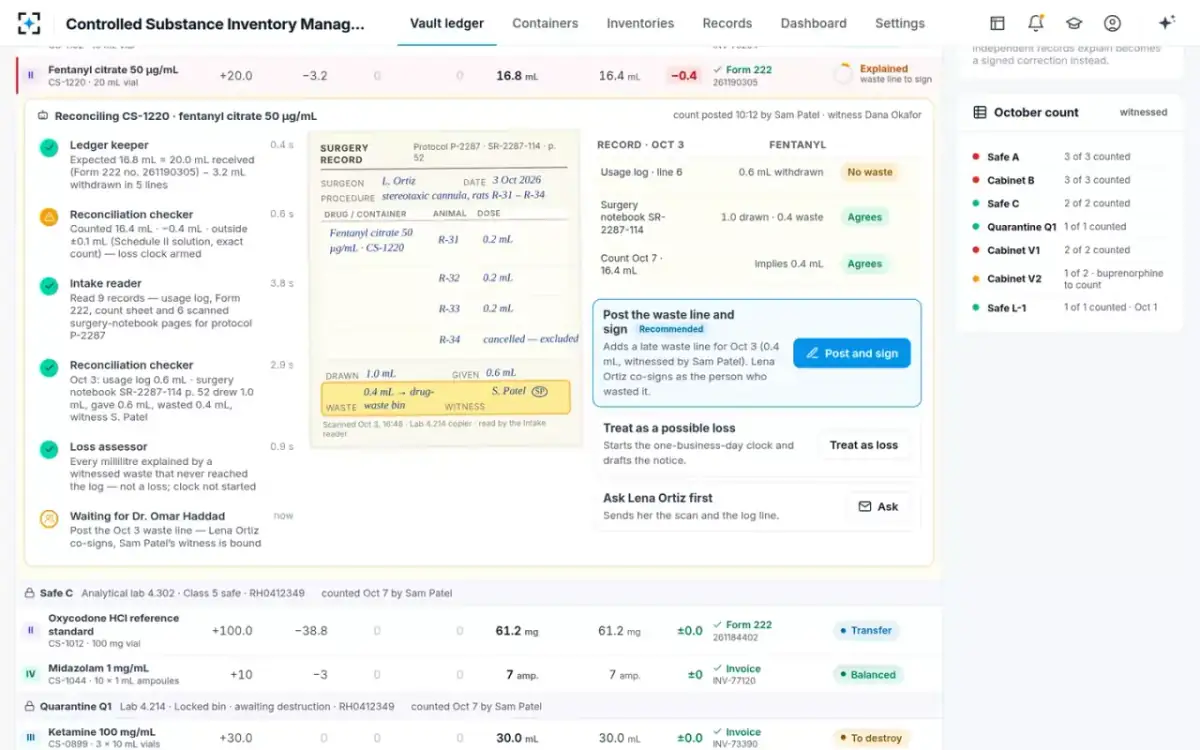
Back to the failure that actually happens. On 3 October a research scientist drew 1.0 mL of fentanyl citrate 50 µg/mL from container CS-1220, gave 0.2 mL to each of rats R-31 to R-33, and wasted the remaining 0.4 mL when R-34 was excluded at weigh-in, with the lab manager watching. She wrote it on page 52 of surgery notebook SR-2287-114. The usage log for that day shows 0.6 mL withdrawn, and no waste.
Four days later the October count found the container 0.4 mL short. Every element of a complete account existed — the quantity, the date, the person, the reason and the witness — and none of it was in the controlled-substance records. That is the entire distance between a recordkeeping entry and an unexplained Schedule II shortfall with a one-business-day clock attached to it.
What closed it was reading the notebook. The waste was posted for 3 October as a new line, signed by the registrant, co-signed by the scientist, with the lab manager's witness bound to it; nothing already posted was altered. The container balanced at 16.4 mL expected against 16.4 mL counted. The order of events matters: the entry was made late and is dated honestly as a late entry for 3 October, which is a correct record of what happened, rather than being backdated, which would not be.
Closed green, on a late entry rather than a loss
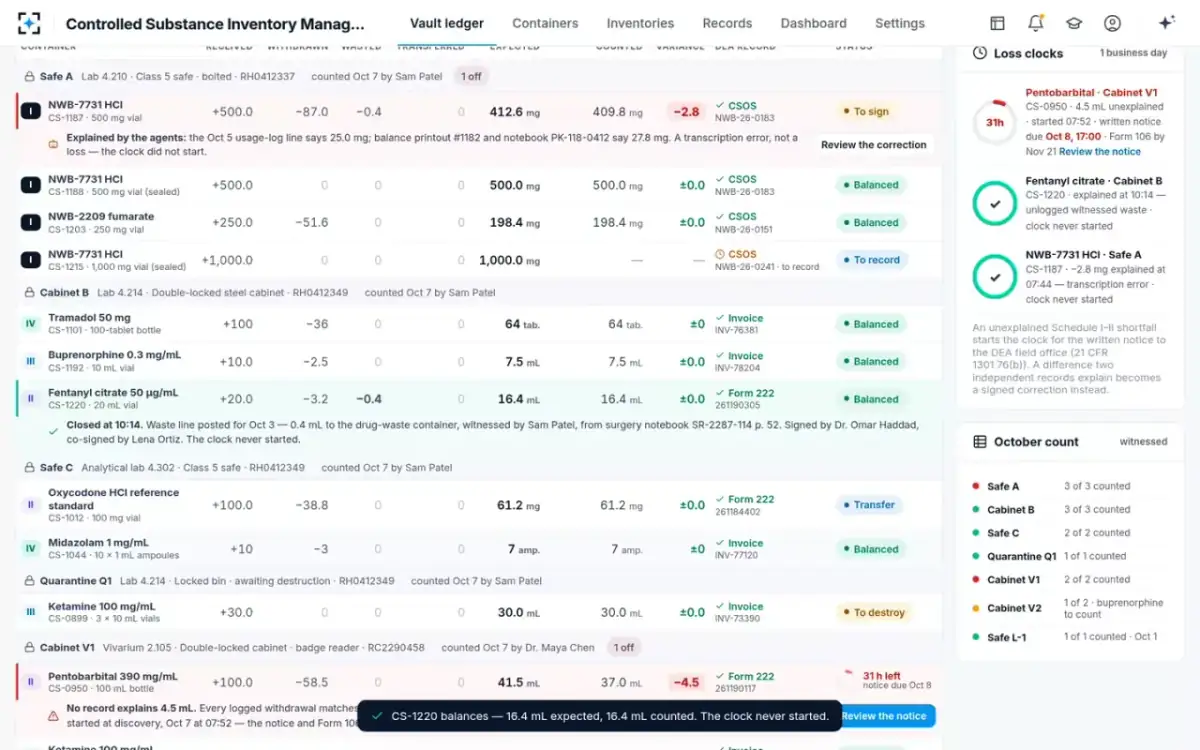
There is a wider lesson in it for anyone writing a waste procedure. The usage log is where the rules expect the entry, and it is the place a person at a bench is least likely to reach. A programme that only reads the usage log will keep producing shortfalls that were never losses; one that reads the records people actually write in will keep producing late entries, which is the correct answer. The decision tree for a difference sets out the rest of the branches.
The notebook page, read beside the usage log
Four events, four records, two forms that are not alternatives. See how a waste entry, a correction and a destruction record are kept and signed on Controlled Substance Inventory Management.
Questions people ask
What is DEA Form 41 used for?
It is the registrant's record that controlled substances were destroyed — the Registrants Inventory of Drugs Surrendered. It carries the substance, form, strength and quantity, the date and method of destruction, and the names and signatures of the two employees who witnessed it. The DEA's stated position is that unrecoverable breakage or spillage is recorded on one too, signed by two people who can testify that it happened.
Do you report a spill to the DEA?
No, provided it was witnessed. The DEA's position is that witnessed breakage or spillage is not a loss, because the registrant can still account for the substance, and that such incidents do not require notification. What they require instead is a record of the circumstances, the quantity and two witnesses. A spill nobody saw is a different matter, and goes through the significant-loss factors.
Can you pour a controlled substance down the drain?
Not as a method of destruction. Destruction has to render the substance non-retrievable — permanently altered through irreversible means, so that it cannot be transformed back into a controlled substance — and dilution does not do that. Local sewer and environmental rules may prohibit it separately. The two defensible routes are an on-site process you can describe and justify, or a registered reverse distributor.
How many witnesses does a destruction need?
Two, and they have a double duty: two employees handle or observe the handling of the substance until it is rendered non-retrievable, and two employees personally witness the destruction itself. Their names and signatures go on the Form 41. Bench waste has no federal witness requirement at all — the witness there is the registrant's own policy, and it is what keeps the account complete.
What do you do with expired controlled substances in a lab?
Until it goes, it is inventoried like anything else, and it belongs in the awaiting-disposal section of the inventory with the reason it is being kept. When it goes, it takes one of the routes in 21 CFR 1317.05: destroyed on site to the non-retrievable standard, delivered to a reverse distributor, returned for recall, or disposed of with the local diversion field office's assistance.
What do the reverse distributor rules require of a research lab?
Transfer the material to a registered reverse distributor's location, and keep the record of the transfer. Where Schedule I or II substances go, the reverse distributor issues an order form — a Form 222 or its electronic equivalent — to you. For Schedules III to V, keep a distribution record naming the drug, dosage form, strength, quantity and date transferred. The reverse distributor files the Form 41 when it destroys the substance; you do not.