Anyone who signs a controlled substance reconciliation has the same problem: they have been shown a result and have no way to check it. The sales answer — "it found three variances last month" — is not evidence, because a system that flags everything finds every variance and a system that flags nothing never embarrasses anyone. The method that does work is to replay counts you have already closed, plant errors whose answers you already know, and measure four different things separately, because they fail independently. This guide gives the four measures, the test design, a two-week plan you can run on your own records, and the published evidence about the method you are using today. Botminds' Controlled Substance Inventory Management is the example, and the measures are written so they would catch it failing.
Figures from the solution describe a fictional sample laboratory — Northwind Bio, Bay Campus — and are labelled as sample data or as design targets. The published figures come from hospital pharmacy, where this has been studied hardest, and the difference matters: they are not research-laboratory numbers and are not comparable with anything a supplier shows you.
What a usable proof looks like
4
separate measures — they fail independently, and an average of them hides which one broke
2
independent records required before an explanation stands
design rule
12months
of counts you have already closed: the test set you already own
Four different questions people call "accuracy"
"Accuracy" in this field is one word covering four questions, and a system can be excellent at one and useless at another. Separate them before you look at a number.
The first is detection: when a count differs from the expected balance, is the difference found at all? This is arithmetic, and most tools pass it — which is why it is the easiest number to quote. The second is explanation: when a difference has a real cause sitting in the records, does the system find that cause, and is it the right one? The third is citation: does the record it points at actually say what the system claims it says? A plausible explanation attached to the wrong notebook page is worse than no explanation, because somebody will sign it. The fourth is the false-alarm rate: of everything the system raised, how much turned out to be nothing?
The four measures, written out so each can be counted
Difference found
differences detected ÷ differences planted
Every seeded error that moved a balance should appear. A miss here is a hole in the arithmetic or in the tolerance.
Counted by whoever planted the errors
Explanation correct
right cause ÷ differences with a cause in the records
The explanation must match the cause you planted — not merely be reasonable.
Judged against the seeding sheet
Citation faithful
citations that say what is claimed ÷ citations given
Open the record it points at and read it. This is the measure nobody runs and the one that decides whether a signature is safe.
Judged by a person, record by record
False alarms
raised and later found to be nothing ÷ everything raised
The measure that decides whether anyone will still be using the system in six months.
Counted over the whole replay
Can you test it on counts you have already closed?
Yes, and it is the single best thing about this problem: unlike most compliance questions, you already own the answer key. A laboratory that has been counting monthly for a year has twelve closed counts, each with its usage logs, balance printouts, notebook pages, receipts and whatever explanation was eventually written for each difference. That is a labelled test set, collected by you, in your own vocabulary, about your own substances.
The regulation also means the material is there to be used. Researchers must keep complete and accurate records on a current basis for every substance received, stored, delivered, dispensed or otherwise disposed of, and DEA's Researcher's Manual says why: "These records are required to provide accountability of all controlled substances to help reduce the potential for diversion" (Researcher's Manual, 2022 edition). Records kept for accountability are, by construction, records you can test a reconciliation against.
Run the replay blind. Give the system the source records for a closed month without the outcome, and compare what it concludes with what your people concluded at the time — in both directions. Where it agrees, you have a baseline. Where it disagrees, you have the interesting cases: either it is wrong, or it found something your month-end missed, and you will want to know which before you buy anything.
Planting errors whose answers you already know
A replay of real months tests the easy half. The hard half needs errors whose answers are known exactly, which means planting them. Twelve planted cases across six error types is enough to be informative in a fortnight and small enough that a compliance lead can grade them by hand.
Twelve planted cases, what each one tests, and what counts as a pass
| Error type | How to plant it | What it tests | A pass looks like |
|---|---|---|---|
| Transcription error in the usage log | Change one logged quantity so it disagrees with the balance printout and the notebook | Explanation and citation: does it find the two records that agree against the log? | The difference is found, the cause is named as a transcription error, and both supporting records are cited correctly |
| Waste that never reached the log | Remove a waste line that is recorded on a notebook page with a witness | Whether it reads records outside the log at all | The notebook page is found and quoted, and a late waste entry is proposed rather than a loss |
| A genuinely unexplained shortfall | Remove a quantity with no record anywhere that accounts for it | Restraint: does it invent an explanation under pressure? | No explanation offered, the shortfall declared unexplained, and the clock started |
| Unit confusion | Record a weight in grams where the log expects milligrams | Whether unit handling is real or cosmetic | The difference is found and the cause named, not a 1,000-fold variance reported as a loss |
| A movement posted to the wrong container | Move one withdrawal to a neighbouring container of the same substance | Whether container identity is carried through from the source record | Both containers are flagged, and the paired differences are linked |
| A small difference repeated across months | Plant the same sub-tolerance shortfall in three consecutive months | Whether a pattern below tolerance is ever surfaced | The pattern is raised even though no single month breaches the tolerance |
Two rules make the seeding honest. Whoever plants the errors does not grade the result, and the seeding sheet stays sealed until the replay is finished. And plant at least two cases that have no answer, because a system that always produces an explanation is a system that will one day produce one for a diversion.
The measure that sinks many tools: the false-positive rate in diversion monitoring
The fourth measure is the one nobody asks about and the one that decides whether a control survives contact with a working laboratory. If every count raises three things to look into and none of them is real, the alerts get closed without being read within a quarter, and the control is gone while the licence is still being paid for.
The clearest published figures on this come from hospital pharmacy. A 2020 study at an academic medical centre compared three surveillance methods and reported: "The PPVs among the ADM, TPS, and EHR reports were 3.28%, 6.82%, and 23.88%, respectively. False positives were high among all reports (96.72%, 93.18%, and 76.12% for the ADM, TPS, and EHR reports, respectively)" (PMC7502867, 2020). Read the best of those again: the strongest method flagged four people for every one worth looking at.
Positive predictive value of three surveillance methods, one academic medical centre
The transfer to a research laboratory is partial and worth stating. Those methods watch people's dispensing behaviour across a hospital; a laboratory reconciliation watches one container's arithmetic against its own records, which is a narrower and better-posed problem. But the lesson transfers: when these surveillance reports were measured, most of their output turned out to be nothing.
What the literature says about the alternative you have now
Before judging a new system, measure the one you already run. The monthly usage report is a common default control, and it has rarely been put to a controlled test of its own. The evidence that such a test can be done comes from hospital pharmacy: a 2022 study in the American Journal of Health-System Pharmacy, by authors who included employees of the company that built the software tested, drew on data from ten acute-care hospitals and compared machine-learning analytics with the detection methods those hospitals already used (AJHP 79(16):1345–1354).
Testing against a large historical dataset, "the analytics detected known diversion cases (n = 22) in blinded data faster than existing detection methods (a mean of 160 days and a median of 74 days faster; range, 7-579 days faster)". Note the design, which is the design recommended here: known cases, blinded data, and a comparison against what the institution was already doing — not a claim about a model in the abstract. The reported model figures in that work were 96.3% accuracy, 95.9% specificity and 96.6% sensitivity on the initial sample dataset, which is a fourth distinct meaning of the word and a reminder to ask which one is on the slide.
False positives were high for all reports, indicating that significant improvements are needed in the development of accurate and reliable software to detect potential and actual CS diversion.
Derington et al., Hospital Pharmacy 55(5), 2020
Why does an explanation need two independent records?
At least two, and they must be independent — written by different hands or produced by different instruments. The reason is not statistical, it is evidential. One record written by the person whose work is in question explains nothing about that person's work; two records that agree, from different sources, cannot both be a single mistake or a single fabrication.
In the sample laboratory this is a rule the reconciliation is built to rather than a preference. A usage log says 25.0 mg of a Schedule I compound was weighed out. The balance printout shows the vial going from 23.4973 g to 23.4695 g; the scientist's notebook records 27.8 mg dissolved in 2.78 mL. Two independent records agree on 27.8 mg against the log's 25.0 mg, and the proposal is a correction to the log line, not a loss. Had only the notebook disagreed with the log, the proposal would have been to ask the scientist — not to close anything.
The rule also sets the shape of the failure you are testing for. When you plant an unexplained shortfall, the right behaviour is silence: no second record exists, so no explanation may stand, and the difference goes to the registrant with the clock running. What to do when a count does not match follows that path to its end.
Controlled Substance Inventory Management: a proposed correction and the records behind it
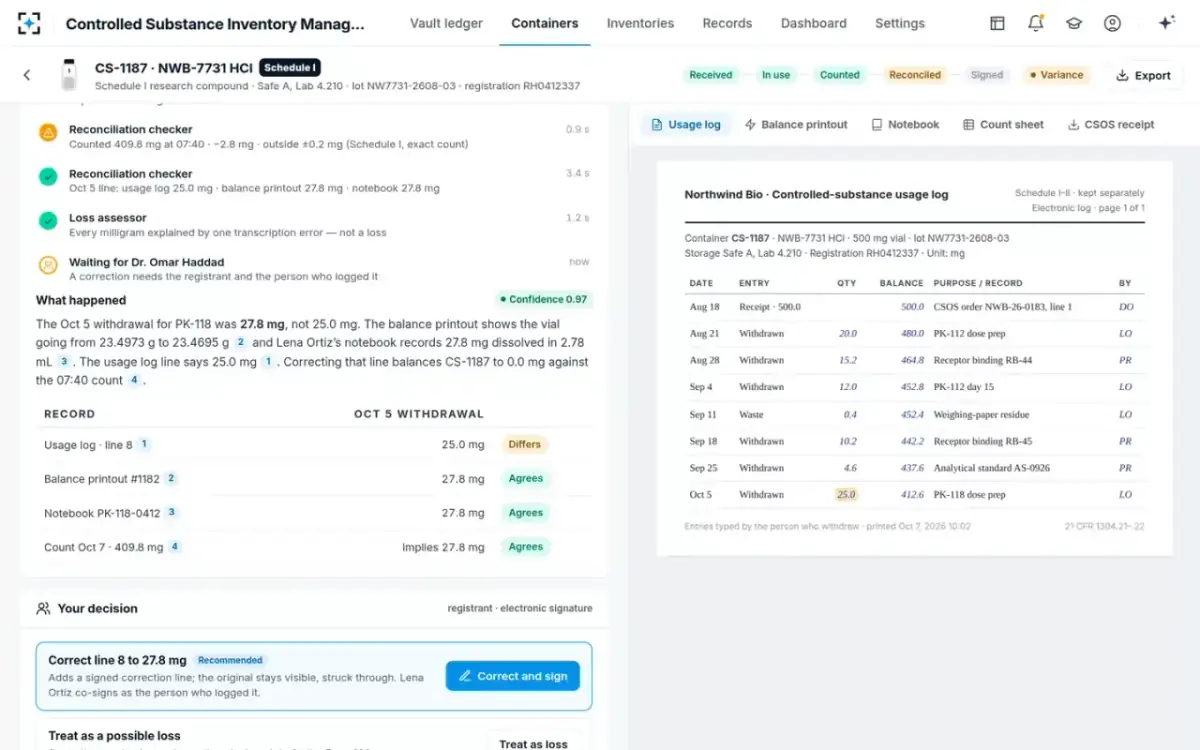
Blind counts, and why the count is part of the test
A blind count is a count taken without being shown the expected balance. It matters because the number a reconciliation works on comes from a person, and a person who has been told to expect 16.8 mL is being invited to write 16.8 mL. A test of the reconciliation that uses non-blind counts is testing arithmetic on a number that was partly copied.
Hospital pharmacy has made this explicit. The ASHP guidelines on preventing diversion of controlled substances state that "CS counts managed by ADCs or done manually are verified by a blind count each time a CS drawer, pocket, cabinet, or refrigerator is accessed, except when unit-of-use dispensing technology is deployed", and that "Inventory verification is conducted for CS managed by ADCs by 2 authorized HCWs if a blind count has not been performed within 1 week" (ASHP, 2022). The automated cabinets are not a research laboratory's world, but the principle — count without the answer in front of you, and verify with a second person if you did not — is medium-independent.
The practical implication for an evaluation is that the count sheet is part of what you are testing. A sheet that prefills expected balances makes counting faster and the reconciliation weaker; a sheet that prefills container identity, schedule, form and location but leaves the quantity blank gives you both. Ask which one a system produces, and ask whether it is a setting.
Reading a confidence figure without being fooled by it
Systems in this field, including this one, will show a confidence figure beside a conclusion — a 0.97 next to the 27.8 mg above. Three things are worth knowing about such a number before anyone signs under it.
It is the system's own score on its own conclusion, on its own sample data. It is not an accuracy rate, it is not a probability that the explanation is true, and it is not comparable with the published positive predictive values earlier on this page, which measure something else entirely on a different population. And it is not a threshold you should delegate to: a figure of 0.97 attached to a citation that says something different when you open it is a 0.97 attached to nothing.
The useful discipline is to treat the confidence figure as a sort order, not as a decision. It tells you which conclusions to read first. The citation tells you whether the conclusion is right, and the two-record rule tells you whether it is allowed to stand.
How do you test controlled substance software? A two-week plan on your own records
Eight steps, two weeks, one compliance lead and a few hours of a lab manager's time. The deliverable is four numbers and a list of disagreements, which is a far better basis for a decision than a demonstration.
A two-week replay on counts you have already closed
- Pick three closed months, including your worst one
The month with the difference nobody could explain is the most informative month you own.
- Assemble the source records exactly as they were
Usage logs, balance printouts, notebook pages, receipts, order forms, access logs. Resist the urge to tidy them; the mess is the test.
- Seal the outcomes
Whatever your people concluded at the time goes into an envelope. Nobody running the replay sees it.
- Plant twelve errors across six types, and seal the seeding sheet
Two of them with no answer at all. A different person plants and grades.
- Run the replay blind, and keep every conclusion with its citation
You are collecting conclusions and the records they point at, not a dashboard.
- Open every citation and read it
This is the slow step and the one that decides the result. Count the citations that say what was claimed.
- Count the four measures separately
Differences found, explanations correct, citations faithful, false alarms. No averaging: the point is which one is weak.
- List the disagreements with your own month-end, in both directions
Cases where it was wrong, and cases where it found something you missed. Take both lists to the registrant.
What a passing result does not prove
Be clear about the limits of your own test, because the person who signs the inventory will be. A replay proves behaviour on the records you gave it, from the months you chose, in your substances and your handwriting. It says nothing about a substance you do not yet hold, a new storage location, or a person who joins next year and logs differently.
It also proves nothing about diversion. A reconciliation that balances tells you the records agree; it does not tell you the records are true. Someone who removes substance and writes a matching waste line produces a perfect reconciliation, which is why separation of duties, access records and witnessed counts carry weight that no arithmetic can carry — see who counts, who witnesses and who signs.
And it proves nothing about the decisions. Whether a shortfall is significant, whether a correction is accepted, whether a notice goes — these remain the registrant's, and a test that appeared to validate a system making them would be testing the wrong thing. What a good replay buys you is narrower and worth having: the knowledge that when a count is short, the explanation you are shown is the one the records actually support, and that you can check it. To run this on your own closed counts, start from Controlled Substance Inventory Management, or read the twelve questions to put to any supplier.
Questions people ask
How do you reconcile a controlled substance log?
Take the container's opening balance, add every receipt, subtract every withdrawal, waste, transfer and destruction in time order, and compare the result with the physical count under a tolerance set for that schedule and physical form. Where the two differ, search the source records — the usage log, the balance printout, the notebook, the order form, the access log — for a movement that was made but not recorded, or recorded wrongly. A difference with no supporting record is unexplained, which is a different thing from a loss.
How accurate is automated controlled substance reconciliation?
The question needs splitting, because "accuracy" covers four measures that fail independently: whether the difference is found, whether the explanation is the right one, whether the citation says what is claimed, and how often the system raises something that turns out to be nothing. Ask for all four separately, measured on a replay of your own closed counts, and treat a single headline percentage as a sales figure rather than a result.
What is a blind count?
A count taken without being shown the expected balance, so that the counter records what they see rather than what they were told to expect. ASHP's diversion-prevention guidelines recommend blind counts each time a controlled-substance drawer or cabinet is accessed in a hospital setting, with verification by two authorised people for cabinet-managed stock if no blind count has been done within a week. In a laboratory, the equivalent is a count sheet that prefills the container and leaves the quantity empty.
Is one record ever enough to close a difference?
No. Two are needed, and they should be independent of each other and of the record being questioned — a balance printout and a notebook page, say, rather than two copies of the same log. One record written by the person whose work is in question cannot settle a question about that work. Where only one record exists, the right outcome is to ask the person, not to close the difference.
What is a false positive in diversion monitoring?
A case the system raised that turned out to be nothing. It matters more than most buyers expect: in one published comparison at an academic medical centre, the false-positive share of three surveillance reports was 96.72%, 93.18% and 76.12%. A control whose output is mostly noise stops being read, and a control that is not read is not a control, however good its detection rate looks.
Can you use past counts to test a new system?
Yes, and it is the best test available to you, because the outcomes are already known and the records are already yours. Replay three closed months blind, seal what your people concluded at the time, plant a dozen errors whose answers you know, then count the four measures and list every disagreement in both directions. Two weeks of a compliance lead's time buys a result that no demonstration can.