A controlled substance inventory system is easy to buy and hard to choose, because almost everything on the market answers a question your laboratory has already solved. Containers are not the problem: you know what is in the cabinet, and a cabinet with a screen on it will tell you again. The problem is the morning a count comes out 0.4 mL short and somebody has to read nine records written by four people to work out whether that is waste, a transcription error or a loss with a one-business-day clock attached. These twelve questions are built to find out whether a system can do that work or only the counting, and they end with the four things no system should do for you, because the judgement and the signature are the parts the regulation leaves with the registrant. Botminds' Controlled Substance Inventory Management is the worked example, including where it stops.
Figures marked as the sample laboratory come from a fictional research site — Northwind Bio, Bay Campus — whose people, registrations and containers are characters and sample data. The published figures are from a peer-reviewed study, linked where it appears.
What a reconciliation in Controlled Substance Inventory Management actually involves
9records
read to explain one 0.4 mL difference: usage log, order form, count sheet and six notebook pages
sample laboratory
2
independent records required before an explanation is allowed to stand
design rule
0
reports sent to the DEA without the registrant’s signature
design rule
What the work actually is, before you look at a screen
Write down the work before anyone demonstrates anything, because the demonstration will otherwise define it for you. In a DEA-registered research laboratory the work has five parts, and only one of them is counting.
First, movements arrive in records of different kinds: a usage log filled in by hand, a balance printout from the analytical balance, a surgery or formulation notebook, an order form or electronic order, an invoice for a Schedule III–V receipt, a reverse distributor's paperwork. Second, those movements have to be posted to a running balance per container, in time order, with Schedule I–II kept separate from everything else. Third, a physical count is taken and compared with the expected balance under a tolerance that depends on the schedule and the form — a powder weighed to a tenth of a milligram is not a solution drawn to a tenth of a millilitre. Fourth, any difference has to be explained from the records, or declared unexplained. Fifth, the inventory, the destruction record, the correction or the loss notice has to be drafted and signed.
Count the number of those five that a cabinet with a screen performs. It is one, and it is the third. Everything that makes a short count turn into a federal deadline happens in the fourth.
The twelve questions, and why each one has a wrong answer
Each question below has an answer that should end the conversation. That sounds harsh for a procurement, but a controlled-substance system is usually lived with for years, and the wrong answers are not matters of taste — they are either a regulatory problem or a promise that the thing cannot do the work.
Twelve questions, the answer that ends the conversation, and the rule behind it
- Which records does it read, besides what someone types in?
Wrong answer: "users enter movements." Then you have bought a paper log with a screen, and the records that explain a difference are still in a drawer.
- Does each value carry the passage it was read from?
Wrong answer: "we show a confidence score." A number without its source cannot be checked, and an investigator checks.
- Can it separate one registration’s records from all others, for a date range?
Wrong answer: anything other than a demonstration. This is the first limb of "readily retrievable", 21 CFR 1300.01(b).
- Are Schedule I–II records kept separately in the record itself?
Wrong answer: "you can filter by schedule." 21 CFR 1304.04(f)(1) and (g) ask for separation, not a view.
- Can executed order forms and inventories be produced at the registered location?
Wrong answer: "everything lives in our cloud." 21 CFR 1304.04(b)(1) never lets those two record types sit only at a central location.
- Is a posted entry ever edited?
Wrong answer: "an administrator can fix it." A correction has to be a new line that leaves the original visible, or the record cannot show that it was corrected.
- Are tolerances set per schedule and per physical form?
Wrong answer: one global tolerance. A milligram on a powder and a millilitre on a solution are different questions.
- Does an explanation have to be supported by more than one record?
Wrong answer: "our model is accurate." One record written by one hand explains nothing about that hand.
- Who can close a variance?
Wrong answer: the system, on a rule. Closing a variance is a judgement about whether a loss occurred, and that belongs to the registrant.
- What does it do when a shortfall is unexplained?
Wrong answer: "it files the report." It should start the clock, assess, draft — and wait. 21 CFR 1301.76(b) puts the notification on the registrant.
- Does it name a person as responsible?
Wrong answer: "it identifies the likely diverter." An assessment that names someone before an investigation turns a record into an accusation.
- Can you export everything, per registration and per schedule, without the supplier’s software?
Wrong answer: "we keep it for you." Your retention duty runs two years from each record’s date, whatever happens to the contract.
Reading the record, not just counting the container
The distinction that matters most is the one buyers notice last. A container-tracking system knows what should be in the cabinet because it knows what it was told. A record-reading system knows what the laboratory's own documents say happened, and can therefore disagree with the log.
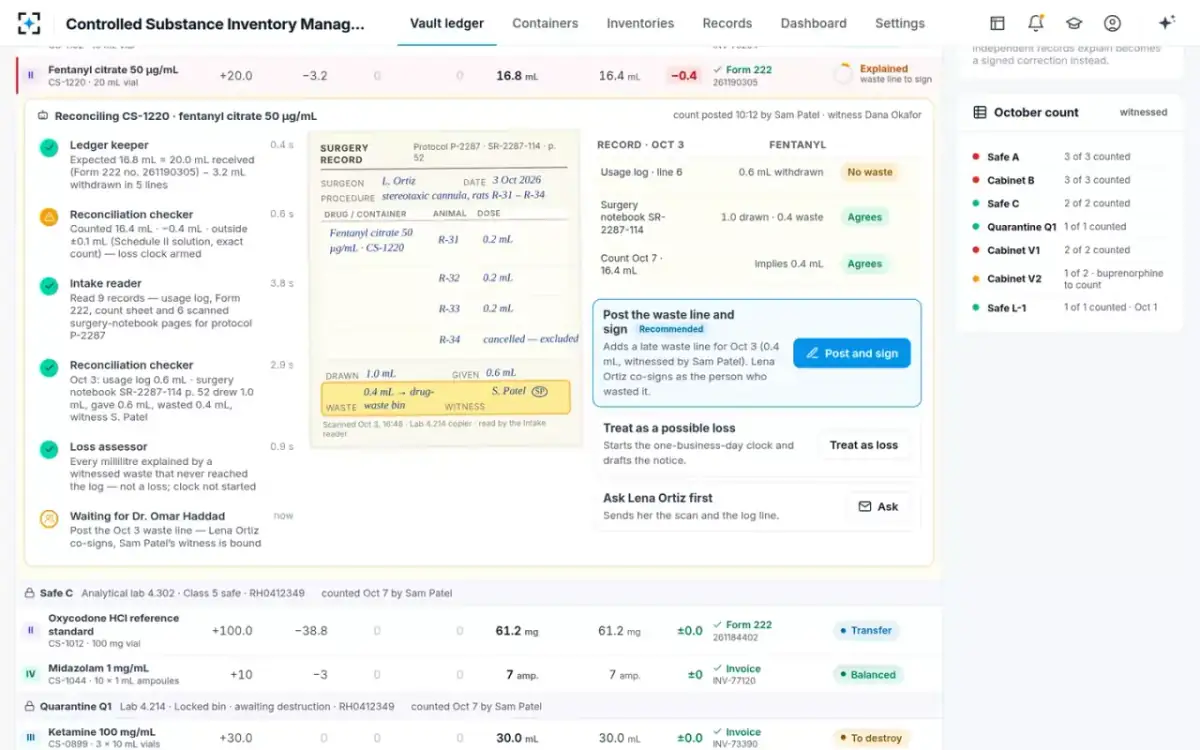
Take the case the sample laboratory is built around. A Schedule II solution is counted at 16.4 mL where the running balance expects 16.8 mL, a difference of 0.4 mL outside the tolerance for that schedule and form. A container tracker reports a variance of −0.4 mL, which everybody could already see. A record-reading system goes and reads: the usage log for the protocol, the order form the container arrived on, the count sheet, and six scanned surgery-notebook pages — and finds, on page 52, that 1.0 mL was drawn, 0.2 mL given to each of three animals, and 0.4 mL wasted in front of a named witness when a fourth was excluded at weigh-in. The usage log for that day records 0.6 mL withdrawn and no waste. The difference is a witnessed waste that never reached the log, and it is not a loss.
The hours between those two outcomes are the product. One of them ends in a late waste entry co-signed by the person who made it; the other ends in a one-business-day clock, a drafted notice, and a conversation with a field office about a laboratory that cannot explain its own records.
The same −0.4 mL, seen by two kinds of system
A system that tracks containers: What someone entered, and what the cabinet door did.
A system that reads the records: What the usage log, the balance printout, the notebook and the order form each say.
A system that tracks containers: A variance of −0.4 mL on one container.
A system that reads the records: A variance, and the nine records searched for its explanation.
A system that tracks containers: Nothing further. The explanation is not in its data.
A system that reads the records: A witnessed waste on a notebook page that never reached the usage log.
A system that tracks containers: A person reconstructs three weeks of records by hand, if the records still exist.
A system that reads the records: A late waste entry is proposed, with its source and witness, for two signatures.
A system that tracks containers: Whether to treat an unexplained difference as a possible loss, with no new evidence.
A system that reads the records: Whether to accept the waste line, treat it as a possible loss, or ask the scientist first.
A system that tracks containers: At the cabinet door.
A system that reads the records: At the signature. It proposes; the registrant decides.
Can software decide whether a loss is significant?
No, and a system that offers to is selling you a liability. "Significant loss" is undefined in the Controlled Substances Act and in the regulations; DEA's Researcher's Manual is explicit that it falls to the registrant to use their own judgement, that it depends on the nature of the researcher's work and on whether a rational explanation exists, and that what is significant for a researcher may be insignificant for a hospital or a manufacturer. What counts as a significant loss works through the factors in detail.
What software can legitimately do is make the judgement well informed and fast: start the clock at discovery so the deadline is visible rather than remembered, work through the six factors the regulation lists — quantity relative to the type of business, the specific substance, whether the loss is associated with access by specific individuals or with unique activities, a pattern of losses over time, whether the substance is a likely candidate for diversion, and local trends — and lay out the evidence for each. Then it stops, because the next step is a notification the registrant signs.
The notification itself is unforgiving about intermediaries, which is another reason no system should offer to make the call for you. DEA's Researcher's Manual states the requirement plainly: "DEA must be notified directly. This requirement is not satisfied by reporting the theft or significant loss in any other manner" (Researcher's Manual, 2022 edition). An institution that routes its notifications through a corporate security department, or through a supplier's service, has not notified DEA.
What should software not do under the DEA rules? The four things to keep out of any system
Four. None of them is a prohibition written into the rules about software; each follows from a duty the rules give the registrant, and they are worth writing into the specification so that a supplier has to say out loud whether their product does them.
It should not decide that a variance is closed. A variance is closed when a person with the duty concludes that the records explain it; a rule that closes differences under a threshold is a rule that hides the pattern of small repeated losses the Researcher's Manual specifically warns may indicate a significant problem.
It should not send a report to the DEA. The written notice within one business day of discovery, and the Form 106 that follows within 45 days, are the registrant's under 21 CFR 1301.76(b). Drafting them is useful; sending them is not the supplier's to automate.
It should not name a person as responsible. An assessment of a shortfall is about quantities, substances, access and patterns. The moment it prints a name it has pre-empted an investigation that has not happened, and it has done so in a record that will outlive the question.
It should not edit a posted entry. Records must be complete and accurate and kept on a current basis under 21 CFR 1304.21(a); a correction that overwrites the original removes the evidence that a correction occurred, which is precisely what an investigator is looking for.
DEA must be notified directly. This requirement is not satisfied by reporting the theft or significant loss in any other manner.
DEA Diversion Control Division, Researcher's Manual, 2022 edition
Where agents help: five jobs, and the limit written into each
The useful way to think about automation here is job by job, with a limit attached to each job rather than a general assurance about safety. In the sample laboratory there are five, and three of them never make a decision.
Five jobs in one reconciliation, each with what it may never do
Agent
Read the recordsTurns balance printouts, notebook entries, usage logs, order forms, invoices and destruction records into movements — container, substance, quantity and unit, person, protocol and time — quoting the passage for every value.
Never: infers a quantity that is not printed or written; unreadable values go to a person
Agent
Post each movement to the running balancePosts receipts, withdrawals, waste, transfers, destructions and counts in time order, Schedule I–II kept in their own set of records.
Never: edits a line already posted — a correction is a new signed line
Agent
Reconcile the countCompares expected with counted under the tolerance for that schedule and form, then searches every source record for the explanation.
Never: closes a variance, and never accepts an explanation resting on a single record
Agent
Assess an unexplained shortfallWorks through the significant-loss factors, starts the one-business-day clock at discovery, and drafts the written notice and the Form 106 fields.
Never: sends anything to the DEA, and never names a person as responsible
Agent
Draft the recordsDrafts monthly and biennial inventories, destruction records and the file an investigator asks for, ready for signature.
Never: changes a signed record; two witnesses on every destruction
A person decides
The registrant decides and signsAccepts the correction, the waste line, the inventory or the notice — with the meaning of the signature, the time and the record it binds to.
The limits matrix: what each job may do, must hand over, and may never do
| The job | May do | Must hand to a person | May never do |
|---|---|---|---|
| Reading the records | Extract movements from any source record and quote the passage behind each value | Anything unreadable, ambiguous or handwritten past legibility | Infer a quantity that is not printed or written |
| Posting to the running balance | Post movements in time order, keeping Schedule I–II separate | Any movement whose container or registration is uncertain | Edit a line already posted |
| Reconciling a count | Compare under the tolerance and search every record for an explanation | The variance itself, with the evidence found and not found | Close a variance, or accept a single record as an explanation |
| Assessing a shortfall | Work the significant-loss factors, start the clock, draft the notice and Form 106 | The decision to report, and the signature | Send to the DEA, or name a person as responsible |
| Drafting the records | Draft inventories, destruction records and the inspection file from signed records | Every signature, and anything with an open item | Alter a signed record |
Citations or it did not happen: every value quotes its source
The single most useful property to demand is also the cheapest to test: can you click any number and see the sentence it came from? Not a document reference, not a confidence score, but the passage — the usage-log line, the printout, the notebook page with the words highlighted.
Two things follow from having it. An explanation becomes checkable by someone who was not there, which is what an inspection is. And a wrong extraction becomes visible instead of becoming the record: if the system read 25.0 mg where the printout shows a 27.8 mg difference in vial weight, you find out by looking rather than by reconciling a container that will not balance for the next six months.
An explanation with the page it came from
Posted entries are never edited — what that means for your supplier
Ask how a mistake is fixed, and listen for the word edit. In a controlled-substance record a correction is a new entry that points at the original, gives the reason and the evidence, and leaves the original visible and struck through. The original is not an embarrassment to be tidied away; it is the thing that proves the correction was a correction.
This has consequences a supplier may not have thought about. Deleting a user must not delete their entries. A bulk import that was wrong must be correctable without rewriting history. An administrator must not be able to make a line disappear, which means the product needs a role model where nobody has that power, not a policy that says nobody uses it. And a late entry — the waste that was made on the third and logged on the seventh — has to be postable as of the date it happened while being visibly late, because 21 CFR 1304.21(d) makes the date a substance was actually received, transferred or destroyed the date that counts.
Who signs, and how the signature is bound to the record
A signature is only evidence if it says what it approves. "Approved by O. Haddad" on a screen is an audit-log entry; "I approve this waste line as the registrant", bound to that line, at that time, is a statement someone can be asked about two years later. Ask to see what a signature looks like in the stored record, not in the notification email.
Ask also who else signs, and whether the product can express it. A correction co-signed by the person who logged the original, a count with a witness, a destruction with two witnesses, a loss notice reviewed by a compliance lead before the registrant signs — these are different relationships, and a system with one generic approval step cannot record them. Who counts, who witnesses and who signs sets out which of them the regulation requires and which are yours to choose.
Does controlled substance software have to be validated?
Not by DEA. Part 1304 sets up no approval for recordkeeping software: "Registrants need not notify the Special Agent in Charge or obtain central recordkeeping approval in order to maintain records on an in-house computer system" (21 CFR 1304.04(c)). There is no approved-products list to check and no filing to make. Where a validation requirement exists it comes from your own institution's quality system or from the regulatory regime of the studies the substances are used in — and it is worth establishing which, because the answer determines who writes the protocol and what it has to cover.
The test DEA does apply is behavioural, and you can run it in an afternoon: pick a registration and a date range, ask for every record of one substance, and see whether the system separates them out from everything else in a reasonable time, in a form that can be inspected and copied. That is the definition in 21 CFR 1300.01(b), and what the rules allow for electronic records works through the rest of it. Then run the harder test on the work itself: replay counts you have already closed and plant errors whose answers you know.
The reason to test rather than to trust a claim is that where surveillance tools have been measured, the results have been sobering. A study at one academic medical centre compared three methods of flagging possible diversion and found that most of what each flagged was not diversion — false positives of 96.72%, 93.18% and 76.12% — and its authors concluded that "significant improvements are needed in the development of accurate and reliable software to detect potential and actual CS diversion" (Hospital Pharmacy 55(5), 2020). That is hospital dispensing, not a research laboratory, and the comparison is not exact — but the lesson transfers: a tool's real performance is something you measure, not something you are told.
Where this solution does not help
Three things, stated plainly so that a procurement does not discover them later. It does not secure a cabinet: physical security, keys, badges and the storage requirements of 21 CFR 1301.75 are yours, and the system only reads the access records they produce. It does not replace a physical count: somebody still opens the safe and weighs the vial, and the solution's contribution is the sheet they count from and the reconciliation the moment the number goes in. And it does not make the significant-loss decision, or send anything to a field office; it assesses, drafts and waits.
Controlled Substance Inventory Management: the whole programme on one screen
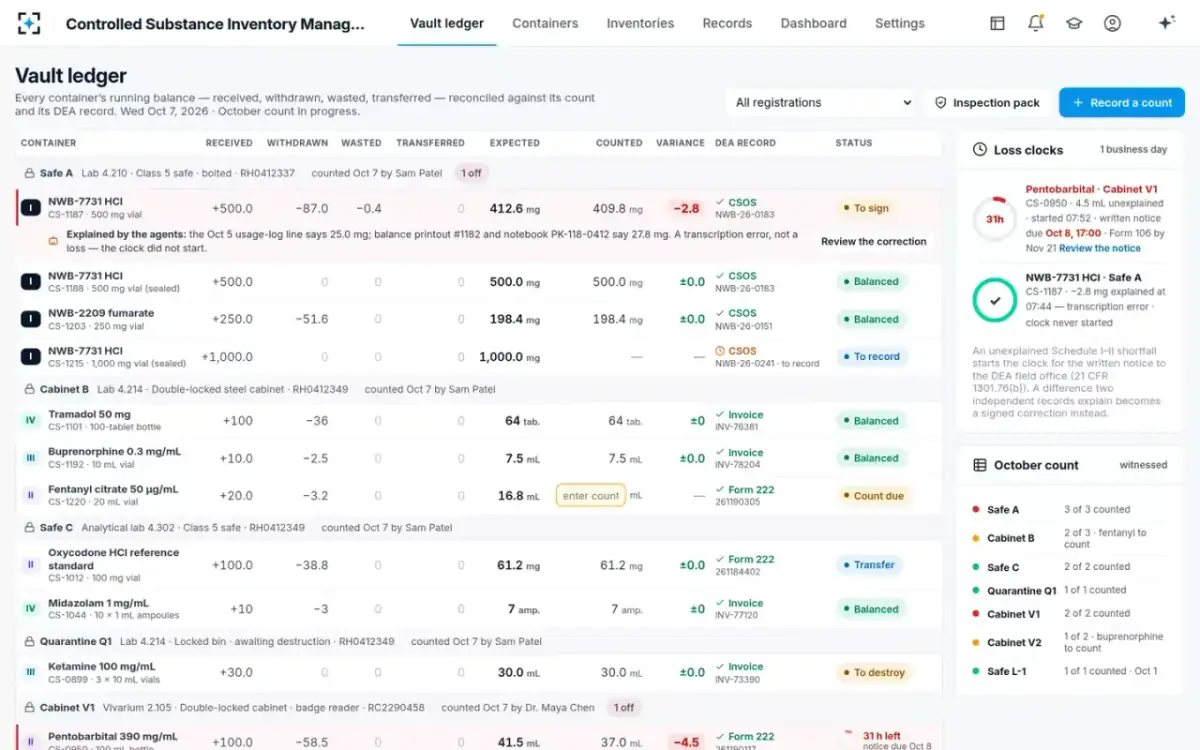
If the twelve questions do their job, they will tell you within one demonstration whether you are looking at a cabinet with a screen or at something that reads your records. To put them to this one, start from Controlled Substance Inventory Management.
Questions people ask
What should controlled substance software do?
Five things: read the laboratory's own source records rather than only what people type in; post every movement to a running balance per container with Schedule I–II kept separate; compare each count under a tolerance set by schedule and form; find and cite the records that explain a difference; and draft the inventory, the correction, the destruction record and the loss notice for signature. Counting containers is the one part a cabinet already does.
Can software decide whether a loss is significant?
No. The term is undefined in the regulations, and DEA's Researcher's Manual puts the judgement on the registrant, who must weigh the quantity against the nature of the work and the likelihood of a rational explanation. Software can start the clock at discovery, work through the six factors the regulation lists, assemble the evidence and draft the notice — and then stop, because the decision and the signature are the registrant's.
Can software file a DEA Form 106?
It should not file it for you. The written notice within one business day of discovery and the Form 106 within 45 days are the registrant's obligations under 21 CFR 1301.76(b), and DEA's Researcher's Manual adds that DEA must be notified directly and that reporting in any other manner does not satisfy the requirement. Drafting the fields from the record is useful; submitting without a signature is not something to buy.
Does controlled substance software have to be validated?
The DEA recordkeeping rules do not ask for validation or set up any certification of software: 21 CFR 1304.04(c) says registrants need not notify or obtain approval to keep records on an in-house computer system. Any validation requirement comes from your institution's own quality system or from the regime governing the studies. The test DEA does apply is whether the records can be separated out in a reasonable time and produced for inspection and copying.
Can AI read a controlled substance usage log?
Yes, including handwriting, balance printouts and scanned notebook pages — and the useful question is what it does when it cannot. The property worth demanding is that every extracted value quotes the passage it came from, and that anything unreadable goes to a person rather than being guessed. A quantity that was inferred rather than read is not a record.
What questions should you ask a controlled substance software vendor?
Start with which records it reads besides what users type, whether every value cites its source, whether it can separate one registration's records for a date range, whether posted entries are ever edited, who can close a variance, and what it does with an unexplained shortfall. Finish with the export: everything, per registration and per schedule, in a form that opens without their software, because your retention duty runs for two years from each record's date.