Controlled substance inventory requirements for a research lab come from one short part of the federal rules, 21 CFR part 1304, and they ask for four things rather than one: a physical count the day you first hold a scheduled substance, a new count at least every two years, a count of any substance on the day it first becomes controlled, and — inside every one of those — a separate list of stock awaiting disposal. The counting is the easy half. The hard half is that none of it is ever sent to the DEA, so the only thing that makes an inventory true is the record of movements underneath it, and in most laboratories those movements live in a paper usage log, a balance printout, a notebook on the bench and a spreadsheet that nobody adds up until count day. Botminds' Controlled Substance Inventory Management posts every receipt, withdrawal, waste, transfer and destruction to a running balance for each container, then drafts the inventory from the day's counts for the registrant to sign.
Almost every page that answers this question answers it for a pharmacy. A research registrant's version is different in four ways, and this guide ends on them. People, companies, registration numbers, containers and lot numbers named here are fictional — characters and sample data in the solution.
The only fixed numbers in the inventory rule
4
inventory duties in one part of the rules: initial, biennial, newly scheduled, and the awaiting-disposal list inside each
2yrs
the longest gap allowed between inventories — and the shortest time a record may be kept
1,000
tablets or capsules: above that, an opened Schedule III–V container is counted exactly too
None
of it is sent to the DEA. It is kept, and produced on inspection
The four inventory duties a research registrant owes
Three of the four are dates; the fourth is a list that every inventory has to carry. They are easy to collapse into one annual ritual, and collapsing them is how registrants end up with a two-year-old biennial inventory, no initial inventory at all, and a Schedule I substance that was counted for the first time nine months after it was scheduled.
The DEA's own definition is narrower than most count sheets. An inventory, the Researcher's Manual says, is "a complete and accurate list of all stocks and forms of controlled substances in the possession of the registrant as determined by an actual physical count for schedule I-V controlled substances" (Researcher's Manual, 2022). An actual physical count: not a balance carried forward, not a printout of what the system believes, not last month's sheet with a tick beside it.
Four duties, four triggers — and only three of them are dates
Initial inventory21 CFR 1304.11(b)
What triggers itThe day you first engage in manufacture, distribution or dispensing of a controlled substance under the registration.
When it is dueThat date. If you hold none yet, write down the zero.
What it must containAn actual physical count of everything on hand, in the eight-part form every inventory takes.
Biennial inventory21 CFR 1304.11(c)
What triggers itTime. It follows the initial one and then repeats.
When it is dueAt least every two years, on any date within two years of the last biennial date.
What it must containThe same information as the initial inventory, for all stocks on hand.
Newly scheduled substance21 CFR 1304.11(d)
What triggers itA rule placing a substance in a schedule when it was not, immediately before, on any schedule — and you possess it.
When it is dueThe effective date of that rule.
What it must containAn inventory of all stocks of that substance. From then on it joins the biennial count.
Awaiting disposal and held aside21 CFR 1304.11(e)(1)(iv), applied to researchers by (e)(6)
What triggers itDamaged, defective or impure stock awaiting disposal, stock held for quality control, stock kept for compounding.
When it is dueNot a date of its own: every inventory above must carry this list.
What it must containName, total quantity to the nearest metric weight or units of finished form, and the reason it is being kept.
The last row is the one that is almost always missing. A vial that cracked in the freezer, a lot that failed its identity test, a bottle set aside for an assay standard: none of it is live stock, all of it is on hand, and the rules want it listed with the reason it is being kept and whether it could be used to make a controlled substance in finished form. A lab that keeps a quarantine shelf and leaves it off the count has an inventory that does not describe the room.
How often must a controlled substance inventory be taken?
At least every two years, and the two years run from the last biennial inventory date rather than from a fixed calendar point. The rule reads: "After the initial inventory is taken, the registrant shall take a new inventory of all stocks of controlled substances on hand at least every two years. The biennial inventory may be taken on any date which is within two years of the previous biennial inventory date" (21 CFR 1304.11(c)). There is no fixed month, no due date printed on the registration, and no reminder from the DEA.
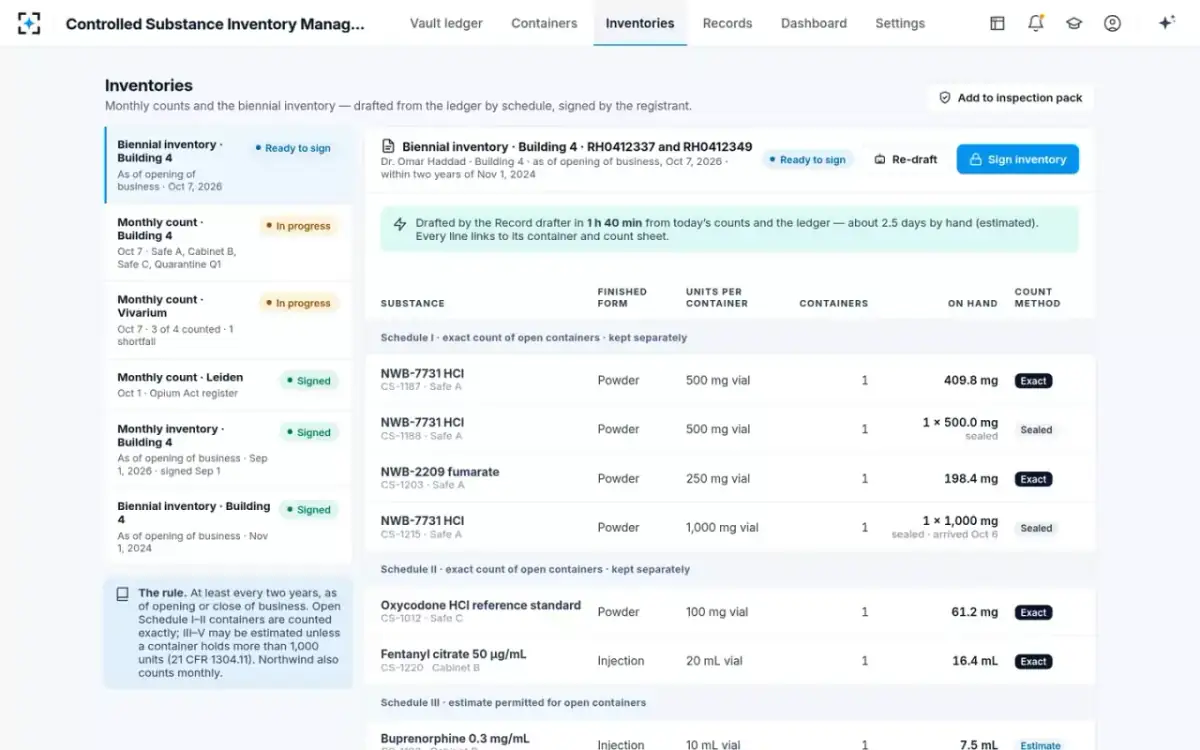
That freedom is a trap in one direction only. Because the window is measured from the previous date, a registrant who drifts later each cycle eventually drifts past it: an inventory taken on 1 November 2024 and the next on 14 November 2026 is late, and no amount of good counting in between repairs it. Many research programmes therefore count more often than the rules require — monthly, or weekly on Schedule I — and nominate one of those counts as the biennial inventory. The sample laboratory in the solution does exactly that: its October count on the first business day of the month is the ordinary cadence, and the Building 4 biennial inventory is drafted from it, as of opening of business on 7 October 2026, within two years of 1 November 2024.
Counting more often is a decision about how fast you want to find a difference, not about the rules. It is worked through in what a running balance costs against a monthly count.
Opening of business or close of business — and why you write down which
An inventory is a photograph, and the rules make you say when the shutter opened. "The inventory may be taken either as of opening of business or as of the close of business on the inventory date and it shall be indicated on the inventory" (21 CFR 1304.11(a)). Either choice is allowed; omitting the choice is not.
The reason is arithmetic, not ceremony. A container that received 20 mL in the morning and gave up 3.2 mL over the afternoon has two different correct balances on the same date, and an investigator reconciling your inventory against your movement records has to know which one you meant. "As of opening of business, 7 October" means the day's receipts and withdrawals belong to the next period. A count sheet with a date and no time basis cannot be reconciled against anything, and it is an easy defect to miss in a hand-kept research inventory.
In practice the choice should be a standing one, written into the standard operating procedure, so that every inventory in the file is comparable. Opening of business is the easier discipline in a research setting: the laboratory is quiet, the safes have not been opened, and nobody has to chase a withdrawal made at 16:40 while the count is being signed.
Exact count or estimate: what changes when a container is opened
Two things decide how a container is counted: its schedule, and whether it has been opened. An unopened commercial container is counted as containers — four 100-tablet bottles, six 3 mL vials — because the sealed quantity is known. Once the seal is broken, the rule for a dispenser or researcher splits by schedule: "(i) If the substance is listed in Schedules I or II, make an exact count or measure of the contents; or (ii) If the substance is listed in Schedule III, IV, or V, make an estimated count or measure of the contents, unless the container holds more than 1,000 tablets or capsules in which case he/she must make an exact count of the contents" (21 CFR 1304.11(e)(6)).
The same two containers, opened: one must be measured, one may be estimated
Opened Schedule II vial: An exact count or measure of the contents. No tolerance appears anywhere in the paragraph.
Opened Schedule IV bottle: An estimated count or measure of the contents — unless the container holds more than 1,000 tablets or capsules, when it must be counted exactly.
Opened Schedule II vial: Draw the residual volume, or weigh it and divide by the known density; write the measured figure, not the label quantity less what the log says.
Opened Schedule IV bottle: Read the fill line, or count the loose tablets to the nearest sensible unit; a litre of Schedule IV solution may still be estimated, because the exception counts tablets and capsules, not millilitres.
Opened Schedule II vial: Nowhere. A Schedule I or II container is exact at any size.
Opened Schedule IV bottle: A 5,000-capsule drum of a Schedule IV substance is counted exactly, one capsule at a time, by the same paragraph that lets you estimate the bottle beside it.
Opened Schedule II vial: An unexplained Schedule I–II shortfall is the branch that can start a reporting clock.
Opened Schedule IV bottle: An estimate that disagrees with the running balance is a prompt to look, not a measurement.
That caption carries the most expensive misunderstanding in this subject, so it is worth saying plainly: there is no DEA tolerance. A screening threshold is a decision about when a human being looks at a difference. It can be set at a balance's readability, at a pipette's precision, at zero; what it can never do is make a measured difference acceptable. On an opened Schedule I or II container the inventory records the measured quantity, and a gap between that and the expected balance is a question to be answered, however small. What to do with that question is the decision tree for a controlled substance discrepancy.
The estimate side has its own trap, in the other direction. "More than 1,000 tablets or capsules" is a count of solid dosage units. A one-litre bottle of a Schedule IV solution holds no tablets and no capsules, so the exception never reaches it, however large it is. Internal policies that round this to "more than 1,000 units" quietly invent an exact-count duty the rule does not impose, and then fail it.
What every line of an inventory must say
The content of a research inventory comes from 1304.11(a), (b) and (e)(6) together, and the Researcher's Manual sets it out as a list. Two of the eight are about the inventory as a whole, six are about each substance on it.
The eight things a research inventory has to state
- The date of the inventory
One date for the document, at the registered location it describes. 21 CFR 1304.11(a).
- Whether it was taken at opening or close of business
Indicated on the inventory itself, not inferred from when the sheet was signed. 21 CFR 1304.11(a).
- The name of each controlled substance
The substance, not the project code or the in-house abbreviation. 21 CFR 1304.11(e)(6) with (e)(1)(iii).
- Each finished form
For example a 10 milligram tablet, or a 390 mg/mL solution — strength and form, as the container is labelled.
- The number of units or volume in each commercial container
A 100-tablet bottle, a 3 mL vial: the container as it was supplied.
- The number of commercial containers of each finished form
Four 100-tablet bottles, six 3 mL vials. Unopened stock is counted this way.
- The total count of the substance
Exact for an opened Schedule I–II container, estimated where (e)(6)(ii) permits it.
- The awaiting-disposal list
Damaged, defective or impure stock, stock held for quality control, stock kept for compounding: name, total quantity, and why it is being kept. 21 CFR 1304.11(e)(1)(iv).
Nothing on that list is a name, a signature or a registration number. The DEA recommends those, and every competent programme includes them, but the eight items above are what the paragraph requires — which is why an inventory can be formally complete and still be impossible to defend. Who counts, who witnesses and who signs takes up the half the rule leaves to the registrant.
The biennial inventory as Controlled Substance Inventory Management drafts it, by schedule
Why Schedule I and II records are kept apart from everything else
Separation is a filing rule with teeth, and the DEA applies it to researchers explicitly. "The inventory records of schedule I and II controlled substances must be kept separate from all other records of the researcher", the Researcher's Manual says, citing 21 CFR 1304.04(g); Schedule III, IV and V inventory records may be kept separately or "in such form that the information required is readily retrievable from ordinary business records of the researcher". One drawer, or one clearly separable file, holds the Schedule I and II material and nothing else.
Two details get lost. The first: it is the records that are separated, not the substances. Nothing in 1304.04 tells you how to arrange your safe. The second: "readily retrievable" is a real standard, not a shrug. The DEA's definition turns on being able to separate the required items out of other records in a reasonable time, or on their being visually marked apart — asterisked or redlined on the page. A spreadsheet in which Schedule II lines sit among Schedule IV lines, distinguished only by a column a reader has to sort, is the case the rule was written about.
In software the separation is structural rather than physical: Schedule I and II movements and inventories are held and produced as their own set, so a Schedule II inventory can be handed to an investigator without carrying anything else with it. Which records may be kept electronically at all, and in what form, is a longer question — see what the rules allow for electronic controlled substance records.
When a substance already on your shelf becomes scheduled
This is the duty people meet unprepared, because the trigger arrives from outside. "On the effective date of a rule by the Administrator … adding a substance to any schedule of controlled substances, which substance was, immediately prior to that date, not listed on any such schedule, every registrant required to keep records who possesses that substance shall take an inventory of all stocks of the substance on hand" (21 CFR 1304.11(d)). The Researcher's Manual puts it in one line: "When a drug not previously listed as a controlled substance is scheduled, the drug must be inventoried as of the effective date of scheduling, if possessed by the registrant."
Read the qualifier carefully, because it does most of the work. The paragraph reaches a substance that was, immediately before that date, not listed on any schedule. A move from one schedule to another does not trigger it, and neither does a rule that makes a temporary placement permanent, because in both cases the substance was already listed. What triggers it is a first placement, and two recent ones show how routine that is.
Twenty-four months of one biennial window, and the two first placements that landed inside it
- Monthly counts; nothing dueNov 2024 – Sep 2026
- Biennial inventory7 Oct 2026
- No first placementNov 2024 – Aug 2026
- Cipepofol · IV27 Aug 2026
- Diphenidine · I21 Oct 2026
The practical difficulty is knowing you hold the substance. A laboratory that bought a research chemical in 2024 under a catalogue name may not connect it to a Federal Register notice naming it as "2-[(1R)-1-cyclopropylethyl]-6-isopropylphenol". The newly scheduled inventory is therefore a matter of keeping an inventory that can be searched by substance and synonym, and of someone reading the scheduling actions. Both are easier when every container already has a line of its own with its substance named on it.
Do you have to keep a running count between inventories?
No, and the rule says so in the same sentence that imposes the recordkeeping duty. Every registrant required to keep records "shall maintain, on a current basis, a complete and accurate record of each substance manufactured, imported, received, sold, delivered, exported, or otherwise disposed of by him/her, and each inner liner, sealed inner liner, and unused and returned mail-back package, except that no registrant shall be required to maintain a perpetual inventory" (21 CFR 1304.21(a)).
Two obligations hide in that sentence, and only one of them is excused. You are not required to keep a running total of what is on hand. You are required to keep a complete and accurate record of every movement, on a current basis — each receipt, each dispensing, each disposal, as it happens. A laboratory that writes its usage log up on Friday from memory has not avoided the perpetual inventory; it has failed the current-basis requirement, which is the one that is actually mandatory.
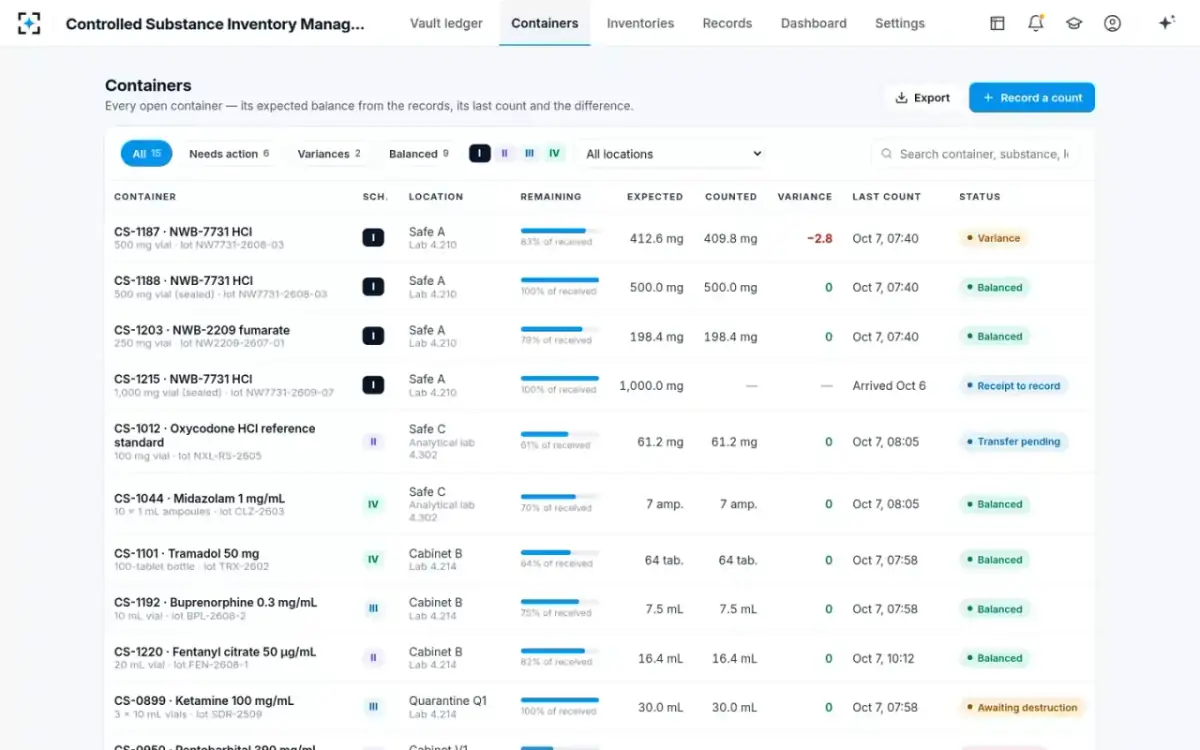
Which is why a running balance per container, though optional, is the cheapest thing a research programme can adopt. If the movements must be recorded as they happen anyway, totalling them costs nothing and turns count day from a reconstruction into a comparison.
One line per container, so an inventory is a comparison and not a reconstruction
Two years, readily retrievable, at the registered location
Inventories are kept, not filed away. Every inventory and other record required under part 1304 "must be kept by the registrant and be available for inspection and copying by authorized employees of the Administration, for at least 2 years from the date of such inventory or record" (21 CFR 1304.04(a)). The Researcher's Manual adds the form: at least two years, in a readily retrievable manner, for inspection and copying.
Two years is a floor, and a low one. Grant conditions, institutional policy and state controlled-substance rules can reach further, and a programme that destroys records at twenty-five months because the federal minimum has passed is making a decision it will not be able to revisit. Keeping them longer is free; the two-year line matters mostly as the point before which there is no argument at all.
Location matters as much as duration. An inventory is maintained at the registered location, and even registrants permitted to keep central records are told that "the records to be maintained at the central record location shall not include executed order forms and inventories, which shall be maintained at each registered location" (21 CFR 1304.04(b)(1)). A laboratory whose inventories live only on a server in another state, or in a filing cabinet in the institution's central compliance office, has moved the two documents that are not allowed to move.
What a research count has that a pharmacy count does not
Search for this rule and you will mostly find pharmacy answers, because their version is the one most often written up. Four differences matter enough to change how a research programme is run.
The unit of measure is continuous. A pharmacy counts tablets. A laboratory measures millilitres of a solution and milligrams of a powder weighed out on a balance that reads to a tenth of a milligram, often formulating a dosing solution from a solid. There is no natural indivisible unit, so a difference is a quantity rather than a missing object, and the exact-count duty on an opened Schedule I–II container is a measurement rather than a tally.
The record of use is not a prescription. There is no label, no patient and no dispensing system. The authoritative record of a withdrawal is a usage log entry written by the person who drew it, backed by a balance printout and a notebook page — three documents in three places, none of which was designed to be reconciled against the others.
One investigator may hold two or three registrations. Research in Schedule I and research in Schedules II–V are separate independent activities, so a laboratory working across both holds two registrations, and a separate registration is needed for each location where substances are stored. A separate inventory is made for each. What a researcher registration does and does not permit follows that line.
Nobody is watching the gap. A pharmacy's dispensing system typically keeps a running count. A laboratory's records often sit still until count day, so a difference can be found weeks after the movement that caused it, when the printout, the person and the memory have gone. On the fictional sample laboratory the median time to detect a variance is 4.2 hours, against roughly fifteen days under monthly counting — our own estimate, taken as about half a monthly cycle — and one inventory is prepared for signature in about 1.7 hours against roughly twenty working hours by hand, which is our estimate of the manual effort rather than a measured customer figure.
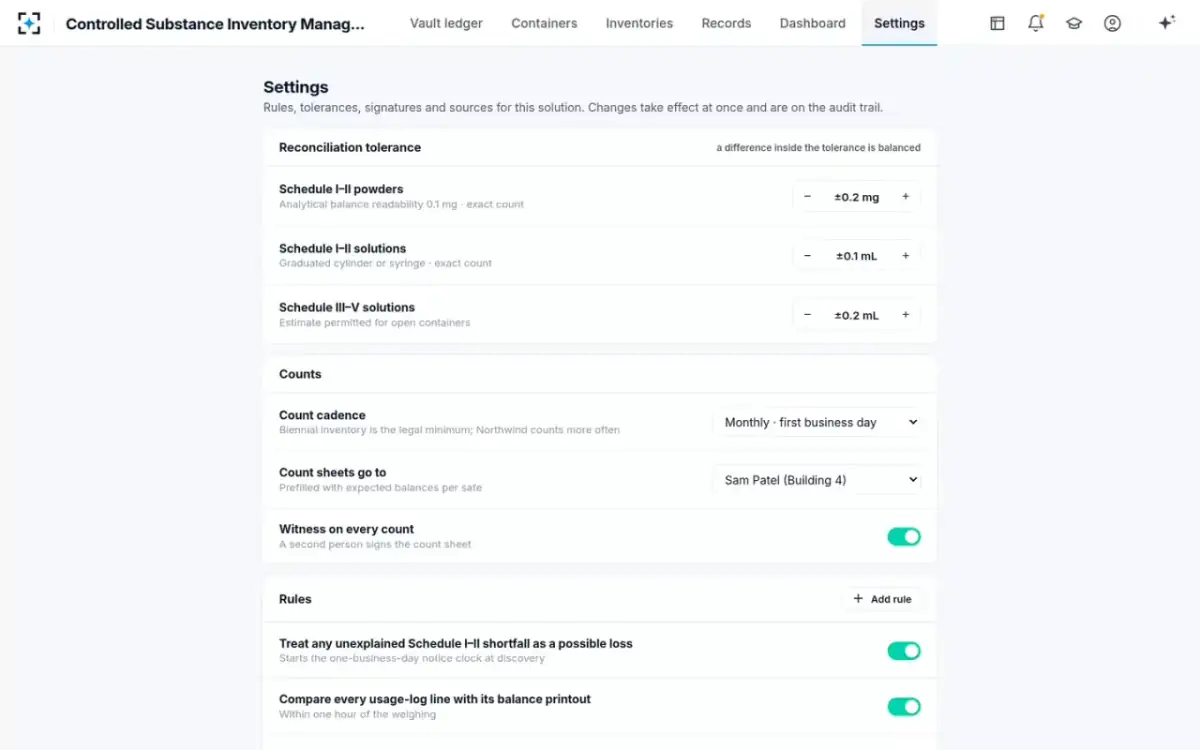
Count cadence, thresholds and witnesses as settings, not as habits
Four duties, eight items a line, two years on site, nothing posted to the DEA: the inventory rule is short enough to read in ten minutes and specific enough to fail on a single omitted time basis. See the counts, the running balances and the drafted inventories together on Controlled Substance Inventory Management.
Questions people ask
What is a biennial inventory, and when is it due?
It is the recurring physical count of all controlled substances on hand that follows the initial inventory, required at least every two years by 21 CFR 1304.11(c). It may be taken on any date within two years of the previous biennial inventory date, so the deadline moves with your own history rather than with the calendar. It needs the same information as the initial inventory, and no copy goes to the DEA.
Does a research lab have to take an initial inventory?
Yes. Every person required to keep records takes an inventory of all stocks on hand on the date they first engage in the manufacture, distribution or dispensing of controlled substances under the registration. If you hold nothing yet, the rule tells you to record that fact as the initial inventory — a documented zero, which also fixes the date the two-year clock starts running from.
How long do you need to keep DEA records?
At least two years from the date of the inventory or record, available for inspection and copying and readily retrievable. Inventories and executed order forms must be kept at the registered location even by registrants who have notified the DEA that they keep other records centrally. Institutional, grant or state requirements are often longer, and nothing stops you keeping them longer.
Do you send the controlled substance inventory to the DEA?
No. The DEA's Researcher's Manual states for both the initial and the biennial inventory that there is no requirement to submit a copy. The inventory is kept at the registered location and produced on inspection. That is precisely why the records underneath it matter: nobody checks the document until an investigator does, and then they check it against your movement records.
Can Schedule III–V controlled substances be estimated?
In an opened container, yes — an estimated count or measure is permitted, unless the container holds more than 1,000 tablets or capsules, in which case an exact count is required. The exception counts solid dosage units, so a large bottle of a Schedule IV solution may still be estimated. Unopened containers are counted as containers, whatever the schedule.
What happens when a drug on the shelf becomes a controlled substance?
If it was not listed on any schedule immediately before the rule took effect, you inventory all stocks of that substance on the rule's effective date, and it joins every biennial inventory after that. A move between schedules does not trigger this duty, because the substance was already listed. Two 2026 examples of a first placement are cipepofol, effective 27 August 2026, and diphenidine, effective 21 October 2026.