A significant loss of a controlled substance is whatever the registrant, applying six factors written into 21 CFR 1301.76(b), concludes is significant — there is no quantity, no percentage and no threshold anywhere in the rule, and the DEA has said in a rulemaking that no single standard could apply to every registrant. That is unsatisfying and it is deliberate: the same 4.5 mL is trivial in a hospital and alarming in a two-investigator vivarium. What the absence of a number actually requires is a written judgement — the factors, what the investigation found against each, and the conclusion — made by a named person who can be asked about it two years later. Botminds' Controlled Substance Inventory Management works each factor against the records, drafts the written notice and the Form 106 fields, and stops there: the call, and the signature, are the registrant's.
The worked assessment below is from a fictional sample laboratory in the solution — Northwind Bio's vivarium, container CS-0950 in Cabinet V1, on 7 October 2026. People, registrations and containers are invented; the rules, the quotations and the deadlines are not.
The only fixed numbers in a judgement call
0
quantities, percentages or thresholds in the rule that defines a significant loss
6
factors the registrant should weigh, five of them about context rather than quantity
1bus. day
from discovery to the written notice to your field division office
45days
from discovery to a complete and accurate DEA Form 106
There is no number: what the regulation actually says
The operative sentence is short, and everything people look for is missing from it. "The registrant shall notify the Field Division Office of the Administration in his area, in writing, of the theft or significant loss of any controlled substances within one business day of discovery of such loss or theft. The registrant must also file a complete and accurate DEA Form 106 with the Administration through DEA's Diversion Control Division secure network application within 45 days after discovery of the theft or loss" (21 CFR 1301.76(b)).
Note what the sentence does not contain: a definition of significant, a de minimis quantity, a schedule-dependent threshold, or any mention of percentages. The six factors that follow it are the whole of the guidance, and they are introduced as things the registrant "should consider" in determining whether a loss is significant — not as a test with a pass mark.
The DEA's guidance for research registrants is equally direct about where that leaves you. "Although the CSA and the regulations do not define the term 'significant loss,' it is the responsibility of the registrant to use their best judgment to take appropriate action. Whether a 'significant loss' has occurred depends, in large part, on the business of the researcher and the likelihood of a rational explanation for a particular occurrence. For example, what would constitute a significant loss for a researcher may be viewed as comparatively insignificant for a hospital or manufacturer" (Researcher's Manual, 2022).
DEA recognizes there is no single objective standard that can be applied to all registrants—what constitutes a significant loss for one registrant may be construed as comparatively insignificant for another. Any unexplained loss or discrepancy must be reviewed within the context of a registrant's business activity and environment.
DEA, final rule on reports of theft or significant loss, 70 FR 47094 (12 August 2005)
Read the second sentence again, because it is the one that is usually skipped. Any unexplained loss or discrepancy must be reviewed. The absence of a threshold is not permission to ignore a small difference; it is an instruction to think about every one of them in context. The judgement that follows can perfectly well be "not significant" — but it has to be a judgement, and it has to exist.
The six factors, one at a time, in a research setting
The factors are listed at 21 CFR 1301.76(b)(1)–(6): the actual quantity lost in relation to the type of business; the specific controlled substances lost; whether the loss can be associated with access by specific individuals or attributed to unique activities; a pattern of losses over a period, whether they appear random, and the results of efforts to resolve them; whether the substances are likely candidates for diversion; and local trends and other indicators of diversion potential.
Five of the six are about context rather than quantity, which is the point. Worked against a real shortfall they stop being abstract.
Six factors against one 4.5 mL shortfall
The actual quantity lost, in relation to the type of business
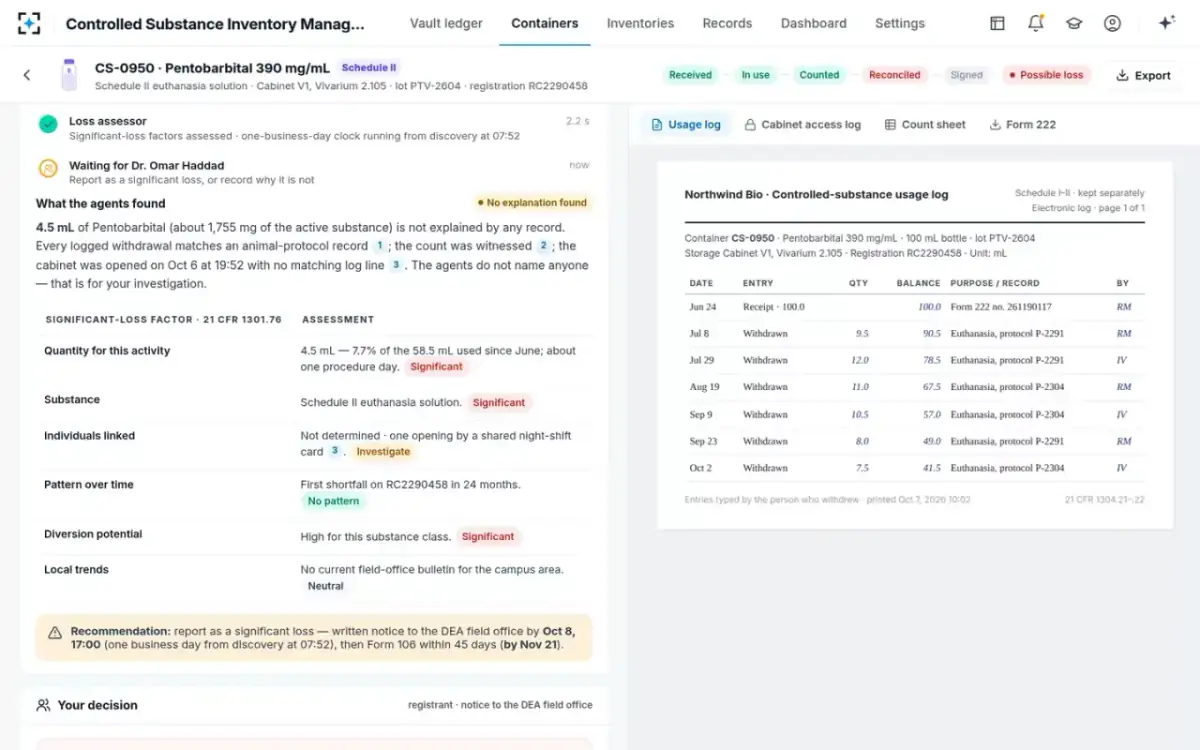
What the investigation found4.5 mL of pentobarbital sodium 390 mg/mL — 1,755 mg — from a cabinet in the vivarium with shared out-of-hours access.
What it arguesArgues for. A large hospital may handle this much routinely; a small research vivarium does not. The factor is explicitly relative to the registrant.
The specific controlled substance lost
What the investigation foundPentobarbital, a Schedule II barbiturate used here for euthanasia and terminal anaesthesia.
What it arguesArgues for. Schedule II, injectable, and lethal at the concentration held.
Whether it can be linked to access by specific individuals, or to unique activities
What the investigation foundThe cabinet was opened on 6 October at 19:52 with no corresponding log entry, using a shared night-shift card.
What it arguesArgues for — and is the reason the next step is an access review rather than a conversation with a named person.
A pattern of losses over time, whether they look random, and what has been done about them
What the investigation foundNo earlier unexplained difference on this container. Two differences elsewhere in the same count, both explained from records and closed.
What it arguesArgues against, weakly. It is also the factor that cannot be answered at all unless closed differences were written down.
Whether the substance is a likely candidate for diversion
What the investigation foundInjectable Schedule II barbiturate in a shared-access cabinet.
What it arguesArgues for.
Local trends and other indicators of diversion potential
What the investigation foundA question for the registrant and, if asked, the local diversion field office — not for a count sheet.
What it arguesUnresolved on the record available. An unresolved factor is not a neutral one.
Four of the six point one way, one points weakly the other, and one cannot be answered from the records at all. On that assessment the sample laboratory's recommendation is to report as a significant loss — and the sixth factor is the reason a registrant should pick up the telephone to the diversion field office before deciding rather than after.
Factor four is worth a separate warning. A pattern of losses over time can only be seen by a programme that writes down the differences it did not report. A laboratory whose file contains only its reported losses has, by construction, no evidence about patterns, and will answer factor four with "none known" every time until the day somebody reconstructs it from count sheets. Writing down every difference, whichever branch it took, is what makes this factor answerable.
When does the one-business-day clock start?
At discovery — and discovery is earlier than many procedures assume. It is not the day the investigation concludes, not the day the registrant accepts that the substance is gone, and not the day the compliance committee meets. The rule says "within one business day of discovery of such loss or theft", and the ordinary meaning of discovery is the moment a responsible person first has reason to believe that a controlled substance cannot be accounted for.
That reading is uncomfortable because it starts the clock while the facts are still soft, which is precisely why the DEA addressed it. In the 2005 final rule the agency wrote that it "does not disagree with these commenters and recognized the incremental nature of discovery in the preamble to the proposed rule when it suggested that an update be provided to DEA within 60 days of initial notification, if the investigation into the theft or significant loss is still ongoing, and that the Form 106 need not be filed at all if the registrant ultimately determines that no theft or significant loss occurred" (70 FR 47094).
So the design of the scheme is: notify early on incomplete information, update at 60 days if you are still working, and withdraw in writing if it turns out there was nothing. A procedure that waits for certainty before notifying has inverted it, and the gap it creates is the one an investigator notices — the count sheet dated the 7th and the notice dated the 23rd, with nothing in between that explains the delay.
Discovery in increments — DEA's own words on the hardest question
"Incremental" is the right word for what actually happens. A count comes up short at 07:52. By 08:30 the usage log has been read and there is nothing in it. By the afternoon the balance printouts and the notebooks have been read too. On the second day the access records come back and show an opening at 19:52 with no entry against it. Each of those is a step, and none of them is the dramatic moment of discovery that a procedure written around the word assumes.
A defensible resolution is this: discovery is the point at which a responsible person knows there is a quantity that the records do not account for, which in the sample laboratory is the moment the witnessed count on a Schedule II container came up 4.5 mL short with no entry to match. Everything after that is investigation, and investigation runs in parallel with the notice rather than before it. The notice says what is known and says that the investigation is open; the Form 106 and the 60-day update carry the rest.
One consequence is worth building into a procedure explicitly: weekends and public holidays are not business days, but nothing else stretches the clock — not a principal investigator who is at a conference, and not an institutional sign-off process. One business day is one business day from discovery. If the registrant who must sign is unreachable for three days, that is a problem to solve before it happens, not after.
The clock on the line, with the hours it has left
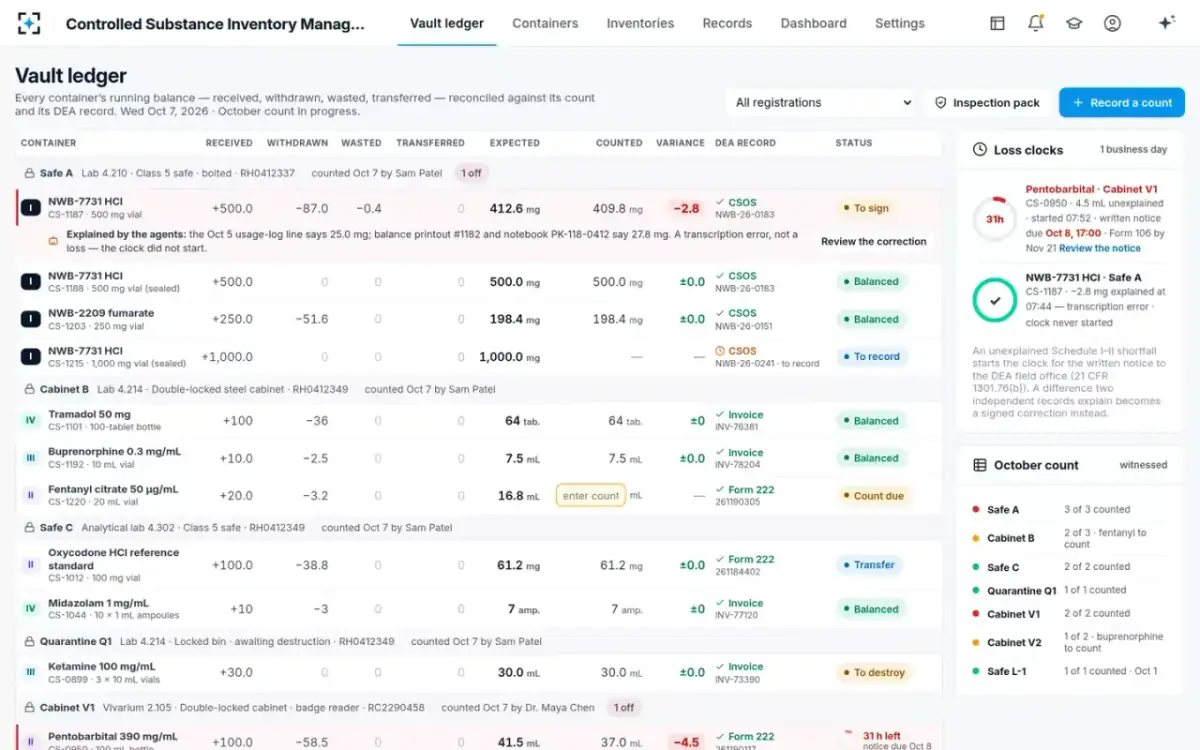
A written notice, directly to your field division office
Two words in the rule do more work than they look. In writing: a telephone call to a diversion investigator is not a notice, however helpful the call is. And the Field Division Office of the Administration in his area: the notice goes to your own local office, not to headquarters, not to a national mailbox, and — the DEA says this expressly in its guidance for researchers — not to a corporate security department or an internal compliance function in the expectation that they will pass it on. A corporation with multiple registered sites that channels notifications through a central department must still give notice directly to the local field office, in writing, and keep a copy.
That last point is easy for universities and institutes to get wrong, because the institutional reflex is to route anything involving a federal agency through a central office. Central review is sensible; it is not notification. The registrant whose name is on the registration is the one who owes the notice, and the copy kept on site is part of the record.
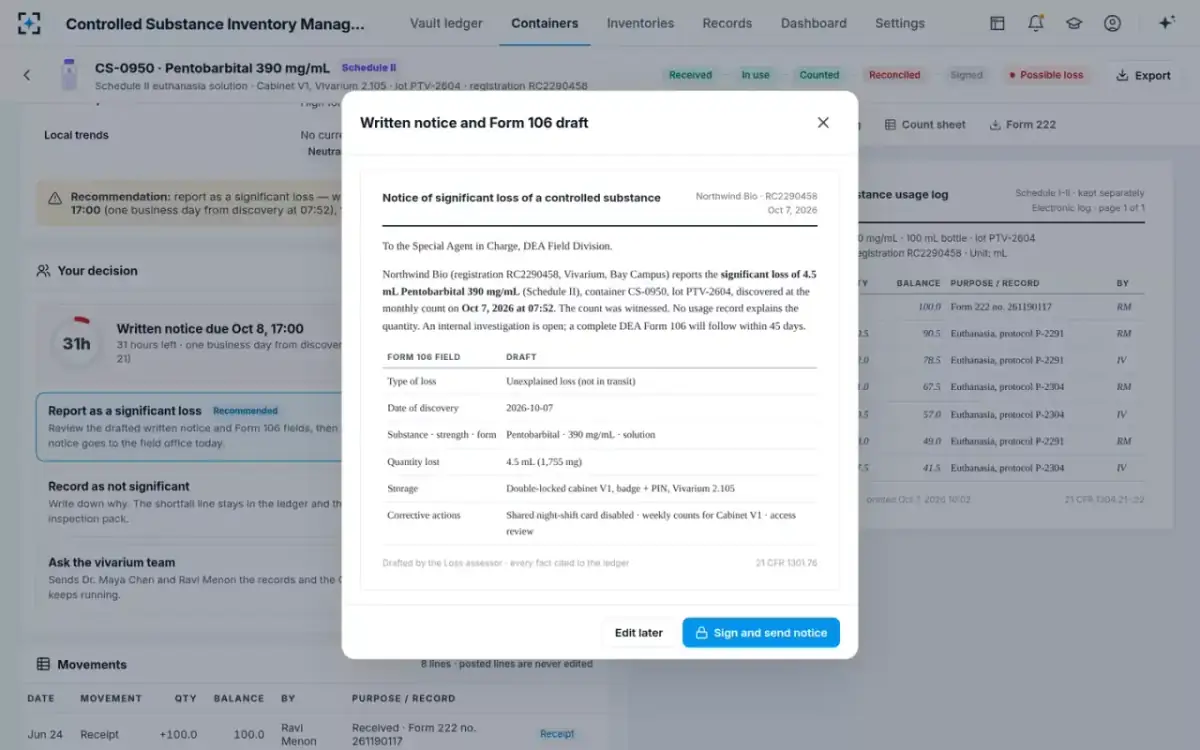
What the written notice carries, and what the Form 106 adds
- The registrant and the registration
Name and address of the researcher, and the DEA registration number the loss sits under. Where a laboratory holds two registrations, the notice names the one that held the substance.
- The substance, in full
Name, strength, dosage form and the size of the container — in millilitres for a liquid — or the corresponding National Drug Code.
- The quantity, as measured
Both the volume and the mass where both are meaningful: 4.5 mL of a 390 mg/mL solution is 1,755 mg, and an investigator will want the figure in the unit the substance is scheduled in.
- The date of the loss, or of discovery
If the date the substance went missing is unknown, the form takes the date it was discovered, which is also the date the clock runs from.
- How it was discovered
A witnessed monthly count, a biennial inventory, a reconciliation. This is where the notice shows that the registrant was looking rather than being told.
- Whether local police were notified
The Form 106 asks for the police department and a telephone number. Federal rules do not require a police report, but the DEA recommends notifying local law enforcement and state regulators.
- The type of incident
Theft, armed robbery, night break-in, employee pilferage, loss in transit — or, for most research shortfalls, an unexplained loss discovered on a count.
- Corrective action, and that the investigation is open
Not required by the rule, and worth including anyway: it is the paragraph that distinguishes a programme that found its own problem from one that was found out.
Form 106 within 45 days — and the 60-day update nobody mentions
The two deadlines in the rule are joined by a third that lives only in a preamble, and the third is the one that keeps a registrant honest when an investigation runs long.
Three deadlines, from one discovery
| What is due | When | Where it comes from | What happens if the facts change |
|---|---|---|---|
| Written notice to the field division office | Within one business day of discovery | 21 CFR 1301.76(b) — a rule | Nothing. The notice records what was known on the day; it is not a finding. |
| Complete and accurate DEA Form 106 | Within 45 days of discovery, through the DEA’s secure network application | 21 CFR 1301.76(b) — a rule | If the investigation establishes there was no theft or loss, the Form 106 is not filed at all — but the DEA is told so in writing. |
| Update on an open investigation | Within 60 days of the initial notification | 70 FR 47094 (2005) — a preamble, not rule text | This is the mechanism for saying "still open" rather than letting the file go quiet. |
| Written resolution where no loss occurred | When the investigation concludes | Researcher's Manual, 2022, Section VII | Explains why no Form 106 was filed and closes the initial report. |
The 45-day deadline rewards preparation in a way the one-business-day deadline does not. A Form 106 asks for container sizes, strengths, dosage forms, dates and identifying marks — the same fields that already sit on each container's line if a programme keeps one. Where they do not, forty-five days is spent assembling from paper what should have taken an afternoon, and the form is filed late or filed thin.
What if the investigation finds there was no loss?
Then no Form 106 is filed, and you say so in writing. The DEA's guidance is explicit: "If, after the initial notification to DEA, the investigation of the theft or loss determines no such theft or loss of controlled substances occurred, a DEA Form 106 does not need to be filed. However, for complete and accurate records, the registrant must notify DEA in writing of this fact in order to resolve the initial report and explain why no DEA Form 106 was filed regarding the incident" (Researcher's Manual, 2022).
This is the safety valve that makes early notification workable, and it is easy to forget. A registrant who notifies on day one, finds the explanation on day four and writes to the field division office on day five has a file that reads as a programme working correctly. A registrant who notifies on day one and then says nothing has left an open report sitting against the registration, which helps nobody.
The same discipline applies to a difference the registrant judges not to be significant in the first place. The DEA's recommendation there is to keep the paper: "If the registrant determines that the loss is not significant, DEA recommends that the registrant should place a record of the occurrence in a theft-and-loss file for future reference." That file is the answer to factor four the next time.
The losses that are significant only when you add them up
Nothing in this subject is more easily missed than the small, repeated shortfall, and the DEA names it directly: "Further, the loss of a small quantity of controlled substances, repeated over a period of time, may indicate a significant problem for a registrant, which must be reported."
Take a hypothetical: three tenths of a millilitre on a fentanyl container, seven times in five months, is 2.1 mL and a pattern. Assessed one count at a time, each instance is beneath anybody's notice; assessed together, it is the pattern the DEA's guidance warns about, and it is what diversion by a person with legitimate access, taking an amount small enough to be mistaken for measurement noise, would look like. This is also the exact failure mode an investigation threshold creates when it is treated as a tolerance: set a ±0.1 mL threshold, take 0.09 mL every time, and no line ever turns red.
Two things defend against it, and neither is a rule. The first is a written record of every closed difference, so a pattern can be seen at all. The second is looking at differences by container and by person over time rather than only by count, which is a reporting question rather than a counting one — see how to prove a reconciliation is right.
Breakage, spillage and in-transit loss are reported differently
Three categories sit outside this judgement entirely, and confusing them with it produces both kinds of error.
Witnessed breakage and spillage are not losses. The registrant can still account for the substance, so there is nothing to assess and nothing to notify; what there is instead is a destruction record or, for unrecoverable material, a DEA Form 41 signed by two people who saw it. What waste, breakage and spillage each have to record sets out the four cases.
In-transit loss belongs to whoever had custody. Where a shipment fails to reach its destination, the supplier reports the in-transit loss; once the purchaser has signed for or taken custody of it, any loss is the purchaser's to report on a Form 106. A research registrant who signs a courier's manifest for a carton and then finds a vial missing is reporting its own loss, not the supplier's.
And the Form 41 is not a reporting form at all. It records a destruction; it does not tell the DEA that anything went missing. Filing one in place of a Form 106 leaves the loss unreported, which is the more expensive of the two mistakes.
The assessment and the notice, drafted and unsent
What getting this wrong costs, in both directions
Under-reporting is the risk everyone thinks about: an unexplained shortfall that is never assessed, never written down and never notified is a recordkeeping failure as well as a reporting one, and the two travel together. The DEA's own advice when the call is genuinely close is to lean towards reporting — "if there is a question as to whether a theft has occurred or a loss is significant, a registrant should err on the side of caution and report it to DEA and local law enforcement authorities." What a recordkeeping failure actually costs sets out the published settlements.
Over-reporting has costs too, and they are usually discussed in whispers rather than in procedures. A notice naming a shortfall that a notebook page would have explained puts a scientist in a file that nothing ever unwrites, invites an inspection into a programme that was working, and burns the registrant's credibility for the notice that actually matters. The answer is not to report less. It is to search the records first and fast, so that the branch is chosen on evidence — which takes hours, not weeks, if the records are already posted against the container.
The balance between the two is why the assessment is worth writing down even when the conclusion is "not significant". A registrant who can produce a dated assessment showing six factors, what was found against each and who decided has answered the only question an investigator can fairly ask about a judgement call: did you actually make one?
The written notice and the Form 106 fields, filled from the records
Six factors, one business day, forty-five days and a judgement somebody has to sign. See the assessment, the notice and the records they are drawn from on Controlled Substance Inventory Management.
Questions people ask
DEA Form 106 time frame: how long do you have?
Forty-five days from discovery of the theft or loss, filed through the DEA's Diversion Control Division secure network application. That is separate from, and later than, the written notice to your field division office, which is due within one business day of the same discovery. Where the investigation is still open, the DEA's 2005 rulemaking suggested an update within 60 days of the initial notification.
Who signs the written notice to the DEA?
The registrant. The notice is owed by the person or institution whose registration held the substance, and routing it through a corporate security or central compliance function does not satisfy the requirement — the DEA must be notified directly, in writing, with a copy kept. A compliance lead can and should review it first; the signature stays with the registrant.
What if we decide it was not a loss after all?
Then no Form 106 is filed, and you write to the DEA to say so and to explain why, so the initial report is resolved rather than left open. If the difference never reached the point of notification, the DEA's recommendation is to keep a record of the occurrence in a theft-and-loss file, which is what lets you answer the pattern-of-losses factor honestly next time.
Does a small repeated loss have to be reported?
It may well have to. The DEA's guidance says that the loss of a small quantity repeated over a period of time may indicate a significant problem that must be reported, and the pattern of losses is one of the six factors by name. A programme that assesses each small difference in isolation, and keeps no record of the ones it closes, cannot see the pattern it is supposed to be weighing.
What is the difference between a DEA Form 106 and a DEA Form 41?
A Form 106 reports a theft or significant loss: something is unaccounted for. A Form 41 records a destruction: something was accounted for, and destroyed. They are not alternatives. Filing a Form 41 for unrecoverable spillage is correct; filing one instead of a Form 106 for an unexplained shortfall leaves the loss unreported.
What is the penalty for not reporting a significant loss?
Failing to make a required report or notification is a prohibited act under 21 U.S.C. 842(a)(5), the same paragraph that covers records, and the current maximum civil penalty for it in the Department of Justice's table at 28 CFR 85.5 is $19,246 per violation. In practice these matters are resolved by negotiated settlement: in July 2026 a West Virginia health system agreed to pay $4,177,139 to resolve allegations that included failures to notify the DEA of thefts or significant losses alongside other recordkeeping and reporting violations.