A controlled substance discrepancy is a difference between what a container's records say should be there and what the count found, and a usable discrepancy policy answers one question before any other: which record is missing? Almost every difference a research laboratory finds has one of six ordinary explanations — a withdrawal never logged, a waste never logged, a transcription error, recoverable breakage, unrecoverable spillage, or a count taken wrong — and each of those ends in a signed record rather than a report to a federal agency. The seventh branch, where nothing explains it, is the one that can start a one-business-day clock, and the only honest way to reach it is to have searched first. Botminds' Controlled Substance Inventory Management compares the expected balance with the count the moment it is entered and reads every source record for the explanation, so the branch is chosen from evidence rather than from the time of day.
The worked examples below come from a fictional sample laboratory in the solution — Northwind Bio, Building 4, on the morning of 7 October 2026. People, registrations, containers and lot numbers are invented. The rules and the quotations are not.
What a difference costs, by branch
6
ordinary explanations, each of which ends in a signed record and no call to the DEA
1branch
where nothing explains it — the only one the reporting rule reaches
1bus. day
from discovery to the written notice, if that branch ends in a significant loss
4.2h
median time to find a difference on the sample laboratory, against roughly 15 days at monthly counts
The first question is not "how much" but "which record is missing"
The instinct when a count comes up short is to ask how much, and then to ask whether that much is serious. Both questions are premature. A quantity on its own carries no information about what happened to it, and a programme that grades differences by size before it has looked for records will report a witnessed waste as a loss and close a genuine theft as a rounding error.
The useful first question is narrower: of the records that should exist for this container, which one is absent or disagrees? That question has a small number of answers, and each answer determines everything that follows — who signs, what gets written, and whether anyone outside the building hears about it. Working the branches in order is faster than arguing about materiality, and it is the only approach that produces a file an investigator can follow two years later.
The sample laboratory's October count makes the point in one container. Fentanyl citrate 50 µg/mL, container CS-1220 in Cabinet B, received 20.0 mL against DEA Form 222 number 261190305. The usage log showed 3.2 mL withdrawn across five surgeries for protocol P-2287, so the expected balance was 16.8 mL. The count was 16.4 mL. The difference was 0.4 mL — 2% of what had ever been in the container, and an amount small enough that a monthly reconciliation done by hand would very likely have absorbed it.
Of the 3.6 mL that ever left this container, one part in nine never reached the usage log
Container CS-1220, fentanyl citrate 50 µg/mL: every millilitre that left it before the October count
- In the usage log — 3.2 mL withdrawn across five surgeries for protocol P-2287 · 89%
- Not in the usage log — 0.4 mL wasted, witnessed, written only in a notebook · 11%
Six ordinary explanations for a difference in a research lab
The branches below are in the order they are worth checking — roughly from the cheapest to rule in or out to the most expensive — and each names the record that settles it. Only the last one is a loss.
One difference in, seven branches out
1 · A withdrawal that never reached the log
What it looks likeThe container is short by a quantity that matches a study day, and somebody worked on it.
The record that settles itThe notebook page, the balance printout and the animal or protocol record for that date.
What you doPost the missing entry as a new, dated, signed line. Nothing already written is altered.
Does the DEA hear about itNo. The substance is accounted for.
2 · A waste that never reached the log
What it looks likeA withdrawal is logged in full, but only part of it was used.
The record that settles itThe notebook page naming the waste, the witness, and what it was wasted into.
What you doPost the waste entry, signed by the person who wasted it and carrying the witness.
Does the DEA hear about itNo. Witnessed waste is not a loss.
3 · A transcription error
What it looks likeThe difference is an exact, implausible round number, or a digit transposition.
The record that settles itTwo independent records of the same event — a balance printout and a notebook page.
What you doA correction line that cites both records and names the figure it replaces. The original stays visible.
Does the DEA hear about itNo. The record was wrong, not the quantity.
4 · Recoverable breakage
What it looks likeA vial broke, an ampoule cracked, the contents are still there and still identifiable.
The record that settles itWho saw it, when, and what was recovered.
What you doDestroy on site or send it to a reverse distributor, and keep the destruction record.
Does the DEA hear about itNo, so long as it is witnessed and recorded.
5 · Unrecoverable spillage
What it looks likeIt went on the floor, down the drain, into the bedding; nobody can get it back.
The record that settles itTwo people who can testify to what they saw.
What you doRecord the circumstances and the quantity, on a DEA Form 41, signed by both witnesses.
Does the DEA hear about itNo. The registrant can still account for it.
6 · The count itself was wrong
What it looks likeA sealed vial counted as opened, millilitres read as milligrams, the wrong container, a tare left on.
The record that settles itThe count sheet, the container label, the balance printout, and a second count.
What you doRecount with a witness, then record both counts and why the first was set aside.
Does the DEA hear about itNo. There was never a difference.
7 · Nothing explains it
What it looks likeEvery record has been searched and the quantity is still missing.
The record that settles itWhatever the investigation can still establish: access records, timing, who had keys.
What you doAssess it against the six significant-loss factors, and decide, as the registrant, whether to report.
Does the DEA hear about itPossibly. This is the only branch with a deadline on it.
Two branches deserve their reputation as the usual suspects. A withdrawal that never reached the log and a waste that never reached the log are the same human failure — a person at a bench with gloves on, a notebook open and a usage log two rooms away — and in a laboratory they are the first two places to look. Both are fixed the same way: by a late, dated, signed entry that says what happened and when, posted as a new line rather than written over an old one.
The records that explain a difference are mostly not DEA records
Here is the uncomfortable part. The records the rules require a registrant to keep — order forms, receipts, inventories, the usage log — are exactly the records that have already failed when a difference appears. If the usage log were complete, the balance would reconcile. The documents that actually explain a difference are, nearly always, documents nobody keeps for the DEA's benefit: a surgery notebook page, an analytical balance printout, an animal protocol record, a badge reader's history, an email about a cancelled experiment.
That is why a discrepancy procedure that only looks at controlled-substance paperwork has a built-in blind spot, and why the branch "nothing explains it" can be reached by laboratories whose answer was sitting in a notebook on the bench. In the sample case, the solution read nine records to settle 0.4 mL: the usage log, the Form 222, the count sheet and six scanned surgery-notebook pages for protocol P-2287. The answer was on one of them: page 52 of notebook SR-2287-114.
The eight places to look before you call a difference unexplained
- The usage log for the container
The starting point and the thing most likely to be incomplete. Read it for the dates around the difference, not just for its totals.
- Analytical balance printouts
A weighing has a before and an after. The difference between two masses is the hardest number in the room to argue with, and it is timestamped.
- Laboratory and surgery notebooks
Where a scientist actually writes what they drew, dosed and discarded. Scanned pages count; the entry is contemporaneous even if the log entry is not.
- Protocol and animal records
Doses given, animals excluded, procedures abandoned. An animal excluded at weigh-in is a common reason a drawn dose is only partly used.
- Receipts, order forms and packing slips
The Form 222 or CSOS order fixes what arrived. A receipt posted at the labelled quantity when the vial was short is a difference created on day one.
- Count sheets, including the previous one
A difference that appeared between two counts is bounded in time. A difference that was present at the last count and missed is a different problem.
- Cabinet and room access records
Badge and PIN openings matched against log lines. An opening with no corresponding entry is not proof of anything, but it is a question worth asking.
- Destruction, transfer and reverse-distributor records
Stock sent out for disposal, or moved to another registered location, that was taken off the shelf but never taken off the line.
A missing waste line looks exactly like a loss — until you read the notebook
Work the sample container through. At 10:12 the Building 4 lab manager entered 16.4 mL on CS-1220's line, witnessed, and the line turned red at −0.4 mL. On the solution's settings that is outside the laboratory's own ±0.1 mL investigation threshold for a Schedule II solution, so the line was treated as a possible loss while the records were read. Nothing about those few minutes is regulatory: the threshold is the registrant's setting for when a human being looks, not a quantity the DEA allows to go missing.
The explanation was on page 52 of surgery notebook SR-2287-114. On 3 October a research scientist drew 1.0 mL, gave 0.2 mL to each of rats R-31 to R-33, and wasted the remaining 0.4 mL to the drug-waste bin when R-34 was excluded at weigh-in, witnessed by the lab manager. The usage log for that day recorded 0.6 mL withdrawn and no waste. Two records — the notebook page and the witness — agreed, so the 0.4 mL was never missing; it was unwritten.
The explanation Controlled Substance Inventory Management found, and the page it came from
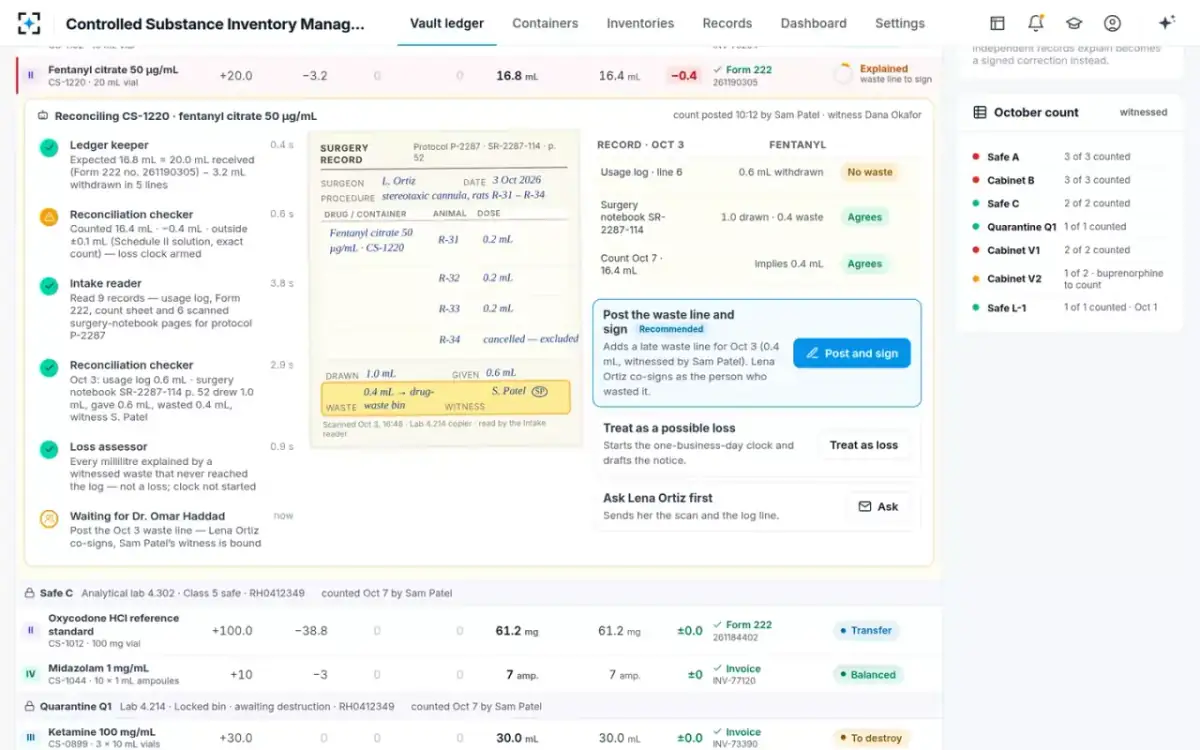
What follows matters as much as the finding. The waste was posted as a new, dated line for 3 October — nothing already posted was edited — signed by the registrant with the meaning of the signature bound to it, co-signed by the scientist who did the wasting, and carrying the witness. The container then balanced at 16.4 mL expected against 16.4 mL counted, and no clock ever started. What waste, breakage and spillage each have to record takes that branch further.
The same −0.4 mL, read two ways
Read without the notebook: A usage log that accounts for 3.2 mL of 20.0 mL, and a count 0.4 mL below the expected balance.
Read with the notebook: The same log, plus a notebook page recording a witnessed waste of 0.4 mL on 3 October that was never entered.
Read without the notebook: An unexplained shortfall of a Schedule II substance.
Read with the notebook: A recordkeeping omission: a waste entry made late.
Read without the notebook: An assessment against the six significant-loss factors, and a decision — in writing — whether to notify the field division office.
Read with the notebook: A dated, signed waste entry, co-signed by the person who wasted it, with the witness bound to the line.
Read without the notebook: Potentially the DEA field division office within one business day, and a Form 106 within 45 days.
Read with the notebook: Nobody outside the laboratory. The substance is accounted for.
Read without the notebook: A report of a loss that did not happen, and a scientist named in a file that never gets unwritten.
Read with the notebook: If the notebook page had not been read, the branch on the left — on the same facts.
Transcription: when three records disagree, which one wins?
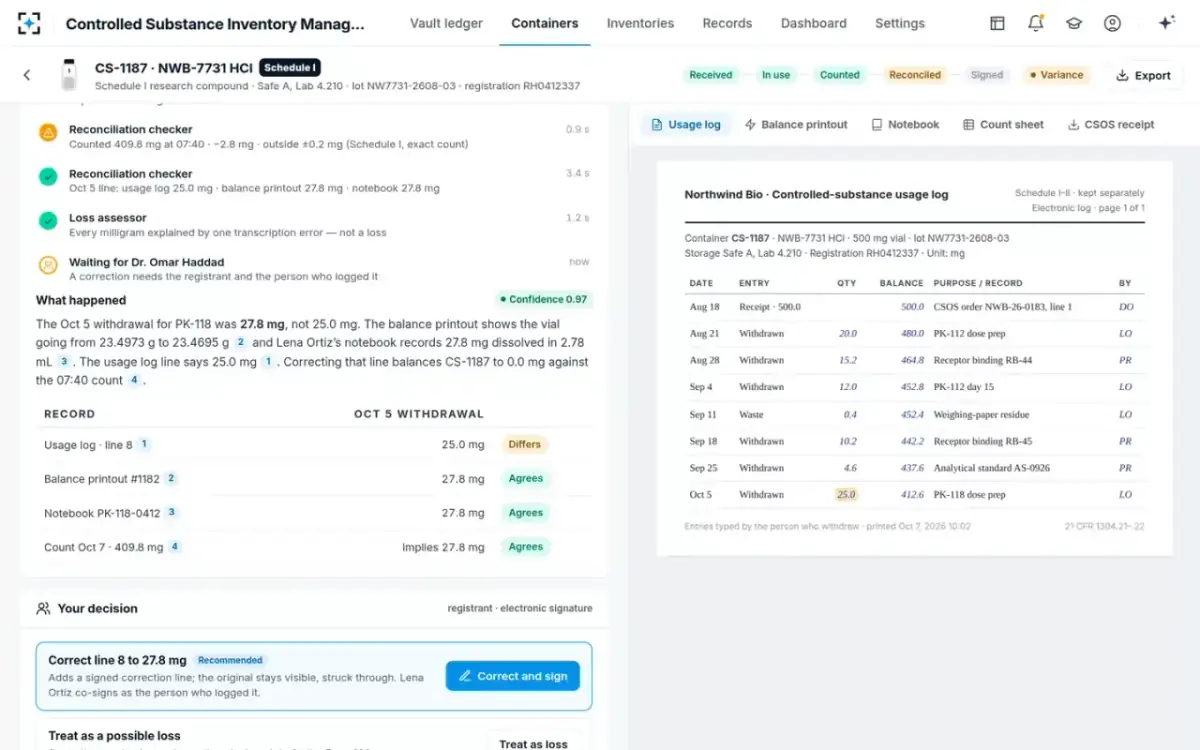
The second difference on the same morning was in Safe A: container CS-1187, 2.8 mg short on a Schedule I research compound. The 5 October usage-log line said 25.0 mg had been weighed out for study PK-118. Balance printout number 1182 showed the vial going from 23.4973 g to 23.4695 g — a difference of 27.8 mg. The scientist's notebook recorded 27.8 mg dissolved in 2.78 mL. Two independent records agreed on 27.8 mg; one said 25.0 mg.
The rule of thumb that resolves this is not "the newest record wins" or "the controlled-substance record wins". It is that a record made by an instrument, at the moment of the event, beats a figure a person wrote down afterwards — and that no single record settles anything on its own. The balance printout is contemporaneous and mechanical; the notebook entry is contemporaneous and independent of it; the usage log entry was written from memory at the end of a procedure. Where the two independent records agree and the third does not, the third is the error.
Correcting it is a recordkeeping act with a signature attached, not an edit. The correction is posted as a new line citing both supporting records and naming the figure it replaces; the original line stays visible, struck through; and it is signed by the registrant and co-signed by the person who made the original entry, because a correction to somebody else's record made without them is how a laboratory loses the ability to say what actually happened.
A correction, with the two records it rests on
Breakage and spillage sit on their own branch
Breakage and spillage feel like losses and are not, and the DEA has said so twice in writing. In its 2003 proposed rule and guidance on theft and loss reporting, the agency wrote that "if controlled substance containers are broken or damaged, or controlled substances spilled, the substances are not considered 'lost' because they can be accounted for" (68 FR 40576). The Researcher's Manual repeats that principle for research registrants and draws the practical conclusion from it: a witnessed breakage or spillage is not a loss, because the registrant can still account for the substance, and such incidents do not require notification to the DEA.
Read the qualifier. Witnessed. The reason a broken vial is not a loss is that somebody can say where the substance went, which makes the account complete. A vial that is found broken in the morning, with nobody able to say when or how, is not on this branch at all; it is on branch seven, and the broken glass is evidence rather than an explanation.
The two sub-branches then separate on one fact: is any of it recoverable? If it is, the substance is disposed of properly — destroyed on site or sent to a registered reverse distributor — and the destruction record is kept. If it is not, the circumstances are documented and, in the DEA's stated position, recorded on a Form 41 signed by two people who can testify that it happened.
What makes an explanation good enough to close a difference
"We think it was probably a waste" is not an explanation; it is a hope with a quantity attached. A test that holds up is simple to state and hard to fudge: an explanation closes a difference when it names the event, the date, the quantity and the person, and when it is supported by at least two records that do not depend on each other.
Independence is the part that gets skipped. A usage log and a count sheet filled in by the same person from the same memory are one record written twice. A balance printout and a notebook page are two, because one came from an instrument and the other from a hand. A notebook page and a witness who remembers the event are two. The sample laboratory's agents are held to exactly this: an explanation stands only when two independent records support it, and no agent ever closes a difference — the registrant does, with a signature.
The second half of the test is arithmetic. The explanation has to account for the whole difference, not most of it. A waste of 0.4 mL explains a 0.4 mL difference; it does not explain 0.9 mL with the remaining 0.5 mL left as a rounding allowance. Where an explanation covers part of the quantity, the rest is its own difference and goes back to the top of the tree.
When nothing explains it: the branch that starts a clock
The third difference that morning took the seventh branch. Container CS-0950 in Cabinet V1, pentobarbital 390 mg/mL, was 4.5 mL short. Every logged withdrawal matched an animal-protocol record, the count had been witnessed, and there was no notebook page, no balance printout and no waste entry that reached the quantity. What there was instead was a badge opening of the cabinet on 6 October at 19:52 with no corresponding log line.
At that point the question changes from "what happened to it" to "is this a significant loss", and the second question belongs to the registrant alone. The rules give six factors — the quantity in relation to the type of business, the specific substances, whether the loss can be linked to access by particular individuals or to unique activities, a pattern of losses over time, whether the substances are likely candidates for diversion, and local trends (21 CFR 1301.76(b)) — and no threshold. The Researcher's Manual is blunt about where that leaves you: "the burden of responsibility is on the registrant to identify what is a significant loss and make the required report to DEA."
What a well-run programme does here is assemble, not decide: set out each factor with what the investigation found, draft the written notice and the Form 106 fields so that the one-business-day deadline is not spent typing, and leave the decision and the signature with the registrant. It also refuses to name anybody. Identifying who is responsible is the registrant's own investigation and, if it comes to it, law enforcement's; a system that guesses contaminates both. What counts as a significant loss works through all six factors and the deadlines.
How quickly must a controlled substance discrepancy be resolved?
The federal rules set no deadline for resolving a difference. They set a deadline for reporting one kind of outcome — a theft or significant loss, notified in writing within one business day of discovery — and they require, separately, that records be kept "on a current basis" (21 CFR 1304.21(a)). Between those two there is a gap that every registrant has to fill with its own policy.
The nearest thing to a published standard comes from the professional guidance written for hospital practice. The ASHP guidelines on preventing diversion of controlled substances recommend that discrepancies "be reported to the supervisor in charge and resolved as soon as possible upon discovery, preferably no later than the end of the work shift" (ASHP Guidelines, American Journal of Health-System Pharmacy, 2022). That is a hospital's cadence, where a cabinet is opened many times a day, and a research laboratory does not have to adopt it. It is a reasonable floor to argue down from, though, and it has an advantage no deadline chosen in-house has: it is somebody else's recommendation, published, and dated.
There is also a practical reason the end of the shift is the right ambition, and it has nothing to do with rules. The records that explain a difference decay. A scientist remembers on Wednesday what they did on Tuesday; by the following month the notebook is still there but the context is not, the printout has been recycled, and the person has moved to another study. Speed is not compliance theatre here. It is the difference between branch two and branch seven.
Writing the difference down, whichever branch it took
Every branch ends in a record, including the ones that end in nothing happening. A difference found, investigated and explained still gets written down: the date it was found, the quantity, the branch it took, the records relied on, who decided and who signed. A difference found and judged not significant gets written down too — the Researcher's Manual recommends keeping a record of the occurrence in a theft-and-loss file for future reference, and that file is also what answers the fourth significant-loss factor, the pattern of losses over time, the next time anybody asks.
The reason to insist on this is that the fourth factor cannot be answered by memory. A laboratory that writes down only the differences it reported has, by construction, no way of knowing whether it has a pattern of small unexplained shortfalls, which is precisely the situation the Researcher's Manual warns about. The file of closed, unreported differences is not paperwork for its own sake; it is the evidence base for the next judgement call.
One more discipline is worth the trouble: write down the branch, by name, every time. A file of differences that each say "resolved" tells you nothing. A file in which forty-one say "waste entered late", six say "transcription" and two say "unexplained — assessed, not reported" tells a registrant, an institutional committee and a diversion investigator the same true story, and it is the raw material for fixing the process rather than the symptom.
A count entered on the line, and the clock the solution arms while the records are read
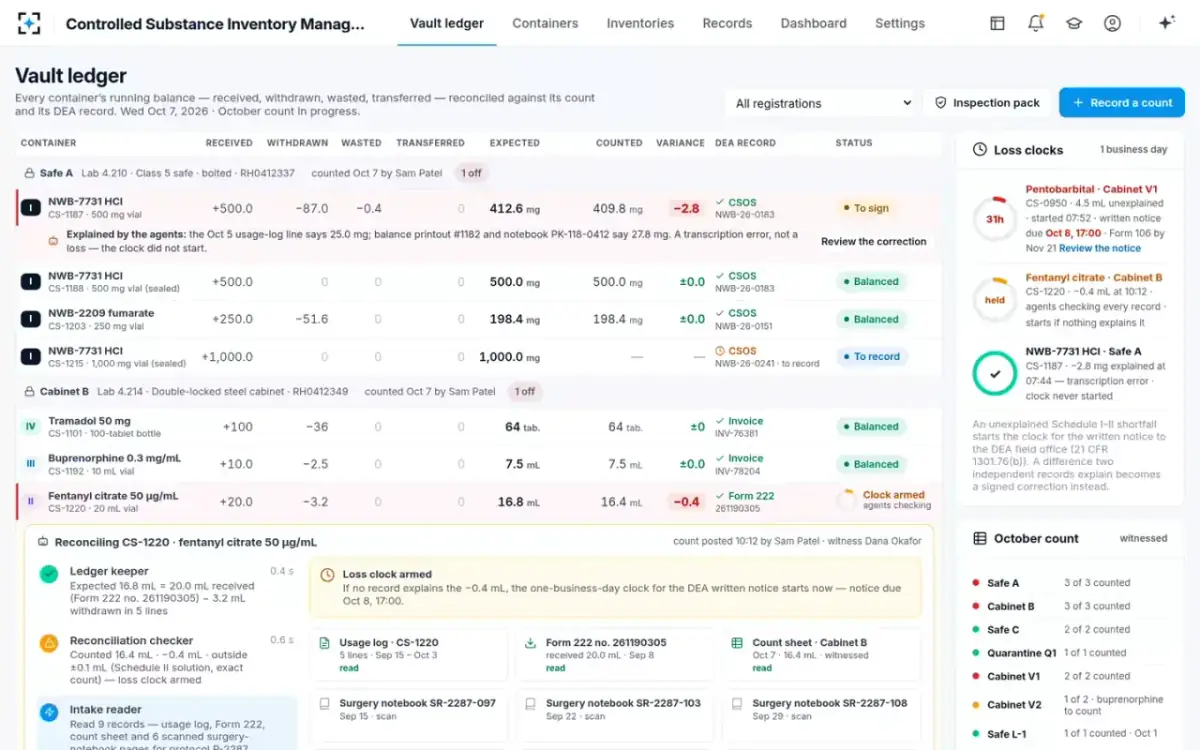
Six branches and a seventh is the whole of it. See the counts, the record searching and the signed corrections in one place on Controlled Substance Inventory Management, or read how to prove a reconciliation is right before you trust one.
Questions people ask
What is a controlled substance variance?
Variance, discrepancy and difference all name the same thing: a gap between the quantity a container's records account for and the quantity a physical count found. The word carries no legal meaning on its own — nothing in the federal rules defines it — and a variance is not a loss until a registrant has searched the records and concluded that the substance cannot be accounted for.
Do you have to report every discrepancy to the DEA?
No. The reporting rule reaches a theft or a significant loss, not a difference. Six of the seven branches end in a record kept on site: a late entry, a correction, a destruction record or a recount. Only an unexplained shortfall that the registrant judges to be a significant loss triggers the written notice within one business day and the Form 106 within 45 days.
Is a transcription error a controlled substance loss?
No, provided the correct quantity can be established from records that do not depend on the one in dispute. A balance printout and a notebook page that agree on 27.8 mg against a usage log that says 25.0 mg describe a record that was written wrong, not a substance that went missing. It is fixed by a signed correction line that cites both records and leaves the original visible.
Is spilled drug a loss?
Not if it was witnessed. The DEA's position is that witnessed breakage or spillage does not constitute a loss, because the registrant can still account for the substance, and that such incidents do not require notification. Unrecoverable spillage is recorded on a Form 41 signed by two people who can testify to what they saw; recoverable material is destroyed or sent to a reverse distributor, with the record kept.
How many records should support an explanation?
At least two that are independent of each other, and together they have to account for the whole quantity. Two documents written by the same person from the same memory are one record. A balance printout and a notebook page, or a notebook page and a named witness, are two. Where the explanation covers only part of the difference, the remainder goes back to the top of the tree.
What happens when a controlled substance count is off?
Recount the container with a witness first, because a mis-count is both the easiest explanation and the easiest to eliminate. If the second count agrees with the first, search the records in order — usage log, balance printouts, notebooks, protocol records, receipts, previous count sheets, access records, destruction and transfer records — and name the branch. Write the result down whichever branch it is; only the seventh can lead to a report to the DEA.