No. DEA does not require a perpetual inventory of controlled substances, and the regulation says so in a clause most people have never read: a registrant must keep a complete and accurate record of each substance received, delivered or otherwise disposed of, "except that no registrant shall be required to maintain a perpetual inventory". That single exception is why this decision is yours and why the arithmetic is worth doing properly. A monthly count cycle is lawful, cheap on paper, and buys you a discovery delay of roughly half a cycle plus a day of reconstruction work for every difference — while the cost of being wrong is set per violation and multiplied by occasions, which is how one fertility centre's records became 685 alleged violations. This guide prices both sides, using Botminds' Controlled Substance Inventory Management for the labour figures and published federal sources for the penalties.
Every figure below is labelled. The laboratory ones come from a fictional sample site — Northwind Bio, Bay Campus — and are marked as sample data, as design targets, or as our own estimates. The penalty and settlement figures are the published ones, linked where they appear.
The four numbers that frame the decision
$19,246
maximum civil penalty per recordkeeping violation, current amount
28 CFR 85.5
685
separate occasions of alleged recordkeeping violation in one DOJ civil settlement
Yale, 2022
$4,177,139
paid in a 2026 settlement covering recordkeeping and reporting failures
WVUHS, 2026
None
perpetual inventory required by the regulation
21 CFR 1304.21(a)
Does DEA require a perpetual inventory? The surprising answer, and the sentence it rests on
The answer is no, and it is written into the general recordkeeping requirement itself. 21 CFR 1304.21(a) obliges every registrant to maintain, on a current basis, a complete and accurate record of each substance manufactured, imported, received, sold, delivered, exported or otherwise disposed of — and then closes with the exception that no registrant shall be required to maintain a perpetual inventory.
…except that no registrant shall be required to maintain a perpetual inventory.
21 CFR 1304.21(a)
Read carefully, the two halves say something more precise than "you need not count". What is required is a current, complete and accurate record of every movement: each receipt, each withdrawal, each waste, each transfer, each destruction, recorded as it happens. What is not required is that those movements be added up continuously into a running figure per container. The records must exist; the arithmetic may wait.
Two other requirements set the outer bounds of waiting. An inventory must be taken at least every two years, and the initial and biennial inventories are themselves required records. And the one-business-day clock for notifying a field office of a theft or significant loss runs from discovery — which means that the later you discover, the later you report; the reporting rule itself puts no deadline on discovery. That asymmetry is the heart of the trade-off on this page, and it is also why a laboratory with a long count cycle should be careful about how it describes its controls.
So why do so many programmes keep a running balance anyway?
Because the regulation's requirement to keep records "on a current basis" is only half of what a registrant actually needs. The other half is the ability to explain a difference, and that ability decays fast.
A difference discovered the morning it occurs can be explained from records that still exist: the balance printout is in the drawer, the scientist is at the bench, the surgery notebook page is this week's, and the person who witnessed a waste remembers witnessing it. The same difference discovered five weeks later has lost all four. Nothing about the regulation changed in those five weeks; what changed is that an explainable event became an unexplained shortfall, and an unexplained Schedule I–II shortfall is the thing that starts a clock and a conversation. What to do when a count does not match follows that path from the first red line.
There is also a scale argument that is easy to miss. DEA's registrant population is very large — the Government Accountability Office reported "approximately 1.4 million individual registrations" in DEA's registration system as of March 2014 (GAO-16-310) — and the inspection resource is not proportional to it. A research registrant may go years between visits. That is a reason to keep your own arithmetic current rather than a reason to relax: the first thorough review of your records may cover everything since the last one.
Where the hours go to prepare one inventory for signature
Ask a compliance lead what an inventory costs and the answer is usually "a couple of days", which is true and unhelpful, because the days are not spent where people think. The physical count is not the expensive part. Reassembling the paper that explains the count is.
One registration's inventory, after the physical count: where the hours go
By hand — about 20 working hours, roughly 2.5 days
- Pulling usage logs, printouts and notebook pages together · 20%
- Running-balance arithmetic, container by container · 25%
- Tracing each difference back to its records · 30%
- Separating Schedule I–II, estimating Schedule III–V · 15%
- Drafting and checking the inventory for signature · 10%
With agents — about 1.7 hours
- Pulling the records together · 12%
- Running-balance arithmetic · 6%
- Tracing each difference back to its records · 29%
- Separating Schedule I–II, estimating Schedule III–V · 18%
- Drafting and checking for signature · 35%
Two things in that split are worth sitting with. The first is that the arithmetic — the part a spreadsheet is supposed to solve — is only a quarter of the work. The second is that tracing differences still takes nearly a third of the second bar after the mechanical parts collapse, because it is the part where a person reads a record and decides what it means. Automation moves the ratio; it does not move the responsibility.
The arithmetic of a monthly cycle: discovery delay, by design
A count cycle sets an expected discovery delay, and the expectation is simple: a movement is equally likely to occur anywhere in the cycle, so on average it waits half a cycle to be noticed. A monthly cycle therefore has a built-in delay of roughly fifteen days — not as a failure, but as its design.
That estimate is ours, and the honest way to state it is as arithmetic rather than as a measurement. In the sample laboratory the solution's own median time to detect a variance is 4.2 hours on sample data; the fifteen days it is sometimes compared with is our estimate of half a monthly cycle, not something anyone measured. Keeping those two labels apart matters more than the comparison does.
The same 0.4 mL difference on two clocks
- Movement occurs, unloggedday 0
- Waiting for the next countabout 15 days
- Reconstructing the records by hand, about a day1 day
- Movement occurs, unloggedday 0
- Counted, read, explained, signedhours
The delay has a second cost that does not appear on any clock. Records degrade in a particular direction: the ones that disappear first are the informal ones — the printout, the notebook page, the colleague's memory of witnessing a waste — and those are precisely the records that turn a shortfall into a waste entry. What survives a month is the formal record that disagreed in the first place.
What is the penalty for a controlled substance recordkeeping violation?
Recordkeeping failures have their own civil penalty, separate from anything to do with diversion. The prohibited act is defined in 21 U.S.C. 842(a)(5): it is unlawful "to refuse or negligently fail to make, keep, or furnish any record, report, notification, declaration, order or order form, statement, invoice, or information required under this subchapter or subchapter II" (21 U.S.C. 842(a)(5)). Negligently is the operative word. No intent to divert is needed; a records system that quietly fails is enough.
The amount is inflation-adjusted each year by the Department of Justice. The current table in 28 CFR 85.5 sets the maximum civil penalty for violations of 21 U.S.C. 842(a)(5), (10) and (17) — the category that contains recordkeeping — at $19,246, up from $18,759 in the previous adjustment (28 CFR 85.5, table 1). The regulation states the mechanism: "For civil penalties assessed after July 3, 2025, whose associated violations occurred after November 2, 2015, the civil monetary penalties provided by law within the jurisdiction of the Department are adjusted as set forth in the fifth column of table 1 to this section."
One thing not to do with that figure: multiply it by a count of your own differences. A maximum is not a tariff, settlements are negotiated, and an exposure number built from a demonstration's statistics is a number nobody can defend. What the figure is good for is understanding the shape of the risk, which is the next section.
Occasions, not incidents: how a penalty multiplies
The reason a recordkeeping penalty is dangerous is not its size but its unit. It attaches to each violation, and a violation is a record — an order form, an inventory, a usage-log line — not an incident. One cause of error, repeated across a year of records, becomes a very large number of violations.
The Yale Fertility Center case is a clear published illustration, from a clinical practice inside a research university. "A related civil investigation identified 685 separate occasions in which the record-keeping requirements of the Controlled Substances Act were allegedly violated by Yale" (U.S. Attorney's Office, District of Connecticut, 4 October 2022). The same announcement describes what the audit found: "The DEA's audit of the Yale Fertility Center's inventory of controlled substances revealed discrepancies of 665 units of controlled substances, including vials of fentanyl 100mcg, ketamine 10mg, and midazolam 2mg. The investigation also found that Yale failed to maintain an initial inventory, failed to keep a record of destruction of controlled substances, and was unable to readily produce DEA e222 forms."
Read that list as a diagnosis rather than a verdict. Three of the four findings are not about drugs at all: no initial inventory, no destruction records, order forms that could not be produced readily. Those are records a laboratory either keeps as it goes or reconstructs under pressure, and the one thing a running balance does structurally is make the first of those possible.
Three settlements, and what each one was actually for
Three published federal settlements show the range, and what each was for is more instructive than the amounts.
Three published settlements, and what each one was about
The West Virginia settlement is the one that reads most like a recordkeeping story. "Pursuant to a Drug Enforcement Administration (DEA) investigation, the United States identified that WVUHS committed numerous recordkeeping and reporting violations between 2017 and 2024. WVUHS facilities failed to notify the DEA regarding thefts or significant losses of controlled substances. In addition to these failures to report, other violations included errors in orders regarding controlled substances; failures to maintain accurate and current inventory records; failures to ensure proper authority for use of DEA order forms" (U.S. Attorney's Offices, Northern and Southern Districts of West Virginia, 13 July 2026). Seven years, several registered facilities, and a list in which the first item is a failure to report.
The third is the one closest to a research registrant. "Charles River Laboratories, Inc. (CRL), successor by merger to Explora Biolabs Holdings, Inc., has agreed to pay $1,000,000 to resolve allegations that Explora engaged in the unlawful manufacturing and distribution of controlled substances between 2019 and 2022 in violation of the Controlled Substances Act (CSA)" (U.S. Attorney's Office, Northern District of California, 5 January 2026). That case was principally about activities outside the scope of a researcher registration rather than about counting, and what a researcher registration does not let you do takes it up in full.
What a running balance changes, and what it does not
Be precise about the claim, because the honest version is narrower than the sales version and still worth the money.
A monthly count cycle against a running balance, row by row
Monthly counts, totted up at month end: At the next count — on average about half a cycle after the movement.
A running balance per container: When the count is entered, against the expected balance.
Monthly counts, totted up at month end: The formal records. The printout, the notebook page and the memory may be gone.
A running balance per container: Everything, because the question is asked while it is all still there.
Monthly counts, totted up at month end: A person, by hand, from whatever survived — roughly a day per difference.
A running balance per container: The records are read and cited; a person decides what the citation means.
Monthly counts, totted up at month end: About 20 working hours per registration, after the count.
A running balance per container: About 1.7 hours per registration, after the count.
Monthly counts, totted up at month end: Invisible: each month is within tolerance and nobody compares months.
A running balance per container: Visible as a pattern, which is the case the regulation warns about.
Monthly counts, totted up at month end: The registrant still decides, still signs, and still owes the notice.
A running balance per container: The registrant still decides, still signs, and still owes the notice.
What a running balance does not do: it does not secure a cabinet, it does not count anything, it does not decide whether a loss is significant, and it does not stop diversion by someone who writes a matching waste line. It changes when you find out and how much of the explaining is already done. That is a smaller claim than a sales pitch usually makes, and it is the one that survives an inspection.
Controlled Substance Inventory Management: what the month looked like
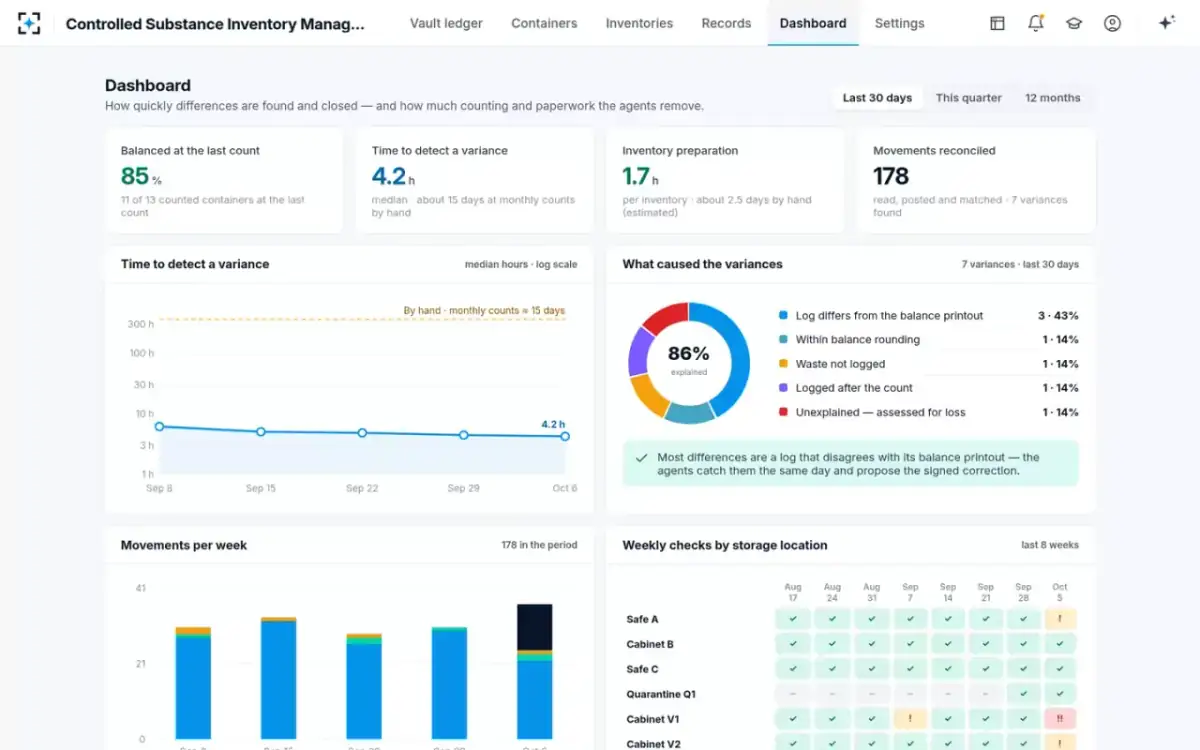
How often should a lab count controlled substances? Weekly, monthly or biennially
Choose on purpose, by schedule and by location, rather than adopting one cadence for everything. Three considerations decide it: the diversion potential of the substance, the number of people with access to the storage location, and how much the records would cost to reconstruct if a difference went unnoticed for a cycle.
Biennial only is lawful and is rarely the right choice — it means a difference can be up to two years old, and on average about a year old, before anyone looks. Monthly is a common choice and a reasonable default for a laboratory where a named handful of people hold keys. Weekly earns its cost in two places: Schedule I and II stocks, and any storage location where access is shared, badge-controlled or out of hours. The sample laboratory makes exactly that split a setting, with monthly as the default, weekly for Schedule I, and the option of biennial only for a registration that holds almost nothing.
A cost card for one registration, with every input named
| Input | Sample laboratory | Where your own number comes from |
|---|---|---|
| Counts per year | 12 monthly, 52 for one shared-access cabinet | Your count cadence setting, by schedule and location |
| Hours per count | Physical count unchanged by any system | Time one counter and one witness take per storage location |
| Differences per year needing explanation | The ones outside tolerance for their schedule and form | Count the red lines in last year’s counts |
| Hours per difference, reconstructed by hand | About a day when the records are weeks old | Ask whoever did it last; include the hours spent finding people |
| Hours to prepare one inventory for signature | About 20 by hand; about 1.7 with the agents (our estimate) | The last biennial inventory, honestly timed |
| Inventories per cycle | Biennial required, plus whatever your policy adds | 21 CFR 1304.11 sets the floor; your procedure sets the rest |
| Cost of being wrong | Priced per violation, multiplied by records | 28 CFR 85.5 for the maximum; the published settlements for the shape |
What it takes to start, and what you bring
Less than a project. The inputs are the registrations and their schedules, the storage locations and who holds access to each, the standard operating procedures that already state your tolerances and cadence, and a sample of past usage logs, balance printouts and count sheets. Those last ones do double duty: they are what the system is built from, and they are the test set for proving a reconciliation is right before you depend on it.
The first useful output is not a dashboard. It is a month you have already closed, reconciled again from its own records, with the differences and the explanations laid out — including any your month-end missed. If that month comes back the same, you have a baseline. If it comes back different, you have learned something about the cycle you are running now, which is the whole question this page asks. To try it on your own closed counts, start from Controlled Substance Inventory Management.
Questions people ask
Does DEA require a perpetual inventory?
No. 21 CFR 1304.21(a) requires a complete and accurate record of each substance received, delivered or otherwise disposed of, kept on a current basis, and then states expressly that no registrant shall be required to maintain a perpetual inventory. The movements must be recorded as they happen; adding them into a continuous running figure per container is not required by the regulation, though an inventory is required at least every two years.
How often should a lab count controlled substances?
The regulation sets a floor of one inventory at least every two years, and leaves the rest to you. In practice, monthly is a sound default, weekly earns its cost for Schedule I and II stocks and for any storage location with shared or out-of-hours access, and biennial-only is defensible on paper but means a difference can be up to two years old before anyone looks at it.
What is the penalty for a controlled substance recordkeeping violation?
Civil penalties for negligently failing to make, keep or furnish a required record fall under 21 U.S.C. 842(a)(5), and the current maximum in the Department of Justice's inflation-adjusted table at 28 CFR 85.5 is $19,246 per violation. The amount is adjusted annually. The figure is a maximum rather than a tariff, and real resolutions are negotiated settlements.
How does a recordkeeping penalty multiply?
It attaches per violation, and a violation is a record rather than an incident — so one systematic failure repeated across a year of logs, order forms and inventories becomes many violations. In the Yale Fertility Center matter, a civil investigation identified 685 separate occasions on which the recordkeeping requirements were allegedly violated, arising from one situation at one site.
Is a running balance worth the effort?
It depends on what explaining a difference costs you now. A running balance does not count anything and does not change who decides; what it changes is that a difference surfaces at the count rather than at month end, while the printout, the notebook page and the person who witnessed a waste are all still available. If reconstructing a difference currently takes a person a day, the answer is usually yes; if your substances are few and your access list is two people, monthly counts and good records may be enough.
How long does it take to prepare a biennial inventory?
In our estimate for one registration, about 20 working hours after the physical count — pulling the records together, doing the running-balance arithmetic, tracing each difference, separating Schedule I–II from the rest and drafting the document for signature. Most of that is not arithmetic; the largest single share is tracing differences back to the records that explain them, which is also the part that still needs a person's judgement when the rest is automated.