You can keep an electronic controlled substance log, and you do not need DEA's blessing to build one. Nothing in 21 CFR part 1304 requires paper; the operative test is a defined term, "readily retrievable", and a system that meets it is as compliant as a bound book. Two things do not move, and they are what most often trips a cutover: executed order forms and inventories have to be maintained at each registered location, and every record has to stay available for inspection and copying for at least two years. This guide sets out what may go electronic, what may not, and how to run the change so that an investigator arriving mid-transition finds one complete record instead of two incomplete ones. Botminds' Controlled Substance Inventory Management is used here as the worked example of what the finished state looks like.
Where a screen is shown it belongs to a fictional sample laboratory — Northwind Bio, Bay Campus — whose people, registrations and container numbers are characters and sample data. The rules are current text, linked at each point.
Three numbers that decide a controlled-substance cutover
2years
every inventory and record must stay available for inspection and copying, from its date
0
DEA approvals needed to keep records on an in-house computer system
2records
that may never be kept centrally: executed order forms, and inventories
Can you keep controlled substance records electronically? Nothing in the regulation requires paper
Read part 1304 end to end and you will not find the word paper used as a requirement. What it requires is that records be complete, accurate, kept on a current basis, maintained for two years, and available for inspection and copying: "every inventory and other record required to be kept under this part must be kept by the registrant and be available for inspection and copying by authorized employees of the Administration, for at least 2 years from the date of such inventory or record" (21 CFR 1304.04(a)). The medium is not specified because the medium was never the point.
The regulation goes further and assumes electronic systems exist. The definition of "readily retrievable" is written around them. Part 1304 explicitly contemplates records kept on microfilm or computer media and only asks that the registrant provide access to whatever equipment is needed to read them, and a key to any code used. And the central-recordkeeping notification asks the registrant to say "whether central records will be maintained in a manual, or computer readable, form" — a question that would make no sense if one of the two answers were forbidden.
So the honest answer to the question people type is yes, with conditions that are narrower than the folklore and sharper than most buyers expect. The conditions are the next four sections.
What does "readily retrievable" mean? The definition is the whole test
"Readily retrievable" is not a standard of good intentions; it is a defined term in 21 CFR 1300.01(b), and it describes exactly two ways of satisfying it. Either the records are kept in a system that can separate them out from everything else in a reasonable time, or the relevant items are marked so as to be visually identifiable among other items on the record.
Readily retrievable means that certain records are kept by automatic data processing systems or other electronic or mechanized recordkeeping systems in such a manner that they can be separated out from all other records in a reasonable time and/or records are kept on which certain items are asterisked, redlined, or in some other manner visually identifiable apart from other items appearing on the records.
21 CFR 1300.01(b)
Three practical consequences follow for anyone choosing a system. First, "separated out from all other records in a reasonable time" is a query requirement: an investigator asks for every movement of one substance at one registered location over a date range, and the system either produces that set or it does not. A spreadsheet that mixes two registrations in one tab fails this before anyone looks at the numbers. Second, the second limb — asterisked, redlined or visually identifiable — is what lets a laboratory keep Schedule III–V records inside ordinary business records, provided the controlled-substance items stand out. Third, nothing in the definition mentions validation, certification or a vendor's compliance claim. The test is behavioural: can you get the records out, separated, in a reasonable time?
The retention clock rides on the same sentence. DEA's Researcher's Manual states it as one rule: "DEA requires that all records concerning controlled substances be maintained for at least two years, in a readily retrievable manner, for inspection and copying by duly authorized DEA officials" (Researcher's Manual, 2022 edition). Two years, retrievable, and copyable — a file format nobody outside your institution can open does not meet the last of those.
What must stay at the registered location, whatever else changes?
Two record types. Where a registrant is authorised to keep central records, "The records to be maintained at the central record location shall not include executed order forms and inventories, which shall be maintained at each registered location" (21 CFR 1304.04(b)(1)). Executed order forms are the DEA Form 222s you have used to receive Schedule I and II substances, and their electronic equivalents; inventories are the initial, biennial and any other inventory records of that registration.
This single sentence is the one a well-meant modernisation most easily breaks. A university consolidates controlled-substance recordkeeping into a central compliance office, the order forms and the signed inventories go with it, and the registration's own location now holds neither. No system removes that obligation, and no supplier can take it off you: an electronic record of an inventory stored only in a data centre is not maintained at the registered location unless it can be produced there. The workable reading is that the registered location must hold, and be able to produce, those two record types — which in practice means a local copy as well as the system of record.
The schedule separation is the second thing that survives any change of medium. Inventories and records for Schedules I and II are kept separately from all other records; for Schedules III, IV and V they are kept either separately "or in such form that the information required is readily retrievable from the ordinary business records of the registrant" (21 CFR 1304.04(f)(2), applied to practitioners by 1304.04(g)). Separation is a property of the record, not of the filing cabinet, so a system that stores everything in one table and separates only on a screen filter has not met it.
The nine records a researcher must keep, and where each one may live
| Record | May it be electronic? | Must it be at the registered location? | Where it usually sits today |
|---|---|---|---|
| Executed order forms (DEA Form 222) or the electronic equivalent | Yes — CSOS orders are the electronic equivalent | Yes. Never at a central record location. | A folder in the compliance office, or a CSOS account nobody has logged into since the order |
| Unexecuted order forms (DEA Form 222) | The paper book stays paper; blank CSOS ordering is electronic by nature | Kept secure by the registrant | The safe, with the blank forms |
| Power of attorney to sign order forms | Yes | Kept with the order records | A signed PDF, often the only copy |
| Receipts and invoices for Schedules III–V | Yes | May be kept centrally if the registrant has notified DEA | Accounts payable, filed by supplier rather than by substance |
| Records of substances distributed, returned or sent for destruction | Yes | With the registration’s records | A reverse-distributor portal plus an email thread |
| Dispensing and usage records | Yes | With the registration’s records | The paper usage log in the safe, and a notebook on the bench |
| All inventory records, initial and biennial | Yes | Yes. Never at a central record location. | A signed printout in a binder |
| Reports of theft or significant loss (DEA Form 106) | Yes — Form 106 is filed through DEA’s secure network application | With the registration’s records | A copy of the submission, if someone kept one |
| Inventory of drugs surrendered for disposal (DEA Form 41) | Yes | With the registration’s records | With the destruction paperwork, signed by two witnesses |
Central recordkeeping: what it covers, and what it never covers
Central recordkeeping is a specific permission with a specific shape, and it is easy to assume you have it when you do not. Financial and shipping records such as invoices and packing slips may be kept at a central location rather than at the registered location, provided the registrant has notified DEA in writing, by registered or certified mail with return receipt requested, in triplicate, to the Special Agent in Charge. The notification has to state what records will be kept centrally, exactly where, under whose registration, and whether they will be manual or computer readable. Unless the Special Agent in Charge says no, central records may begin 14 days after the notification is received.
Three conditions ride with it. Records in any form needing special equipment to read must come with access to that equipment and, if a code is used, a key to the code. The registrant agrees to deliver the records to the registered location within two business days of a written request — or to let DEA inspect them where they sit, without a warrant. And a registrant who fails these conditions can have the authorisation cancelled without a hearing. Read together, they are a sensible standard for anyone who stores controlled-substance records away from the registered location, whether or not the letter has been sent.
Do you need DEA approval to use a computer system?
No, and the regulation says so in one sentence: "Registrants need not notify the Special Agent in Charge or obtain central recordkeeping approval in order to maintain records on an in-house computer system" (21 CFR 1304.04(c)). Part 1304 sets up no certification of recordkeeping software, no approved-products list and no filing to make before you switch, so a supplier claiming DEA approval for its record system should be asked exactly which approval it means and where it is written.
What this sentence does not do is make the choice of system unimportant. It moves the whole burden onto the registrant: because nobody vets the system, the registrant answers for whatever it produces. That is why the useful diligence is not "is it approved" but "can I get my records out of it, separated, in a reasonable time, for two years, including after we stop paying for it". The twelve questions to put to a supplier go at that from the work side; the questions at the foot of this page go at it from the rules side.
Ordering electronically: CSOS, and what it does not replace
Ordering is the one place where the electronic route is defined by regulation rather than left open. For each distribution of a Schedule I or II controlled substance, "Either a DEA Form 222 or its electronic equivalent as set forth in subpart C of this part and Part 1311 of this chapter is required" (21 CFR 1305.03), with a short list of exceptions such as exports and deliveries to a registered analytical laboratory. The electronic equivalent is a digitally signed order under the Controlled Substance Ordering System, and it carries the same weight as the paper form.
The paper side has also changed recently enough to catch people out. DEA's 2019 final rule replaced the triplicate Form 222 with a single-sheet format and "provided for a two-year transition period to switch from the triplicate form"; a March 2026 technical amendment removed the now-obsolete transition provision and clarified who may execute or revoke a Form 222 power of attorney — the registrant, a partner, or an officer of a registrant corporate entity (91 FR 13498, 20 March 2026). If your procedure still describes a triplicate form or lets a laboratory manager grant a power of attorney, it is out of date.
What CSOS does not replace is the recordkeeping around the order. The executed order, electronic or not, still has to be kept at the registered location. The receipt still has to be recorded against the container it arrived in, with the date actually received. And nothing about ordering electronically touches the usage log, the count, the inventory or the loss report — which is why a laboratory that has CSOS and nothing else is still keeping its real records by hand.
The records a research lab has that no pharmacy system models
Much controlled-substance software was built for a pharmacy or a hospital, where the unit is a dose, the dispensing event has a patient attached, and a cabinet does the counting. A research laboratory breaks all three assumptions, and a buyer who does not check for that discovers it after the contract.
A research registrant works in mass and volume, not units: a vial of powder weighed to a tenth of a milligram, a solution formulated at the bench and dosed in fractions of a millilitre. The balance printout is a primary record, and the number on it only becomes a movement when someone ties it to a container and a protocol. Withdrawals go to animals under a protocol, not to patients. Waste happens for reasons a pharmacy does not have — an animal excluded at weigh-in, a formulation discarded after a failed quality check — and the entry for it may be in a surgery notebook rather than a log. A Schedule I registration adds the research protocol itself as a limit on what may be done. None of this is exotic; it is simply not in the data model of a dispensing cabinet.
The question to ask a supplier is therefore not whether the system handles controlled substances, but which records it reads. A system that only records what someone types into it has moved the paper log onto a screen. The work that goes wrong in a laboratory is the reconciliation of several records written by different hands, which is a thing you can test before you buy.
The same month of records, kept two ways
A paper log, a printout and a notebook: At the monthly count, when someone adds the column up.
One electronic record of each movement: When the count is entered, against the expected balance.
A paper log, a printout and a notebook: Whatever survived three weeks: the printout if the drawer was not cleared, the notebook if the page is findable.
One electronic record of each movement: Every source record read at the time, each movement quoting the passage it came from.
A paper log, a printout and a notebook: A crossing-out, an initial, and a line nobody can date reliably.
One electronic record of each movement: A new signed line pointing at the original, which stays visible and struck through.
A paper log, a printout and a notebook: Pulling binders, photocopying, hoping Schedule I–II was really kept apart.
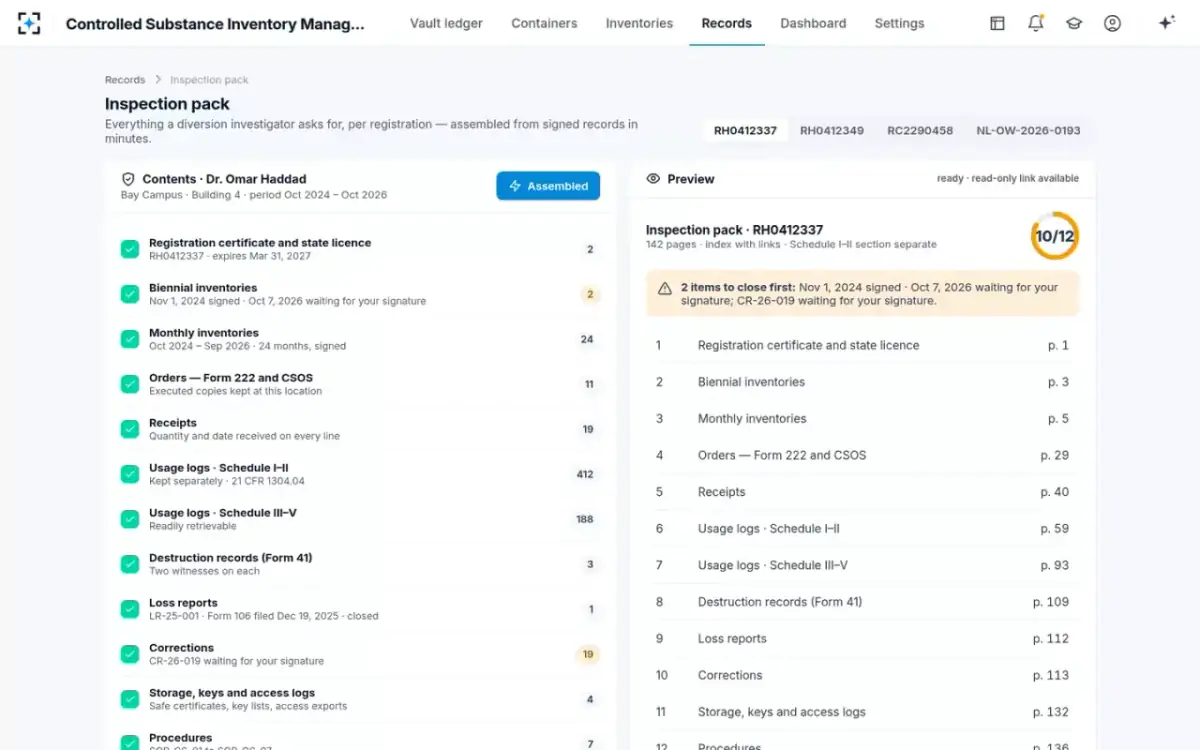
One electronic record of each movement: A file assembled per registration from signed records, with Schedule I–II in its own section.
A paper log, a printout and a notebook: Survives as long as the cabinet and the building do.
One electronic record of each movement: Survives the departure of the person who made the records — if you can export it.
A paper log, a printout and a notebook: Executed order forms and inventories at the registered location.
One electronic record of each movement: Executed order forms and inventories at the registered location.
Two years, and what "available for inspection and copying" asks of a file format
Retention is the quiet clause that outlives every procurement. The record has to be available for inspection and copying for at least two years from its date — not from the end of the study, not from the end of the contract. Three questions follow, and they are worth settling before signature rather than after.
Can you export everything, including the source documents a value was read from, in a format that opens without the supplier's software? Can the export be produced per registration and per schedule, so that Schedule I–II comes out separately? And if the relationship ends, what happens on the day access stops — because a two-year obligation attached to records you can no longer reach is a finding waiting to be written. These are not unusual demands of a records system. They are unusual demands of a subscription, which is why they belong in the contract.
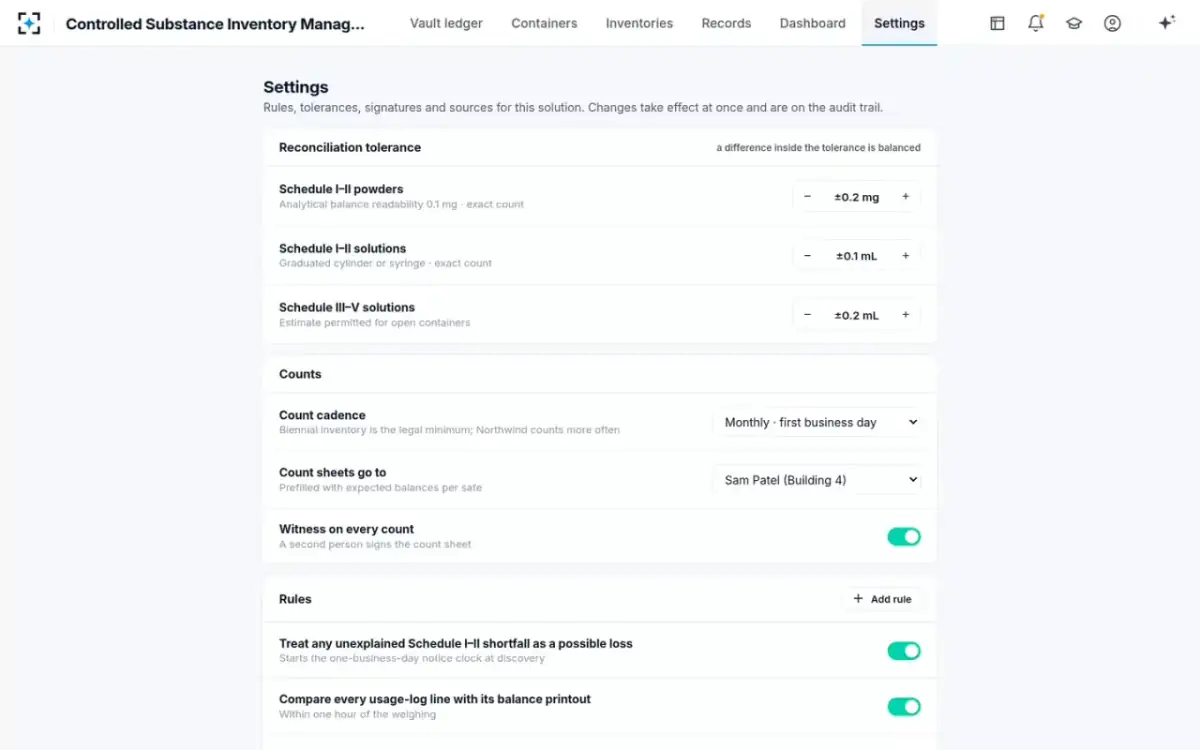
Controlled Substance Inventory Management: the programme written down as settings
How to switch without losing the record: a cutover that survives an inspection
The failure mode of a controlled-substance cutover is not data loss. It is a period in which neither record is complete: the paper log has stopped being filled in properly because everyone knows it is going away, and the new record does not yet hold the history. An investigator who arrives during that period will not accept the two halves as one record, and the two-year clock applies to both.
The way through is unglamorous and well tested in other regulated records: run both, prove they agree at a point the regulation already defines, then retire one. The natural proof point is an inventory. Take one inventory both ways — on the old log and in the new record — reconcile every container, and have the registrant sign the result. That inventory becomes the join between the two eras, and it is the document you hand an investigator who asks what happened in April.
A twelve-week cutover, with the two-year retention tail running on past it
- Load history: past usage logs, count sheets, receipts3 wks
- Confirm registrations, locations, tolerances1 wk
- Both records kept, every movement in each4 wks
- One inventory taken both ways, reconciled, signed2 wks
- Paper retired; the signed inventory is the join2 wks
- Retention tail: both eras available for inspection and copying2 years
What a laboratory brings on day one of a controlled-substance cutover
Less than most people expect, and all of it already exists. The registrations and their schedules, so each record attaches to the right one. The storage locations and who holds keys or badges for each. The standard operating procedures, because the tolerances and the count cadence in them become the settings the system runs on. And a sample of the records as they really are — past usage logs, balance printouts, count sheets, a notebook page or two — which is what tells you, before any commitment, whether a system can read the records you actually have rather than the ones a demonstration was built on.
That last item is the one worth insisting on. Any supplier can show you a clean log. Ask them to read last March's, with the crossing-out, the initials and the page where someone wrote the weight in grams instead of milligrams. In the sample laboratory the solution is built and deployed from exactly that material — the customer's own registrations, procedures, locations and a sample of past logs and count sheets — and the first thing it does with them is reconcile a month you already closed.
Ten questions about the rules, each with the paragraph behind it
- Can the system separate one registration’s records from every other record, in a reasonable time?
That is the first limb of the definition of readily retrievable, 21 CFR 1300.01(b). Ask to see it done on a date range you choose.
- Are Schedule I–II records kept separately, in the record itself?
21 CFR 1304.04(f)(1) and (g). A screen filter is not separation.
- For Schedule III–V, are the items visually identifiable within ordinary business records?
The alternative route in 1304.04(f)(2), and the only one that works if those records sit in a purchasing system.
- Can executed order forms and inventories be produced at the registered location?
21 CFR 1304.04(b)(1) never lets those two leave it, whatever else is centralised.
- Will every record remain available for inspection and copying for two years from its date?
21 CFR 1304.04(a). Ask what happens on the day the subscription ends.
- Does the system hold the source document behind each value, not just the value?
Not a rule, but the difference between an explanation and an assertion when a count is short.
- Is a posted entry ever edited?
Records must be complete and accurate on a current basis. A correction that overwrites the original destroys the evidence that it was a correction.
- Does it support CSOS orders and the single-sheet Form 222 as they stand today?
The triplicate form and its transition provision are gone; 91 FR 13498 also clarified who may execute a power of attorney.
- Can you export everything, per registration and per schedule, without the supplier’s software?
Inspection and copying is the regulation’s phrase. An archive only the supplier’s software can open makes both halves harder.
- Does anyone claim DEA approval of the software?
Ask which approval they mean: 21 CFR 1304.04(c) says no approval is needed to keep records on an in-house computer system.
What an investigator asks for, produced from signed records
The rules, in the end, are permissive and precise at the same time: keep whatever medium you like, provided you can separate the records out, keep them two years, produce them for copying, keep Schedule I–II apart, and leave the order forms and the inventories where the registration is. To see those constraints met on your own usage logs, printouts and count sheets, start from Controlled Substance Inventory Management, or read what the inventory itself has to contain.
Questions people ask
Can you keep controlled substance records electronically?
Yes. Nothing in 21 CFR part 1304 requires paper. The requirements are that records be complete, accurate, kept on a current basis, maintained for at least two years from their date, and available for inspection and copying by authorised DEA employees — plus the separation of Schedule I–II records and the rule that executed order forms and inventories stay at the registered location. A system that meets those is compliant whatever the medium.
What does readily retrievable mean?
It is a defined term in 21 CFR 1300.01(b), and it offers two routes. Either records are kept by automatic data processing or other electronic or mechanised systems in such a way that they can be separated out from all other records in a reasonable time, or the relevant items are asterisked, redlined or otherwise visually identifiable among the other items on the record. In practice the first route is the one an electronic system takes, and the test is whether it can produce one registration's records for a date range on request.
Do executed DEA 222 forms have to be kept on paper?
No — a Form 222 has an electronic equivalent under CSOS, and 21 CFR 1305.03 treats the two as alternatives for each distribution of a Schedule I or II substance. What does not change is where the executed order is kept: 21 CFR 1304.04(b)(1) excludes executed order forms and inventories from any central record location, so they stay with the registration.
Do you need DEA approval to use a computer system?
No. 21 CFR 1304.04(c) states that registrants need not notify the Special Agent in Charge or obtain central recordkeeping approval in order to maintain records on an in-house computer system. The recordkeeping rules set up no certification scheme for that software, so any claim of DEA approval for a product should be treated as a reason to ask harder questions, not fewer.
Can controlled substance inventories be kept at a central location?
No. Central recordkeeping, once notified, covers financial and shipping records such as invoices and packing slips, and it explicitly excludes executed order forms and inventories, which must be maintained at each registered location. A central compliance office can hold copies and do the work; the registration's own location still has to be able to produce those two record types.
How do you move off a paper controlled substance log without losing the record?
Run both for a period, take one inventory on both records, reconcile every container, and have the registrant sign the result — then retire the paper with that signed inventory as the join between the two eras. Keep both eras available for inspection and copying for two years from the date of each record. The thing to avoid is a gap in which neither record is being kept properly, which is what an investigator will find if the paper is abandoned before the new record holds the history.