A DEA research license — formally a Researcher registration — authorises one registrant, at one address, to handle controlled substances in one band of schedules for research, and it is narrower than many people using one assume. Research in Schedule I and research in Schedules II to V are two separate independent activities, so an investigator working across both needs two registrations; each runs for a year rather than three; each is tied to a registered location rather than to the person's programme; and the coincident activities it carries stop precisely where dosage form development begins. That last line was drawn by the DEA in 1995, the agency says it cannot predict when an investigator will cross it, and in 2026 a contract research provider paid a million dollars to resolve allegations that it had. Botminds' Controlled Substance Inventory Management keeps the records per registration, which is the form in which this question is actually answered when an investigator asks.
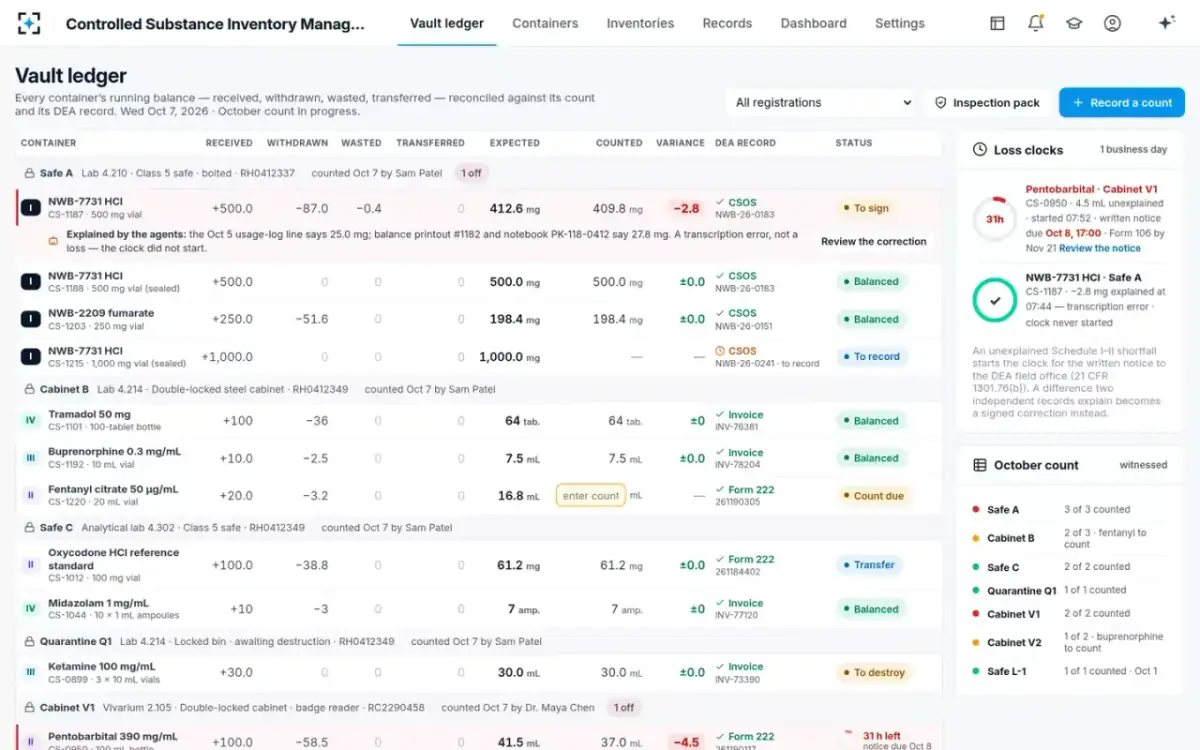
The sample laboratory below is fictional: Northwind Bio, where one investigator holds two registrations and the vivarium holds a third. The registration numbers, people and containers are invented. The rules, the quotations and the settlement are not.
What a researcher registration actually fixes
2
separate registrations for one investigator working in Schedule I and in Schedules II–V
1year
the registration period for a researcher, against three for a dispensing practitioner
$296
the application fee for each researcher registration, new or renewed
178
instances of allegedly unlawful manufacture and distribution in one 2026 settlement
One laboratory, two registrations — and why
The rule that produces this is a filing rule, not a drug rule. "Any person who engages in more than one group of independent activities shall obtain a separate registration for each group of activities, except as provided in this paragraph under coincident activities. A single registration to engage in any group of independent activities listed below may include one or more controlled substances listed in the schedules authorized in that group of independent activities" (21 CFR 1301.13(e)).
Research in Schedule I and research in Schedules II to V appear in that table as two different rows, which makes them two different groups of independent activities. The DEA's guidance for researchers states the consequence without hedging: if a researcher wishes to conduct research in Schedule I and in Schedules II–V, they must obtain two separate registrations, and a researcher may not have Schedules I–V on one registration.
Nothing about this is intuitive, because the second half of the same paragraph says a single registration may cover more than one substance within its own band. One registration can carry every Schedule II, III, IV and V substance an investigator works with. It cannot stretch upwards to cover one Schedule I compound, however small the quantity and however closely related the work.
The two rows a research programme lives in
Research · Schedule I
- Forms
- DEA Form 225 to apply, Form 225a to renew
- Application fee
- $296
- Registration period
- One year
- Before it issues
- A research protocol must be filed and approved before the registration issues, under 21 CFR 1301.18 and 1301.32.
- Coincident activities it already carries
- Manufacture or import the basic class registered for, but only to the extent set out in the approved protocol; and distribute that class to persons registered or authorised to conduct research with it, or to conduct chemical analysis.
Research · Schedules II–V
- Forms
- DEA Form 225 to apply, Form 225a to renew
- Application fee
- $296
- Registration period
- One year
- Before it issues
- Any manufacture must be set out in a statement filed with the application or re-application — and must not be for dosage form development.
- Coincident activities it already carries
- Conduct chemical analysis; manufacture within the filed statement; import for research; distribute to persons registered or authorised to conduct chemical analysis, instructional activities or research, and to persons exempted under 21 CFR 1301.24; and conduct instructional activities.
In the sample laboratory one investigator holds RH0412337 for Schedule I and RH0412349 for Schedules II–V, and the vivarium registrant holds a third, RC2290458, for its own location. Three registrations, three sets of records, three inventories — and an inspection that asks about one of them.
Annual, not every three years: the renewal nobody diarises
The registration period for both researcher rows is one year. A dispensing practitioner's registration runs for three, which is the number most people in a university remember, because most people in a university have a clinician colleague. The Certificate of Registration a researcher holds is valid for twelve months, although a first registration may run between nine and fifteen months as the DEA assigns the business activity to one of twelve monthly groups.
Two consequences are worth building into a calendar. A researcher may apply to be reregistered no more than 60 days before expiry, so the renewal window is short and late in the cycle. And each registration renews separately: an investigator holding Schedule I and Schedules II–V registrations has two renewal dates, two fees and two opportunities to let one lapse while the other is current — which is an easy way for this to go wrong, often noticed only when an order is refused.
The certificate itself is a record with its own requirement: it is kept at the registered location, readily retrievable, and available for inspection. It is an obvious first request from a diversion investigator, and the first thing an inspection file should contain.
The registration is tied to a place, not to a person's work
A registration authorises activity at a registered location. A separate registration must be obtained for each principal place of business or professional practice where controlled substances are stored, administered or dispensed, and where a person conducts research at more than one location, each place is separately registered.
This regularly catches multi-building programmes. An investigator with laboratories in two buildings on one campus, a satellite in a hospital research facility, or a vivarium run by a different department is not covered by one registration because it is one person's grant. The storage location is what matters. The security statement filed with a Schedule I application makes the same point from the other direction: the application asks for a "Statement of the security provisions for storing the controlled substances (in accordance with § 1301.75) and for dispensing the controlled substances in order to prevent diversion" (21 CFR 1301.18(a)(2)(vi)) — a statement about a specific room with a specific cabinet in it.
It also shapes the records. A separate inventory is made for each registered location and each independent activity registered, so a programme with two registrations in one building still keeps two inventories, and substances held somewhere the registrant is not registered must be included in the inventory of the registered location responsible for them.
Two registrations held by one investigator, each location with its own balances
What a Schedule I researcher may do without another registration
Coincident activities are the things a registration already carries, so that a registrant does not need a second one to do them. For Schedule I research the list is short and tightly fenced: a researcher may manufacture or import the basic class of substance the registration was issued for, provided that the manufacture or import is set forth in the protocol required under 21 CFR 1301.18, and may distribute that class to persons registered or authorised to conduct research with it or to conduct chemical analysis with controlled substances.
Read the fence. The permission is for "the basic class of substance or substances for which registration was issued" — not for anything else in Schedule I. And the protocol is doing the authorising: an activity not described in the approved protocol is not covered by the coincident activity, however reasonable it sounds. A Schedule I programme that changes what it synthesises, or how much, without amending its protocol has stepped outside its own registration.
What a Schedule II–V researcher may do without another registration
The Schedules II–V row is broader, and it contains the sentence this whole guide turns on. A researcher registered in those schedules "may conduct chemical analysis with controlled substances in those schedules for which registration was issued; manufacture such substances if and to the extent that such manufacture is set forth in a statement filed with the application for registration or reregistration and provided that the manufacture is not for the purposes of dosage form development; import such substances for research purposes; distribute such substances to persons registered or authorized to conduct chemical analysis, instructional activities or research with such substances, and to persons exempted from registration pursuant to § 1301.24; and conduct instructional activities with controlled substances" (21 CFR 1301.13(e)(1), row (vii)).
Three conditions are stacked in one clause. Manufacture is permitted only to the extent set out in a statement filed with the application or re-application; only where it is not for the purposes of dosage form development; and distribution is permitted only to a closed list of recipients. Miss any one and the activity needs a manufacturer or distributor registration instead.
The statement filed with the application matters more than its length suggests. It is the thing that defines "to the extent" — and a laboratory whose synthesis has grown in scale or changed in purpose since the statement was written is operating outside a boundary it drew itself.
When does making a dosing solution become manufacturing?
Dissolving a weighed powder in saline to dose an animal that afternoon is research. Running batches to support a regulatory submission is manufacturing. The space between them is where registrants get into trouble, and the DEA marked it in a 1995 policy statement that is still the clearest text on the subject.
The agency's reason for drawing a line at all is in the same document: "Manufacturers are held to more stringent requirements than researchers because of the greater threat of diversion associated with manufacturing" (60 FR 55310). The line itself is a list.
Research, and the activities the DEA puts on the manufacturing side
Inside a researcher registration: Answering a scientific question: pharmacology, toxicology, behaviour, mechanism.
Requires a manufacturer registration: "Activities for the purpose of satisfying regulatory requirements such as FDA submissions or good manufacturing practice."
Inside a researcher registration: Making what this week’s experiment needs, within the statement filed with the application.
Requires a manufacturer registration: "Activities associated with establishing the manufacturing processes and procedures, including, but not limited to, production of material used for pilot, scale-up and reformulation studies, as well as the studies themselves."
Inside a researcher registration: Preparing a dosing solution or suspension for the study in front of you.
Requires a manufacturer registration: "All activities associated with such development including, but not be limited to, bioavailability, formulation, stability, an validation studies."
Inside a researcher registration: Your own protocol, or another registrant authorised to conduct research or chemical analysis with that substance.
Requires a manufacturer registration: A development programme, a sponsor, or a third party taking the material onward.
Inside a researcher registration: Manufacture only to the extent set out in the filed statement, and not for dosage form development.
Requires a manufacturer registration: A manufacturer registration, with the quota, security, recordkeeping and reporting that come with it.
The DEA's own guidance adds the warning that makes this a live question rather than a historical one, and it is addressed directly to the person at the bench.
DEA cannot predict when an individual's activities may shift from researcher to manufacturer. Therefore, it is imperative that a person who is conducting research, whose activities move from bench type to scale-up and development, be aware and alert for the requirements of 21 CFR 1301.13.
DEA Diversion Control Division, Researcher's Manual, 2022 edition
In practice this means the scope question has to be asked again whenever the work changes, not once at registration. Three triggers are worth writing into a programme's procedures: a change in why material is being made, a change in how much, and the arrival of a sponsor or a regulatory submission at the other end of it.
May I give some to the lab upstairs?
Sometimes, and the answer depends entirely on who the recipient is and what they are registered for. The coincident activity permits distribution to a closed list, and a transfer outside that list is a distribution requiring a distributor registration.
Who a research registrant may transfer to, and what the transfer needs
| Recipient | Permitted under the researcher row? | What the transfer needs |
|---|---|---|
| Another researcher registered for that class or those schedules | Yes, for Schedule I within the registered basic class; yes for Schedules II–V within the registered schedules. | For Schedule I or II, a DEA Form 222 or its electronic equivalent issued by the recipient. For Schedules III–V, a distribution record with the drug, form, strength, quantity and date. |
| A registrant authorised to conduct chemical analysis | Yes, under both researcher rows. | For Schedule III–V, a distribution record. For Schedule I or II, 21 CFR 1305.03(c) exempts deliveries to a registered analytical laboratory from the order-form requirement; keep the distribution record all the same. |
| A registrant conducting instructional activities | Yes, under the Schedules II–V row. | As above, with the recipient’s registration verified before the material moves. |
| A person exempted from registration under 21 CFR 1301.24 | Yes, under the Schedules II–V row. | Evidence of the exemption on the file, with the distribution record. |
| A colleague in another building on the same campus, not separately registered | No. The registration is tied to a registered location. | A registration for that location, or the material stays where it is. |
| A reverse distributor, for disposal | Yes — under the disposal rules at 21 CFR 1317.05 rather than the coincident activities. | For Schedule I or II, the reverse distributor issues the order form. For III–V, keep the distribution record. |
| A commercial sponsor or a manufacturer | No, not as a researcher. | A distributor registration, or the transaction does not happen. |
The row in the middle is the one that causes arguments, because it feels unreasonable. A colleague forty metres away, doing legitimate science, cannot be handed a vial if their location is not registered. The rule is about where substances are stored, and it does not bend for proximity or goodwill.
Ordering: Form 222, CSOS, and the power of attorney clarified in 2026
Acquiring Schedule I and II substances needs an order form — a paper DEA Form 222 or its electronic equivalent through the Controlled Substance Ordering System — and the executed form is a record that stays at the registered location rather than going to a central file with the invoices. Which parts of that may be held electronically, and in what form, is set out in what the rules allow for electronic controlled substance records.
One recurring question was settled in 2026. The DEA issued technical amendments which, in the agency's words, "clarif[y] that a DEA Form 222 Power of Attorney may only be executed or revoked by a registrant, a partner of the registrant, or an officer of a registrant corporate entity", resolving "ambiguity over who may sign a DEA Form 222" and removing the obsolete transition provision for the triplicate version of the form (91 FR 13498). The DEA describes these as conforming revisions with no substantive change, but they make the point plain for a university research programme: the power of attorney authorising a laboratory manager to sign orders has to be executed by the registrant — or, where the registrant is an institution, by an officer of it — not by a departmental administrator or whoever holds the delegation for purchase orders.
It is worth auditing. Powers of attorney tend to be written once, at registration, and then survive three changes of laboratory manager. A power of attorney executed by the wrong person puts every order signed under it in question, and the problem is visible on the face of the record.
What crossing the line cost a contract research provider
In January 2026 the U.S. Attorney's Office for the Northern District of California announced a civil settlement that is a clear published example of this line being enforced against a research organisation. The office described the registrant's position as follows: "Explora, a provider of contract vivarium research services, was previously registered with the DEA for its facilities in South San Francisco and San Diego. Both facilities held Researcher registrations, which generally do not authorize the manufacture or distribution of controlled substances" (U.S. Attorney's Office, N.D. Cal.).
The conduct alleged was volume rather than a single lapse: "the United States contends that Explora unlawfully manufactured and distributed controlled substances in at least 178 instances, in violation of provisions of the CSA that closely regulate the manufacture, distribution, dispensation, importation, and exportation of controlled substances, and that Explora also violated multiple recordkeeping requirements of the CSA." The matter resolved for a million dollars. The office's release states that the claims resolved are allegations only and that there has been no determination of liability; what the release is, for every other research registrant, is a published statement of how the government reads the scope of a Researcher registration.
Two things in that description are worth sitting with. The first is that the registrations were real and current — this was not an unregistered operation, it was a registered one doing activities its registration did not carry. The second is the last clause: the recordkeeping allegations travelled with the scope allegations. That pairing is not surprising. Activity outside a registration tends to be activity the records are not designed to describe, so the first failure can produce the second, and the second is what makes the first visible.
The records the scope question lands in
A scope question is never asked in the abstract. It is asked by a diversion investigator holding a file and pointing at a line in it: where did this quantity come from, who did it go to, what registration covered that, and what is the order form behind it. Which means the practical defence against a scope problem is the same as the practical defence against everything else in this subject — records kept per registration, with each movement tied to the document that authorised it.
In the sample laboratory that is how the inspection file is built: for one registration, twelve sections assembled from signed records — the registration itself, the biennial and monthly inventories, order forms and electronic orders, receipts, usage logs with Schedule I and II kept separate, destruction records, loss reports, corrections, and the storage and key lists — running to 142 pages, with the signatures still open flagged before it is handed over. One registration, one file. A programme that cannot produce that split is a programme that will answer a scope question with a shrug.
Everything an investigator asks for, assembled per registration
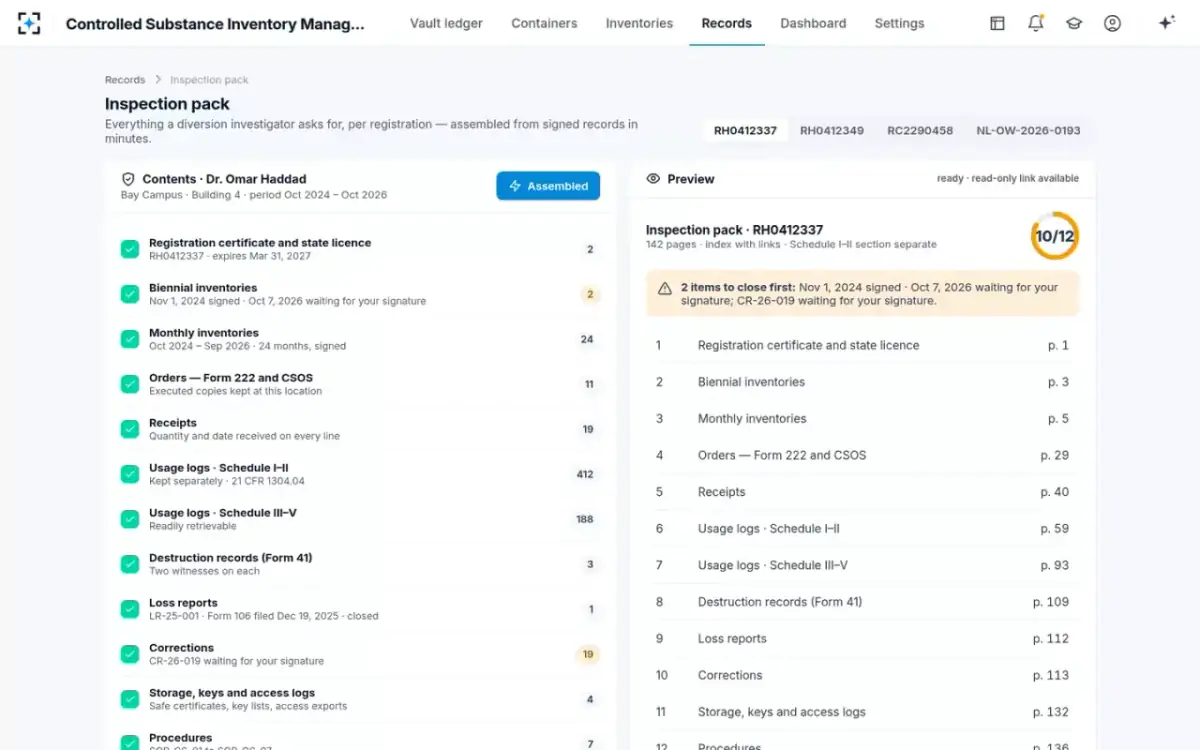
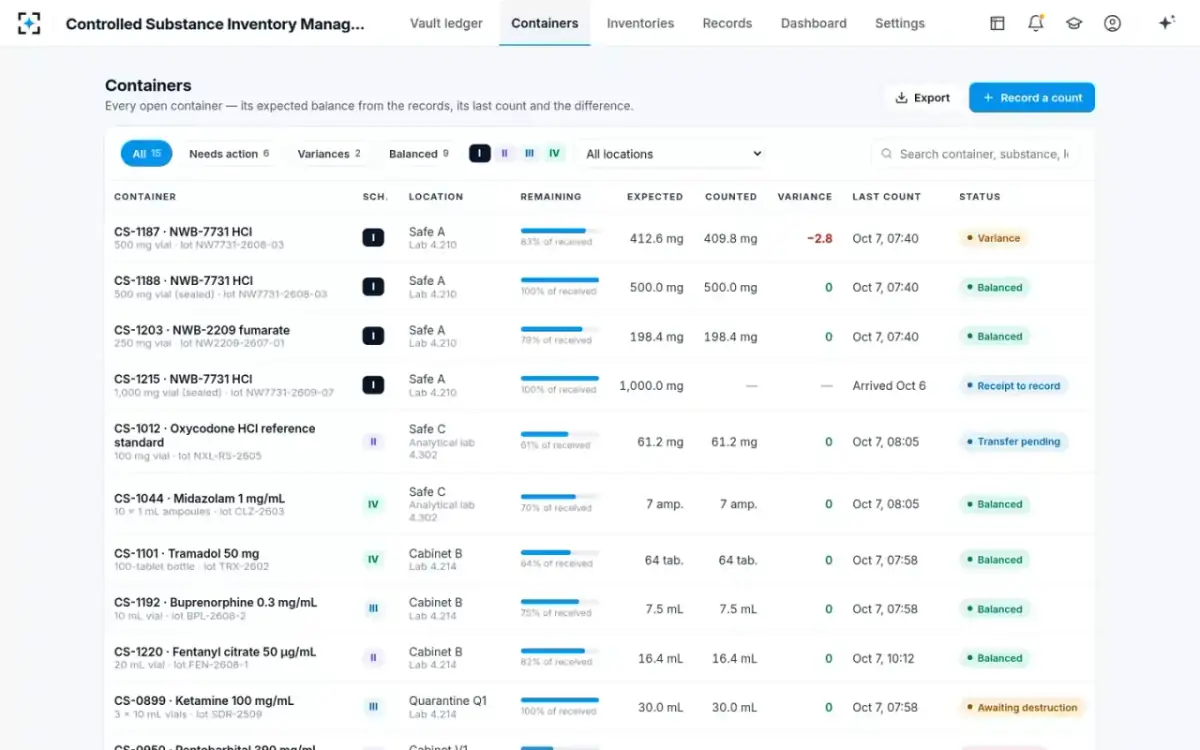
Scope is a records question in the end, and the records that answer it are the ones on each container's line. See how receipts, order forms and transfers are tied to their containers on Controlled Substance Inventory Management, or read the inventory rule for a research registrant for what each registration owes separately.
Every container tied back to the order form that authorised it
Questions people ask
How long does a DEA research registration last?
One year. Both researcher rows in the registration table carry a one-year period, unlike the three years a dispensing practitioner gets, and the Certificate of Registration is valid for twelve months — although a first registration may run between nine and fifteen months while the DEA assigns the business activity to one of twelve monthly groups. Reregistration may be applied for no more than 60 days before expiry.
How much does a DEA researcher registration cost?
The application fee in the registration table is $296 for Research Schedule I and $296 for Research Schedules II–V, payable on each application and each renewal, so an investigator holding both pays two fees a year. Fee exemption applies to federal, state and local government employees acting in their official duties; it does not extend to non-profit or tax-exempt institutions, contract employees at government institutions, or faith-based organisations.
Do you need a separate DEA registration for each building?
Yes, where controlled substances are stored, administered or dispensed there. A separate registration is required for each principal place of business or professional practice, and a person conducting research at more than one location registers each place. Proximity does not help: two buildings on one campus are two locations, and each keeps its own inventory.
Can a researcher transfer controlled substances to another lab?
Only to the recipients the coincident activities allow: another registrant authorised to conduct research or chemical analysis with those substances, a registrant conducting instructional activities, or a person exempted from registration under 21 CFR 1301.24. Schedule I transfers are limited to the basic class the registration was issued for. A Schedule I or II transfer needs an order form from the recipient; Schedules III–V need a distribution record.
Can a researcher make a dosing solution?
Yes, within the limits the registration carries. Manufacture is permitted to the extent set out in the statement filed with the application, and must not be for the purposes of dosage form development. Preparing a solution to dose animals on your own protocol sits comfortably inside that; preparing material for formulation, stability, bioavailability or validation studies does not, and needs a manufacturer registration.
Does a researcher need a DEA registration at all?
Unless an exemption applies, yes — every researcher intending to work with Schedule I or with Schedules II–V controlled substances must be registered, and a state licence or state controlled-substance registration must also be obtained where applicable. The narrow exemptions cover an individual acting as an agent or employee under a registered practitioner's or institution's registration, and certain federal officials acting in their official duties.