Construction projects go over budget because the budget is a forecast made before the work, and the work then meets prices, conditions and delays the forecast did not include. The OCC's examiner handbook names the usual causes: inaccurate budgets, site or environmental issues, increases in materials or transportation expenses, material or labour shortages, substandard work that must be redone, increased interest expense and weather delays. Overruns are common enough that a peer-reviewed study of 258 transport infrastructure projects found costs underestimated in almost nine out of ten. For a construction lender, the question is less why than when: when each cause first became visible, and how long it took to reach the loan's numbers. Botminds' Construction Loan Monitoring reads each document that carries a cause as it lands, which is the difference this page traces on one loan.
The loan is sample data: Harrow Yard Apartments, a fictional 248-unit building in Charlotte, financed by a fictional bank with a $52.4 million construction loan. The research is linked where it is used.
How often construction costs overrun, in the best-known peer-reviewed sample
86%
of projects where actual costs exceeded the estimate
28%
average amount by which actual costs exceeded estimates
258
transport infrastructure projects studied, worth US$90 billion
Why do construction projects go over budget?
They go over budget for reasons that fall into three families: the estimate was wrong, the prices or conditions changed, or the schedule ran long and time-driven costs followed. The OCC's Comptroller's Handbook lists them in one sentence, and the list is still the best single answer.
Overruns can be caused by inaccurate budgets, site or environmental issues, increases in materials or transportation expenses, material or labor shortages, substandard work performed by the borrower's employees or subcontractors that must be redone to satisfy contract performance conditions or meet local building codes, increased interest expense, or delays caused by inclement weather.
OCC, Comptroller's Handbook, Commercial Real Estate Lending (2022)
The handbook adds why the lender cares: "Cost overruns can erode a borrower's equity in the project and reduce the bank's collateral margin or can result in total costs that exceed the property's value when completed" (OCC, p. 10). An overrun is first the borrower's problem, then the collateral's, then the bank's.
Notice what the list does not separate: an overrun that nobody could have foreseen and one that a better budget would have caught. That distinction decides who pays, and the regulators draw it elsewhere, as the section on who pays below sets out.
How often do construction projects go over budget?
Often, though the best evidence comes from public infrastructure rather than private buildings. Flyvbjerg, Holm and Buhl studied 258 transport projects and found that "costs are underestimated in almost 9 out of 10 projects. For a randomly selected project, the likelihood of actual costs being larger than estimated costs is 86%", with actual costs "on average 28% higher than estimated costs" (Flyvbjerg et al., 2002). Rail ran 45% over on average, bridges and tunnels 34%, roads 20%.
Two cautions apply before carrying that across to a construction loan. The projects were public works sized by their promoters, and the authors argue the underestimates were often strategic, which a bank's underwriting is meant to catch. And no public, peer-reviewed or government source publishes an overrun rate for privately financed US commercial buildings; figures quoted online for that usually come from surveys by software vendors. The honest statement is that overruns are frequent, their size varies widely, and a lender should plan for them rather than estimate their odds.
One loan, traced: where the $613,000 came from
On 12 October the sample loan was in balance, with $25,713,000 left to fund and exactly that much budget remaining. Its forecast cost to complete was $26,326,000, so it was heading $613,000 short. The forecast breaks the shortfall into three parts, each traceable to a cause on the OCC's list.
The sample loan's $613,000 forecast overrun, by cause
Forecast shortfall at completion · $613,000
- Change orders past the contingency · $122,000 · 20%
- Contractor delay claim · $281,000 · 46%
- Interest the reserve cannot carry · $210,000 · 34%
Most of the overrun is time, not materials. The delay claim and the uncovered interest, $491,000 together, both come from the same 70-day slip in substantial completion. The change orders, the part most people picture when they hear overrun, account for the smallest share once the contingency has done its job. That pattern is typical of a project that slips: price shocks are absorbed by contingency, while schedule shocks spill into lines nobody set a contingency for.
Each part of the overrun, traced to its cause and to who usually pays
| What happened | Cost | Cause on the OCC list | Usually paid by |
|---|---|---|---|
| Switchgear and copper feeders re-priced (PCO 11), supplier letter citing metals tariffs | $612,000 | Increases in materials expenses | Contingency, then the borrower |
| Podium waterproofing failed a flood test at three drains; remediation (PCO 12) | part of $536,000 | Substandard work that must be redone | Contractor or subcontractor, if their work; often disputed |
| Amenity deck upgrade requested by the owner (PCO 13) | part of $536,000 | Owner-driven change (redesign) | Contingency or the borrower's equity |
| Switchgear on a 22-week lead time; completion moves 70 days | $281,000 claimed | Material shortages; delays | Disputed: owner if excusable, contractor if not |
| Lease-up starts later and runs 22 a month, not 26 | $210,000 of interest | Increased interest expense | Borrower, through a balancing deposit |
How do tariffs and material prices push a project over budget?
Tariffs and price increases reach a construction budget through the scopes not yet bought out. Once a subcontract is signed at a fixed price, a later price rise is the subcontractor's problem; until then, it is the owner's. On the sample loan the main switchgear had not been released for fabrication, so when the supplier wrote on 30 September citing metals tariffs, the contractor re-priced the switchgear and copper feeders at $612,000 as pending change order 11.
The market backdrop is mixed rather than inflationary across the board. The Census Bureau put private nonresidential construction spending at a seasonally adjusted annual rate of $773.0 billion in August 2026, 1.0% below a year earlier, with total construction 1.7% lower (Census Bureau, CB26-158). Falling volume does not mean falling prices for every input, and electrical equipment with long lead times is the classic exception. That is why the solution's change order and cost watcher applies construction cost indices only to scopes not yet bought, rather than to the whole remaining budget.
How do construction delays increase costs?
Delays increase costs in three ways at once: the contractor's time-related costs (site staff, equipment, insurance, general conditions) run longer, the lender's interest runs longer, and the property starts earning later. The sample loan shows all three. A switchgear delivery on a 22-week lead time, due 9 February 2027, sits on the critical path ahead of permanent power, the elevators and the temporary certificate of occupancy. Schedule update rev 9 moved substantial completion 70 days, to 26 March 2027.
The critical path in Construction Loan Monitoring, baseline against update rev 9
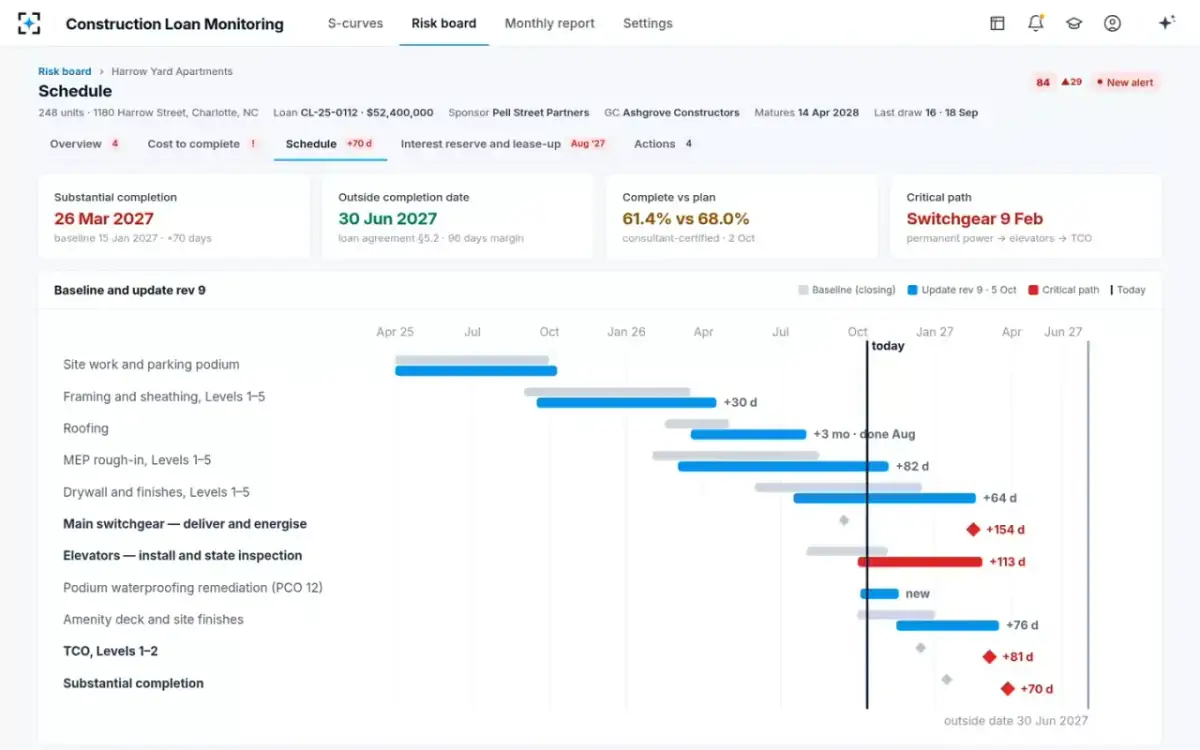
The contractor's 70-day claim for extended general conditions, $281,000, is the first cost of that delay. Whether the owner owes it depends on whether the delay was excusable, a supplier's lead time or the contractor's own procurement, and that is a legal question between the owner and the contractor. The bank's recommended action holds the claim until the cause is agreed. HUD's multifamily program shows the principle in its own rules: soft cost overruns caused by the general contractor's poor performance are paid from the construction contract's damages clause, not from the project's contingency.
Rework: when substandard work has to be redone
Rework is the cause owners least expect and contractors least like to price. The OCC names it precisely: "substandard work … that must be redone to satisfy contract performance conditions or meet local building codes". On the sample loan the consultant's site report noted that podium waterproofing failed a flood test at three drains on 24 September; the remediation became pending change order 12.
For the lender, the important point is that rework is usually the contractor's cost, not the owner's, if the work was defective. Pricing it as a change order to the owner is a negotiating position, and the cost to complete should show it as pending and disputed until the parties agree. A budget that silently absorbs rework into contingency spends the owner's cushion on the contractor's mistake.
Interest: the overrun that arrives last
Interest overruns arrive last because they are a function of time, and time costs show up only when the money runs out. The sample loan's interest reserve, $1,835,000 on 12 October, runs dry in August 2027. Stabilisation, 90% occupancy, comes in December, after a lease-up of 22 units a month against a plan of 26. Four months of interest, $210,000, have nothing to pay them.
That part of the overrun was set in motion by the same switchgear delay, and made worse by leasing that the comparables suggested was optimistic from the start. The guide to interest reserves on construction loans explains why this is the overrun examiners watch most closely: until the reserve runs out, the loan looks current.
Who pays for construction cost overruns?
The borrower pays first, through contingency and then its own equity, unless the overrun is the contractor's fault or the contract shifts it. The OCC's rule is that overruns from poor projections or management are the borrower's to fund, not the contingency's. A fixed-price or guaranteed-maximum-price contract shifts estimating risk to the contractor; the OCC says the bank can mitigate overruns "by requiring the borrower to enter into a fixed-price contract with the contractor". Payment and performance bonds stand behind a contractor that cannot finish.
The lender pays only when the borrower and contractor cannot, and then through more debt, a workout or a loss. That is why the timing of the demand matters. A balancing notice sent while the sponsor can still re-scope, settle the claim or inject equity keeps the overrun where it belongs. The guide to construction contingency percentages covers the first line of that defence.
How can a lender see an overrun coming?
A lender sees an overrun coming by reading the documents that carry its causes when they arrive, rather than waiting for the costs to reach a draw. Every cause in the sample loan was on paper before 10 October. The FDIC's examination manual treats the same signals as warning signs of a troubled project: delays that lead to overruns, slow leasing or sales, and draws larger than the work needs (FDIC RMS Manual §3.2).
When each cause was on paper, and when a draw-day test would have shown it
- Waterproofing fails flood testday 6
- Site report 17, supplier letterday 14
- Schedule rev 9, change orders, claim, leasingday 21
- Before the forecast24 days to the re-forecast
- Draw 17, 5 November24 more to the draw
Construction Loan Monitoring's scenario panel: the same overrun under a slower lease-up
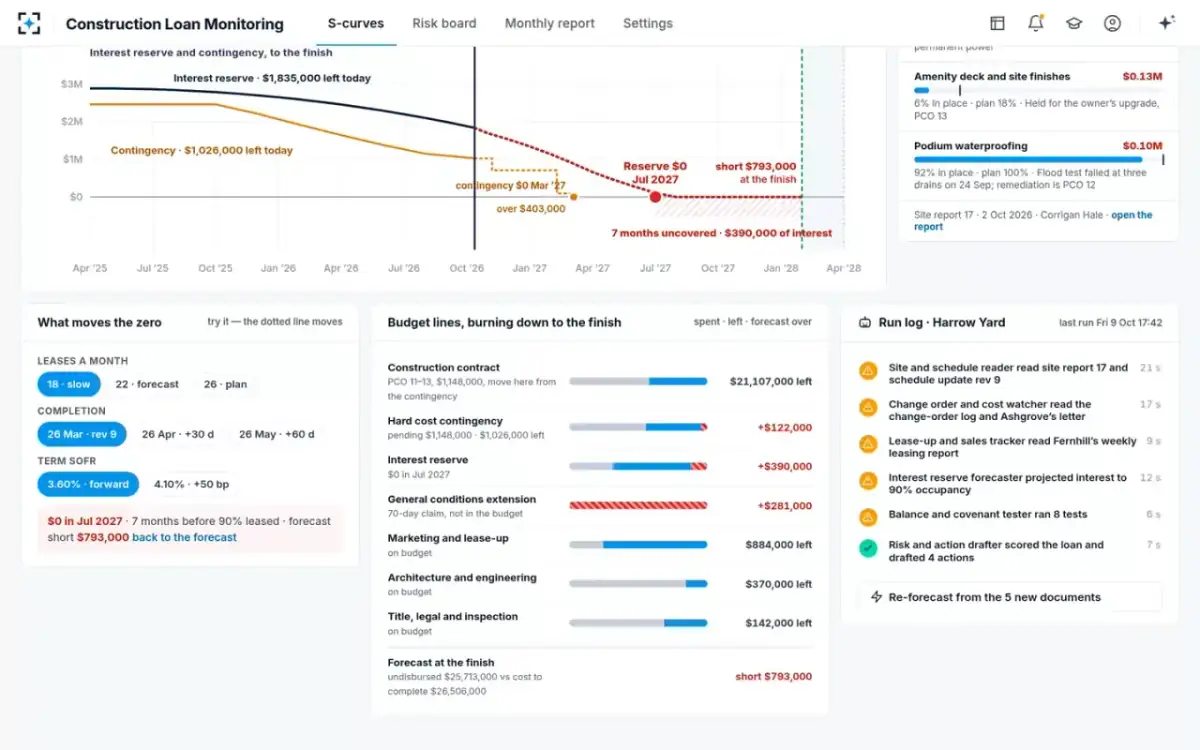
The research on bank failures is the reason to bother. Studying the failures of 2009, Cole and White found that construction and development loans "are consistently associated with a higher likelihood of bank failure", and that "construction loans continue to be a harbinger of failure"; failed banks held 23.2% of assets in construction and development loans against 7.0% at survivors (Cole and White, MPRA 24690; Journal of Financial Services Research, 2012). An overrun on one loan is ordinary. Overruns seen late across a construction book are how a bank gets into trouble. See how the sample loan's causes were read and traced at Construction Loan Monitoring.
Questions people ask
Do most construction projects go over budget?
The largest peer-reviewed sample, 258 transport infrastructure projects, found costs exceeded estimates 86% of the time, by 28% on average. No public source gives a comparable figure for privately financed US buildings, so treat overruns as likely and plan contingency and monitoring accordingly.
What is the most common cause of construction cost overruns?
No public US dataset ranks them. The OCC's list starts with inaccurate budgets, and on many loans the largest effects come from delay, because one late delivery adds general conditions, interest and a later lease-up at the same time. On the sample loan, delay-driven costs were $491,000 of the $613,000 shortfall.
Are renovation projects more likely to go over budget?
Yes. The OCC singles out projects that rehabilitate or heavily modify existing buildings as especially exposed, because their costs are hard to estimate before walls are opened. HUD sizes renovation contingency at 10 to 15% of rehabilitation cost for that reason.
How do construction delays affect a construction loan?
A delay adds interest at close to the full loan balance with no income to offset it, pushes back the date the property starts earning, and can breach an outside completion date in the loan agreement. On the sample loan the 70-day slip left 96 days of margin to the outside date, and four months of interest the reserve could not carry.
Can a lender refuse to fund an overrun?
Usually yes: most construction loan agreements require the borrower to keep the loan in balance and allow the lender to withhold advances until a balancing deposit is made. Lenders typically negotiate first, because stopping a project is costly for everyone.