Construction loan monitoring software tracks each construction loan between draws: progress against plan, the budget and cost to complete, whether the loan stays in balance, the interest reserve and the lease-up, and it alerts the lender when any of them is heading the wrong way. The category is easy to confuse with three neighbours: draw-management platforms that run the disbursement, construction monitoring companies that inspect the site, and the spreadsheets most banks still use. Each covers part of the job. Botminds' Construction Loan Monitoring covers the forecasting part: six agents read every site report, schedule update, change-order log and leasing report as it lands, re-forecast the loan to its finish, and draft the actions for a person to decide. This guide is written to help a lender choose, including when the answer is something else.
Where the guide uses product figures they come from a fictional sample bank with 31 construction loans, or are labelled as targets or estimates. Market and supervisory figures come from the FDIC, the OCC and the Federal Reserve, linked where used.
Why construction books get their own monitoring
$453.5B
construction and development loans at insured institutions, mid-2026
0.99%
of them noncurrent: performing, for now
80%
of 2007–2011 deposit insurance losses came from banks over the construction concentration screen
What is construction loan monitoring software?
It is software that answers, for every construction loan and at any moment, whether the money and time left are enough to finish the building and carry the debt to stabilisation. The OCC's booklet describes the work the software supports: "An established credit administration process that continually monitors each project's progress, costs, and loan disbursements is essential to effectively controlling commercial construction risk" (OCC, Commercial Real Estate Lending, p. 46). The word that matters is continually; draws happen monthly, but the documents that change a forecast arrive any day.
The minimum feature set follows from that. The software reads the documents a construction loan produces, keeps progress against plan, forecasts cost to complete with pending items included, tests the balance today and at completion, projects the interest reserve to stabilisation, tracks leasing, and alerts on thresholds the bank sets. The better products then rank the whole book by forecast risk and draft what to do about it.
Construction loan monitoring companies, software and spreadsheets: who covers what
Four kinds of provider sell into this work, and most lenders need two of them. Construction monitoring companies, the independent consultants the OCC says banks often retain, inspect the site and certify progress. Draw-management platforms run the disbursement: requests, lien waivers, title date-downs and approvals. Portfolio forecasting software, the category of this guide, reads both and forecasts each loan. Spreadsheets do a little of everything by hand.
Construction loan monitoring software and its neighbours: what each covers
| Provider type | What it does well | What it does not do | Who uses it |
|---|---|---|---|
| Construction monitoring company (inspecting consultant) | Site visits, certified percent complete, plan and budget review, draw recommendation | Forecast the loan; read leasing, rates or the loan agreement | Construction loan administrator |
| Draw-management platform | Draw requests, lien waivers, title updates, approvals and disbursement on draw day | Read what arrives between draws; forecast the reserve or the balance at completion | Administrator, borrower, title company |
| Portfolio forecasting software | Re-forecasts each loan from every new document; ranks the book; drafts actions | Inspect the site; disburse funds | Portfolio manager, CCO, lending officer |
| Spreadsheet per loan | Flexible; free; familiar | Read anything; keep sources; stay current without re-keying | Everyone, unevenly |
Is a spreadsheet enough to track construction loans?
A spreadsheet is enough to calculate a construction loan; it is rarely enough to track a book of them, because it knows only what someone re-keyed into it. The FDIC's inspector general found that failure pattern repeatedly in the last crisis. Banks "did not always track, monitor, and report on the use of interest reserves or their effect on the reported income of the institution" (FDIC OIG, MLR-11-010).
One review is a case study in spreadsheet tracking. Examiners found that Appalachian Community Bank "did not have a formal way to track the dollar amount of interest reserves". When asked, it produced "a spreadsheet that identified $51.8 million in loans with $6.2 million in documented interest reserves, but this document did not take into account loans for which interest reserves may have been funded but not formally documented" (FDIC OIG, MLR-11-001). The spreadsheet was accurate about what it contained, and silent about everything else.
The test for a spreadsheet, then, is not its formulas but its inputs. If the schedule update, the pending change orders, the leasing report and the rate curve reach it within a day for every loan, it may be enough. If they reach it at the next draw, the bank is monitoring the past.
What alerts should a construction lender set?
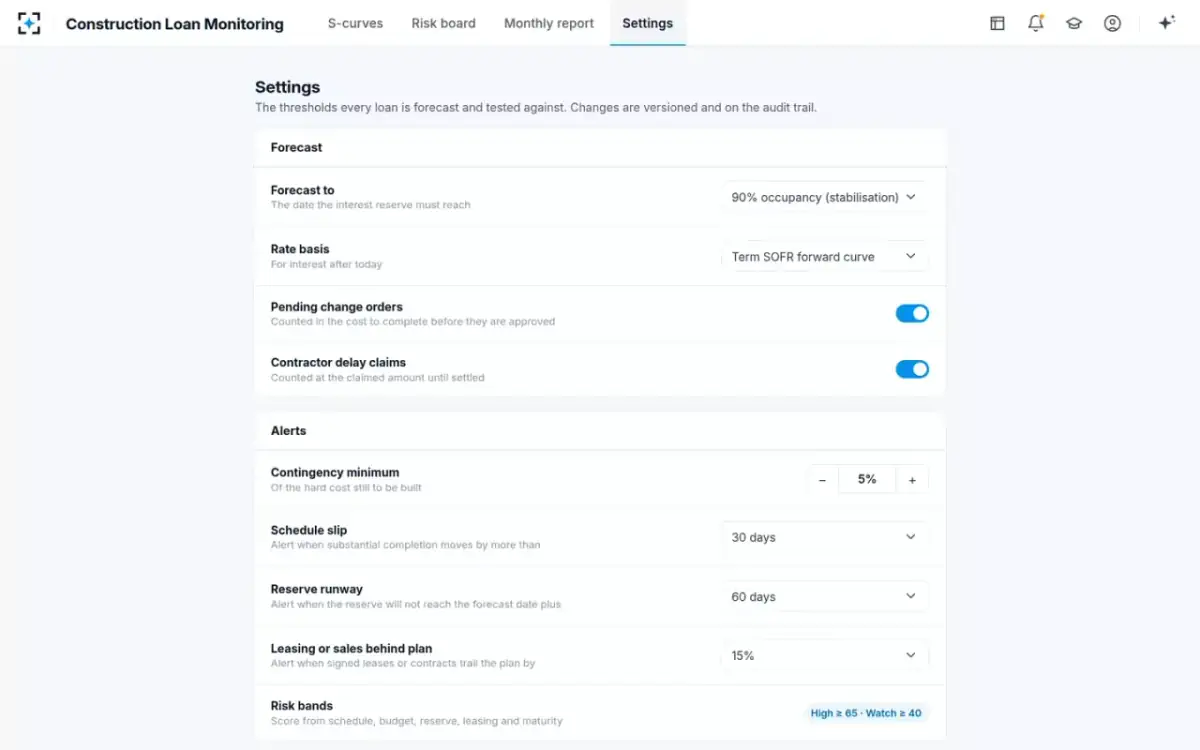
A construction lender should set alerts on four forward-looking measures: contingency left against work left, schedule slip against the outside completion date, the interest reserve's runway against stabilisation, and leasing or sales against plan. A fifth, a forecast shortfall at completion, combines them. Each threshold is a credit policy decision, not a software default, and the software should hold them as settings with a history of every change.
Alert thresholds for construction loan monitoring, as the sample bank set them
| Alert | Sample bank setting | Options offered | Why it matters |
|---|---|---|---|
| Contingency minimum | 5% of the hard cost still to be built | 2% to 10%, one-point steps | Contingency is the first money spent on overruns; measuring it against work left, not the original budget, shows how thin it has become |
| Schedule slip | Substantial completion moves by more than 30 days | 14, 30, 45 or 60 days | Every month of slip adds interest and pushes lease-up later |
| Reserve runway | Reserve will not reach stabilisation plus 60 days | 30, 60 or 90 days | Catches the long tail that a draw-day test cannot see |
| Leasing or sales behind plan | Signed leases or contracts trail the plan by 15% | 10%, 15% or 25% | Slow absorption is an FDIC warning sign and drains the reserve |
| Risk bands | High at a score of 65 or more; watch at 40 | Bank-defined | Decides which loans reach the credit committee |
Settings: the thresholds every loan is forecast and tested against
What to look for in construction loan monitoring software
Look for evidence, not features. Ask each vendor to run its product on three of your own loans, including one you already know went wrong, and judge what it shows. The checklist below is ours, written from the OCC's monitoring guidance and from the failures the FDIC's inspector general documented.
Construction loan monitoring software: a buyer's checklist
- Reads your documents as they are
Site reports, schedule updates, change-order logs, contractor letters and leasing reports in the formats your consultants and borrowers already send.
- Forecasts, not just records, the balance
In balance today and at completion, with pending change orders, claims and interest beyond the reserve counted.
- Projects the interest reserve to stabilisation
On the rate curve and the leasing pace, with the month it runs dry and every assumption shown.
- Every figure traceable to its page
An examiner or a credit officer can open the source of any number in one step.
- Thresholds are your policy
Held as versioned settings, not coded defaults, with an audit trail of changes.
- People decide, sign and send
No changes to terms, rates or ratings by the software; approvals carry their meaning; only your staff contact the borrower.
- Works beside your draw process and core system
Reads draw history; does not need to replace the platform that disburses.
- Proves itself on a loan you know
Run it on a past problem loan and see how many months earlier it would have flagged it.
Where Construction Loan Monitoring fits, and where it does not
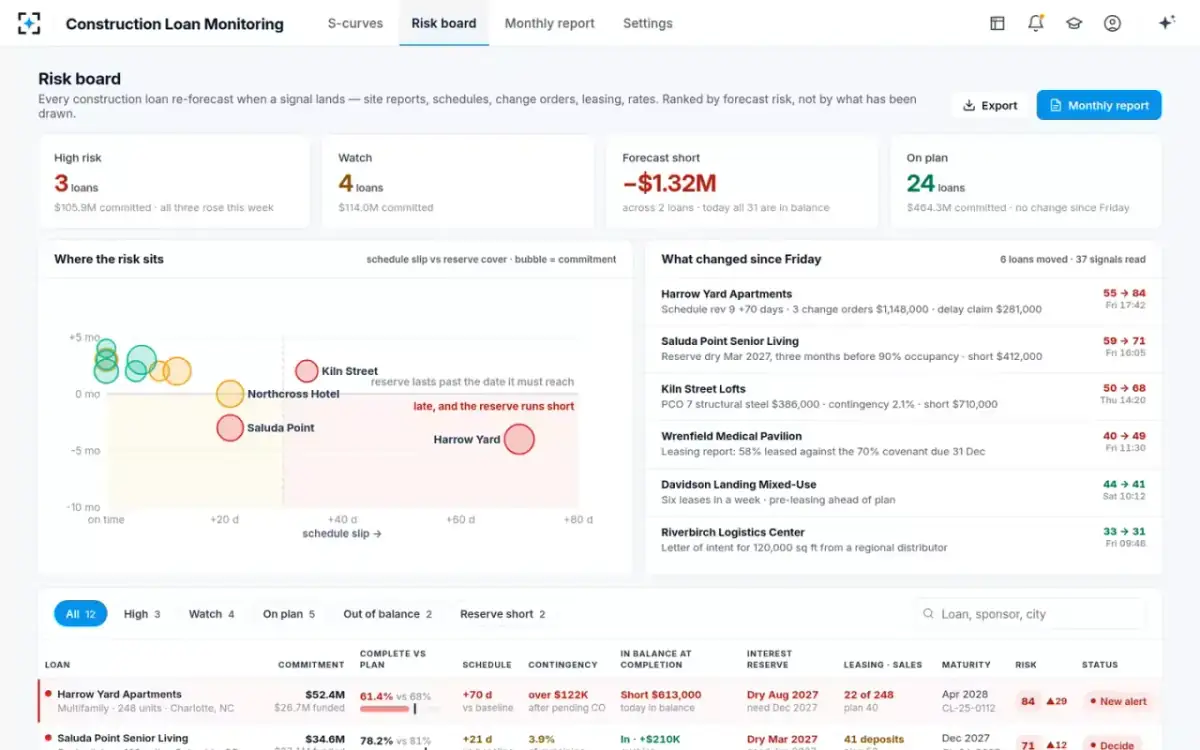
The solution fits a bank or credit union with enough construction loans that the documents between draws go unread: commonly a few dozen loans or more, with monthly consultant reports and a credit team that hears about trouble at the draw. It reads those documents, keeps each loan's S-curve, budget, reserve and lease-up current, ranks the book by forecast risk, and drafts actions and borrower notices for a named person to approve. On the fictional sample book, all 31 loans were in balance on draw-day tests while two were forecast $1.32 million short at completion between them.
The risk board: 31 loans, all in balance today, two forecast short
It does not fit four needs, and a buyer should know them. It does not inspect: the bank still needs its consultant, whose certified percentage the solution reads and never changes. It does not disburse: lien waivers, title updates and the draw itself belong to a draw platform or a sibling solution. It does not replace the core loan system: it reads draw history and the reserve balance. And it does not decide: the agents never change loan terms, the rate or a risk rating, never approve a change order and never declare a default. For a bank with a handful of construction loans, a disciplined spreadsheet and the monthly construction progress report template may be the better first step.
How long to implement construction loan monitoring software: an eight-week plan
Eight weeks is a realistic plan for a lender that can supply its documents and decide its thresholds promptly; most of the calendar is the bank's own decisions, not configuration. The plan below is our suggestion, not a measured average, and the parallel run is the part not to shorten: it is where the bank learns whether the forecasts would have changed a decision.
Construction loan monitoring software, live on your book in eight weeks (our suggested plan)
- Loan agreements, budgets and schedules for every loan2 weeks
- Connect site reports, change orders, leasing reports1.5 weeks
- Set thresholds and approvers in policy1 week
- Run in parallel for one draw cycle3.5 weeks
Week one and two gather what each loan already has: the loan agreement with its balancing and outside-date clauses, the current budget revision, the baseline schedule and the draw history. Week three connects the documents that arrive between draws, from the consultant, the borrower portal and the leasing agent. Week four is the credit committee's: the contingency minimum, the alert thresholds, the risk bands and who approves what. The remaining weeks run the forecasts alongside the existing process, so the first live alert arrives with a draw to check it against.
What construction loan monitoring software costs to run: the hours
The licence is only part of the cost; the larger part is the staff time each loan takes every month, and that is what the software changes. Botminds estimates that monitoring one construction loan by hand takes about 11.5 hours a month, and about 2.75 hours with the solution. Across a 31-loan book that is roughly 356 hours a month by hand against 85, our arithmetic on the estimate.
Where one loan's monthly monitoring hours go, by hand and with the solution
By hand · about 11.5 hours
- Re-keying reports · 3 h · 26%
- Pricing change orders · 2 h · 17%
- Reserve and lease-up · 2 h · 17%
- Balance tests · 1.5 h · 13%
- Committee write-up · 2 h · 18%
- Deciding · 1 h · 9%
With the solution · about 2.75 hours
- Checking the agents' reading · 1.25 h · 46%
- Committee write-up · 0.5 h · 18%
- Deciding · 1 h · 36%
The time saved is the smaller benefit. The larger one is when the bank learns: on the sample loan, the forecast moved the balancing demand and the watch-list rating from the February draw to October, ten months before the reserve would have run dry. That is the difference between a negotiation with a sponsor who still has options and a workout with one who does not, a difference the guide to construction loans out of balance works through in detail.
Governance: how examiners will look at agent-based software
Examiners will look at it as a tool inside the bank's credit administration, judged by the controls around it. The 2026 model risk guidance leaves agentic systems outside its definition for now: "GenAI and agentic AI models are novel and rapidly evolving and are not within the scope of the revised model risk management guidance", the OCC wrote in spring 2026, adding that the agencies plan a request for information (OCC Semiannual Risk Perspective, Spring 2026). That is not an exemption from scrutiny; it means the bank's own controls carry the weight.
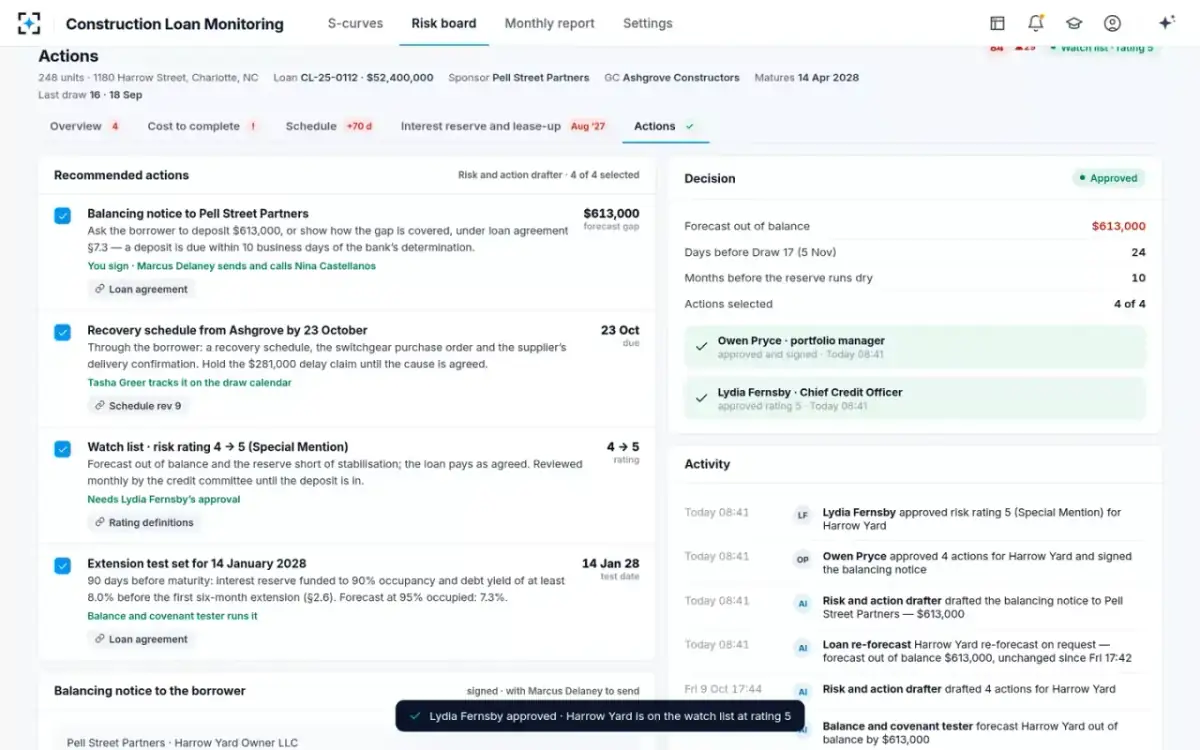
Three controls answer most of an examiner's questions. Every figure is traceable to its source document and page. Every threshold is a versioned setting with its history. And every action is approved by a named person with the meaning of the approval kept beside it, with rating changes reserved to the chief credit officer.
Both approvals and the activity trail, on the loan's decision panel
The guide to a construction progress monitoring system that asks, not guesses covers how the agents handle conflicting sources. To see the full product on a sample book, or to run it on your own loans, start from Construction Loan Monitoring.
Questions people ask
What is construction loan management software?
The term usually means the system that runs the loan's administration: draws, disbursements, lien waivers and payments. Construction loan monitoring software sits beside it and forecasts each loan between draws. Many lenders need both, and the two should share the draw history.
Do construction loan monitoring companies replace software?
No; they do different work. An inspecting consultant visits the site and certifies progress, which the OCC notes banks often buy in when they lack in-house construction expertise. Software reads the consultant's report together with the schedule, change orders, leasing and rates to forecast the loan.
What is a construction loan tracking spreadsheet good for?
Underwriting one deal, and tracking a few loans with disciplined monthly updates. It struggles when documents arrive faster than anyone re-keys them; FDIC inspector general reviews found banks that could not say how much of their book carried interest reserves.
Can the software change a loan's risk rating?
It should not. In Construction Loan Monitoring the agents recommend a rating change and the chief credit officer approves it; on the sample loan the move from 4 to 5 waited for her approval. Ratings are a credit decision with regulatory consequences.
How quickly does the software react to a new document?
Construction Loan Monitoring's design target is every loan re-forecast within an hour of a new document. On the sample loan, six agents re-forecast from five new documents in 72 seconds.