A construction progress monitoring system measures how far a building has progressed against its plan and reports the gap, and for a lender the useful version goes one step further: it compares every source that claims a percentage complete, such as the inspector's site report, the contractor's pay application, the schedule update and, increasingly, site photos, and it says plainly where they disagree. Most of the hard cases in construction lending start as a disagreement nobody resolved. A system that fills the gap with an assumption hides the problem; one that names the conflict and puts the question to the person who owns the answer surfaces it. Botminds' Construction Loan Monitoring is built on that rule: six agents read each document as it lands, keep each source's number with its page, and re-forecast the loan without changing a figure anyone certified.
The examples come from a fictional sample loan, Harrow Yard Apartments, and the fictional bank that carries it. The research on photo-based monitoring and the supervisory expectations are linked where they are used.
Two kinds of construction progress monitoring system, built for different questions
Site-side systems: Is the work in place, and where on the model?
Lender-side systems: Can the money left finish the building, and carry the debt to stabilisation?
Site-side systems: Site photos, drone and laser scans, the building information model, the schedule.
Lender-side systems: Site reports, pay applications, schedule updates, change-order logs, leasing reports, the loan agreement and draw history.
Site-side systems: As-built against as-planned, element by element; percent complete by area or trade.
Lender-side systems: In balance today and at completion, the interest reserve runway, risk score and recommended actions.
Site-side systems: Contractor, owner's representative, inspecting consultant.
Lender-side systems: Construction loan administrator, portfolio manager, chief credit officer.
Site-side systems: Says little about money: a pending change order or a slow lease-up is invisible to a camera.
Lender-side systems: Depends on the quality of the percentages it is given; it cannot see the site.
What is a construction progress monitoring system?
A construction progress monitoring system is software that tracks completed work against the planned schedule and budget and reports the variance, usually by trade, area or milestone. There are two families, and they are rarely the same product. Site-side systems measure the building: they turn photos, scans and models into a percentage complete. Lender-side systems measure the loan: they turn documents into a forecast of whether the money and the time left are enough.
The distinction matters when buying. A contractor's photo platform can tell a lender that drywall on Levels 3 to 5 is 22% in place against a plan of 41%. It cannot tell the lender that this delay, with two pending change orders and a slow leasing week, leaves the loan $613,000 short at completion. That second sentence is the one a credit committee needs, and the guide to choosing construction loan monitoring software sets out what else to require of it.
Can photos measure percent complete? What the research shows
Photos can measure progress well enough to be useful, not well enough to replace a certified percentage on a loan. University research has shown the principle for more than a decade. The University of Illinois RAAMAC group proposed "a fully automated approach for construction progress tracking and as-built model visualization using unordered daily construction images collections as well as Building Information Models (BIM)", published in the Journal of Computing in Civil Engineering in 2015 (University of Illinois, RAAMAC).
General-purpose AI models are newer to the task and show where the limits sit. A 2024 study of aerial construction imagery found that "GPT-4 Vision is proficient in identifying construction stages, materials, and machinery, it faces challenges with precise object localization and segmentation" (Ersoz, arXiv:2412.16108). Identifying that framing is under way is not the same as measuring that it is 52% done, and a draw is paid on the second.
For a lender, the honest reading is that photos are a second source, not a replacement. They are valuable exactly where they disagree with the site report, because a disagreement is a question for the inspector. Construction Loan Monitoring does not process photos or scans; it reads the consultant's report and the other documents a loan already produces.
How do lenders verify percent complete today?
Lenders verify percent complete through an inspection by their own staff or an independent consultant, and they pay draws against that figure. "Inspection reports typically state compliance with plans and specifications, support disbursements typically based on percentage complete, and state whether the project is progressing as anticipated," the OCC's Comptroller's Handbook notes (OCC, p. 45). The consultant's percentage is therefore not one opinion among several; it is the number the bank has contracted for.
Examiners look for draws that outrun that number. The FDIC's examination manual lists among the warning signs of a troubled project "periodic construction draws that exceed the amount needed to cover construction costs and related overhead expenses", alongside "construction delays resulting in cost overruns" and "slow leasing or lack of sustained sales activity" (FDIC RMS Manual §3.2). Each of those is a comparison between two sources: the draw and the inspection, the schedule and the baseline, the leasing report and the plan.
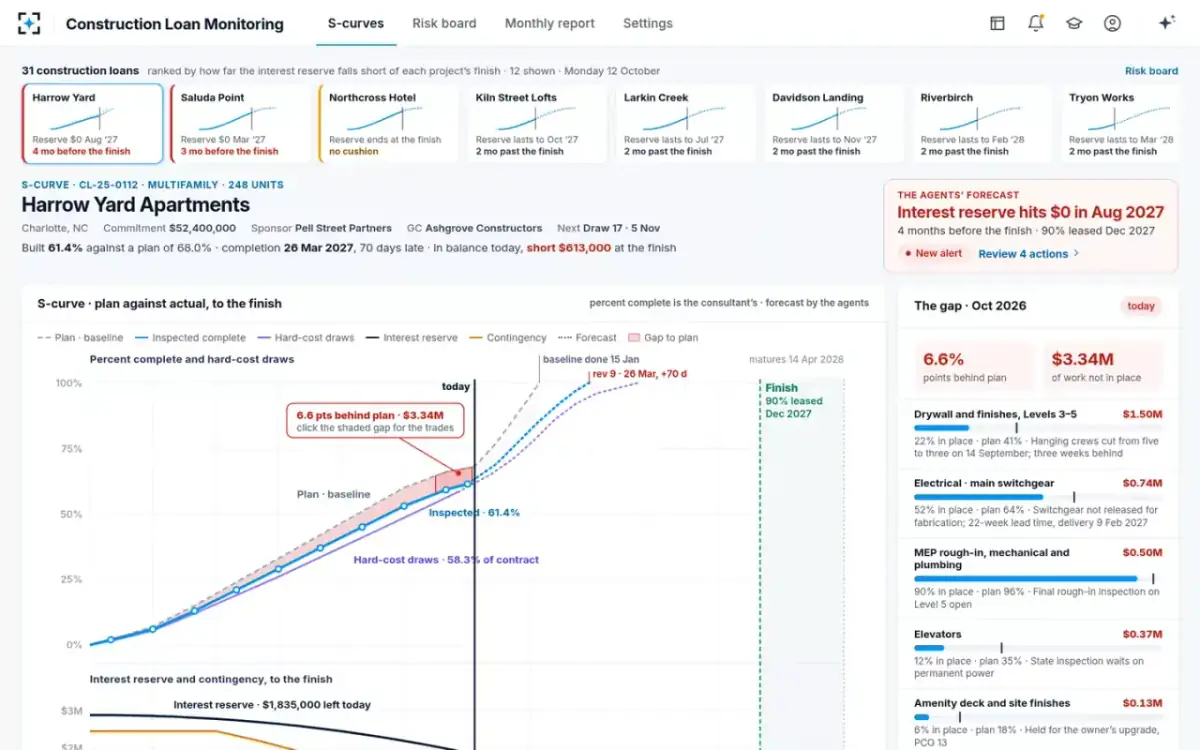
Three sources of percent complete on one chart: plan, inspected and hard-cost draws
What happens when the inspector and the pay application disagree?
When the inspector and the pay application disagree, the draw is funded on the inspector's figure and the difference becomes a question, not an adjustment. On the sample loan the consultant certified 61.4% complete while hard-cost draws stood at 58.3% of the contract. That is the healthy direction: billing behind inspected work, partly because retainage is held back. The reverse, billing ahead of inspected work, is the pattern the OCC calls front loading, where "a builder deliberately overstates the cost of the work to be completed in the early stages of construction".
Other disagreements are less obvious and matter more. The table below lists the ones a lender's system should surface, and who owns the answer to each.
The disagreements a construction progress monitoring system should surface, and who answers each
| Two sources disagree | What it may mean | Who is asked | What a guess would hide |
|---|---|---|---|
| Pay application ahead of inspected percent complete | Front loading, or work in place the inspector has not seen | Inspecting consultant, then the contractor through the borrower | Funds advanced for work not done |
| Schedule update holds the date, site report says a trade is weeks behind | A schedule with float that no longer exists | Consultant; contractor's recovery schedule | A completion date that cannot be met |
| Supplier letter moves a delivery onto the critical path | Slip on everything downstream of that delivery | Contractor: purchase order and delivery confirmation | Months of extra interest |
| Pending change orders exceed the contingency left | An overrun the approved budget cannot see | Administrator, then the borrower | A loan out of balance at the next draw |
| Leasing report trails the plan | Later stabilisation, a reserve that runs dry first | Leasing agent; lending officer with the sponsor | Interest with nothing to pay it |
| Contractor's delay claim against the owner's position | A cost whose amount is disputed | Borrower; held until the cause is agreed | Either a hidden cost or a double count |
Why a monitoring system should ask, not guess
A guess is an assumption the reader cannot see; a stated assumption is a policy the bank can defend. Every forecast needs assumptions, and the line between the two is whether they are written down, set by someone with authority, and shown beside the number. Construction Loan Monitoring counts pending change orders and contractor delay claims at the claimed amount until they are settled. That is not a guess: it is a setting in the bank's thresholds, versioned and on the audit trail, and it can be switched off.
What the system must not do is resolve a factual conflict on its own. On the sample loan, the consultant wrote in site report 17 that the contractor's new completion date "is achievable only if the switchgear date holds; it shows no float on that path." A system that guesses would either accept the 26 March date or invent a later one. The agents did neither. They forecast to the schedule update's date, flagged that the critical path ran through a switchgear delivery due 9 February, and drafted a request through the borrower for a recovery schedule, the switchgear purchase order and the supplier's delivery confirmation, due 23 October.
The same rule governs the $281,000 delay claim. The forecast counts it at the claimed amount; the recommended action holds it until the cause is agreed. Two people decide what happens next: the administrator, who tracks the recovery schedule on the draw calendar, and the portfolio manager, who signs the request. That is what asking looks like in practice: the right document, from the right party, requested by a named person, with a date. The guide to the monthly construction progress report follows the same five documents through the lender's month.
How Construction Loan Monitoring turns a disagreement into a question for a named person
Agent
Site and schedule readerReads the consultant's certified percent complete, the milestones and the opinion, and the contractor's schedule update, citing the page for every date.
Never: alters a percentage the consultant certified
Agent
Change order and cost watcherReads pending change orders and contractor letters and prices each at the claimed amount, line by line.
Never: approves or rejects a change order
Agent
Interest reserve forecasterProjects interest and lease-up income to stabilisation and finds the month the reserve runs dry.
Never: changes the loan terms or the rate
Agent
Balance and covenant testerRuns the in-balance, contingency, completion, leasing, maturity and extension tests and reports pass, close or fail with the figure.
Never: declares a default
Agent
Risk and action drafterWrites each open conflict as a recommended action with an owner and a date, and drafts any notice.
Never: sends anything
A person decides
Portfolio managerApproves the actions and signs any request or notice, with the meaning of the signature recorded.
A person decides
Lending officer and administratorThe lending officer sends to the sponsor and makes every contact; the administrator tracks the answers on the draw calendar.
Who decides: approval stays with people
Approval stays with named people because the regulators expect it and because the decisions carry legal weight. The OCC describes banks' use of generative and agentic AI as measured, "with usage generally limited to specific use cases with guardrails and human-in-the-loop accountability to manage risk" (OCC Semiannual Risk Perspective, Spring 2026). A balancing demand, a rating change or a delay-claim position is a credit decision under the loan agreement; a system can draft it but should not make it.
Banks are taking a measured approach to the adoption of generative AI (genAI) and agentic AI, with usage generally limited to specific use cases with guardrails and human-in-the-loop accountability to manage risk.
OCC, Semiannual Risk Perspective, Spring 2026
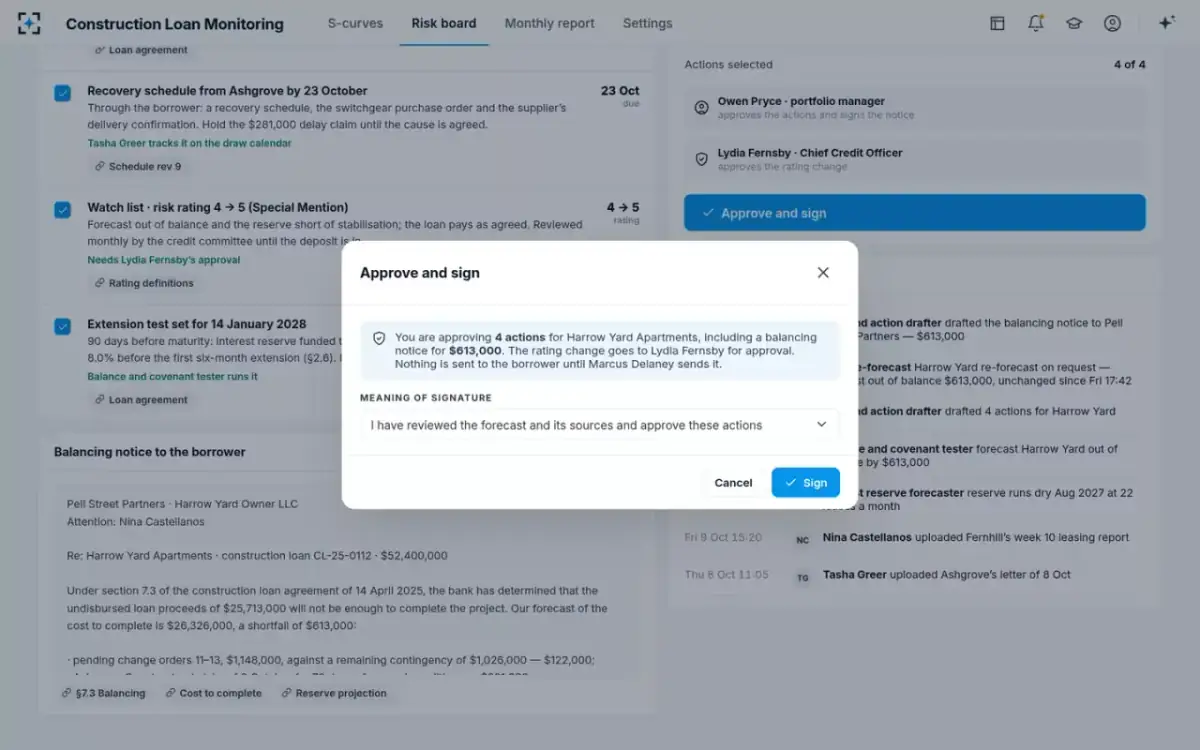
On the sample loan, four recommended actions reached the portfolio manager: a balancing notice for $613,000, the recovery schedule request, a watch-list rating of 5, and an extension test set for January 2028. He approved them with the meaning of his signature stated. The rating change waited for the chief credit officer, and nothing reached the borrower until the lending officer sent it.
Approve and sign: the meaning of the signature travels with it
What to look for when buying a construction progress monitoring system
Look first for what the system does with a disagreement, then for what it reads, and only then for its charts. The checklist below is ours. It is written for a lender's system; a contractor choosing a site platform would weight it differently.
Construction progress monitoring system: what a lender should require
- Every number keeps its source
Each percentage, date and dollar links to the document and page it came from, so a reviewer can check it in one click.
- Certified figures are never overwritten
The consultant's percent complete stays the consultant's. Disagreements are shown beside it, not blended into it.
- Assumptions are settings, not code
How pending changes, claims, rates and lease-up are treated is set by credit policy, versioned and visible on every forecast.
- Reads what arrives between draws
Schedule updates, supplier letters, change-order logs and leasing reports change the forecast the day they land.
- Conflicts become actions with owners and dates
Not a red cell: a named person, the document requested and the day it is due.
- People approve, sign and send
No terms, ratings or borrower contact changed by the system; approvals carry their meaning.
- Works with your inspectors, not instead of them
The system reads the consultant's report; it should not claim to replace the site visit.
- Shows its working to an examiner
Every agent step, upload and approval on the loan's activity trail, with who, what and when.
Where the solution fits a lender's progress monitoring, and where it does not
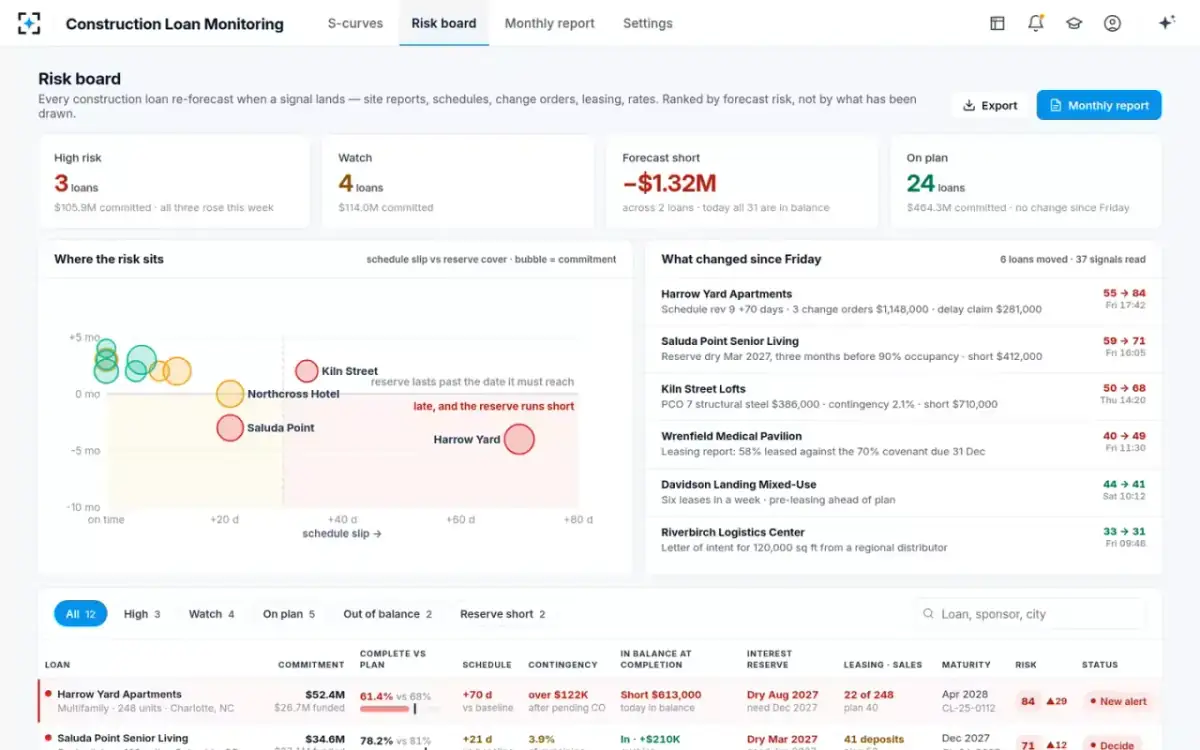
The solution fits a lender with a construction book large enough that documents between draws go unread: dozens of loans, monthly site reports, schedule updates and leasing reports, and a credit team that hears last. It reads those documents, keeps each source's figure, forecasts each loan to its finish and drafts the actions. In the sample run it re-forecast one loan from five new documents in 72 seconds; across the portfolio, the risk board ranks all 31 loans by forecast risk rather than by what has been drawn.
Construction Loan Monitoring's risk board ranks loans by where they are going
It does not fit three needs. It does not measure the site: there is no photo, drone or model analysis, so a lender wanting a second source of percent complete still needs one. It does not run the draw itself: lien waivers, title date-downs and disbursement are a sibling solution's work. And it does not decide: every action, rating and contact stays with the bank's people. The guide to the construction S-curve shows the chart the agents draw from the sources they read. Start from Construction Loan Monitoring to see the whole loan.
Questions people ask
Is AI construction progress monitoring accurate enough for a lender?
Not as the only source. Research shows models can identify construction stages from images, but a 2024 study found GPT-4 Vision "faces challenges with precise object localization and segmentation". Use image-based progress as a check on the inspector's certified figure, and treat a disagreement as a question for the inspector.
What is drone construction progress monitoring?
It uses aerial photos or scans of the site, compared with the plan or the building model, to estimate work in place. It suits large sites and exterior work; interior trades such as drywall and finishes, often where a mid-rise falls behind, are harder to see from the air.
What is the difference between progress monitoring and construction loan monitoring?
Progress monitoring measures the building against the schedule. Construction loan monitoring measures the loan: whether the funds left can finish the work, whether the interest reserve lasts to stabilisation, and whether the loan stays in balance. The first is an input to the second.
Should the system adjust the inspector's percent complete?
No. The certified percentage is what the bank contracted for and what the draw is paid against. A good system shows other sources beside it and asks the inspector about a gap; it never blends them into a new number.
What warning signs should trigger a question?
The FDIC's examination manual lists them: draws exceeding what construction costs require, construction delays causing overruns, slow leasing or sales, changes in concept or plan, and the lack of a sound feasibility study. Each is a comparison a system can run every time a document lands.