A typical construction contingency percentage is 5 to 10 percent of the overall budget for new construction, and the OCC, the national bank regulator, uses exactly that range: contingency allowances "vary based on the project's size or complexity but usually range between 5 and 10 percent of the overall budget". Renovation of older buildings runs higher; HUD's multifamily program sizes it at 10 to 15 percent of rehabilitation cost. For a lender, though, the percentage at closing is only the start. What decides whether a loan stays in balance is how much contingency is left against the work still to be built, and whether the change orders already submitted will use it up. Botminds' Construction Loan Monitoring measures exactly that, after every change order and site report, against a minimum the bank sets in its own credit policy.
The worked example is sample data from a fictional apartment loan, Harrow Yard in Charlotte. The benchmarks are quoted from the OCC and HUD, which publish the only regulatory figures on contingency.
The contingency percentages regulators publish
5–10%
of the overall budget: the usual range, per the OCC
10–15%
of rehabilitation cost: HUD's range for older buildings
2%
of the mortgage: HUD's construction contingency escrow on new construction
What is a typical construction contingency percentage?
For new commercial construction the typical contingency is 5 to 10 percent of the overall budget, set higher for larger or more complex projects. The OCC's Comptroller's Handbook puts it this way: "The budget typically includes a contingency account to fund unanticipated cost overruns. Contingency allowances vary based on the project's size or complexity but usually range between 5 and 10 percent of the overall budget. Common uses of contingency funds include an unexpected increase in material costs or a buyer-mandated redesign" (OCC, Commercial Real Estate Lending, p. 32).
Two words in that passage carry most of the meaning. "Unanticipated" sets the purpose: contingency pays for what nobody could reasonably have priced, not for what was priced too low. "Complexity" sets the size: a repeat garden-apartment design on a clean site justifies the low end, a mixed-use tower with a podium, structured parking and long-lead equipment the high end. The range is not a rule; it is what examiners expect to see, and a budget outside it should come with a reason.
Commercial construction contingency percentage: what lenders accept by project type
Lenders accept less contingency on simple new construction and require more on renovation, where the unknowns are behind walls. HUD's guide states the renovation case in numbers: for substantial rehabilitation, "there will normally be included in the mortgage amount a reserve for contingencies based on the percentage of estimated rehabilitation cost without fees. This percent may range between 10 and 15 percent", depending on the scope, the sponsor's and contractor's experience, and "whether the contractor's bid already contains a reserve for contingencies" (HUD MAP Guide 4430.G, §7.13.7).
The OCC explains why: "Projects that rehabilitate or extensively modify existing buildings can be exceptionally vulnerable to overruns because these costs can be difficult to estimate." For new construction, HUD takes a different route. Instead of a line in the budget, it requires a working capital escrow of 4% of the mortgage, half of it set aside "specifically as a construction contingency to cover construction cost overruns and change orders" (HUD MAP Guide, §3.2.10).
Construction contingency percentage by benchmark, and the sample loan at closing
Hard cost vs soft cost contingency
A hard cost contingency covers the building itself: materials, labour, site conditions and change orders on the construction contract. A soft cost contingency covers everything else that can overrun, chiefly interest, taxes, insurance, fees and the costs of a longer schedule. Lenders usually see a hard cost contingency as a budget line and treat soft cost risk through the interest reserve and a cushion in each soft line, if at all.
Hard cost and soft cost contingency: what each covers and what it misses
Hard cost contingency: Material and labour price increases, unforeseen site or subsurface conditions, redesign, change orders on the contract.
Soft cost contingency: Extra interest, taxes, insurance, fees and general conditions when the schedule runs long.
Hard cost contingency: A budget line, often 5–10% of the budget on new construction, more on renovation.
Soft cost contingency: Cushions inside the interest reserve and soft cost lines; HUD keeps 2% of the mortgage for it.
Hard cost contingency: Hard cost still to be built.
Soft cost contingency: Months to stabilisation, and the rate.
Hard cost contingency: Change orders exceed what is left.
Soft cost contingency: Completion or lease-up slips past the date the reserve was sized to.
Hard cost contingency: $1,026,000 left; $1,148,000 of change orders pending.
Soft cost contingency: Interest reserve short $210,000 to 90% occupancy; a $281,000 general conditions claim.
The sample loan shows why both matter. Its hard cost contingency is nearly spent, and the change orders pending would overdraw it by $122,000. Its soft costs are worse: the 70-day schedule slip produced a $281,000 general conditions claim and pushed stabilisation four months past the date the interest reserve runs out. A budget with only a hard cost contingency has nowhere to put either of the last two. The construction interest reserve calculator sizes the soft side.
How to calculate hard cost contingency, and how to measure it after closing
At closing, hard cost contingency is the chosen percentage times the hard cost budget: 5% of a $49.2 million contract is about $2.46 million, which is what the sample loan carried. After closing, the useful percentage is a different one: contingency left divided by hard cost still to be built. That ratio falls if contingency is spent faster than the building rises, and it is the one a lender should set a minimum on.
Hard cost contingency on the sample loan, at closing and on 12 October
| Measure | Calculation | Result |
|---|---|---|
| Contingency at closing | Budget line | $2,460,000 |
| As a share of the original hard cost contract | $2,460,000 ÷ about $49,218,000 | 5.0% |
| Used by approved change orders 1–6 | Moved into the contract | $1,434,000 (58% of it) |
| Building complete | Consultant-certified | 61.4% |
| Contingency left | $2,460,000 − $1,434,000 | $1,026,000 |
| As a share of hard cost still to be built | $1,026,000 ÷ $21,107,000 remaining on the contract | 4.9% |
| After pending change orders 11–13 | $1,026,000 − $1,148,000 | −$122,000 |
Read in order, the table tells a story the closing percentage hides. Contingency was spent roughly in step with progress, 58% used at 61% complete, which is healthy. It then sat at 4.9% of the remaining work, just under the bank's 5% minimum, which was the first warning. The pending change orders would take it below zero. Each step was visible from documents the bank already had, and none of them showed up in a draw-day test.
Do lenders require a contingency?
In practice, yes. The OCC describes a contingency account as typical of a construction budget and expects plans, budgets and cost estimates on complicated projects to be reviewed by an architect, engineer or construction consultant. Its examiners' questionnaire asks whether "the bank require[s] a line-item budget or cost breakdown for each construction stage". HUD makes it a condition: a contingency reserve in the mortgage for substantial rehabilitation, and a contingency escrow for new construction.
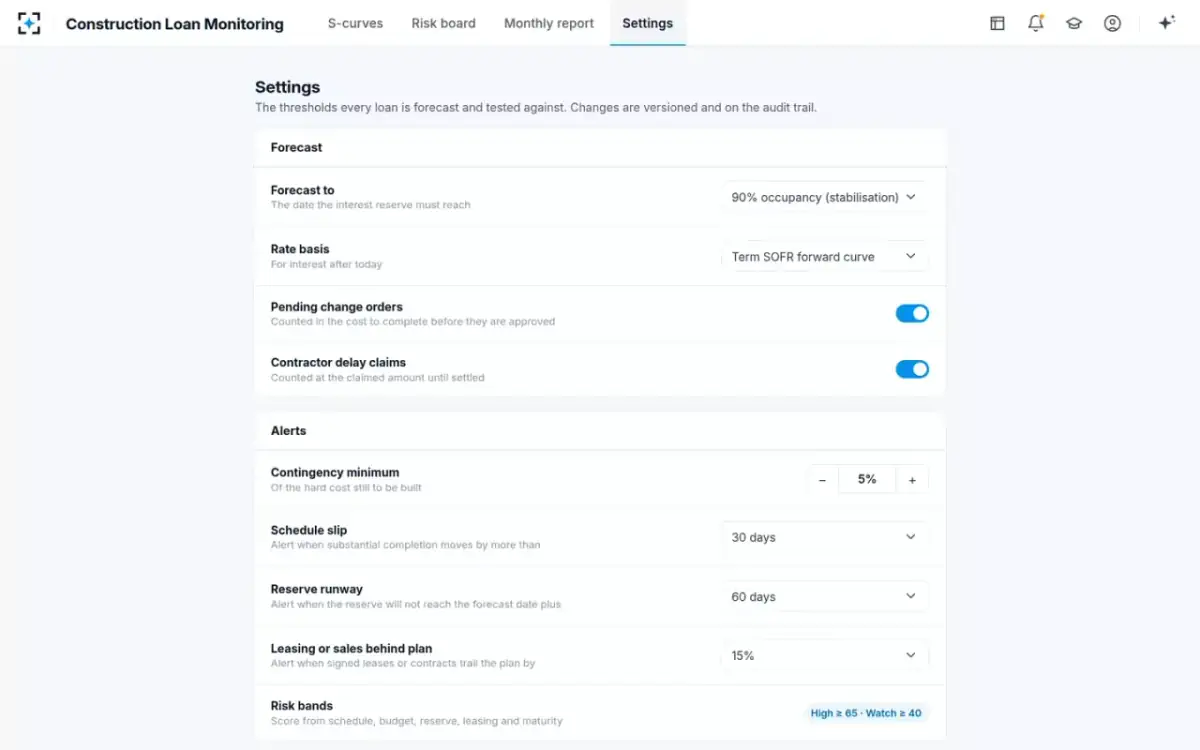
What lenders differ on is the minimum after closing. Few loan agreements set one explicitly; most rely on the in balance clause, which only bites when the whole budget is short. A bank can set its own monitoring minimum in credit policy without changing a loan agreement, and use it to trigger a conversation earlier than the balancing clause would.
The contingency minimum as a credit policy setting in Construction Loan Monitoring
Who pays for cost overruns beyond the contingency?
The borrower does, and in some cases the contractor. The OCC draws the line on purpose rather than amount: "Cost overruns on a project may also be the result of poor projections or management. In these cases, the increased cost would ordinarily be covered by the borrower rather than by a draw-down on the loan amount budgeted for contingencies" (OCC, p. 46). Contingency is for the unforeseeable; a budget that was simply wrong is the sponsor's problem.
HUD adds the contractor's share. Soft cost overruns caused by a general contractor's poor performance are paid from the damages clause of the construction contract, while change orders and overruns "not caused by the contractor" come out of the 2% contingency escrow (HUD MAP Guide, §12.7.8 and §12.15.3). The sample loan has one item of each kind in dispute: a $281,000 delay claim from the contractor, which the bank's recommended action holds until the cause is agreed, and change orders that the owner and contractor will argue about. The guide to why construction projects go over budget traces each one to its cause.
What happens when contingency runs out?
When contingency runs out, each further overrun lands directly on the in balance test, and the borrower must fund it or the loan goes out of balance. On the sample loan the agents' forecast shows the contingency reaching zero in March 2027 and the overruns beyond it, change orders plus the delay claim, at $403,000. Add the interest the reserve cannot carry and the loan is forecast $613,000 short at completion.
Construction Loan Monitoring burns contingency and the reserve down on one time axis
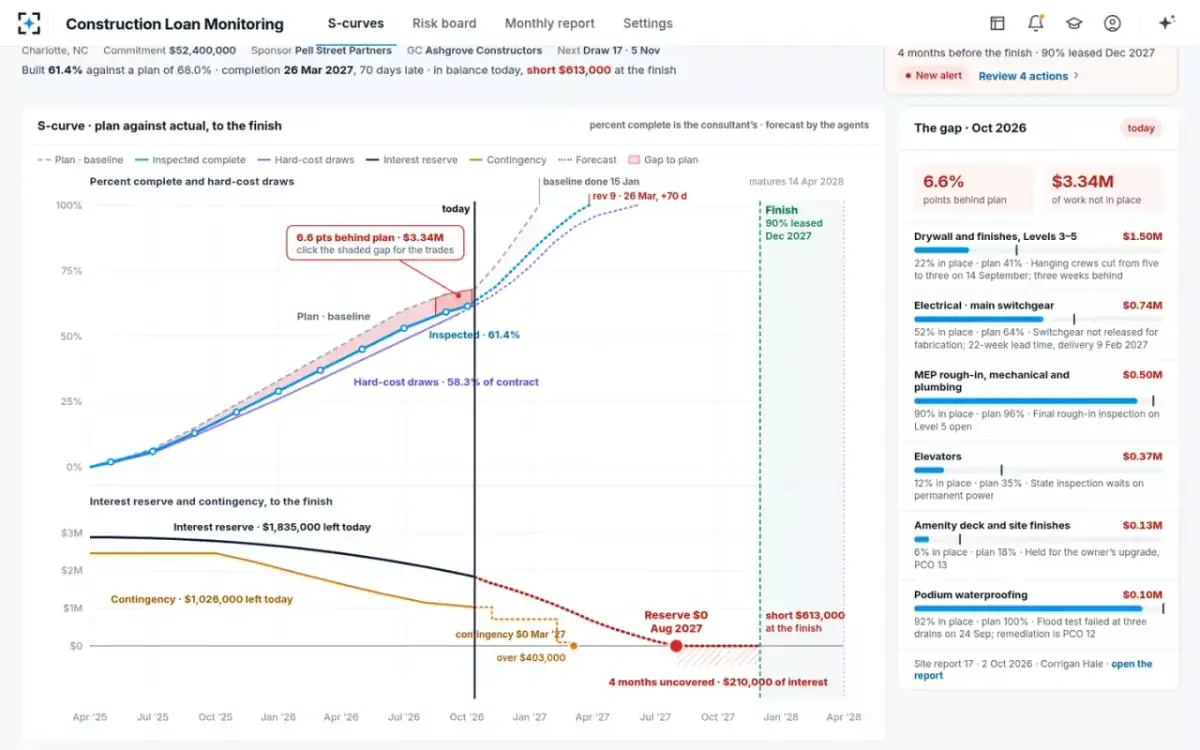
The order matters. Contingency usually runs out first, because change orders arrive during construction and interest overruns arrive in lease-up. A bank that watches contingency against work left gets the earlier warning, and a sponsor told in October still has choices: value engineering, a negotiated claim, new equity. One told at the draw after the contingency is gone has fewer.
Setting a contingency policy a lender can monitor
A contingency policy works when it names a percentage, a base and a trigger. The checklist below is ours; the ranges come from the OCC and HUD, and the trigger is the one the sample bank uses.
Construction contingency policy: what to write down
- Minimum at closing, by project type
For example 5% of hard cost on simple new construction, more for complexity, 10–15% of rehabilitation cost on older buildings.
- The base, stated
Overall budget, hard cost or rehabilitation cost: the same percentage means different money on each.
- A monitoring minimum against work left
Contingency left as a share of hard cost still to be built, tested whenever a change order or site report arrives.
- Pending change orders counted
Against the contingency before approval, at the claimed amount, so the test sees what is coming.
- What contingency may not pay for
Overruns from poor projections or management, and new scope the loan did not finance.
- Who approves a contingency draw
Named, with a second approval above a set amount.
- The action when the minimum is breached
A call to the sponsor, a recovery plan, or a balancing demand, with the owner of each.
In the solution, the balance and covenant tester runs the contingency minimum alongside the in balance forecast and the completion, leasing and maturity tests each time a document lands, and reports pass, close or fail with the figure. The threshold is the bank's; the agents never approve a change order or a contingency draw. To see contingency tracked across a whole book, start from Construction Loan Monitoring; the cost to complete report shows where the pending orders enter the forecast.
Questions people ask
Is 10% contingency enough for a construction project?
For straightforward new construction, 10% is at the top of the OCC's usual range and generally ample. For renovation of older buildings HUD sizes contingency at 10 to 15% of rehabilitation cost, so 10% is the floor there. What matters after closing is whether the contingency left still covers the risk in the work left.
What is contractor contingency vs owner contingency?
A contractor's contingency sits inside its guaranteed maximum price and covers its own estimating risk; an owner's contingency sits in the project budget and covers scope and unforeseen conditions. HUD asks whether the contractor's bid already contains a reserve when sizing the owner's. A lender's budget contingency is usually the owner's.
Can contingency be used for change orders?
Yes; funding approved change orders is its main use, and the OCC names material price increases and buyer-mandated redesign as common uses. It should not pay for new scope the loan did not finance or for overruns from poor projections, which fall on the borrower.
What happens to unused contingency at the end of a project?
It depends on the loan agreement. Often it is released to the borrower or used to reduce the loan. In HUD's new construction program, any unused portion of the construction contingency escrow is refunded to the developer at final endorsement.
How should a lender measure contingency during construction?
As contingency left divided by hard cost still to be built, with pending change orders subtracted. On the sample loan that ratio was 4.9% before the pending orders and negative after them, while the closing figure still read 5.0%.