A monthly construction progress report, on the lender's side of a construction loan, is the monthly package that shows work completed, costs to date, cost to complete, the schedule against its deadlines and the loan funds remaining, which is the list the OCC's Comptroller's Handbook gives for sound monitoring. The hard part is that the bank writes almost none of it: the contractor, the inspecting consultant, the architect, the leasing agent and the borrower each send a piece, on their own calendars, and the credit team reads the result last. Botminds' Construction Loan Monitoring exists for that gap. Its agents read each site report, schedule update, change-order log and leasing report as it lands and re-forecast the loan to its finish, so the monthly report is a reading of where the project is going, not a file of where it was.
The worked example on this page is sample data: a fictional 248-unit apartment loan, Harrow Yard in Charlotte, and the fictional people who carry it at a fictional bank. The rules and the research come from regulators, linked where they are used.
The scale of the monthly reading load
$453.5B
construction and development loans at FDIC-insured institutions, 30 June 2026
$83.1B
unfunded CRE construction commitments at community banks alone
1visit
job-site inspection a month on HUD-insured new construction
What is in a monthly construction progress report?
A lender's monthly construction progress report contains five measures and two running logs. The OCC states the five directly: "Sound monitoring includes obtaining monthly reports of work completed, costs-to-date, costs-to-complete, construction deadlines, and loan funds remaining" (OCC, Commercial Real Estate Lending, p. 46). The two logs are change orders, which the same page says should be tracked against the budget, and leasing or sales, which it expects monthly during lease-up, with rent rolls.
Read as a lender, each measure answers a different question. Work completed answers whether the money drawn has bought the building it should have. Costs to date and cost to complete together answer whether the money left can finish it. Deadlines answer whether it will be finished before the loan's outside completion date and maturity. Loan funds remaining is the number the other three are tested against, and it includes the interest reserve, which has to carry the debt until the property can.
The OCC adds two things a contractor's report never contains. Banks should periodically review "the developer's financial statements", because a problem on another of the developer's projects can drain the cash this one depends on. And monitoring "should include verifying property tax payments", because unpaid taxes become a lien ahead of the bank (OCC, pp. 45–46). Neither arrives in the draw package; both belong in the monthly report.
Each part of the monthly construction progress report comes from someone else
| Part of the report | Who produces it | Document | What the lender tests |
|---|---|---|---|
| Work completed | Inspecting consultant or the bank's inspector | Site report, certified percent complete | Percent complete against the baseline schedule and against hard-cost draws |
| Costs to date | General contractor, certified by the architect | Pay application and continuation sheet (schedule of values) | Billing by line against inspected work; retainage held |
| Cost to complete | Contractor's budget, re-read by the lender or its consultant | Budget revision, change-order log, contractor letters | Remaining budget plus pending changes against funds left |
| Construction deadlines | General contractor | Schedule update | Substantial completion against the outside date and maturity |
| Loan funds remaining | Construction loan administrator | Draw history and interest reserve balance | In balance today, and the month the reserve runs dry |
| Leasing or sales | Leasing agent or builder | Weekly or monthly leasing report, rent roll | Pace and rents against the pro forma and the appraisal |
| Sponsor condition | Borrower and guarantors | Financial statements, tax receipts | Liquidity, other projects, taxes paid |
Who prepares the construction progress report, piece by piece
Nobody prepares the whole report; four outside parties prepare its parts, and the construction loan administrator assembles them. The general contractor bills monthly on a pay application, usually the AIA G702 with its G703 continuation sheet, which breaks the contract sum into a schedule of values and shows work completed, stored materials, retainage, change orders and the amount requested. The architect certifies it. The contractor also issues schedule updates, on a cadence the construction contract sets.
The inspecting consultant is the lender's own eyes. "Banks often retain an independent construction consulting firm if they do not have the necessary in-house engineering, architectural, and construction expertise to perform a physical inspection," the OCC notes (OCC, p. 46). The consultant's site report certifies percent complete, comments on quality and the schedule, and recommends an amount to fund. Its percentage is the one the draw is paid against.
The leasing agent or builder sends absorption and pricing, and the borrower sends its own statements. The administrator, finally, owns the draw: the request, the title date-down, the lien waivers and the budget reconciliation. Those draw-day controls are the subject of a sibling solution; this page is about everything that happens between draws.
Five people produce the monthly construction progress report; the credit team reads it last
Today
Re-keys the site report, schedule and change-order log into a spreadsheet for each loan, then runs the draw against a budget that knows only approved changes.
With agents
Sees each budget line with remaining, pending and forecast amounts the day a document lands, and works the draw calendar from them.
Still theirs: the draw, the budget reconciliation and the borrower requests
Today
Visits monthly and writes a report whose opinion sits in a PDF until the next draw review.
With agents
Is quoted, page by page, in the lender's forecast the day the report arrives; the percentage stays the consultant's.
Still theirs: the certified percent complete
Today
Hears of an overrun when a draw no longer balances, by which time the contingency is gone.
With agents
Starts the week on every loan ranked by how far its reserve falls short of the finish, with sources attached.
Still theirs: the actions and the borrower notice
Today
Calls the sponsor with a problem but without the breakdown behind it.
With agents
Calls with the shortfall split into change orders, a delay claim and interest, each figure cited.
Still theirs: the sponsor relationship and every contact with it
Today
Learns of a troubled loan at committee, from a draw that failed.
With agents
Approves rating changes months earlier, with the forecast in front of her.
Still theirs: risk ratings and the watch list
How often are construction loan inspections, and is monthly enough?
Monthly is the common floor for commercial construction: lenders typically inspect before each draw, and draws are usually monthly. HUD writes the rhythm into its multifamily program, where "the inspector shall make one job site visit each month for new construction and substantial rehabilitation projects", with more visits when the work demands (HUD MAP Guide 4430.G, §12.3). The OCC ties the inspection to the money instead: banks "typically require architect or engineering inspection reports with each draw to verify that work is done according to specification" (OCC, p. 45).
The rhythm is not the weakness; the scope is. A failed-bank review by the FDIC's inspector general found that a lender's third-party inspectors "were not contracted to review an assigned project as a whole, but rather review the current disbursement requested", so "management was unable to determine the degree of completion of an entire project" (FDIC OIG, MLR-10-020). That bank's six subsidiaries cost the insurance fund about $807 million. An inspection that answers only "was this month's work done" cannot answer "will the rest of the money finish the building".
The labour pool behind those visits is not growing. The Bureau of Labor Statistics counted about 153,900 construction and building inspectors in 2025, a median wage of $74,690, and projects "little or no change" in their number to 2035, noting that "financial institutions also may use their services" (BLS Occupational Outlook Handbook). More reading of each report, not more visits, is where a lender can add attention.
Who waits on whom: the month as a relay
A lender's month on a construction loan is a relay in which each runner waits for the one before. The site report waits for the visit. The draw review waits for the site report, the pay application and the title date-down. The credit team waits for the draw review. Anything that arrives between draws, such as a schedule update, a change-order request or a weak leasing week, waits for the next draw to be read in context, because that is when the administrator next opens the budget.
Take the sample loan. Harrow Yard funded Draw 16 on 18 September and passed its balancing test. Over the next three weeks five documents landed: the consultant's site report 17 on 2 October, the contractor's schedule update rev 9 on 5 October, pending change orders 11 to 13 on 7 October, the contractor's delay letter on 8 October and the leasing agent's week-ten report on 9 October. Each was filed. None changed the approved budget, so none changed the draw test.
Five documents landed in a week; the draw test would have read them in November
- Waiting for site report 1714 days
- Five documents land7 days
- Filed until Draw 17 on 5 November27 days
- Waiting for site report 1714 days
- Five documents land7 days
- Re-forecast, signed 12 Oct3 days
- Notice and actions before the draw24 days
Where the month is lost: what arrives between draws
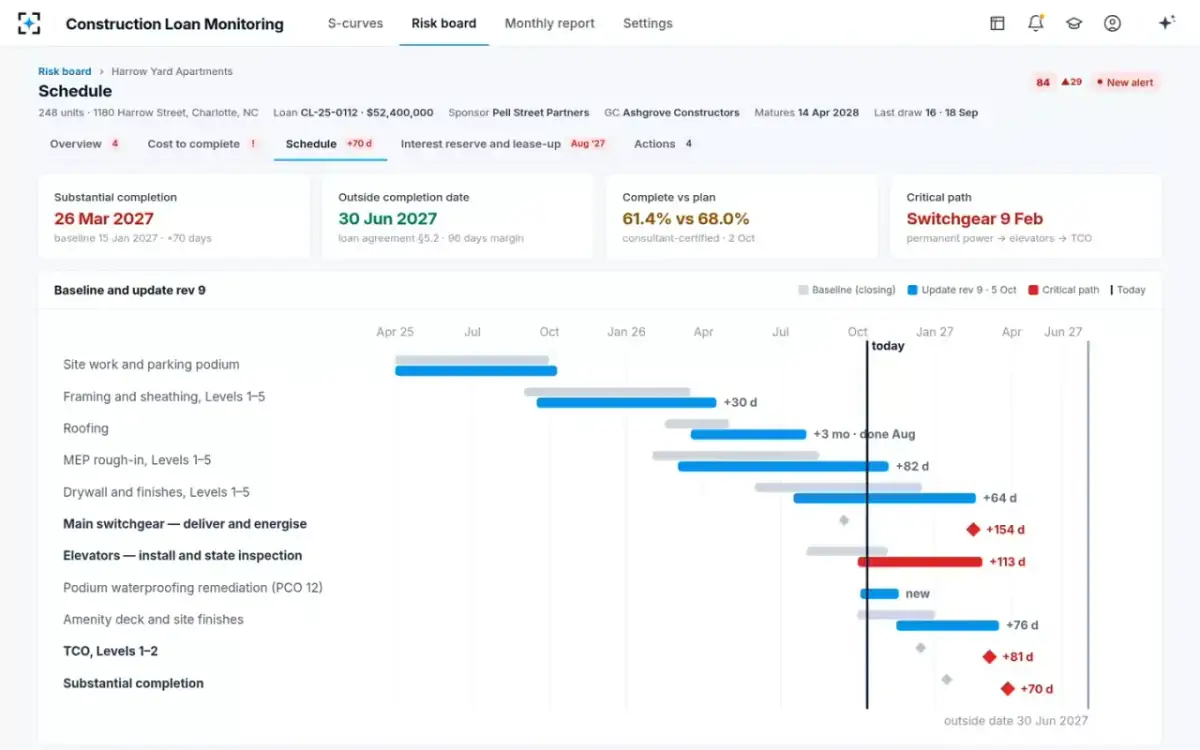
The month is lost in the documents that change the forecast but not the budget. On the sample loan, the site report put the building at 61.4% complete against a plan of 68.0%, 6.6 points and about $3.34 million of work not in place. The schedule update moved substantial completion 70 days, from 15 January to 26 March 2027. The pending change orders totalled $1,148,000 against a remaining contingency of $1,026,000. The delay letter claimed $281,000 of extended general conditions. The leasing report showed 22 units leased against a plan of 40.
Not one of those touches a draw-day test. A pending change order is not yet in the approved budget; a schedule slip costs nothing until the extra months of interest are drawn; a slow leasing week changes nothing until the reserve runs dry. Together they forecast the loan $613,000 short at completion, while it remained in balance on the day. The guide to a construction loan going out of balance though every draw passed works through that arithmetic line by line.
Construction Loan Monitoring's loan monitor: five signals since the last draw
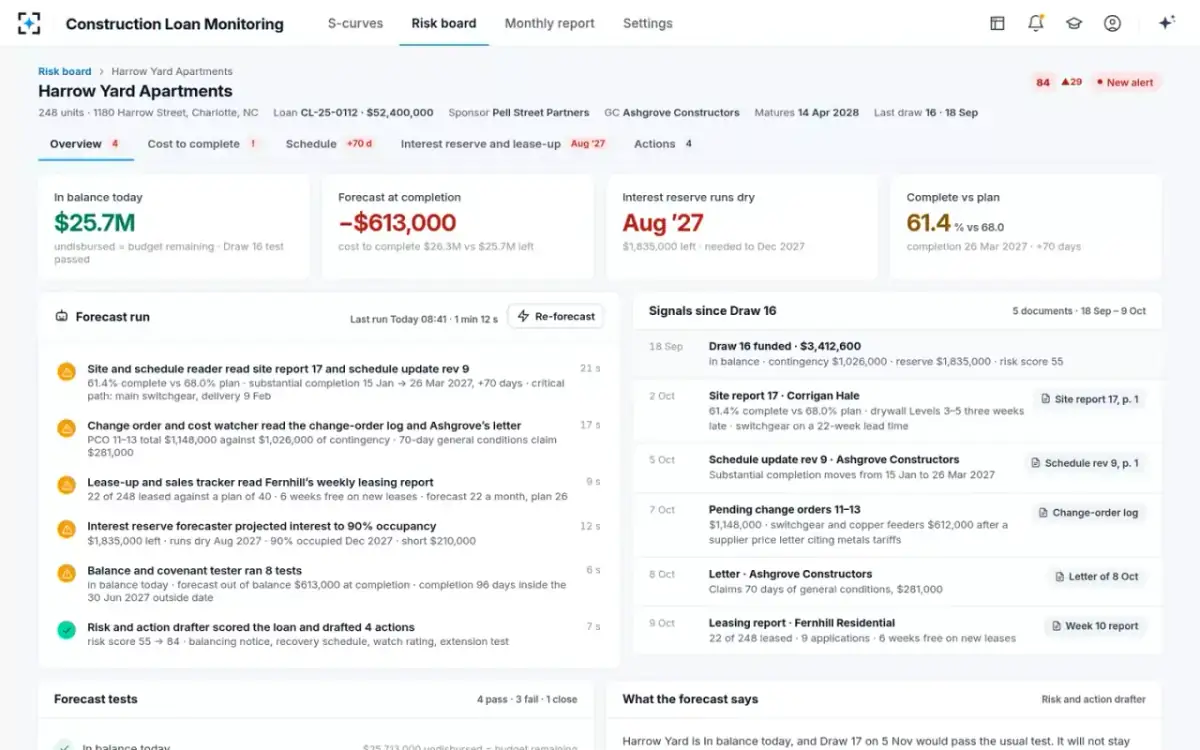
Reading those five documents by hand is real work. Botminds estimates that one construction loan takes about 11.5 hours a month to monitor this way: re-keying site reports and schedule updates, pricing pending change orders, projecting the reserve and lease-up, running the balance tests, writing the loan's part of the committee report and deciding the actions. Its design estimate with the solution is under three hours, almost all of it the deciding and signing, which stays with people.
What does a construction lender monitor that the contractor does not report?
A construction lender monitors three things the contractor's report leaves out: the money that is not construction cost, the market the building will open into, and the sponsor. The interest reserve is the largest of the first group. "Extended lease-up periods can deplete the interest reserve prematurely and render the construction budget inadequate," says the OCC's monitoring section, which is why the leasing report sits in the lender's package and not the contractor's (OCC, p. 46).
The market comes next. The OCC asks banks to "continually assess the project's marketability and whether demand will continue to exist when the project is completed", because development and lease-up "can span several years". On the sample loan the leasing agent's comparables averaged 22 leases a month against a plan of 26, a gap that moves the date the building can carry itself, and the construction interest reserve calculator shows how far.
The sponsor is the third. A developer under strain on another job draws on the same equity, the same guarantor and the same contractor. The monthly report is the natural place to note the sponsor's liquidity, any judgments or late payments on an updated credit report, and the property taxes paid, because each of those can end a project that the site report says is on track.
The schedule section, baseline against the latest update
A template for the lender's monthly construction progress report
A lender's template should follow the OCC's five measures and add the forecast each one implies. The checklist below is ours, built from the booklet's monitoring and disbursement pages and from HUD's in-balance rule; a bank should set its own thresholds in credit policy. The template works whether the package is assembled by hand or read by agents. What changes is how soon it is read.
Monthly construction progress report template for a lender, section by section
- Progress: certified percent complete against plan
From the consultant's site report, with the points behind and the dollars of work not in place. Note any trade more than a month behind.
- Draws against progress
Hard-cost draws as a share of the contract against inspected percent complete. Draws running ahead of progress is front loading until shown otherwise.
- Schedule: substantial completion against the outside date
Baseline, latest update and the days of margin to the loan agreement's outside completion date and to maturity. Name the critical path.
- Cost to complete, including what is pending
Remaining budget plus pending change orders and claims at the claimed amount, less contingency. Not just the approved budget.
- In balance today and at completion
Funds left in the loan against today's budget remaining, and against the forecast cost to complete.
- Interest reserve runway
The month the reserve runs dry against the month the property is forecast to stabilise.
- Leasing or sales pace
Signed leases or contracts against plan, with concessions, from the monthly leasing report and rent roll.
- Sponsor and collateral
Developer liquidity and other projects, taxes paid, insurance in force, and any liens or judgments.
- Actions, owners and dates
What the bank will do, who signs it, and the date it will be checked again.
Two sections are where hand-built reports usually fall short. Cost to complete is often copied from the contractor's budget, which knows only approved changes; the guide to the cost to complete report shows how to build it as a forecast. And the reserve runway is often left out entirely, because it needs a projection rather than a reading. Both are where Construction Loan Monitoring puts its agents' work, with every assumption shown.
Where Construction Loan Monitoring fits in the month, and where it does not
Agents fit where the relay stalls: reading, re-keying, pricing and projecting. In the sample run, six agents read the five documents, re-priced the budget, projected interest to 90% occupancy, ran eight tests and re-scored the loan from 55 to 84 in 72 seconds. The design target is every loan re-forecast within an hour of a new document arriving, rather than at the next draw.
They do not fit where judgement or authority sits. The consultant's certified percentage stays the consultant's; the agents compare it with plan and never change it. They never approve a change order, change a rate or a rating, or declare a default. The portfolio manager approves the actions and signs any notice, the chief credit officer approves any rating change, and only the lending officer contacts the sponsor. On the sample loan, that put a signed balancing notice and a watch-list rating in place on 12 October, 24 days before Draw 17. To see the monthly cycle end to end, start from Construction Loan Monitoring.
Questions people ask
What is a monthly construction progress report template?
It is a standing structure for the report, so every month and every loan is read the same way. For a lender it should cover progress against plan, draws against progress, the schedule against the outside date, cost to complete, in balance today and at completion, the interest reserve runway, leasing and the sponsor. The OCC's monitoring section lists the core five: work completed, costs to date, costs to complete, deadlines and funds remaining.
What does a construction loan inspector do?
The inspector, often an independent construction consultant engaged by the lender, visits the site, certifies the percentage of work completed, comments on quality and schedule, and recommends how much of a draw to fund. In the OCC's description, the report confirms the work meets the plans and specifications, supports the draw on a percentage-complete basis and says whether the project is on track. The best scope covers the whole project, not only the current draw.
How long does a construction draw take?
No regulator sets a standard time, and published figures come mostly from vendors. The draw's length is set by its slowest dependency: the inspection, the title date-down and the lien waivers. What a lender controls is whether the documents that arrive between draws are read when they land or held for the next draw review.
Who reads the monthly report at the bank?
The construction loan administrator assembles it, the portfolio manager or lending officer acts on it, and the chief credit officer and credit committee see the loans that need a decision. Examiners read it too: the OCC's internal control questionnaire asks whether the bank requires a construction completion schedule and construction reviews and inspections.
Does the lender's report replace the contractor's progress report?
No. The contractor's report describes the work; the lender's report tests whether the loan can finish it. The lender's version adds the interest reserve, the leasing pace, the sponsor's condition and a forecast of whether the loan stays in balance to completion, none of which the contractor is asked to report.