An interest reserve on a construction loan is money set aside inside the loan, usually as a line in the construction budget, to pay the loan's interest during construction and lease-up, so the borrower makes no payments from its own pocket until the property earns enough to carry the debt. It is a standard and sensible structure for a building that produces no income while it is being built. Its danger is that it makes every loan look current: interest is paid on time from the reserve whether the project is on schedule, stalled or failing. The OCC says inappropriately administered reserves "have been a major contributor to banks' losses in ADC lending", and the 2023 interagency workout statement says a loan kept current by its reserve may still deserve an adverse classification. Botminds' Construction Loan Monitoring forecasts each reserve to stabilisation, so a bank knows the month it will run dry while the loan still looks healthy.
The worked example is a fictional sample loan, Harrow Yard Apartments in Charlotte, carried by a fictional bank. The supervisory quotations come from the OCC, the 2023 interagency policy statement and the FDIC's Office of Inspector General.
What interest reserves hid in the last crisis
$807M
estimated loss to the insurance fund from six banks whose reserves kept ADC loans looking current
36months
of interest paid on time from the reserve in the 2023 statement's example, before the loan failed to refinance
55%
occupancy in the 2023 statement's example, against the 75% the take-out lender required
What is an interest reserve on a construction loan?
It is a reserve the lender sets up to pay the loan's interest until the project can. The OCC's definition is the standard one: "An interest reserve is a reserve account established by the lender and used by the borrower to cover loan interest during construction and lease-up. The interest reserve is typically funded via a budget line item in the construction loan; however, the interest reserve may also be funded by the borrower into a separate escrow account as a condition of the loan" (OCC, Commercial Real Estate Lending, p. 7).
The OCC also sets the standard for its size: enough to pay interest through completion and on through lease-up, sale or occupancy. A reserve that ends at substantial completion, on a building that then takes nine months to lease, is not appropriate by that definition. The construction interest reserve calculator shows how to size one.
Interest reserve construction loan explained: how the money moves
Each month the lender charges interest on the drawn balance, pays it by advancing funds from the reserve line, and adds that advance to the loan. The 2023 interagency statement describes the mechanics: "During the construction phase, the lender recognizes interest income from the interest reserve and capitalizes the interest into the loan balance." When the building is finished and stabilised, a sale or a permanent loan repays the construction loan, "including any of the capitalized interest" (88 FR 43115).
Two consequences follow. The borrower pays interest on interest, because each month's reserve advance becomes principal. And the bank books interest income that no outside cash has paid; the cash comes from the bank's own loan. Both are fine while the project is sound. Both become a problem when it is not, because the income continues and the loan stays current as the collateral weakens.
In lease-up the order changes. Project income pays interest first and the reserve only covers the gap, and once income covers interest in full the OCC says no more reserve draws should be allowed, so income is not diverted from the project. A reserve account on a construction loan is therefore a bridge, not a fund: it should shrink to nothing as the building earns.
Are interest reserves risky?
A reserve is not risky in itself; a reserve nobody watches is. The OCC's warning is direct: "The presence of an interest reserve may not accurately reflect a borrower's ability to pay. Inappropriately administered reserves, however, can mask a poorly performing project, increase the bank's loss exposure, and have been a major contributor to banks' losses in ADC lending. For these reasons, examiners should thoroughly assess interest reserves" (OCC, p. 7).
The booklet also says where reserves do not belong. Using reserves for loans "that should be generating cash flow such as those financing stabilized properties or speculative purchases of raw land is generally not appropriate". A stabilised property should carry its own debt, and raw land has no plan to produce income at all. A reserve on either pays interest that nothing will ever earn.
How interest reserves kept failing loans current: what the inspectors general found
When the FDIC's inspector general reviewed the bank failures of 2009 and 2010, interest reserves appeared again and again as the reason problem loans were reported as healthy. The findings are specific, and they describe practices rather than bad luck.
What FDIC inspector general reviews found about interest reserves
| Review | Finding | Effect |
|---|---|---|
| Security Bank Corporation, six bank subsidiaries, Georgia (MLR-10-020, 2010) | Banks "allowed borrowers to continue using interest reserves, despite problems with the project being financed (e.g., a delay or total cessation of the project)" | "Loans would not be reported as delinquent or non-performing until all interest reserves were depleted or the loan matured" |
| Follow-up audit of FDIC supervision (MLR-11-010, 2010) | Banks "frequently relied heavily on interest reserves" and some were "replenishing interest reserves when payment was in doubt" | Reserves "can mask loans that would otherwise be reported as delinquent and erode collateral protection" |
| Alpha Bank and Trust (MLR-09-010, 2009) | The bank "used interest reserves for many of the loans in its portfolio" | This "masked deterioration in asset quality" |
The Security Bank finding is the clearest statement of the mechanism. Reserves "masked weaknesses in the ADC portfolio by showing credits as current and performing" (FDIC OIG, MLR-10-020). A loan funded from its own reserve cannot become delinquent while there is money in the reserve. Delinquency, the signal most credit systems are built around, arrives only at the end.
The lesson for monitoring is to stop treating "current" as information on a construction loan. The useful signals are the ones a reserve cannot hide: progress against plan, cost to complete against funds left, and the month the reserve will run dry against the month the property will stabilise.
Can a loan with an interest reserve be classified?
Yes. A construction loan can be adversely classified while it is fully current, if the reserve is paying interest on a project that can no longer repay principal. The 2023 Interagency Policy Statement on Prudent Commercial Real Estate Loan Accommodations and Workouts, the current guidance from the OCC, the Federal Reserve, the FDIC and the NCUA, says so in terms.
"If the development project stalls and management fails to evaluate the collectability of the loan, interest income could continue to be recognized from the interest reserve and capitalized into the loan balance, even though the project is not generating sufficient cash flows to repay the loan. In this case, the loan will be contractually current due to the interest payments being funded from the reserve, but the repayment of principal may be in jeopardy." The uncertainty is greatest "when leases or sales have not occurred as projected and property values have dropped", and "in this situation, adverse classification of the loan may be appropriate" (88 FR 43115).
The 2023 statement's example: a reserve that lasts exactly as long as the loan
- Construction24 months
- Lease-up to 55%, not the 75% the take-out needs12 months
The example ends where many real loans did. At maturity the loan was fully drawn at $10 million, the reserve was gone, the take-out lender had walked away and the borrower could not refinance. Every interest payment over three years had been made, from the bank's own money. The statement then works through how to classify the loan under several renewal scenarios, which the guide to construction loans out of balance complements from the cost side.
What does repacking an interest reserve mean?
Repacking means increasing a depleted interest reserve by lending the borrower more money, so the loan stays current. The OCC calls it what it is: the bank "may elect to increase, or repack, the interest reserve by extending additional debt to keep the loan current, thereby potentially masking a nonperforming loan. The decision to revise the budget and repack the interest reserve with debt is a red flag indicating possible credit deterioration" (OCC, pp. 7–8).
A repack is not forbidden; it needs support. The OCC says that "to properly support repacking an interest reserve, it is appropriate for the bank to obtain a new appraisal or evaluation and re-evaluate the feasibility of the project in the current market". A replenishment from the sponsor's own cash is different in kind, and the OCC treats it as the normal response when a reserve runs short.
Replenishing an interest reserve with cash, against repacking it with debt
Replenished with the sponsor's cash: Borrower or guarantor, as new equity.
Repacked with more loan: The bank, as an increase in the loan.
Replenished with the sponsor's cash: Loan-to-cost improves; the collateral margin is restored.
Repacked with more loan: Loan-to-cost and loan-to-value rise on the same collateral.
Replenished with the sponsor's cash: A sponsor with liquidity standing behind the project.
Repacked with more loan: In the OCC's words, "a red flag indicating possible credit deterioration".
Replenished with the sponsor's cash: Re-forecast to stabilisation with the new money.
Repacked with more loan: New appraisal or evaluation, a feasibility review in today's market, and a fresh look at the risk rating.
Replenished with the sponsor's cash: Equity in, the project supported.
Repacked with more loan: A loan kept current by its lender; possibly classified.
Why do examiners look at interest reserves?
Examiners look at interest reserves because a reserve can make a weak loan look current, inflate reported income and delay recognition of a loss, and because the last crisis showed banks often could not even say how many reserves they had. The follow-up audit of FDIC supervision found banks that had used reserves "for highly speculative loans, such as land purchases", and others that could not report how reserves affected their income (FDIC OIG, MLR-11-010).
In practice an examiner will ask three things of a construction loan with a reserve. Is the reserve sized to the current completion and lease-up plan, or to the one at closing? Has it ever been refilled, and with whose money? And is the loan's rating based on the project's prospects or on its payment history? A bank that can answer all three from its monitoring, loan by loan, is in a good position. One that answers from the payment history is answering the wrong question.
One sample loan: a reserve that runs dry ten months out
On 12 October the sample loan's reserve held $1,835,000 of its original $2,883,000, and the loan was current, as it had been every month. The forecast said the reserve would run dry in August 2027, four months before the building reached 90% occupancy, leaving $210,000 of interest with nothing to pay it. The causes were a 70-day slip in substantial completion and a lease-up of 22 units a month against a plan of 26.
Construction Loan Monitoring's reserve and contingency, burning down to the finish
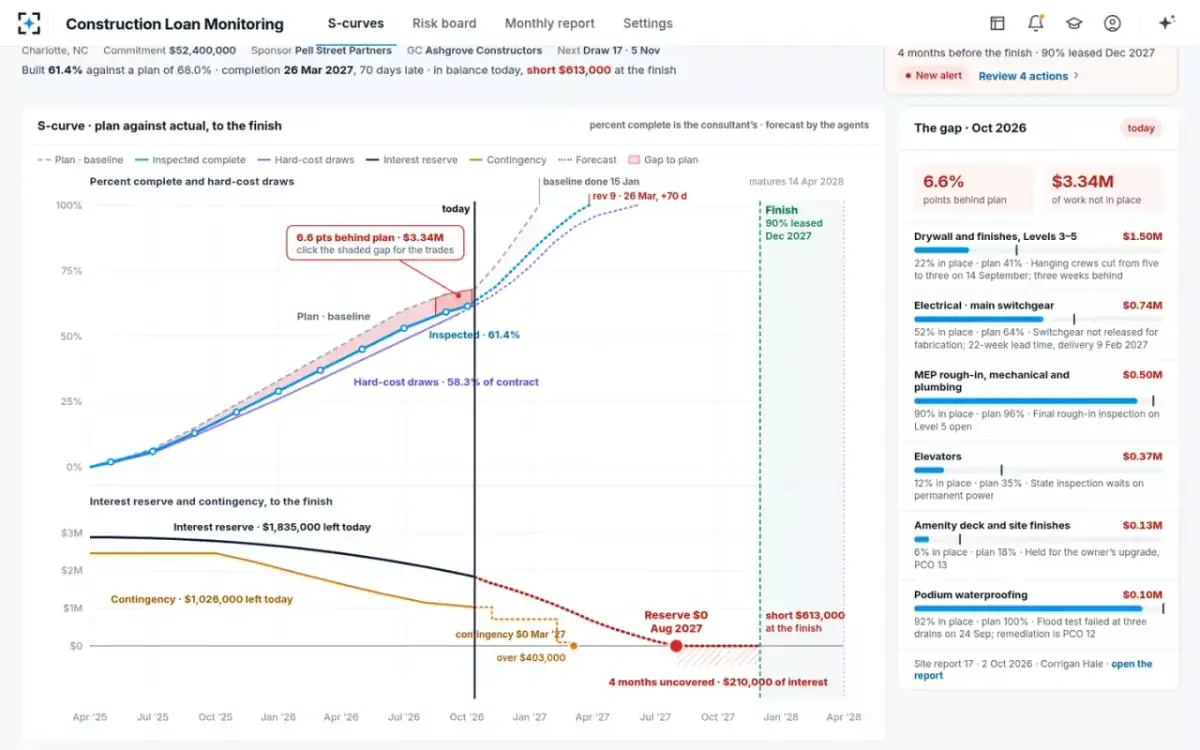
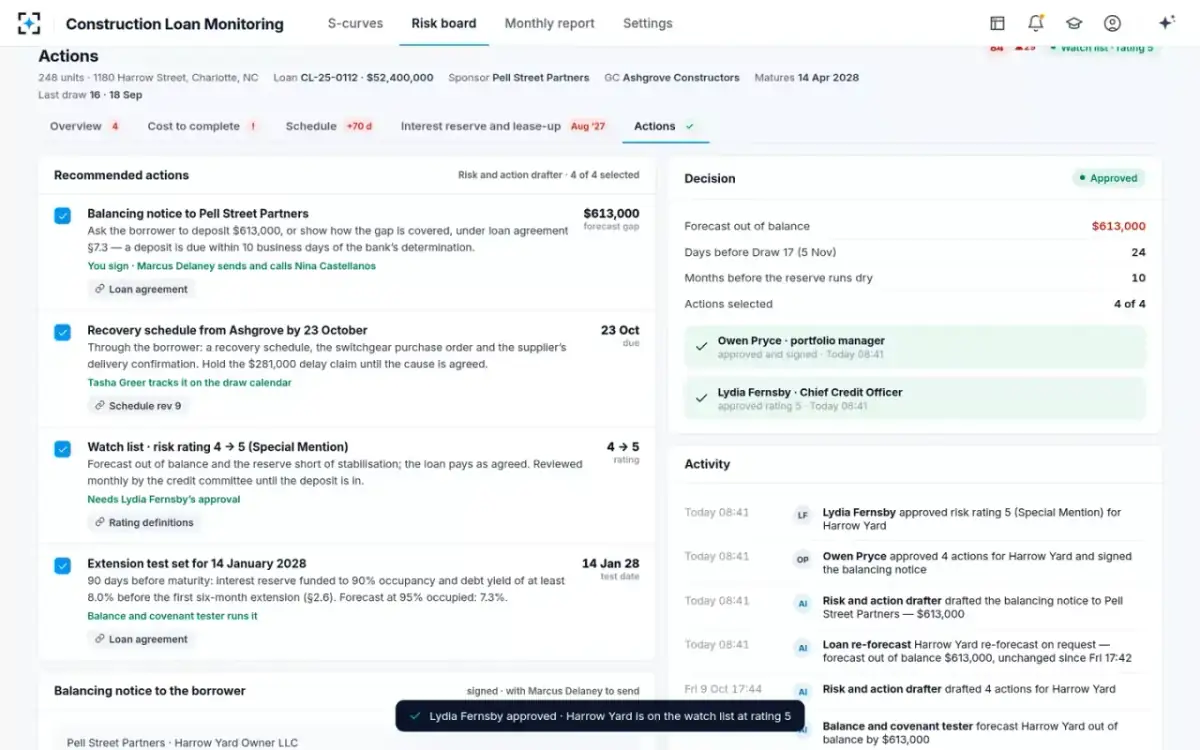
The bank acted ten months before the reserve would have run out. The portfolio manager approved a balancing notice for the full forecast shortfall of $613,000, of which the uncovered interest was one part, and the chief credit officer moved the loan to the watch list at rating 5, Special Mention, while it was still paying on time from its reserve. No repack was proposed. The agents never change a risk rating; they recommend, and the rating change waited for her approval.
Approved in Construction Loan Monitoring: a watch-list rating while the loan is current
What a lender should track for every interest reserve
Every reserve needs a runway, a history and a link to the project's progress. The checklist below is ours, built from the OCC's considerations and the inspector general findings; the sample bank's thresholds are noted where it has one.
Interest reserve monitoring: what to track on every construction loan
- Which loans carry a reserve, and how much
A complete list, including reserves funded outside the budget; the inspector general found banks that could not produce one.
- The month it runs dry against the month the property stabilises
Re-forecast on the latest schedule, leasing pace and rate curve. The sample bank alerts when the reserve will not reach stabilisation plus 60 days.
- Interest spent against progress
Share of the reserve used against percent complete; a reserve burning faster than the building rises is a stalled project.
- Every refill, with its source
Cash from the sponsor or debt from the bank. A refill with debt triggers a new appraisal or evaluation and a feasibility review.
- Project income applied first
In lease-up, income pays interest before the reserve; once it covers interest in full, reserve draws stop.
- The rating on prospects, not payment history
A reserve-funded loan whose principal is in doubt is rated on that, whatever its payment history.
The S-curve is the natural place to see the second and third items together; the guide to the construction S-curve shows the reserve plotted under progress on one time axis. In the solution, the interest reserve forecaster projects every reserve month by month to the date it must reach, shows every assumption, and never changes the loan's terms or rate. See every reserve in a construction book ranked by how far it falls short at Construction Loan Monitoring.
Questions people ask
What is an interest reserve account on a construction loan?
Usually it is not a separate account at all but a line in the construction budget, drawn like any other cost to pay interest. The OCC notes it can instead be a separate escrow that the borrower funds as a condition of the loan; that version is the borrower's cash, not the bank's.
Can an interest reserve be replenished?
Yes, and the OCC's normal expectation is that the borrower or guarantor replenishes it with cash when it runs short. Replenishing it with more debt, a repack, is allowed but is "a red flag", and should be supported by a new appraisal or evaluation and a fresh feasibility review.
Does a loan with an interest reserve count as performing?
Contractually it is current while the reserve pays. Whether it is performing in a credit sense is a separate judgement; the 2023 interagency statement says a reserve-funded loan whose principal repayment is in jeopardy may warrant adverse classification.
Should interest reserves be used on land loans?
Generally not. The OCC says reserves for "speculative purchases of raw land" are generally not appropriate, because raw land has no immediate plan to produce income, and the FDIC inspector general cited reserves on land purchases among the practices that hid losses.
When should the interest reserve stop being drawn?
When project income covers the interest. The OCC says that once cash flow is sufficient, no further reserve draws should be permitted, so income that should support the project is not diverted. On most loans that happens during lease-up, before stabilisation.