A construction loan is out of balance when the undisbursed loan proceeds, together with any equity the borrower still owes, are less than the cost to complete the project; the lender then usually stops funding until the borrower deposits the difference. Lenders test the balance at each draw, against the approved budget. That test is valid but not always accurate, because the costs that push a loan out of balance often sit outside the approved budget until it is too late: pending change orders, contractor delay claims and the interest the reserve can no longer carry. Botminds' Construction Loan Monitoring forecasts the balance at completion, not just on draw day, so a loan that is in balance today but headed short is seen months before a draw fails.
The worked example is sample data from a fictional 248-unit apartment loan, Harrow Yard in Charlotte, carried by a fictional bank. The rules are quoted from the OCC and HUD, and the history from the Government Accountability Office.
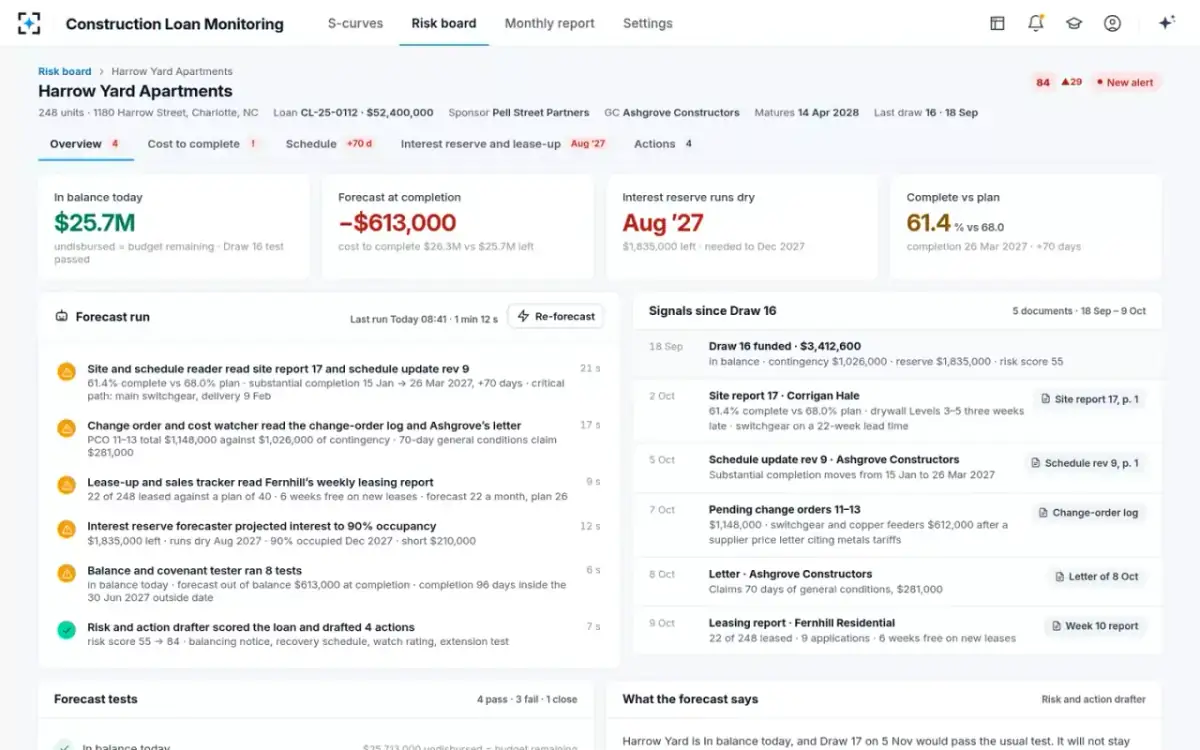
One sample loan on 12 October: in balance today, short at completion
$25.7M
left in the loan, exactly the approved budget remaining
$26.3M
forecast cost to complete once pending items are counted
$613K
forecast out of balance at completion, with the draw test still passing
What does it mean when a construction loan is out of balance?
It means the loan can no longer pay for the building it was made to finance. The regulators write the requirement into loan policy itself: the OCC expects every construction lender's policy to provide "disbursement controls confirming construction draws are commensurate with verified improvements and that the budget remains in balance with sufficient funds available to fund completion" (OCC, Commercial Real Estate Lending, loan policies). In balance is the condition; out of balance is the breach of it.
Most construction loan agreements make the condition contractual. They define the loan as in balance when the undisbursed proceeds plus remaining equity equal or exceed the cost to complete, and require the borrower to deposit any shortfall within a set period of the lender's notice. On the sample loan the agreement gives ten business days. Until the deposit is made, the lender can usually withhold further advances, which is why a balancing demand is one of the hardest conversations a lending officer has with a sponsor.
The construction loan in balance test, as most lenders run it
The usual in balance test compares two numbers at each draw: the money left to fund and the approved budget left to spend. When the first is at least the second, the loan is in balance and the draw proceeds. The arithmetic is simple, and it is exactly as good as the budget it uses.
The in balance test in four terms, and the one that changes between draws
Undisbursed loan proceeds
commitment − advances to date
Includes the unspent interest reserve and contingency lines.
Equity still due
required equity − equity contributed
Zero on most commercial loans once equity goes in first, as the OCC says policy should require.
Approved budget remaining
current budget revision − costs paid
Knows only approved change orders. This is the draw-day test.
Forecast cost to complete
budget remaining + pending changes + claims + interest beyond the reserve − contingency that absorbs them
The forecast test. Moves every time a document lands.
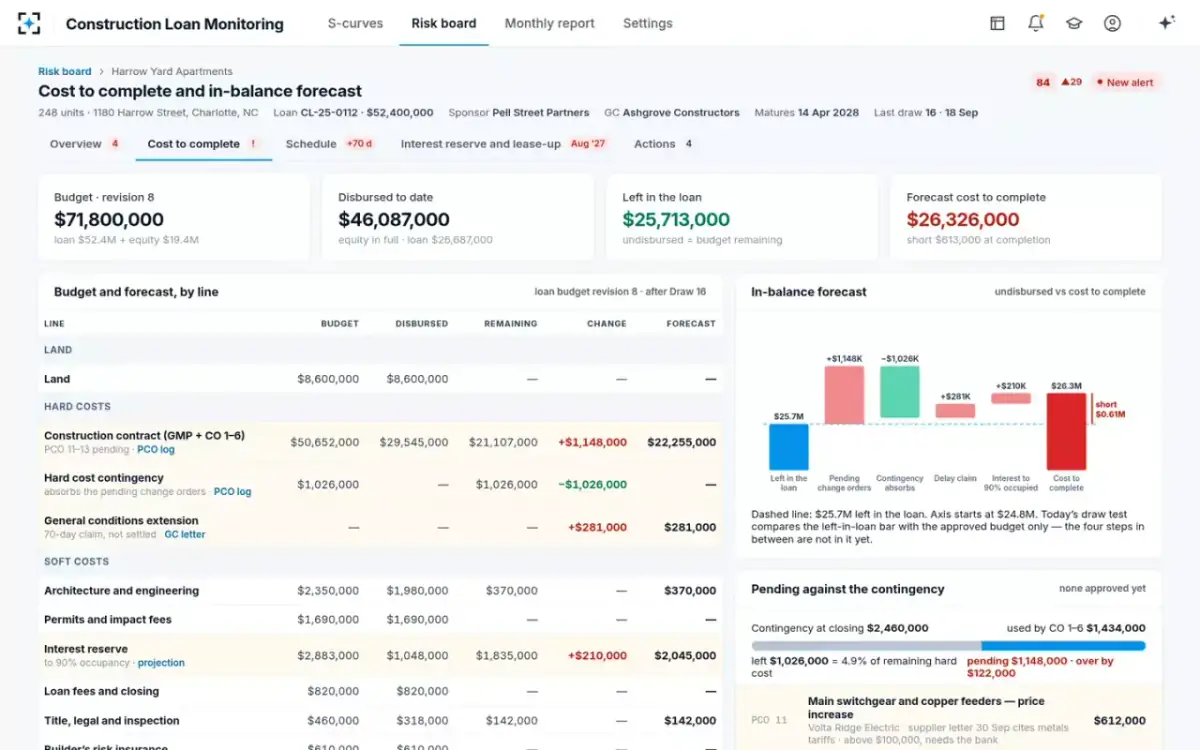
On the sample loan the draw-day test is exact. The budget, revision 8, totals $71.8 million, $52.4 million of loan and $19.4 million of equity already contributed. Advances to date are $46,087,000, which leaves $25,713,000 in the loan. Costs paid leave $25,713,000 of budget. The loan is in balance to the dollar, and Draw 17 on 5 November would pass.
Why every draw passed: four costs the draw test cannot see
Every draw passed because the costs that broke the balance were not yet in the approved budget. Since Draw 16, four had arrived. Pending change orders 11 to 13 added $1,148,000, among them $612,000 for the main switchgear and copper feeders after a supplier cited metals tariffs. The remaining hard cost contingency of $1,026,000 absorbs most of that, leaving $122,000. The contractor's letter claimed $281,000 for 70 days of extended general conditions. And the schedule slip pushed stabilisation four months past the date the interest reserve runs out, adding $210,000 of interest with nothing to pay it.
From in balance today to $613,000 short: the four steps the draw test leaves out
None of the four is exotic. A pending change order is a cost the contractor has priced but the owner has not approved. A delay claim is a cost the contractor says the owner owes. Interest beyond the reserve is the cost of time, which the budget recognises only as far as the reserve it set at closing. Each would enter the draw test eventually: the change orders when approved, the claim when settled, the interest when the reserve hit zero in August 2027. By then the contingency is spent and the options have narrowed. The guide to the cost to complete report builds each line of that forecast.
The in balance forecast bridge in Construction Loan Monitoring, line by line
HUD's over-expended test: the one numeric rule
The only published numeric test for a construction loan drifting out of balance comes from HUD's multifamily program, and it watches interest. Section 12.7.8 of the MAP Guide, "Keeping the Mortgage in Balance", says the interest allocation is over expended when "the percent of the expended interest allocation exceeds by 10% or more the percentage of completion indicated by the Construction Progress Schedule, form HUD-5372; or, the budgeted interest allocation remining is demonstrably insufficient to carry the loan through Final Endorsement". When either is true, "the Lender must notify HUD immediately" (HUD MAP Guide 4430.G, §12.7.8).
The rule applies to HUD-insured loans, but its two halves are a useful pattern for any lender. Apply them to the sample loan as an illustration. The interest reserve was budgeted at $2,883,000 and $1,048,000 has been drawn, 36.3% of the allocation, against 61.4% complete. The first test passes comfortably. The second fails: the forecast needs $2,045,000 of interest to reach stabilisation, $210,000 more than the reserve holds.
HUD's two over-expended tests, applied to the sample loan as an illustration
| HUD test (§12.7.8) | What it catches | Sample loan | Result |
|---|---|---|---|
| Interest spent runs 10 points or more ahead of completion | Interest burning faster than the building rises: a stalled site with the meter running | 36.3% of the allocation spent; 61.4% complete | Passes |
| Interest remaining demonstrably insufficient to carry the loan through the end | A long tail: delay and slow lease-up after the building is done | $1,835,000 left; $2,045,000 needed to 90% occupied | Fails by $210,000 |
The contrast teaches the main lesson. A percentage test is lenient early, because a construction loan's balance, and so its interest, grows as the building rises; interest naturally lags completion for most of the job. The sufficiency test is the one that bites, and it needs a forecast to run: a completion date, a lease-up pace, a rate. Neither half is part of a draw-day balancing test. The construction interest reserve calculator shows how to build the sufficiency forecast.
How do lenders detect an out of balance loan before the draw?
Lenders detect it early by testing the forecast, not the budget, every time a document changes it. That means pricing pending change orders and claims as they arrive, re-dating completion from each schedule update, re-running the interest reserve to stabilisation, and comparing the result with the money left. It also means setting thresholds in policy, so a near miss is flagged before it becomes a miss.
Draw-day balancing test against an in balance forecast
Draw-day balancing test: At each draw, roughly monthly.
In balance forecast: Whenever a site report, schedule update, change order, letter or leasing report lands.
Draw-day balancing test: Approved budget remaining.
In balance forecast: Budget remaining plus pending changes and claims, less contingency, plus interest to stabilisation.
Draw-day balancing test: None: today's balance only.
In balance forecast: Completion and lease-up dates from the latest schedule and leasing reports.
Draw-day balancing test: Pass or fail today.
In balance forecast: The shortfall at completion, the month the reserve runs dry, and why.
Draw-day balancing test: Pass: $25,713,000 against $25,713,000.
In balance forecast: Short $613,000, explained in three parts.
In the solution, eight tests run on each re-forecast, among them the in balance forecast, the contingency minimum, completion against the outside date, leasing against covenants, and maturity and extension. On the sample loan four passed, three failed and one was close. The thresholds are the bank's: a contingency minimum of 5% of the hard cost still to be built, an alert when substantial completion moves more than 30 days, and an alert when the reserve will not reach stabilisation plus 60 days.
Construction Loan Monitoring: in balance today, forecast short at completion
What happens if a construction loan goes out of balance?
When a loan goes out of balance, the lender demands a balancing deposit and, until it arrives, usually withholds further advances. What follows depends on the borrower. A sponsor with liquidity deposits the shortfall or funds it through equity. One without it negotiates: a reallocation between budget lines, a value-engineered scope, a claim settled for less, or a request for more debt. The OCC's monitoring section names the same two outcomes when a lease-up runs long: more equity from the sponsor, or a loan increase nobody planned.
The unplanned increase is where the risk turns. A larger loan on the same collateral raises loan-to-cost and loan-to-value, and if it refills the interest reserve it can keep a weak loan current for another year. The guide to interest reserves on construction loans sets out how examiners treat that. The sample bank's choice was the conservative one: a balancing notice for $613,000, a recovery schedule requested from the contractor, the delay claim held, and the loan moved to the watch list, 24 days before the next draw. The notice told the sponsor that Draw 17 would be funded as usual while they talked.
Who funds an out of balance construction loan?
The borrower funds it, under almost every construction loan agreement, and the guarantor stands behind the borrower. The lender's own exposure begins only if the borrower cannot or will not pay, which is when the choice between more debt, a workout and enforcement becomes real. The contingency is the first line of defence, and the guide to construction contingency percentages covers how large it should be and who may spend it.
The timing of the demand matters as much as its size. A demand made in October, with the contingency nearly intact and a sponsor who can still re-scope, is a negotiation. A demand made at the February draw, after the contingency is gone and the switchgear has slipped again, is a workout. That is the practical case for forecasting: it changes when the conversation happens.
Why the drift matters: what happened when nobody looked
Construction loans that drift unseen were the centre of the last banking crisis. The Government Accountability Office traced the failures of small banks between 2008 and 2011 largely to commercial real estate, and acquisition, development and construction loans above all. At the small banks that failed, "only 2 percent of ADC loans … were classified as nonperforming" in December 2001; the share rose "quickly to 11 percent by June 2008 and 46 percent by June 2011" (GAO-13-71).
The lesson is not that construction lending is unsafe; today's construction book is performing, with 0.99% of construction and development loans noncurrent at insured institutions in mid-2026, according to the FDIC. The lesson is that construction loans fail slowly and then quickly, and the slow part is where a forecast earns its place. To see the in balance forecast on a whole book, start from Construction Loan Monitoring.
Questions people ask
What is a balancing deposit on a construction loan?
It is the cash the borrower must deposit with the lender to bring an out of balance loan back into balance, usually within a set number of days of written notice. On the sample loan the agreement allows ten business days. The deposit is typically spent before any further loan proceeds.
What is an in balance requirement?
It is the loan agreement's condition that undisbursed loan proceeds plus remaining equity always cover the cost to complete. The OCC expects loan policy to require that "the budget remains in balance with sufficient funds available to fund completion", so the requirement appears in both the bank's policy and the borrower's contract.
Can a construction loan be out of balance and still current?
Yes. Interest is usually paid from the reserve inside the loan, so the loan stays current until the reserve runs dry, whatever the balance at completion. On the sample loan the reserve lasts until August 2027, ten months after the shortfall was first forecast.
Does reallocating the budget fix an out of balance loan?
Only if a line genuinely has money to spare, such as a soft cost that came in under budget. Moving contingency or interest reserve into hard costs to pass a draw test hides the shortfall rather than funding it, and the forecast cost to complete stays where it was.
How often should the in balance test run?
At every draw at least, as loan policy requires. A forecast version is worth running whenever a document arrives that changes cost or time; Construction Loan Monitoring's design target is every loan re-forecast within an hour of a new document.