A construction interest reserve calculator sizes the money set aside inside a construction loan to pay its interest until the property can: take the average loan balance during construction, multiply by the interest rate and the construction months, add the interest during lease-up at close to the full balance, and subtract the share of that interest the project's own income will cover. The calculation is easy; the inputs are not, because every one of them moves after closing. A schedule slip, a slower lease-up or a higher rate each shorten the time the reserve lasts. Botminds' Construction Loan Monitoring re-runs the reserve for every loan whenever a new site report, schedule or leasing report lands, and reports the month it runs dry against the month the building stabilises.
The worked figures come from a fictional sample loan, Harrow Yard Apartments, a 248-unit building in Charlotte. The rules are quoted from the OCC and HUD. The calculator on this page runs in your browser and keeps nothing.
The construction interest reserve formula, in three terms
Construction interest
commitment × average balance share × rate × construction months ÷ 12
The balance rises from the first draw to nearly the full commitment, so its average is often taken as about half.
Lease-up interest
funded balance × rate × lease-up months ÷ 12
The loan is close to fully drawn once the building is finished; the lease-up runs to the stabilisation date the loan needs.
Project income in lease-up
net operating income applied to interest, month by month
The OCC says income ordinarily pays interest before the reserve does.
How to calculate interest reserve on a construction loan
To calculate an interest reserve on a construction loan, project the loan balance month by month from the draw schedule, multiply each month's balance by the monthly rate, add the months of lease-up to stabilisation, and subtract the interest that project income will pay. A precise reserve uses the contractor's draw schedule, not a rule of thumb, because construction balances do not rise in a straight line: they climb slowly through site work, steeply through framing and rough-in, and slowly again through finishes.
The OCC lists what the calculation has to consider. Its key considerations for the amount of an interest reserve start with "the reasonableness of the development assumptions, including potential changes in interest rates, the timing of expected disbursements and pay downs, and the time required for the completion and sale or lease-up of the project" (OCC, Commercial Real Estate Lending, p. 8). Each phrase is a term in the formula: the rate, the draw schedule and the months to stabilisation.
The booklet adds the purpose: "An appropriate interest reserve provides sufficient funds to pay interest through the project's anticipated completion and lease-up, sale, or occupancy." A reserve sized only to the end of construction, for a building that then needs nine months to lease, is not appropriate by that definition.
The interest reserve formula a regulator publishes: HUD's 50% method
HUD publishes the one regulator formula for construction interest, and it is the 50% average-balance rule in writing. For a multifamily loan's firm commitment, the MAP Guide sets interest during construction as the greater of a formula and the lender's estimate. The formula is "the amount of the mortgage multiplied by 0.5, multiplied by construction interest rate and multiplied by construction years", where construction years are "the construction time in months … plus 2 months, then divided by 12" (HUD MAP Guide 4430.G, §7.11.1).
The lender's alternative "must be documented with a pro-forma draw schedule or its equivalent". Two details are worth copying. The two extra months are a built-in allowance for the time between the end of construction and final endorsement. And taking the greater of the two methods stops a lender from sizing interest on an optimistic draw schedule.
HUD's interest-during-construction formula, worked on the sample loan
| Step | Calculation | Result |
|---|---|---|
| 1. Mortgage amount | Commitment of the sample loan | $52,400,000 |
| 2. Average balance share | HUD's fixed factor | 0.5 |
| 3. Construction interest rate | Term SOFR 3.60% + 2.85% spread, today's forecast rate | 6.45% |
| 4. Construction years | (21 months from the April 2025 closing to the baseline completion + 2) ÷ 12 | 1.92 |
| 5. Interest during construction | $52,400,000 × 0.5 × 6.45% × 1.92 | about $3,239,000 |
Construction interest reserve calculator
The calculator applies the three-term formula and, beside it, HUD's construction-only method. It is a sizing tool for underwriting or a quick re-check, not a forecast: it assumes an average balance and a flat rate, where a forecast follows the draw schedule and the forward curve. The defaults are the sample loan's commitment and today's rate, with assumptions of our own for the rest.
Construction interest reserve calculator, with the cost of each month of delay
With the defaults, the reserve comes to about $4.48 million: $2.96 million of construction interest and $1.52 million of lease-up interest net of income, and each month of delay before completion adds about $282,000. That is well above the sample loan's actual reserve of $2,883,000, which shows how much the assumptions matter: a lower rate at closing, a shorter lease-up or a draw schedule weighted to the end each cut the figure sharply. Change the lease-up months from nine to twelve and the reserve rises by roughly half a million dollars. Those swings are the reason a reserve sized once at closing needs re-running.
What each late month costs
A month of delay before completion costs roughly a full month of interest on a nearly fully drawn loan, with no income to offset it. On the sample loan that is the commitment of $52.4 million times 6.45% divided by twelve, about $281,650 a month at the full balance. The sample loan's schedule update moved substantial completion 70 days, from 15 January to 26 March 2027, and every one of those days pushes the whole lease-up later.
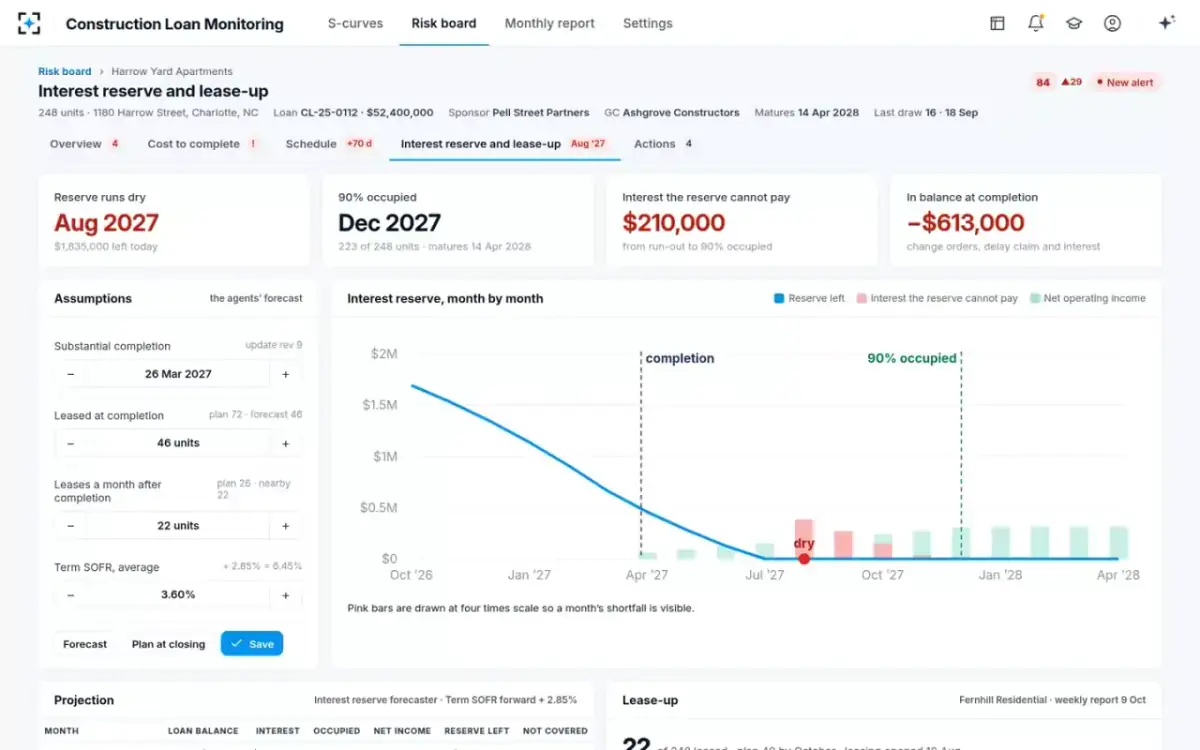
A month of delay after completion costs less, because income is starting to pay interest; but it lasts longer, because a slow lease-up stretches the time to stabilisation. The sample loan shows both. The contractor's slip and a lease-up of 22 units a month against a plan of 26 leave the reserve, $1,835,000 today, running dry in August 2027. The building reaches 90% occupancy, 223 of 248 units, in December. Four months of interest, $210,000, have nothing to pay them.
The sample reserve runs ten months, then four months of interest go uncovered
- Construction to 26 March 20275.5 months
- Lease-up, reserve still paying4.5 months
- Reserve dry August: $210,000 uncovered4 months
Construction Loan Monitoring's interest reserve forecast, month by month to 90% occupied
Lease-up: the months a simple formula forgets
Lease-up is where most reserves fall short, because it is the term a simple formula treats as fixed. The OCC sets the order of payment: "During the lease-up period, any cash flow from the project is ordinarily applied to pay interest before interest reserves are applied. Once the cash flow is sufficient to cover the interest, no further draws on the reserve should be permitted" (OCC, p. 8). The reserve covers only the gap between interest and income, and that gap closes at the pace the units lease.
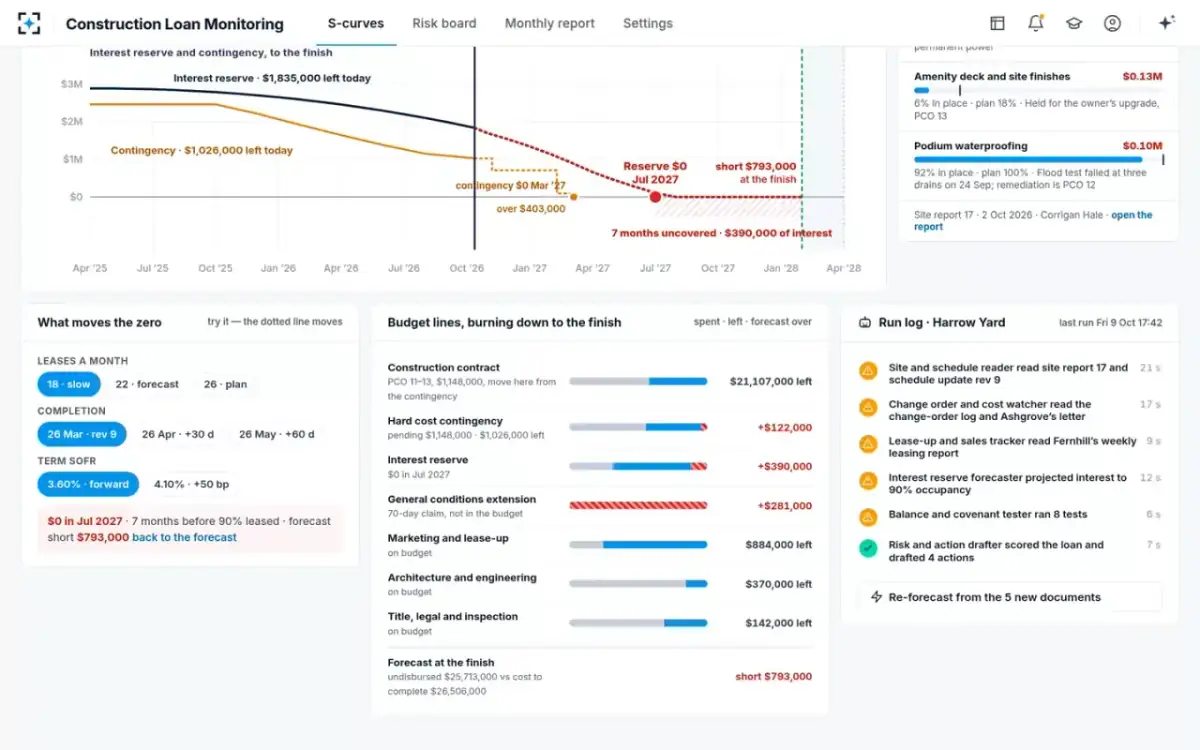
That makes leasing pace the most sensitive input after the completion date. On the sample loan, the leasing agent's comparables averaged 22 leases a month; the closing plan assumed 26. Try 18 a month on the scenario panel and the reserve runs dry a month sooner, in July 2027, the uncovered interest rises to $390,000, and the forecast shortfall at completion grows from $613,000 to $793,000.
Leasing four units a month slower nearly doubles the interest left uncovered
What moves the zero in Construction Loan Monitoring: leasing pace, completion and rate
Rates: a forward curve, not today's rate held flat
Most construction loans float, so the rate in a reserve calculation is a forecast too. The OCC's first key consideration names "potential changes in interest rates", and a reserve sized at a flat rate is a bet that rates stay put for two or three years. A floating loan's reserve should be projected on the forward curve plus the spread, and stressed.
The sample bank's settings make the choice explicit: the forecast uses the Term SOFR forward curve; the alternatives are today's rate held flat or the forward curve plus 100 basis points as a stress. On the scenario panel, a 50 basis point rise moves the zero date the same way a slower lease-up does. As a rule of arithmetic, every 50 basis points on $52.4 million is about $21,800 a month of interest at the full balance.
What happens when the interest reserve runs out?
When the reserve runs out before the property carries its own debt, the borrower owes the interest in cash, and the lender usually asks the borrower or guarantor to replenish the reserve. The OCC describes the sequence: the reserve "is sometimes depleted before the project is completed and lease-up or sale is achieved", often "because of construction delays or a change in market conditions", and the bank "generally requires the borrower or guarantor to provide additional cash to cover interest payments or replenish the reserves".
If the sponsor cannot pay, the loan becomes delinquent for the first time in its life, often more than a year after the problem began. That delay is the subject of the guide to interest reserves that keep a failing loan current, which explains why examiners look hard at a reserve that is refilled with more debt.
Can an interest reserve be increased?
Yes, but an increase funded with more debt is treated as a warning sign, not a routine change. The OCC expects a bank that does it to support the decision with a new appraisal or evaluation and a fresh look at the project's feasibility in the current market. An increase funded by the sponsor's own cash is different: it is new equity, and it improves the loan.
The practical lesson for a calculator is to size the reserve so that an increase is unlikely. The common cushions are a few extra months of lease-up, a rate stress and a contingency for completion slip. On the sample loan the forecast says the closing reserve is $210,000 short; the solution's recommended action was a balancing notice to the sponsor, not an increase in the loan.
Interest reserve calculation in Excel, against a forecast that re-runs itself
An Excel interest reserve calculation is the right tool at underwriting and the wrong one for monitoring. At underwriting, one spreadsheet per deal, built from the contractor's draw schedule, is exactly what HUD's "pro-forma draw schedule or its equivalent" asks for. After closing, the same spreadsheet needs new inputs every month: the latest completion date, the actual draws, the leasing report and the rate curve. Few banks re-key all four for every loan every month, which is why reserves tend to be re-checked when they are nearly empty.
Construction Loan Monitoring keeps the same calculation running. The interest reserve forecaster projects draws, interest on the forward curve plus the spread, and income as units lease, month by month to the date the reserve must reach, 90% occupancy by default. It shows every assumption, cites where each came from, and never changes the loan's terms or rate. When the forecast is short, the risk and action drafter writes the actions; a person decides them. The guide to why construction projects go over budget traces the sample loan's whole shortfall, of which interest is one part. See the forecaster on a full book at Construction Loan Monitoring.
Questions people ask
What is the 50 percent average outstanding rule?
It assumes the construction loan's balance averages about half the commitment over the build, so construction interest is roughly commitment × 0.5 × rate × years. HUD writes it into the MAP Guide, with two months added to the construction period. It is a reasonable sizing shortcut and a poor monitoring tool, because real draw schedules are rarely symmetrical.
How long should an interest reserve last?
Through completion and lease-up, sale or occupancy, in the OCC's words, so to the point the property's income can carry the debt. Lenders usually measure that as a stabilisation occupancy, such as 90%, plus a cushion. The sample bank alerts when the reserve will not reach stabilisation plus 60 days.
Is the interest reserve part of the loan amount?
Usually, yes: it is funded as a line in the construction budget and drawn like any other cost, so the borrower pays interest on the interest. The OCC notes it may instead be funded by the borrower into a separate escrow as a condition of the loan.
Should an interest reserve use the forward curve?
For a floating-rate loan, yes, with a stress on top. A flat rate understates the reserve when the curve slopes up and leaves no allowance for a rise. On $52.4 million, each 50 basis points is about $21,800 a month at the full balance.
Can I download an interest reserve calculation Excel template?
The calculator above shows the formula in full, and it transfers directly to three spreadsheet columns: balance, interest and income by month. For a loan already under construction, replace the average-balance shortcut with the actual draws to date and the contractor's remaining draw schedule.