A cost to complete report in construction estimates the money still needed to finish a project, line by line: what remains on each budget line, plus approved and pending change orders, plus claims and soft costs such as interest that will run longer than planned, less any contingency available to absorb them. For a construction lender it is half of the in balance test, the half that moves. The OCC lists "costs-to-complete" among the monthly reports sound monitoring requires, yet many monitoring packages simply copy the approved budget's remaining column, which knows nothing that has not yet been approved. Botminds' Construction Loan Monitoring builds cost to complete as a forecast: its agents price every pending change order and claim as it arrives and forecast each budget line to completion, so the report says what the finish will cost, not what was once approved.
The worked figures come from a fictional sample loan, Harrow Yard Apartments, a $52.4 million construction loan on a 248-unit building in Charlotte. The rules are quoted from the OCC and HUD.
Budget remaining and cost to complete answer different questions
Budget remaining: Current approved budget revision less costs paid.
Cost to complete: Everything still to be spent to finish, by line, on current knowledge.
Budget remaining: Only once approved and written into a budget revision.
Cost to complete: Approved and pending, the pending ones at the claimed amount until settled.
Budget remaining: Excluded until settled.
Cost to complete: Included at the claimed amount, labelled as disputed.
Budget remaining: The reserve set at closing.
Cost to complete: Interest to the stabilisation date on the latest schedule, lease-up and rate.
Budget remaining: The draw-day in balance test.
Cost to complete: The in balance forecast at completion, and any balancing demand.
Budget remaining: $25,713,000
Cost to complete: $26,326,000
What is a cost to complete report?
A cost to complete report is a statement, usually monthly, of the money required to finish a project, set against the money available to do it. Contractors prepare it for owners and owners for lenders, and each reads it for a different risk: the contractor for margin, the owner for equity, the lender for whether the loan stays in balance. The OCC puts it in the lender's monthly package by name, beside work completed, costs to date, deadlines and loan funds remaining (OCC, Commercial Real Estate Lending, p. 46).
The report's value depends on whether it is a reading or a forecast. A reading restates the approved budget's remaining column. A forecast asks of every line what it will actually cost to finish, given what is known today. Only the forecast answers the lender's question, and only the forecast can disagree with the budget, which is the point of having it.
Cost to complete vs budget remaining: why they differ
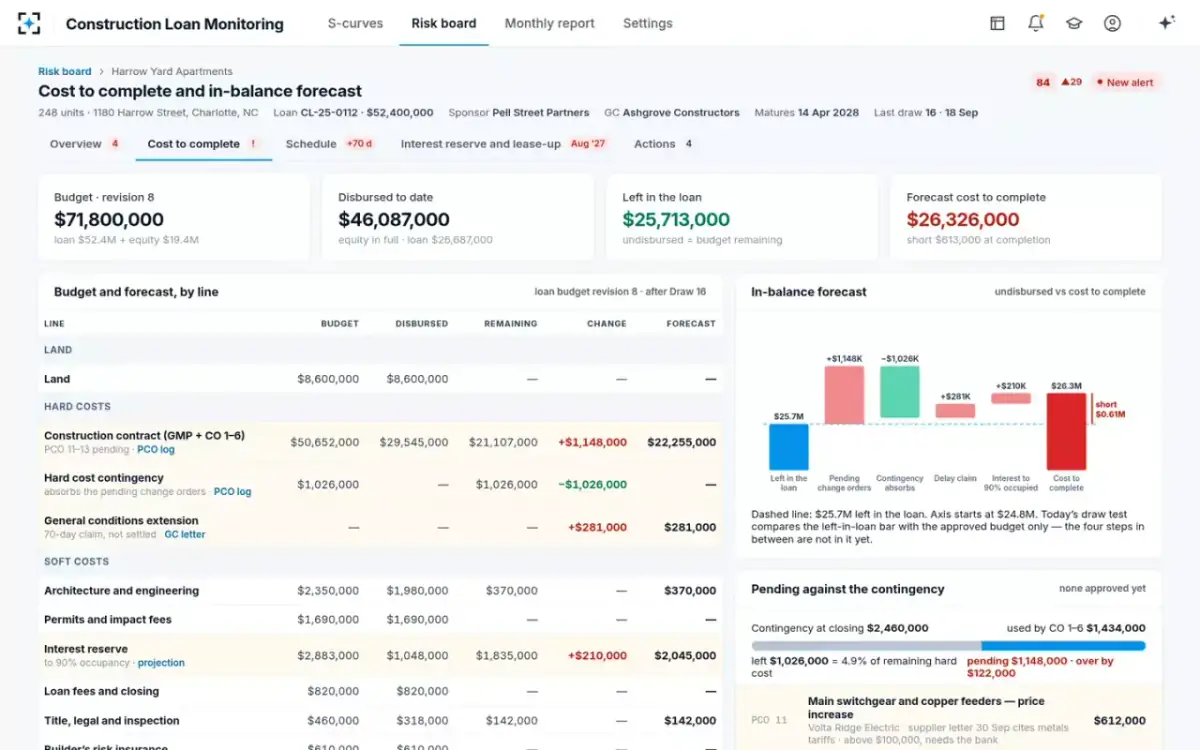
They differ by everything that has happened since the last budget revision and has not yet been approved. On the sample loan, budget revision 8 totals $71.8 million and $46,087,000 has been disbursed, leaving $25,713,000 of budget and exactly the same amount undisbursed in the loan. By the approved budget, the loan is in balance to the dollar.
The forecast cost to complete is $26,326,000. The $613,000 difference is four items that have arrived since Draw 16 and are not in revision 8: pending change orders of $1,148,000, the remaining contingency of $1,026,000 that absorbs most of them, a contractor's delay claim of $281,000, and $210,000 of interest beyond the reserve because stabilisation has moved. The guide to a construction loan going out of balance though every draw passed explains why the draw test cannot see them.
How to calculate cost to complete in construction
To calculate cost to complete, start from each budget line's remaining amount, add approved and pending change orders and any claims that fall on that line, adjust soft costs that depend on time, such as interest, insurance and general conditions, for the latest schedule, and subtract contingency only where it is genuinely available. Sum the lines. Then compare the total with the undisbursed loan proceeds plus any equity still due.
Three rules keep the calculation honest. Price a pending change order at the amount claimed, not the amount hoped for, until it is settled. Measure contingency against the work still to be built, not the original budget, because a 5% contingency on a half-built job is really a 10% cushion on what is left, or a 2% one, depending on how much has been used. And carry time-driven soft costs to the stabilisation date, not to substantial completion, because interest keeps running through lease-up.
The cost to complete formula, line by line on one loan
The formula is a sum across budget lines: forecast cost to complete equals, for each line, remaining budget plus change. The table shows it on the sample loan, line by line, from the solution's cost-to-complete view.
Cost to complete report, line by line: from $25.7 million remaining to $26.3 million forecast
| Budget line | Remaining | Change | Forecast to complete | Why it changed |
|---|---|---|---|---|
| Construction contract (GMP + CO 1–6) | $21,107,000 | +$1,148,000 | $22,255,000 | Pending change orders 11–13, at the claimed amount |
| Hard cost contingency | $1,026,000 | −$1,026,000 | — | Absorbs the pending change orders, and runs out |
| General conditions extension | — | +$281,000 | $281,000 | Contractor's 70-day delay claim, not settled |
| Interest reserve | $1,835,000 | +$210,000 | $2,045,000 | Interest to 90% occupied on the new completion and lease-up |
| Marketing and lease-up | $884,000 | — | $884,000 | On budget |
| Architecture and engineering | $370,000 | — | $370,000 | On budget |
| Title, legal and inspection | $142,000 | — | $142,000 | On budget |
| All other soft cost lines | $349,000 | — | $349,000 | On budget |
| Total | $25,713,000 | +$613,000 | $26,326,000 | Undisbursed loan proceeds: $25,713,000 |
Read the table from the bottom. Remaining budget and undisbursed proceeds match, so the loan passes today. The change column is where the forecast lives, and only three of eight lines carry anything. That is typical: cost to complete is usually driven by a few lines, the contract, the contingency and the time-driven soft costs, and a report that gives each of those its own reasoning is worth more than one that lists every line with equal weight.
The cost to complete view in Construction Loan Monitoring, line by line
How do pending change orders affect cost to complete?
Pending change orders raise cost to complete the day they are submitted, whether or not anyone approves them, because the work they price will be done or the dispute over it will cost money. The OCC is explicit that change orders belong in the budget early: "A significant number of change orders could indicate poor planning or project design, or problems in construction, and should be tracked and reflected in the project's budget" (OCC, p. 46).
On the sample loan, three pending change orders arrived on 7 October. The largest, PCO 11 for $612,000, re-prices the main switchgear and copper feeders after a supplier's letter citing metals tariffs. The others cover remediation of podium waterproofing that failed a flood test and an amenity deck upgrade the owner asked for. Together they exceed what is left of the contingency.
The contingency, from closing to the pending change orders that exceed it
Two judgements stay with people. Whether a change order is approved is the owner's and, where the loan agreement requires it, the lender's; the agents never approve or reject one. And whether a cost belongs in contingency at all is a credit question: the OCC expects overruns caused by poor projections or management to fall on the borrower rather than the contingency, a distinction the guide to construction contingency percentages covers.
Cost to complete forecast: checking billing against inspected work
A cost to complete forecast is only as good as the costs to date beneath it, so the first check is whether billing matches the work in place. If the contractor has billed more than the inspector has certified, the remaining contract understates what is left to do; the OCC warns examiners about front loading for exactly that reason. If billing runs behind inspected work, the remaining contract is, if anything, conservative.
On the sample loan the consultant certified 61.4% complete. Against a contract of $50,652,000, that is about $31.1 million of work in place, our arithmetic. Disbursed against the contract is $29,545,000, or 58.3%. Billing trails inspected work by about $1.56 million, consistent with retainage held back, so the remaining contract of $21,107,000 is not understated. That check takes a minute with the figures side by side and is easy to skip when they are in three different documents.
The cost estimators behind the numbers
226,400
cost estimator jobs in the United States in 2025
$78,740
median annual wage, May 2025
−3%
projected change in employment, 2025 to 2035
Who prepares cost to complete, and who checks it?
The contractor prepares the construction cost to complete, the owner adds soft costs, and the lender, usually through its inspecting consultant, checks both. The contractor's view comes from the schedule of values on its monthly pay application and its own estimate of committed and pending costs. The consultant reviews it against the site and the plans. The construction loan administrator reconciles it with the loan budget and the draw history.
The people who do the estimating are specialists. The Bureau of Labor Statistics counts about 226,400 cost estimators, at a median wage of $78,740, and expects their number to fall slightly to 2035 as estimating software improves (BLS Occupational Outlook Handbook). A lender rarely employs one; it relies on the contractor's and the consultant's. That is why the lender's report should keep each source's number with its name, and why the solution never alters a figure a consultant certified.
When the report says fund the gap
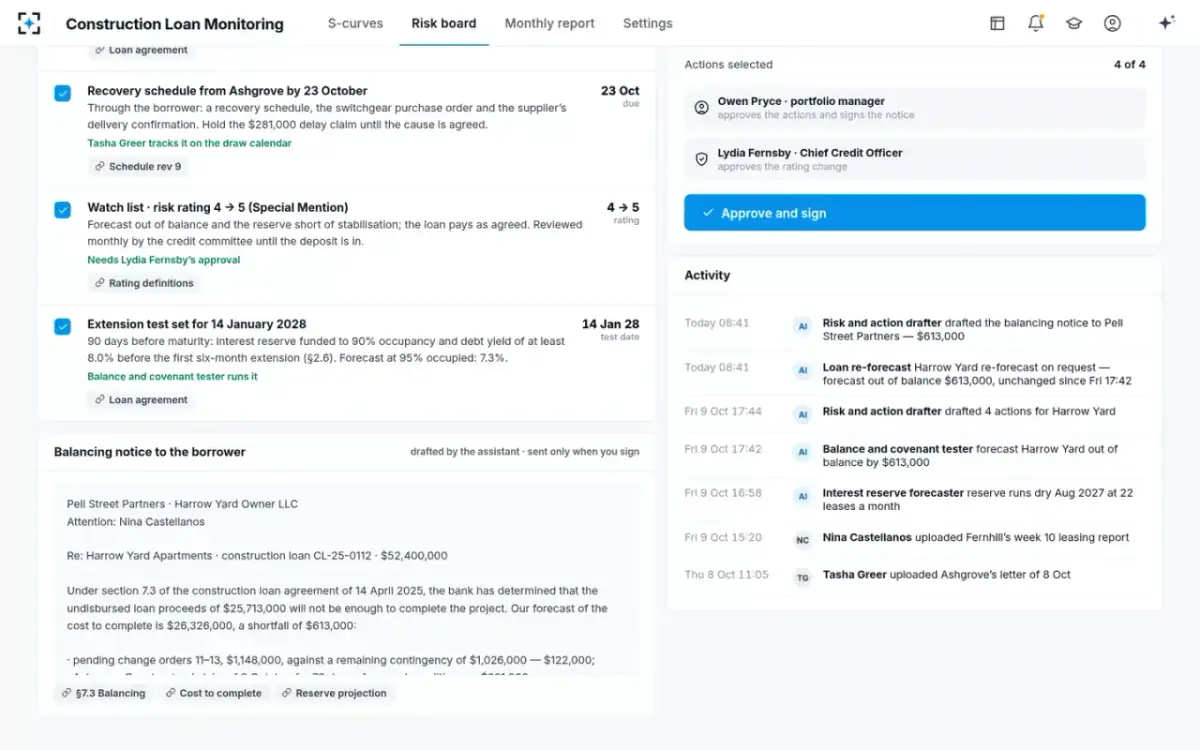
When cost to complete exceeds the money available, the report becomes a demand. Most construction loan agreements require the borrower to deposit the difference within a set period of the lender's notice; the sample agreement gives ten business days under §7.3. A good report makes the notice easy to write, because each part of the shortfall already has a source.
HUD's multifamily program shows the same discipline for time-driven costs. When a contractor's delay causes soft cost overruns, such as interest, taxes and insurance, they are "funded according to the liquidated/actual damages clause in the construction contract", a clause HUD says is "not intended to penalize the contractor, but to provide a source of funds for the increased soft cost" (HUD MAP Guide 4430.G, §12.7.8). A lender's report should show which party each overrun belongs to, because the answer decides who funds it.
From the cost to complete report to a balancing notice in Construction Loan Monitoring
A cost to complete template for lenders
A lender's cost to complete template needs more columns than a contractor's, because it has to explain changes, not just total them. The checklist below is ours; it works in a spreadsheet and is the structure the solution's cost-to-complete view follows.
Cost to complete template: the columns and checks a lender needs
- Budget, disbursed and remaining by line
From the current budget revision and the draw history; the remaining column must reconcile to undisbursed proceeds plus equity due.
- Change, with its source and status
Approved, pending or claimed, with the document and date for each.
- Forecast to complete by line
Remaining plus change; time-driven soft costs carried to the stabilisation date.
- Contingency left against work left
In dollars and as a share of hard cost still to be built, against the policy minimum.
- Billing against inspected progress
Contract billed to date against the consultant's percent complete; billing ahead is a question for the consultant.
- Who funds each overrun
Contingency, borrower, contractor under liquidated damages, or disputed.
- Total against funds available
Forecast cost to complete against undisbursed proceeds plus equity due: the in balance forecast.
The template's weak point by hand is the change column, because it depends on documents that arrive between draws. In the solution, the change order and cost watcher reads pending change orders, contractor letters and construction cost indices as they land, applies cost indices only to scopes not yet bought, and forecasts each line. The guide to why construction projects go over budget traces where the sample loan's changes came from. See the full report on a sample book at Construction Loan Monitoring.
Questions people ask
What is the cost to complete formula?
For each budget line, cost to complete equals the remaining budget plus approved and pending changes and claims, with time-driven costs carried to the latest finish date; the total is the sum of the lines. Lenders then compare it with undisbursed proceeds plus equity still due. On the sample loan that gives $26,326,000 against $25,713,000 available.
Is cost to complete the same as estimate to complete?
In practice yes: both mean the forecast of remaining cost. Project controls teams often say estimate to complete and add it to actual cost to get an estimate at completion. Lenders more often say cost to complete, because the comparison they need is with the money left in the loan.
How often should a cost to complete forecast be updated?
At least monthly, the frequency the OCC names for costs-to-complete reports. A forecast changes whenever a change order, claim, schedule update or rate move arrives, so a lender that updates only at draws reads each change up to a month late.
Should pending change orders be included in cost to complete?
Yes, at the claimed amount until they are settled, and labelled as pending. Leaving them out is how a loan passes its draw test while heading out of balance. A bank can switch the treatment off as a policy choice, but it should then know what it is not counting.
What is a cost to complete report used for in construction lending?
It is the cost side of the in balance test, the basis for any balancing demand, and an early warning of overruns. Examiners also read it: the OCC expects a bank's files to include "documentation sufficient to demonstrate whether remaining funds are adequate to complete the project".