A lender's pay app review in construction is the check that every dollar on the contractor's AIA G702 application and G703 continuation sheet is earned, in place, paid down the chain and within the loan agreement before the bank advances it. The arithmetic of the forms is the easy part. The OCC's standard is that each draw be "commensurate with improvements made as of the date of the inspection or certification provided by the bank" (OCC Comptroller's Handbook, Commercial Real Estate Lending), which means each G703 line has to be held against the inspector's percent, the subcontractor's invoice, two lien waivers and the approved budget. On a mid-sized project that is twenty lines, a dozen invoices and dozens of waivers every month, under a contractor's payment clock. Botminds' Construction Draw Management reads the whole package, ties each line to its evidence, and hands the construction loan administrator a recommended amount with every hold explained.
The figures below follow one fictional sample loan as it runs through the solution: Larkspur Commons, 186 apartments over 14,200 square feet of retail, Draw 14, Application 14 for the period to 30 September 2026.
One sample draw: what the pay app asked for, and what the review funded
$4.38M
requested: $3,992,730 of hard cost after retainage plus $392,240 of soft cost
$782,750
held across four exceptions, each with the document that releases it
20 of 20
G703 lines tied to their inspection, invoice and waivers
1 day
from a complete package to the advance going to the title company
What a lender's pay app review has to prove
That the advance matches work in place, that the people who did the work are being paid, that nothing has changed without the bank's approval, and that the loan is still in balance after the money goes out. The OCC frames the controls the same way: banks "typically require architect or engineering inspection reports with each draw", confirm "that the budget remains in balance with sufficient funds available to fund completion", and "funds should not be advanced unless the funds are to be used solely for the project being financed and as stipulated in the draw request and consistent with the loan agreement".
The pay application is the document that carries the request, and its design helps the review. The AIA describes G702 and G703 as forms "on which the contractor can apply for payment and the architect can certify that payment is due", requiring the contractor to show "the total dollar amount of the work completed and stored to date, the amount of retainage (if any), the total of previous payments, a summary of change orders, and the amount of current payment requested" (AIA, G702-1992). Every one of those figures has a counterpart outside the form that the lender can test it against, and the review is the act of testing them.
G702 vs G703: which form carries the risk?
The G703 does. The G702 is a one-page summary whose lines are the continuation sheet's totals and arithmetic on them; the G703 "breaks the contract sum into portions of the work in accordance with a schedule of values prepared by the contractor" (AIA, G703-1992), and that is where an overbilled trade, a stored-materials claim or an unapproved scope change sits. A review that starts and ends on the G702 can confirm the arithmetic of a bill it has not read.
The first test is still the tie between them. G702 line 4, total completed and stored to date, must equal the G703's column G total; line 3, contract sum to date, must equal the total of column C; and line 8, current payment due, must follow from line 6 less the last certificate the bank accepted. On the sample application all 20 G703 lines tie to G702 line 4, $29,574,660, against a contract sum to date of $50,048,900. Only then does the review move from the forms to the evidence.
The G703 columns, and what a lender ties each one to
| Column | What the contractor enters | What the lender ties it to |
|---|---|---|
| C · Scheduled value | The line's share of the contract sum, with approved change orders | The budget the bank approved at closing, plus change orders the bank has approved |
| D · From previous application | Work completed on prior applications | Last month's column G as the bank funded it, not as the contractor requested it |
| E · This period | Work completed since the last application | The inspector's percent for the line, the subcontractor's invoice and its conditional waiver |
| F · Materials presently stored | Materials bought and stored, not yet installed | The inspector's count, the location rule in the loan agreement, invoices and insurance |
| G · Completed and stored to date | D + E + F, and its percentage of C | The inspector's certified percent, within the bank's tolerance |
| H · Balance to finish | C − G | The cost-to-complete and in-balance tests |
| I · Retainage (if variable rate) | Retainage by line where rates differ | The retainage terms of the loan agreement and any reduction the bank approved |
Tying column G to the inspector: where most holds come from
The most valuable test in a pay app review is the billed percent on each G703 line against the inspector's certified percent for the same line. The OCC notes that inspection reports "support disbursements typically based on percentage complete", and the bank's own inspection, not the architect's certificate, is what the advance is measured against.
On the sample application the framing subcontractor's line, wood framing and sheathing, has a scheduled value of $6,950,000 and bills $6,116,000 to date: 88.0%. The inspector certifies 81%. On Level 5 the east wing walls are framed but not sheathed, and the roof trusses are on site but not set. The G703 arithmetic is flawless, and $486,500 has still been billed ahead of the site; net of 10% retainage, $437,850 is held until a later inspection certifies the work. Every other line sits within the bank's 3-point tolerance.
One G703 line in Construction Draw Management, with the inspection, invoice and waivers beside it
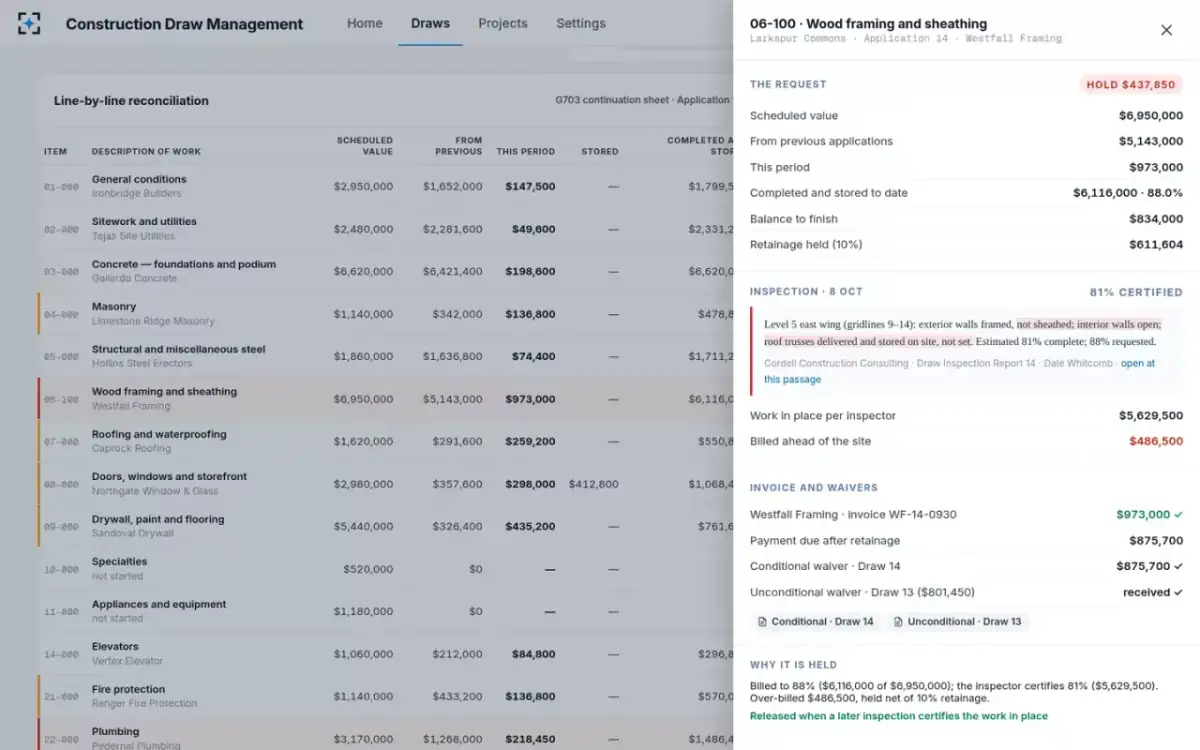
The tolerance itself is a policy decision worth writing down. Inspectors estimate; a 2-point difference on a drywall line is noise, while a 7-point difference on framing is a month of work. A bank that sets its tolerance by line, and keeps every variance it waived, can show an examiner that its inspection test was applied rather than glanced at.
Which pay application lines do lenders challenge most?
The lines where the arithmetic can be right and the bill still wrong. They are the ones a review should reach before it reaches the payment due, and each has a document that resolves it.
Pay application lines a construction lender challenges, and what resolves each
| Line or column | The challenge | What resolves it |
|---|---|---|
| G703 column G against the inspection | Billed percent ahead of the certified percent | Hold the difference, net of retainage, until a later inspection certifies it |
| G703 column C changes | A scheduled value moved without an approved change order | The change order, approved by the bank where above the loan agreement's threshold |
| G703 column D | Last month's requested amount carried forward instead of the amount the bank funded | Last month's column G as funded, line by line |
| G703 column F, stored materials | Materials off site, unbonded, uninsured or uncounted | The inspector's count and the bank's stored-materials rule |
| G702 line 2, change orders | A change billed before the bank approved it | Bank approval; until then the billed amount is held |
| G702 line 5, retainage | A lower rate than the loan agreement allows | The agreement, or a reduction approved in writing |
| General conditions line | Billed faster than the project is progressing | A limit on how far ahead of overall completion it may run |
Two of these deserve a note for credit. Retainage on line 5 is the bank's cushion as much as the owner's: the OCC describes banks that "normally retain, or holds back, 10 to 20 percent of each payment to cover project cost overruns or outstanding bills from suppliers or subcontractors". A pay application that quietly applies 5% where the agreement says 10% releases almost $1.5 million in one draw on the sample loan. And early-trade lines whose scheduled values exceed their real cost are the mechanism of front loading, which the OCC warns leaves "insufficient loan funds to complete construction if there is a default"; how a review sees it across months is set out in front loading in construction.
Invoices and lien waivers: proving the money moves down the chain
A G703 line is only fundable if the subcontractor behind it was paid for last month and will be paid for this one. The OCC expects the draw request to "include waivers from the project's subcontractors and suppliers indicating that payment has been received for the work completed", and the practical test is two documents per party: a conditional waiver for this period's amount, and an unconditional waiver for what the bank funded last month.
The sample package carries 13 invoices and 27 of the 28 expected waivers. Two hold money. The electrical subcontractor's unconditional waiver for the $241,650 paid in Draw 13 has not arrived, so its $257,760 due this period, net of retainage, is held. The plumbing subcontractor's conditional waiver releases $176,605 against $196,605 due, so $20,000 is held. Each waiver is read for its type, amount, through date, signer and, on this Texas project, the statutory form; the difference between the two kinds is the subject of conditional vs unconditional lien waivers.
Where the sample draw's $782,750 of holds came from
Change orders, stored materials and the in-balance test
A pay app review ends by asking whether the loan can still finish the job. The OCC expects banks to confirm "that the budget remains in balance with sufficient funds available to fund completion", and lists among its warning signs "construction budget overruns, changes to construction plans, materials, finishes, and borrower requests for significant reallocation of funds to other budget line items" and "draw requests ahead of schedule for work yet to be completed".
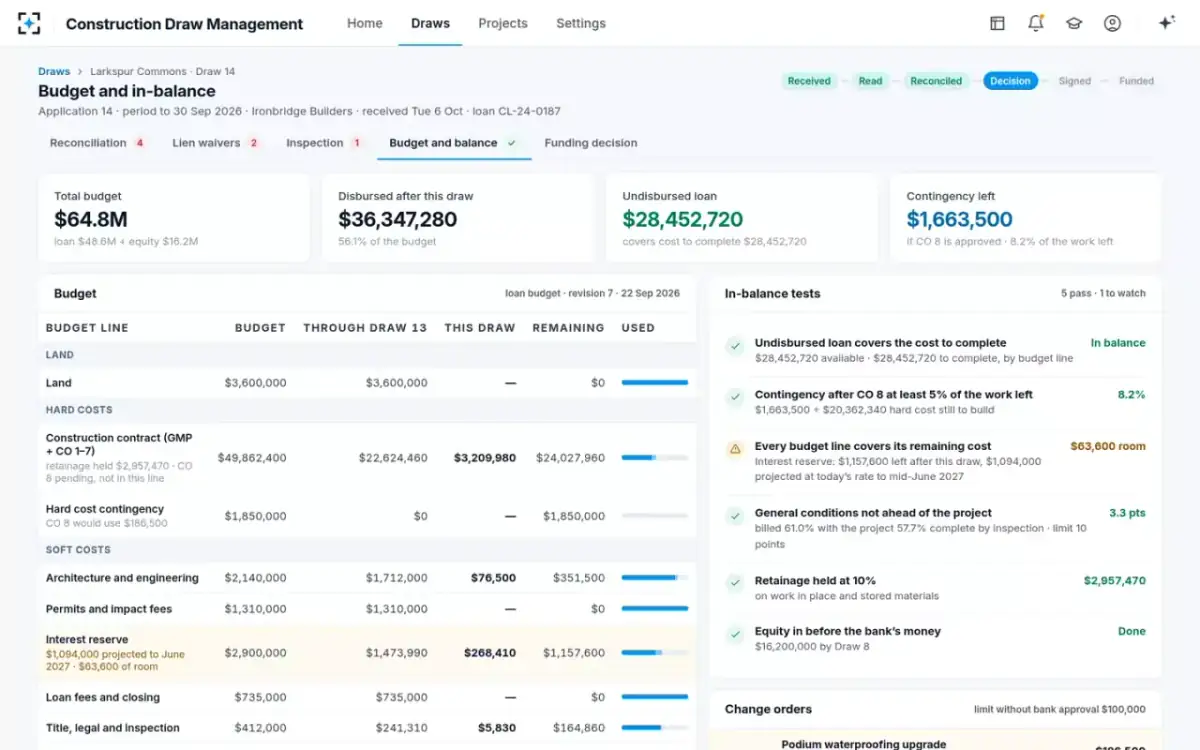
Change order 8 on the sample loan is billed on the G702 before the bank approved it, so its amount is held until approval; contingency after it would be $1,663,500, 8.2% of the work left and above the bank's 5% minimum. The 212 stored windows are counted on site, which is where the loan agreement allows them. After the draw the undisbursed loan of $28,452,720 covers the cost to complete, general conditions run 3.3 points ahead of the project inside the 10-point limit, and one thing goes on the watch list: $1,157,600 left in the interest reserve against $1,094,000 of projected interest.
Still in balance after the advance, with the interest reserve to watch
Who reviews what: the administrator, the inspector and the signer
A pay app review is a chain of judgements with one accountable signer, and the evidence each link produces is what makes the advance defensible. The OCC expects "adequate segregation of duties" in construction lending; in practice that means the person who reads the package is not the only person who can release a large advance.
From pay application to advance on the sample loan
Agent
Pay application readerReads the G702 and G703, recomputes every column, ties the continuation sheet to the summary and checks retainage against the agreement.
Never: Changes a submitted figure; it reports differences.
Agent
Invoice and waiver matcherTies 13 invoices and 27 waivers to their lines by party, amount, through date and statutory form.
Agent
Inspection reconcilerCompares each line's billed percent with the inspector's certified percent and counts stored materials.
Never: Changes a percentage the inspector certified.
Agent
Budget, balance and title checksRuns the in-balance tests and reads the title search since the last draw.
Agent
Funding recommenderProposes the amount to fund, each hold with the document that releases it, and drafts the borrower notice.
A person decides
Construction loan administratorReviews the exceptions, adds holds from the inspector's notes, and signs with the meaning of the signature.
A person decides
Senior construction lending officerCo-signs any advance above the administrator's $2,500,000 limit before it goes to the title company.
What do examiners ask about draw disbursements?
They ask whether each advance was supported, authorised and checked by someone independent of the loan's origination. The OCC's internal control questionnaire for commercial real estate lending puts the pay app review into a list of yes-or-no questions: are disbursements "made only after reviewing written inspection reports", "reviewed by a bank employee who had no part in granting the loan", "compared with original cost estimates", "checked against previous disbursements" and "supported by invoices describing the work performed and the materials furnished"?
The same questionnaire asks about the inspector, whether inspection reports are "sufficiently detailed to support disbursements", whether inspectors are "competent and independent of the loan origination function", and whether spot checks are made of the inspectors' work; and it asks about the paper that protects the lien: whether the bank obtains "waivers of subcontractors' and materialmen's liens as work is completed and disbursements made", and a "date down" endorsement with each draw where applicable. The examination procedures go further and ask examiners to "determine whether material changes have been made to the construction budget and the reasons for these changes" and to "assess adequacy of the interest reserve in light of construction progress".
Read as a whole, the list is a description of what a pay app review should leave behind. Each question is answerable only if the review kept its evidence by line and by draw: the inspector's percent beside the billed percent, the waiver beside the payment it covers, the change order beside its approval, the in-balance test beside the advance. A bank whose answer is a signed G702 and an email approving the wire has done a review an examiner cannot see.
The date-down deserves its own sentence, because it is the step most often treated as the title company's problem. The OCC notes that "in some jurisdictions, mechanics liens can take priority over the bank lien", and that in those jurisdictions "it is important for the lender to update the title policy with each draw". On the sample loan the title date-down checker read the search since the last advance before the recommendation was made, and on another of the administrator's projects the same check found a $48,200 lien affidavit that the borrower was asked to bond around. Where a lien can outrank the mortgage is the subject of whether a mechanics lien takes priority over a mortgage.
How long should a pay app review take?
Long enough to tie every line, and no longer than the contractor's payment terms and the bank's own service promise allow. Contractors live on the gap between being paid and paying their subcontractors, and a review that runs ten days on a complete package is a cost the borrower passes back in price or relationship. On the sample loan the package was complete when the 51st document arrived; the agents finished their tie-out in 1 minute 24 seconds, and the advance went to the title company for the ALTA date-down and disbursement one business day later, after two signatures.
The time saved is not in reading faster. It is in the administrator starting from a list of four exceptions with their proof, rather than from a stack of 51 documents with no indication of which twenty lines matter. That is also where the quality gain sits: a review that reaches every line every month does not have to choose which lines to sample. How the steps fit into the life of the loan, from closing to the final draw, is in how construction loan draws work.
A pay app review a construction lender can defend
- The forms tie before anything else is read
G703 column G to G702 line 4, column C to line 3, and line 7 to the last certificate the bank accepted.
- Every line is held against the inspection
Billed percent against certified percent, within a tolerance the bank has written down, with every waived variance kept.
- Every party has two waivers
Conditional for this period's amount after retainage, unconditional for what the bank funded last month, on the right statutory form.
- Changes are approved before they are funded
Change orders above the agreement's threshold, budget reallocations and contingency draws each carry the bank's approval.
- The loan is in balance after the advance
Undisbursed funds cover the cost to complete, contingency and interest reserve are above their minimums, and equity requirements still hold.
- Every hold says what releases it
The document, inspection or approval that frees the money, so the contractor knows what to send and the next review knows what to check.
Where Construction Draw Management fits
The solution reads AIA G702 and G703 or a lender's own draw request form, ties each line to the inspection report, invoices and lien waivers, runs the budget and title checks, and proposes the amount to fund with every hold explained and linked to the page it came from. The rules it applies, inspector tolerance, retainage schedule, stored-materials location, change-order thresholds and signing limits, are the bank's settings, versioned and changed only with a second person.
It does not inspect the site, approve a change order or sign the advance. The inspector's percentages stand as certified, credit decides on exceptions, and the administrator and the officers with authority sign. What it changes is the starting point of every review and the evidence left behind: a funded draw carries, line by line, the documents it was funded on. To see the tie-out on your own loans, start from Construction Draw Management.
Questions people ask
Does the lender rely on the architect's certificate on the G702?
Not alone. The architect certifies to the owner what is due under the construction contract, and the AIA notes the form allows the architect to certify an amount different from the amount applied for. The bank funds on its own inspection, because the OCC's test is improvements as of the inspection or certification the bank provides.
What retainage do construction lenders hold?
Whatever the loan agreement and construction contract set. The OCC describes banks under a progress payment plan as normally holding back 10 to 20 percent of each payment; the sample loan holds 10% throughout, and some agreements step it down after the project is half complete.
Should stored materials be funded?
Only where the loan agreement allows, and only after the inspector has counted them. Common rules are on site or in a bonded warehouse, on site only, or not funded until installed; the sample loan funds 212 windows counted on site.
What happens to a line billed ahead of the inspection?
The difference is held, net of retainage, until a later inspection certifies the work. On the sample loan the framing line billed 88% against 81% inspected, so $437,850 was held and the rest of the line funded.
Can the review be done on a lender's own draw form instead of AIA forms?
Yes. The tests are the same: tie the line detail to the summary, each line to its inspection, invoice and waivers, and the result to the budget. The AIA notes it publishes no standard schedule of values, so the lines vary by project whichever form carries them.
Who should sign a large advance?
Someone in addition to the person who reviewed it, above a limit the bank sets. The OCC expects segregation of duties in construction lending; on the sample loan any advance above $2,500,000 needs a senior construction lending officer's signature as well as the administrator's.