Construction loan administration software manages a construction loan from closing to the final draw: it takes in each draw package, checks the pay application, invoices, lien waivers, inspection, budget and title date-down, recommends what to fund and hold, and keeps the evidence for the examiner. The way to choose one is a pilot on paid draws, re-running the last fifty draws the bank has already funded and comparing the exceptions the software raises with what the bank actually paid. That test uses documents the bank owns, outcomes it already knows and rules it already wrote, so the result is evidence rather than a demonstration. Botminds' Construction Draw Management is built to be piloted this way, with six agents that read each package and a recommendation that a named administrator signs.
A pilot of construction loan administration software in ten steps
- Choose 50 funded draws across at least 10 loans
Mix project types, contractors and administrators; include a final draw and a draw with a known problem.
- Gather each draw's full package as it arrived
Not the cleaned file: the scans, the late waivers, the revised G703.
- Write the bank's rules down as settings
Inspection tolerance, retainage, contingency floor, change-order threshold, waiver forms, approval limits.
- Keep the bank's own decision for each draw sealed
What was funded, what was held and why, from the funding memo.
- Run the software on every package without help
No one corrects the input between runs.
- Compare its exceptions with the bank's holds, line by line
Agreements, misses on each side, and differences in the amount held.
- Have a senior administrator classify each difference
Real issue the desk missed, real issue the software missed, or a false exception.
- Trace each real miss to the document that shows it
If the software found it, it should cite the page.
- Measure time from complete package to recommendation
On the same packages, for the desk and for the software.
- Write the result for credit and for the examiner
The pilot file is the first evidence that the control works.
What is construction loan administration software? The loan between closing and the final draw
Construction loan administration software covers the part of a construction loan that happens after closing: the monthly draw, the inspection that supports it, the lien and title checks that protect the bank's position, and the budget that has to stay in balance until the building is finished. The OCC describes the monitoring a bank needs as "obtaining monthly reports of work completed, costs-to-date, costs-to-complete, construction deadlines, and loan funds remaining," with changes to the plans "reviewed by competent staff or a construction consulting firm and approved and documented by the bank" (OCC, Commercial Real Estate Lending booklet).
The category overlaps with two others. Construction draw management software focuses on the draw itself; testing it with planted errors is covered on its own page. Loan servicing systems hold the note, the balance and the payments. Construction loan administration sits between them and is where most of the bank's construction risk is actually controlled.
The volume is material at almost every bank that lends on real estate. FDIC-insured institutions held $453.5 billion of construction and development loans at June 30, 2026, and community banks alone had $83.1 billion of unfunded commitments on CRE construction still to be drawn (FDIC Quarterly Banking Profile, Q2 2026).
What should construction loan software do? Start from the examiner's questions
Construction loan software should be able to answer, for any draw, the questions an examiner will ask about the control. The OCC's examination procedures and internal-control questionnaire are the most complete list, and they are free.
What the examiner asks, and what construction loan administration software must show
| Examiner's question | Where it comes from | What the software must show |
|---|---|---|
| Is the construction risk function independent of loan production? | OCC ICQ question 50 | Who prepared, who recommended and who approved each draw, with roles separate. |
| Is there a line-item budget for each construction stage? | OCC ICQ question 53 | The budget by line, with change orders rolled in and each draw posted against it. |
| Are draws commensurate with verified improvements? | OCC loan policy expectation | Billed against inspected percent, line by line, and what was held for the difference. |
| Does the budget remain in balance with funds to complete? | OCC loan policy expectation | The in-balance test after every draw, and what stopped a draw that failed it. |
| Were liens searched before disbursement? | OCC credit administration controls | The date-down result read before the recommendation. |
| Were waivers obtained for payments made? | OCC disbursement processes | Each party's waivers for this payment and the last, by amount and form. |
| Was the disbursement approved by two people? | OCC credit administration controls | Both signatures, with the limit that required the second. |
A tool that cannot answer one of these rows from its own screens leaves the bank to answer it from email and spreadsheets, which is the situation the software was bought to end.
Why pilot on paid draws instead of watching a demo
A demo shows the software on data chosen to show it well. A pilot on paid draws shows it on the bank's packages, which are messier, against outcomes the bank already knows. It also produces something a demo never does: a list of exceptions on draws the bank funded, which is either reassurance that the desk was right or an early warning about what it has been missing.
That second result is uncomfortable and valuable. The FDIC Inspector General's review of the Security Bank failure found draw requests without consistent invoices, no lien waivers from subcontractors, and inspections contracted to look only at the current disbursement (FDIC OIG, MLR-10-020). None of those gaps was visible in any single draw. They show up when many draws are re-read the same way, which is what a fifty-draw replay does.
What data do you need for a draw software pilot?
A pilot needs each draw's complete package and the bank's decision on it, plus the documents that set the rules: the credit policy, the loan agreement and the approved budget. Most of it already sits in the loan files.
The data a fifty-draw pilot needs, and where it usually lives
| Document | Where it usually lives | What the pilot uses it for |
|---|---|---|
| Credit policy and construction procedures | Credit administration | The tolerances, retainage, limits and waiver rules, set once as settings. |
| Loan agreement and approved budget, with change orders | Loan file | Retainage terms, change-order thresholds and the budget each draw posts against. |
| G702 and G703, or the bank's own draw request form | Draw package | The billed amounts by line. |
| Contractor and subcontractor invoices | Draw package | Tying each billed line to a vendor and a cost. |
| Conditional and unconditional lien waivers | Draw package, often arriving late | Party, amount, through date and form for each payment. |
| Inspection reports with stored-materials counts | Inspector | Certified percent complete per line. |
| Title date-down results | Title company | Liens recorded since the last draw. |
| Funding memo or approval with holds | Credit administration | The answer key: what was funded and held, and why. |
How to measure a construction loan software pilot: five numbers
Measure a pilot with five numbers, and report each separately, because a tool can do well on one and badly on another. Agreement with the desk is the least informative of them: two reviewers can agree and both be wrong.
Five numbers that decide a construction loan administration software pilot
What to count: Issues the software raised, confirmed by a senior administrator, that were funded.
How to read it: The most important number. Each one should cite its page; classify by type and amount.
What to count: Holds the desk made that the software did not raise.
How to read it: Find out why: a document it could not read, a rule not yet set, or a judgement call.
What to count: Exceptions the senior administrator rejects.
How to read it: Too many and the desk stops reading them. Look at whether a setting fixes them.
What to count: For agreed exceptions, the amount each side held.
How to read it: Retainage, change-order and partial-waiver arithmetic shows up here.
What to count: From complete package to a recommendation ready to sign.
How to read it: Measured, not estimated; the contractor's clock starts when the package is complete.
One caution on the first number. An exception on a funded draw is not necessarily a loss: a short waiver may have been corrected the next week, a line ahead of the inspector may have been certified a month later. Classify each by what happened next, using the following draw's package, before treating it as a finding.
How long does it take to implement draw software?
Implementation length depends mostly on how quickly the bank can write its rules down and assemble the pilot packages, not on the software. A pilot of the shape above can be planned around six weeks. The plan below is our suggestion, not a measured result.
A six-week plan for a construction loan administration software pilot
- Rules and packagesWeeks 1–2
- Replay 50 drawsWeeks 3–4
- Classify and scoreWeek 5
- DecideWeek 6
For Construction Draw Management, going live means configuring the solution from the bank's own requirements and documents: its credit policy, its loan agreement and a sample of past draw packages. It goes live once its checks pass on those draws, and we run it with the bank on its own draws first.
Your credit policy, as settings: what the pilot should let you change
A pilot is only meaningful if the software applies the bank's rules rather than the vendor's. Every threshold the desk uses should be a setting, versioned, with the change and the person who made it on the audit trail.
Construction Draw Management settings: the rules every draw is checked against
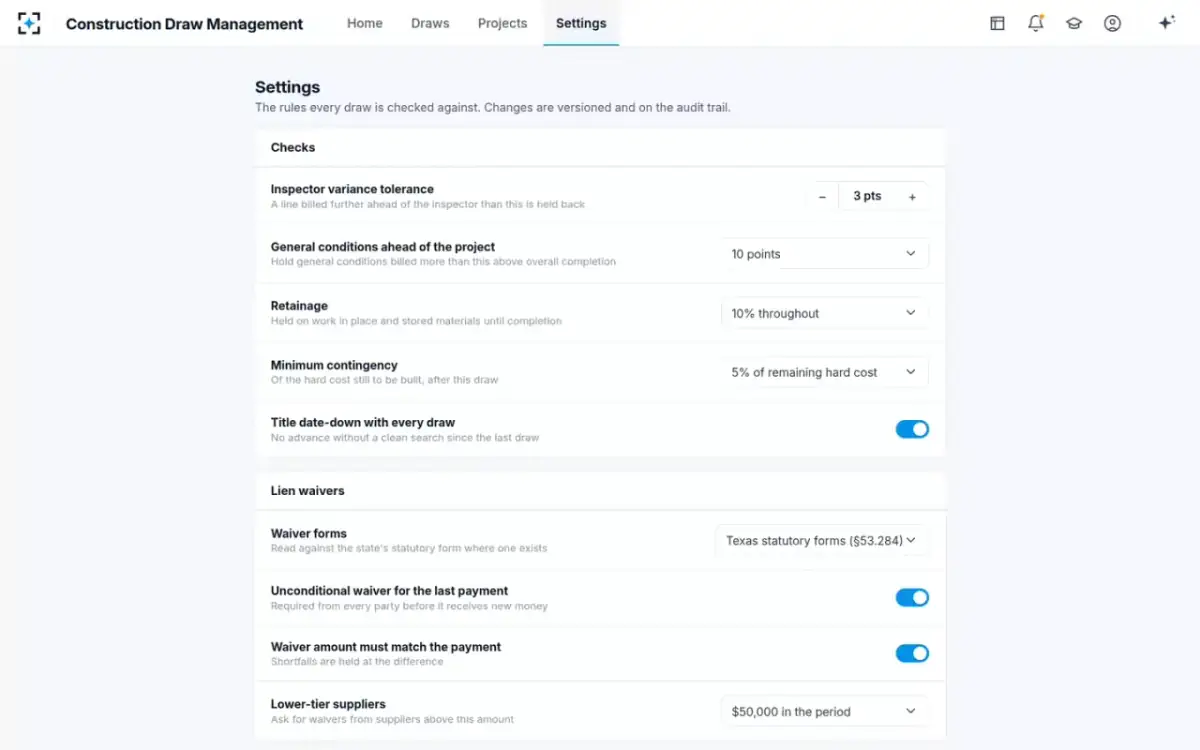
On the sample book the defaults are a 3-point inspection tolerance, general conditions no more than 10 points ahead of the project, 10% retainage, a 5% contingency floor on remaining hard cost, change orders above $100,000 needing bank approval, and an administrator who signs alone to $2,500,000. None of these comes from a regulator; the OCC asks only that draws be commensurate with verified work and that the budget stay in balance. The numbers are each bank's credit policy, and the pilot is the moment to write them down.
What the desk sees once it is live: projects, draws and holds
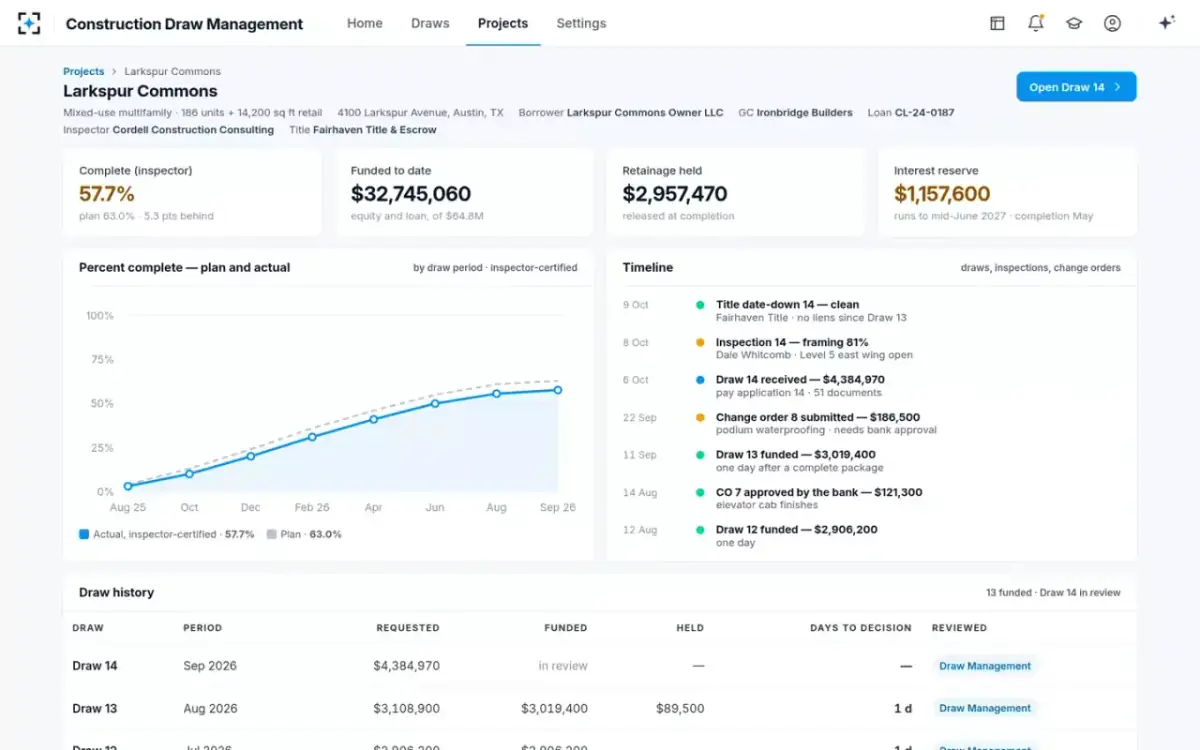
After the pilot, the same reading runs on every new draw, and the results roll up by project. The administrator sees each project's inspector-certified percent complete against plan, funded to date, retainage held and the interest reserve, and the manager sees the same across the book.
One project in Construction Draw Management: certified progress, funding and draw history
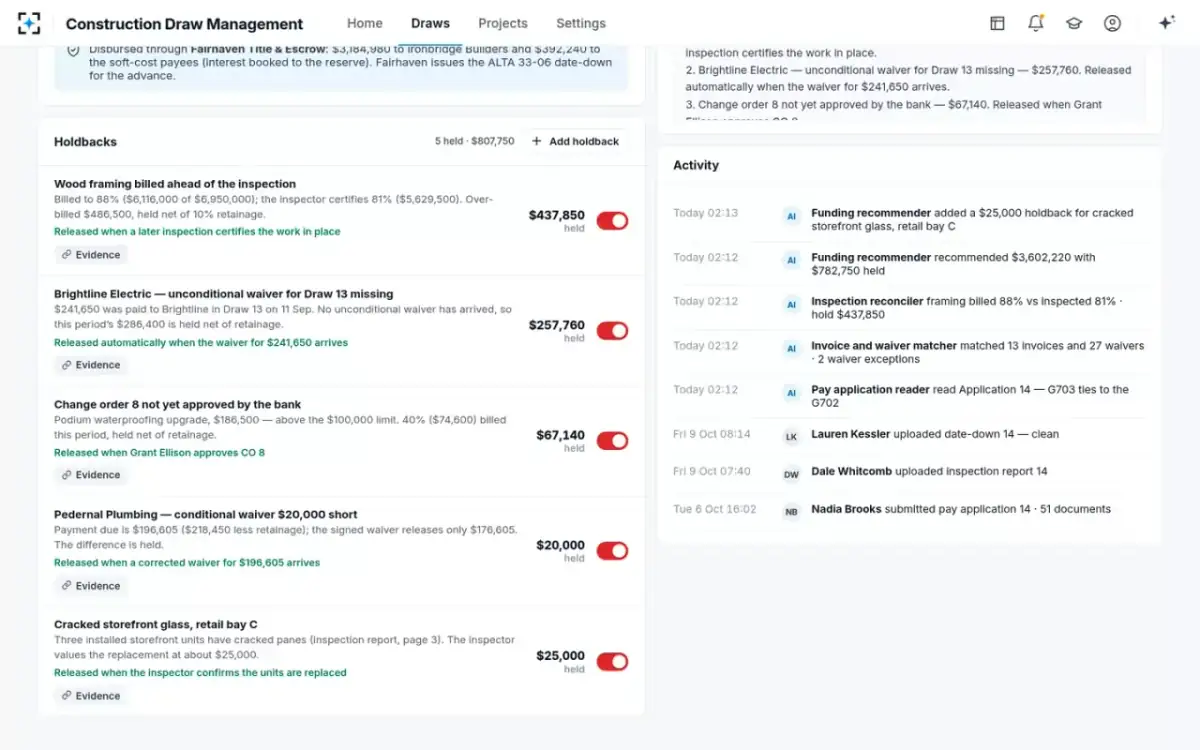
Holdbacks and activity: every hold with its evidence and release
Where Construction Draw Management fits, and where it does not
It fits the reading and recommending half of construction loan administration. Six agents tie every G703 line to its invoice, waivers and inspection, run the budget and in-balance tests, read the title date-down, and recommend an amount with a holdback for each exception and the document that releases it. The administrator decides and signs; above her limit, a construction lending officer co-signs. The design targets are every line tied to its proof before money moves, and a signed decision within one business day of a complete package; the pilot is how a bank checks both on its own draws.
It does not replace the loan servicing system, the inspector, the title company or the bank's disbursement process; it never approves or moves money. It reads AIA G702 and G703 or the bank's own draw request form, and it reports differences rather than altering the contractor's figures or the inspector's percentages. That restraint is also what regulators are looking for. The OCC's spring 2026 risk report describes the industry's approach:
"Banks are taking a measured approach to the adoption of generative AI (genAI) and agentic AI, with usage generally limited to specific use cases with guardrails and human-in-the-loop accountability to manage risk."
OCC, Semiannual Risk Perspective, Spring 2026
A draw review with fixed limits on what the agents may do and a named signer for every decision is that shape. The people who carry the work, seat by seat, are described in construction loan administration, seat by seat.
Questions people ask
What is construction loan management software for banks?
It is software a bank uses to administer construction loans after closing: draws, inspections, waivers, title updates, budgets and approvals. The bank's version has to show the OCC's two tests on every advance: funding commensurate with verified improvements, and a budget in balance with funds to complete.
How many draws should a pilot include?
Fifty funded draws across at least ten loans is a workable planning figure, enough to include final draws, change orders and the occasional lien. A smaller bank can use fewer loans over a longer period, as long as the funding memos are kept as the answer key.
Can a pilot use the bank's own draw request form instead of the AIA forms?
It should, if that is what borrowers send. Construction Draw Management reads AIA G702 and G703 or a lender's own form; the AIA itself notes that it publishes no standard schedule of values form, so continuation sheets vary in practice.
What should a bank do with exceptions found on draws it already funded?
Classify each by what happened next, using the following draws. A corrected waiver or a later inspection may have resolved it; an issue that never resolved is a finding for credit and possibly for the loan's risk rating.
Does the software decide how much to fund?
It recommends. In Construction Draw Management the agents never approve or move money; the administrator signs with the meaning of her signature, a second signer is required above her limit, and every holdback is released only by its document or with a reason and a second person.