The difference between a conditional and an unconditional lien waiver is when it takes effect: a conditional lien waiver releases the signer's lien rights only when the payment it describes has actually been received, while an unconditional lien waiver releases them as soon as it is signed and delivered, whether or not the money arrived. That is why, on a construction loan, each draw needs both: a conditional waiver from every party for the payment this draw will fund, and an unconditional waiver for the payment the party received from the last draw. The conditional protects the lender if this month's money is diverted; the unconditional proves last month's money got through. Botminds' Construction Draw Management reads both for every party on every draw, checks the amount, through date and statutory form, and holds new money when either is short.
Which lien waiver goes with which payment, across two draws
A person decides
Draw 13 fundedThe lender advances the draw; the general contractor pays the subcontractor its share, less retainage.
A person decides
Sub signs an unconditional for Draw 13Only after the money is received in good funds. It waives lien rights for that amount from the moment it is delivered.
A person decides
Draw 14 package goes inWith the Draw 13 unconditional and a conditional waiver for the Draw 14 payment.
Agent
Lender checks bothThe unconditional covers the amount paid; the conditional covers the payment due after retainage, through the period end, on the statutory form.
Never: Never accepts a waiver off the statutory form.
A person decides
Draw 14 funded; the conditional takes effect on paymentNext month the sub signs the Draw 14 unconditional, and the cycle repeats until the final waivers.
What is the difference between a conditional and an unconditional lien waiver?
A conditional lien waiver is a release that depends on payment: it says the lien rights are waived if and when the named payment clears. An unconditional lien waiver has no condition: signing and delivering it waives the rights for the amount stated, even if the check later bounces. The Texas statutory conditional form, which tracks wording used in many states, makes the condition explicit: the release becomes effective "On receipt by the signer of this document of a check ... and when the check has been properly endorsed and has been paid by the bank on which it is drawn" (Tex. Prop. Code §53.284(b)).
Conditional against unconditional, on the questions a lender asks
Conditional lien waiver: When the named payment is received and clears.
Unconditional lien waiver: When signed and delivered.
Conditional lien waiver: Before payment, in exchange for it.
Unconditional lien waiver: Only after payment is received.
Conditional lien waiver: Liens for this payment, once it has reached the signer.
Unconditional lien waiver: Liens for money already paid, with no further condition.
Conditional lien waiver: Proves nothing until the money arrives; the recipient should verify payment.
Unconditional lien waiver: Useless if missing; a party paid last month without one may not have been paid at all.
Conditional lien waiver: For this draw's payment, after retainage.
Unconditional lien waiver: For the previous draw's payment.
When to use a conditional lien waiver, and when an unconditional one
Use a conditional lien waiver whenever the waiver is handed over before, or in exchange for, the payment it covers; use an unconditional one only once the payment has been received. On a construction draw that means the conditional comes with the request and the unconditional comes a month later. Texas writes the second half into law: "A person may not require a claimant or potential claimant to execute an unconditional waiver and release for a progress payment or final payment amount unless the claimant or potential claimant received payment in that amount in good and sufficient funds" (§53.283).
The lender's own reason for wanting both comes from the OCC's description of a draw: "The construction draw request should include waivers from the project's subcontractors and suppliers indicating that payment has been received for the work completed" (OCC, Commercial Real Estate Lending booklet). Payment has been received is the unconditional's job. A package with only conditionals tells the bank what will be waived if the money arrives, not what happened to last month's.
The four statutory forms: progress and final, conditional and unconditional
Waivers come in a two-by-two set: conditional or unconditional, on a progress payment or on final payment. Texas prescribes all four in §53.284 and makes the wording mandatory.
The four Texas statutory lien waiver forms, and when a construction lender sees each
| Form | Signed when | With which draw |
|---|---|---|
| Conditional Waiver and Release on Progress Payment | Before or in exchange for a progress payment | Every draw, for this draw's payment. |
| Unconditional Waiver and Release on Progress Payment | After a progress payment is received | Every draw after the first, for last draw's payment. |
| Conditional Waiver and Release on Final Payment | Before or in exchange for the final payment | The final draw, which usually releases retainage. |
| Unconditional Waiver and Release on Final Payment | After the final payment is received | Close-out, before the lender treats the job as lien-free. |
One phrase in the progress forms changes how a lender reads them. The Texas conditional progress release covers labour and materials "except for unpaid retention, pending modifications and changes, or other items furnished." Progress waivers therefore do not release the retainage. Until the final waivers are in, every subcontractor still holds a lien right for its retained balance, which on a large job can be the biggest single exposure left. That is why the OCC lists all waivers or releases among the checks before the final draw releases the holdback.
Unconditional waiver on a progress payment: why it is the one that matters most
The unconditional waiver on a progress payment is the lender's only document proving that money it advanced reached the people who did the work. A general contractor that diverts a draw leaves that waiver missing, and nothing else in the next package shows it: the pay application, the invoices and this month's conditionals can all be perfect.
The sample loan shows what a lender does about it. On the fictional Larkspur Commons Draw 14 in the solution, Brightline Electric was paid $241,650 in Draw 13 but no unconditional waiver for it has arrived. Brightline bills $286,400 this period, $257,760 after retainage, and the bank's rule is no new money to a party until its unconditional waiver for the last payment is in. The whole $257,760 is held and released automatically when the waiver arrives.
Construction Draw Management on one sample draw: waivers by the numbers
28
waivers expected: a conditional and an unconditional for each of 14 paying parties
27
received, on the Texas statutory forms
2
parties holding money: one missing unconditional, one short conditional
When a waiver is valid but short: amount, through date and changes
A waiver on the right form can still leave money lienable if it names too little or stops too early. The amount has to match what the party is owed from this draw after retainage, and the through date has to reach the end of the pay application period; anything outside either is not waived.
The sample draw's second hold is the amount case. Pedernal Plumbing bills $218,450 on its G703 line this period. Less 10% retainage, $196,605 is due, but its conditional waiver for Draw 14 releases only $176,605. If the bank funds the full payment, $20,000 reaches Pedernal with no waiver behind it, and that $20,000 stays lienable. The agent holds exactly the difference, and the hold releases when a corrected waiver for $196,605 arrives.
The through date works the same way in time. A conditional waiver through 31 August attached to an application for the period to 30 September leaves September's work unwaived, however large the amount. And the Texas progress forms carve out "pending modifications and changes," so work billed under a change order that is still pending may not be covered by the progress waiver at all, one more reason a lender holds change-order work until the change is approved.
Who signs a lien waiver, and what the lender checks on the signature
The claimant signs, or someone authorized to sign for it. After the 2022 amendment, Texas §53.281(b) makes a waiver effective only if it substantially complies with a statutory form, "is signed by the claimant or the claimant's authorized agent," and, for a conditional release, "evidence of payment to the claimant exists." Each of those is something a reviewer can check.
In practice the lender checks three things about the signature: that the company named on the waiver is the subcontractor billed on the G703 line, not an affiliate; that the signer holds a role that can bind it, such as owner, president or controller; and that the signature date sits after the payment for an unconditional waiver. On the sample draw each waiver row shows the signer's name and title beside the party, so a waiver signed by a project manager rather than an officer is visible before it is accepted.
A worked month: one draw's waivers, party by party
A worked month shows how the two waivers line up in practice: each party's conditional should equal what it is due from this draw after retainage, and its unconditional should equal what it was paid from the last one. Six of the fourteen parties on the fictional Larkspur Commons Draw 14 show every case a reviewer meets.
Six parties on one sample draw: this payment's conditional, last payment's unconditional
| Party | Billed this period | Due after 10% retainage | Conditional, this draw | Unconditional, last draw |
|---|---|---|---|---|
| Limestone Ridge Masonry | $136,800 | $123,120 | $123,120, matches | $98,370, received |
| Westfall Framing | $973,000 | $875,700 | $875,700, matches | $801,450, received |
| Caprock Roofing | $259,200 | $233,280 | $233,280, matches | $141,300, received |
| Arroyo Mechanical | $405,900 | $365,310 | $365,310, matches | $284,130, received |
| Pedernal Plumbing | $218,450 | $196,605 | $176,605, $20,000 short | $188,910, received |
| Brightline Electric | $286,400 | $257,760 | $257,760, matches | Not received for $241,650 paid |
Read across a row and the logic is mechanical: the conditional column is checked against the due column, the unconditional column against last month's payment. Read down the last column and the risk is concentrated in one cell. Five parties have proven they were paid; one has not, and it is the one whose new money is held in full rather than at a difference.
What failed-bank reviews found when waivers were not collected
The inspector general's material loss reviews of failed banks return to waivers again and again, usually as something the bank never asked for. In the Security Bank failure, about $807 million to the deposit insurance fund, the FDIC Inspector General found the banks did not obtain lien waivers from subcontractors to show they had been paid by the general contractor (FDIC OIG, MLR-10-020). At First Lowndes Bank in Alabama, closed in 2010 with an estimated $35.3 million loss, the loan policy had no procedure for authenticating construction draw requests at all; the review described collecting third-party vendor invoices and lien waivers, and inspecting the site, before funds are released as normal and customary practice (FDIC OIG, MLR-11-006).
Neither review turns on the subtle difference between conditional and unconditional forms; both turn on waivers not being collected or checked at all. The two-waiver rule on this page is the routine that prevents that: a conditional with every request and an unconditional for every payment made, read against the amounts, every month.
Do lien waivers need to be notarized in Texas?
No, not since January 1, 2022. Before then, §53.281(b) made a Texas waiver effective only if it was "signed by the claimant or the claimant's authorized agent and notarized." House Bill 2237 struck "and notarized," and the act "takes effect January 1, 2022" (HB 2237, 87th Legislature, enrolled). A waiver must still be signed by the claimant or its authorized agent and, for a conditional release, evidence of payment must exist.
The form is the requirement that did not relax. The statute's opening rule for every Texas waiver is blunt:
"A waiver and release given by a claimant or potential claimant is unenforceable unless it substantially complies with the applicable form described by Subsections (b)-(e)."
Texas Property Code §53.284(a)
A lender that accepts a subcontractor's home-made waiver in Texas, however clearly worded, may be holding a document that releases nothing. Construction Draw Management checks the wording of each waiver against the statutory form the bank selects for the project's state.
Lien waiver requirements by state: what to check before the first draw
Lien waiver rules are state law, and states differ on whether a form is prescribed, whether a notary is required, and whether a waiver can be given before payment. Texas is the clearest public example: four mandatory forms, no notary, no unconditional waiver for money not yet received. Federal guidance does not set waiver rules; the OCC and FDIC expect waivers with each draw and leave the form to the state.
Before the first draw on a project in a new state, a lender should know three things: whether the state prescribes statutory waiver forms, whether suppliers several tiers down hold lien rights, and whether a mechanics lien can take priority over the construction mortgage there. The last question decides how much a missed waiver can cost, and whether a mechanics lien takes priority over a mortgage is set out on its own page.
Waivers by party in Construction Draw Management: this draw's conditional, last draw's unconditional
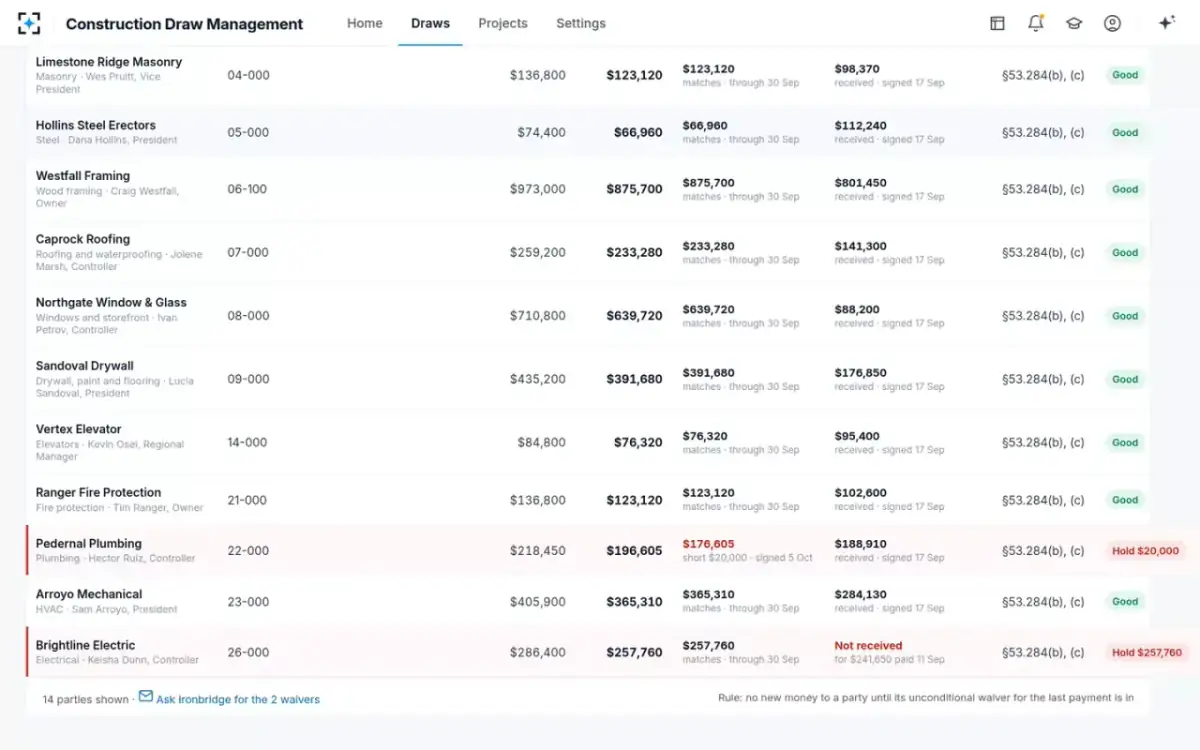
A lender that wants this check to run without a spreadsheet will find the tools compared, including what to look for in any of them, on lien waiver tracking software.
Questions people ask
Can you sign an unconditional lien waiver before payment?
A signer can, but should not, because it releases lien rights even if the payment never arrives. In Texas no one may require an unconditional waiver for a progress or final payment the claimant has not received in good and sufficient funds.
What is a final lien waiver?
A waiver on final payment releases lien rights for the whole job, including retention, which progress waivers exclude. The OCC lists obtaining all waivers or releases from contractors, subcontractors and suppliers among the checks before a lender releases the final draw and the holdback.
Does a conditional lien waiver protect the lender?
Only once the payment it names has cleared. Until then it is a promise, which is why the Texas form tells recipients to verify evidence of payment and why lenders pair it with last month's unconditional.
Who should give lien waivers on a construction draw?
The general contractor, every subcontractor paid from the draw, and suppliers above the lender's threshold. The OCC refers to waivers "from the project's subcontractors and suppliers"; the sample bank in Construction Draw Management asks suppliers for waivers above $50,000 in the period.
Is a lien release the same as a lien waiver?
In everyday use the terms overlap; Texas's statutory forms are titled "waiver and release." Elsewhere, a lien release often means a document discharging a lien already recorded, while a waiver gives up the right to file one.