Lien waiver tracking software keeps a list of every conditional and unconditional lien waiver a construction project needs, by party and by payment, and flags what is missing; the version a construction lender needs goes further and checks each waiver against the draw it supports before any money moves. That check is the difference between tracking and protection. A waiver that arrived but names the wrong amount, covers the wrong dates or is off the state's statutory form can leave the lien right alive, and a lender that funds against it can lose priority to a subcontractor it believed was paid. Botminds' Construction Draw Management gives the job to one agent, the invoice and waiver matcher, which reads every waiver in the package and holds the difference wherever the proof falls short.
The examples on this page come from a fictional sample loan run through the solution: Larkspur Commons, a mixed-use project in Austin, Draw 14 for $4,384,970 from general contractor Ironbridge Builders, with 14 paying parties and 27 of 28 waivers in the package.
How Construction Draw Management's waiver agent turns 28 waivers into two holds
Agent
Find the paid linesReads the G703 and each invoice: which subcontractor billed which line, and the payment due after retainage.
Never: Never alters a submitted figure.
Agent
Pair each party with two waiversA conditional waiver for this draw's payment, and an unconditional waiver for the payment it received last draw.
Agent
Read each waiver's five fieldsParty and signer, type, amount, through date, and whether the wording matches the statutory form.
Never: Never accepts a waiver off the statutory form.
Agent
Hold the shortfallA missing unconditional holds the party's new money; a short conditional is held at the difference. Each hold names the waiver that releases it.
A person decides
Administrator decidesReviews the two holds, asks the contractor for the waivers in one click, and signs the funding decision.
What is lien waiver tracking software? A list of waivers, or a check on each one
Lien waiver tracking software is any tool that keeps the expected waivers for each payment and shows which have been delivered; the products on the market split into two kinds. One serves the general contractor or owner collecting waivers from subcontractors so it can pay them. The other serves the lender, which has to decide whether a draw can be funded on the waivers it has. The two look alike on a screen and answer different questions.
A collection tool asks "has this sub sent its waiver?" A lender's check asks "does this waiver release the lien right for the money this sub has received, and for the money it is about to receive?" The second question needs the pay application, the invoices, the last draw's payments and the state's lien statute in the same place, which is why it is usually done by hand in a spreadsheet beside the draw.
What a construction lender's waiver check has to prove
The regulator's expectation is short. In a progress payment plan, "The construction draw request should include waivers from the project's subcontractors and suppliers indicating that payment has been received for the work completed," and before the final draw the bank should confirm "that the borrower has obtained all waivers of liens or releases from the project's contractors, subcontractors, and suppliers" (OCC, Commercial Real Estate Lending booklet). The OCC lists liens "filed by contractors, subcontractors, or material suppliers for nonpayment" among the main threats to a construction loan.
Two things follow for software. First, the unit is not the waiver but the payment: each paid line on each draw needs its proof. Second, the proof that matters most is backward-looking. The conditional waiver for this draw becomes effective only when the money clears; the unconditional waiver for the last draw is the evidence that the money the bank advanced last month actually reached the subcontractor. A tool that only tracks this month's conditionals tracks the half that protects the least.
The cost of skipping the check is not theoretical. In the Security Bank failure, which cost the deposit insurance fund about $807 million, the FDIC Inspector General found that the banks did not require contractors to consistently support draws with invoices and "did not obtain lien waivers from subcontractors" (FDIC OIG, MLR-10-020).
The five fields that make a lien waiver count
A waiver counts when five fields agree with the draw. The waiver agent reads each one and compares it with the pay application and the payment history, and a mismatch on any field is a hold, not a note.
Five fields on every waiver, and what each one is checked against
| Field | Checked against | What a mismatch means |
|---|---|---|
| Party and signer | The subcontractor billed on the G703 line and its invoice; the signer's authority | A waiver from the wrong entity, or signed by someone who cannot bind it, releases nothing. |
| Type | Conditional for this payment; unconditional for the last payment received; final at the end | An unconditional for money not yet paid is one the claimant cannot be required to give in Texas. |
| Amount | Payment due on the line after retainage, or the amount paid last draw | A waiver short of the payment leaves the difference lienable; it is held at the difference. |
| Through date | The pay application's period end | Work after the through date is not waived; a stale date leaves this period open. |
| Form | The state's statutory wording, where the state has one | In Texas a waiver that does not substantially comply with the statutory form is unenforceable. |
The form field is where hand review fails quietly. A waiver on a subcontractor's own letterhead that says the right things in its own words looks fine to a tired reader; under the Texas statute it does not release the lien. The agent compares the wording with the statutory text, which the bank selects per state in Settings. The difference between conditional and unconditional lien waivers, and when each is due, is set out on its own page.
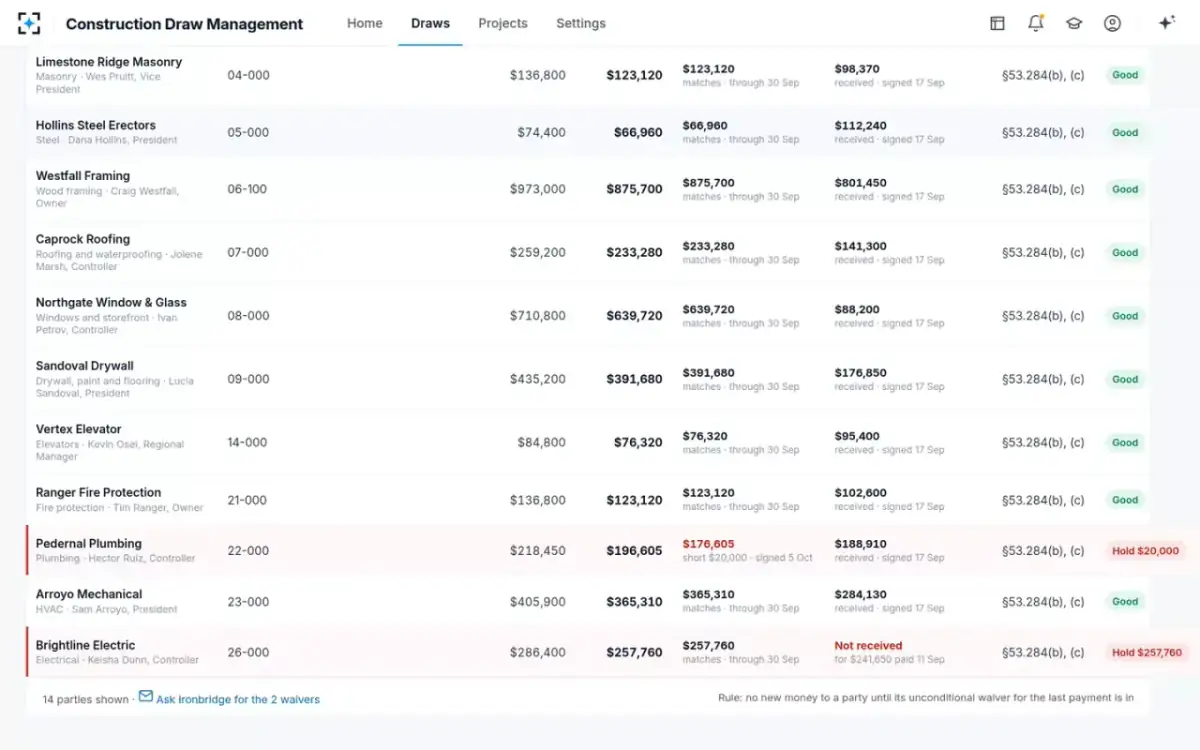
Lien waivers by party in Construction Draw Management: two of fourteen hold money
How do lenders check lien waivers against the payment? Two holds, worked
Lenders check a lien waiver against the payment by computing what the party is owed after retainage, comparing the waiver's amount and through date with it, and doing the same for last draw's payment and its unconditional waiver. The sample draw produces one of each kind of failure.
Two waiver failures on one sample draw, and the money each holds
$257,760
held from Brightline Electric: no unconditional waiver for the $241,650 paid last draw
$20,000
held from Pedernal Plumbing: its conditional waiver is short of the payment due
26
other waivers on the Texas statutory forms that match
Pedernal Plumbing, the short conditional. The G703 bills plumbing at $218,450 this period. Less 10% retainage, $196,605 is due. Pedernal's conditional waiver for Draw 14 reads $176,605. If the bank funds the full $196,605, $20,000 of payment is not covered by any waiver, and Pedernal keeps a lien right for it. The agent holds $20,000, and the hold releases when a corrected waiver for $196,605 arrives.
Brightline Electric, the missing unconditional. Brightline was paid $241,650 in Draw 13 on 11 September. No unconditional waiver for that payment has arrived, so there is no evidence the money reached it. Brightline bills $286,400 this period, $257,760 after retainage, and the rule the bank set is plain: no new money to a party until its unconditional waiver for the last payment is in. The whole $257,760 is held, and released automatically when the waiver for $241,650 arrives.
The two holds differ in kind. Pedernal's is a dollar mismatch on paper that will probably be fixed by a corrected form. Brightline's could be a sub that was not paid, which is the early sign of a general contractor diverting draws, and the reason the unconditional check runs first.
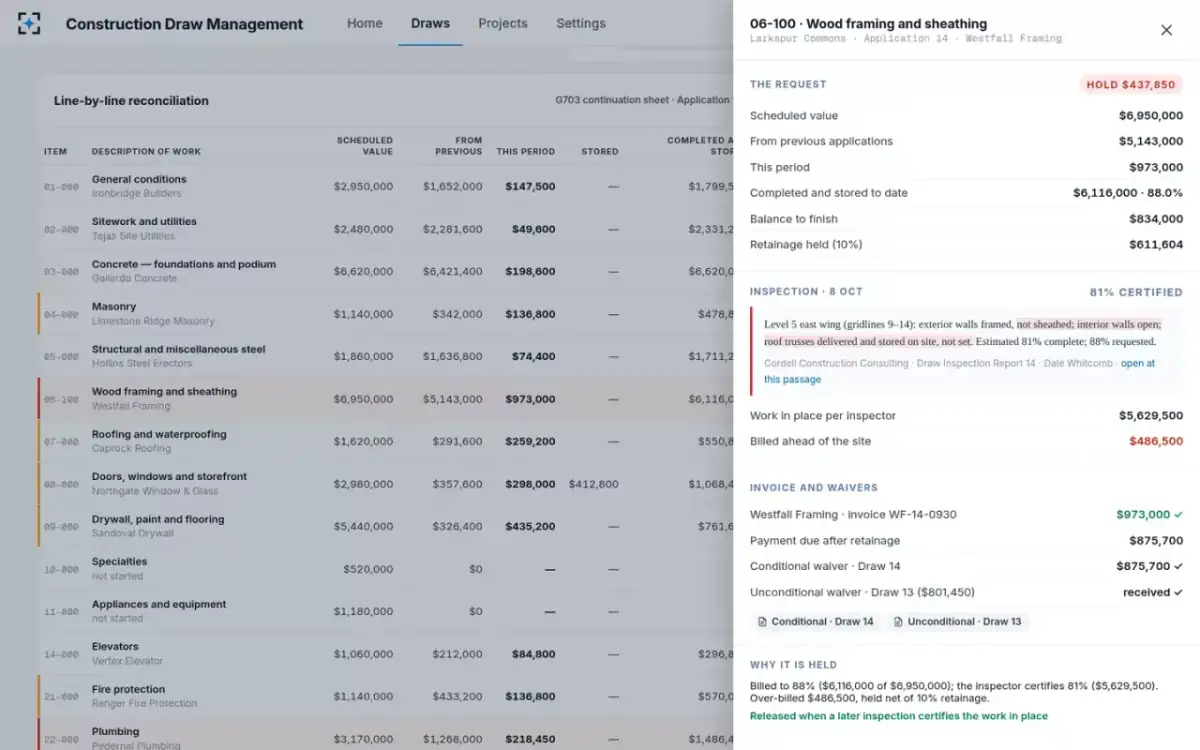
One line, all its proof: the G703 line, the inspection, the invoice and both waivers
Lien waiver tracking spreadsheet or software: where the spreadsheet breaks
A spreadsheet works for one project with a handful of subcontractors and a careful administrator. It breaks on volume, on the backward-looking check and on the form, and it breaks silently: nothing in a spreadsheet tells you the waiver in column G is on a non-statutory form.
Waiver tracking spreadsheet against a lender's waiver agent
Lien waiver tracking spreadsheet: One row per waiver received.
Waiver agent in the draw review: One check per paid line per draw: this payment and the last.
Lien waiver tracking spreadsheet: Typed in by hand; a $20,000 difference is easy to miss.
Waiver agent in the draw review: Recomputed from the G703 and retainage; a short waiver is held at the difference.
Lien waiver tracking spreadsheet: Often not tracked at all.
Waiver agent in the draw review: The unconditional for last draw is checked before any new money.
Lien waiver tracking spreadsheet: Not checked; depends on the reader knowing the statute.
Waiver agent in the draw review: Wording compared with the statutory form chosen for the state.
Lien waiver tracking spreadsheet: An email, written from scratch.
Waiver agent in the draw review: One request to the contractor naming each missing waiver and amount.
Lien waiver tracking spreadsheet: A tick in a cell.
Waiver agent in the draw review: A link to the waiver page, kept with the funding decision.
Who must sign a lien waiver, and how far down the chain to go
The party that holds the lien right signs the waiver: the general contractor, each subcontractor, and suppliers who furnished material, through an officer or authorized agent. Texas's statute, as amended from January 1, 2022, requires that the waiver be "signed by the claimant or the claimant's authorized agent" and no longer requires a notary (Tex. Prop. Code §53.281(b), as amended by HB 2237).
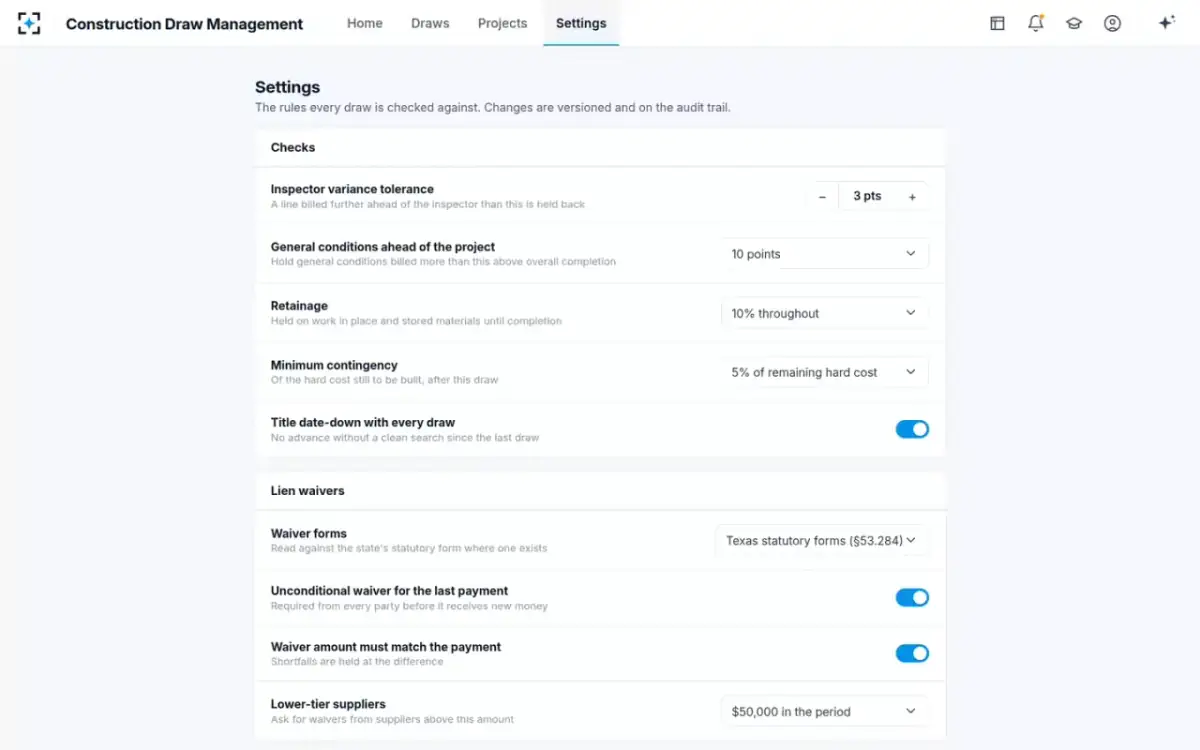
How far down the chain a lender goes is a policy choice. Federal guidance names subcontractors and suppliers but sets no dollar threshold, and lower-tier claimants (a supplier to a subcontractor) are the ones a general contractor's waiver does not cover. The sample bank asks for waivers from suppliers above $50,000 in the period; the threshold is a setting, and a lender in a state where suppliers' liens can prime the mortgage may set it lower.
The waiver rules are settings: form by state, last-payment rule, amount match, supplier threshold
What to look for in lien waiver tracking software, and where this one fits
For a lender, the test of a tool is whether it would have stopped the two sample holds without being told about them. The checklist below is what we would ask any vendor, including ourselves.
Eight questions to ask of any lien waiver tracking software
- Does it check last draw's unconditional before releasing new money?
The single most protective check, and the one most tools skip.
- Does it compute the amount owed after retainage, or trust a typed number?
A short waiver should be held at the difference automatically.
- Does it compare wording with the state's statutory form?
Ask which states it has forms for, and how a new state is added.
- Does it read through dates against the pay application period?
A waiver through last month leaves this month open.
- Can you set a lower-tier supplier threshold?
And see which suppliers crossed it this period.
- Does every hold name the document that releases it?
So the contractor knows exactly what to send.
- Can you open the waiver page from the exception?
An examiner will ask to see the waiver, not the tick.
- Does a person still sign the funding decision?
The software should hold and recommend; it should not approve.
Construction Draw Management fits the lender's side of that list: it reads waivers inside the draw review, alongside the inspection, budget and title checks, and recommends an amount for the administrator to sign. It is not a subcontractor payment portal and does not collect signatures from subs; contractors send waivers as they do today. Its statutory-form check covers the forms the bank configures, starting with Texas, and it reports differences rather than offering legal opinions on a waiver's effect. How the whole review behaves under deliberately planted errors is tested on our page on construction draw management software.
Why waivers and invoices are checked together
A waiver proves payment for the amount it names; it does not prove the amount was earned. That is the invoice's job, and the inspection's. In the Northern District of Texas, two developers on a $39 million Austin construction loan admitted conspiring to defraud the lenders, "with both Sarwal and Yeo submitting fake invoices to justify large draws from the construction loan," after drawing more than $33 million (US Attorney, N.D. Texas, 2013).
A waiver check alone would not have caught a fabricated invoice backed by a matching waiver from a cooperative party. The agent therefore ties every invoice to its G703 line and the line to the inspector's percent complete, so a waiver is only ever accepted for money that the site and the invoice both support.
Questions people ask
How do you track lien waivers on a construction project?
List every party that will be paid, then for each draw record the conditional waiver for this payment and the unconditional for the last, with amount, through date and form. A lender should check each against the pay application and hold any party's new money until its last-payment unconditional is in.
Is a lien waiver tracking spreadsheet enough?
For a small project with few parties it can be. It does not check amounts after retainage, last-payment unconditionals or statutory wording on its own, and those are the failures that leave a lien right alive.
Can software check whether a lien waiver amount is right?
Yes, if it reads the pay application. On the sample draw the agent computed Pedernal Plumbing's payment due as $196,605 ($218,450 less 10% retainage) and held the $20,000 its $176,605 waiver did not cover.
Do lien waivers need to be notarized?
It depends on the state. Texas removed the notarization requirement for statutory waivers from January 1, 2022; a waiver must still substantially comply with the statutory form and be signed by the claimant or its authorized agent.
What happens if a subcontractor never sends its unconditional waiver?
At the sample bank, its new money stays held, and the funding recommender names the waiver that would release it. A missing unconditional can mean a sub that was not paid, which is a question for the general contractor before it is a funding decision.