Does a mechanics lien take priority over a mortgage? Sometimes: it depends on the state, and on a construction loan the answer can change with every draw. The OCC's examiner handbook says it directly, "In some jurisdictions, mechanics liens can take priority over the bank lien," and the FDIC's manual adds that some states protect the construction lender only "to the point of first default, provided certain legal requirements have been met." For a construction lender that is the difference between a first-lien loan and an unsecured one for the amount a contractor or supplier was not paid. The defence is not a legal opinion at closing but a control on each advance: lien waivers for the money already paid, and a title search for anything recorded since the last draw. Botminds' Construction Draw Management runs both checks on every draw and will not recommend funding past a recorded lien.
Three ways a mechanics lien can sit against a construction mortgage
Lien law favours the trades
When it appliesThe state lets an unpaid contractor's or supplier's lien rank ahead of the construction mortgage, for example by dating it from the start of work.
Who is firstThe lien can come first for the amount unpaid.
The lender's defenceWaivers and a title date-down at every draw; a payment bond; title coverage for construction liens.
Lien law protects the lender to first default
When it appliesThe state protects the construction lender "to the point of first default, provided certain legal requirements have been met."
Who is firstThe mortgage keeps first position while the lender follows the statute.
The lender's defenceMeeting those requirements on every advance; advances after default may not share the protection.
First in time
When it appliesA perfected lien ranks after encumbrances already recorded, and ahead of later ones.
Who is firstThe mortgage comes first, but a lien recorded before the next advance can complicate it.
The lender's defenceNo advance past a lien found by the date-down; bond around it or clear it first.
Does a mechanics lien take priority over a mortgage? Sometimes, and state law decides
A mechanics lien is "a statutory security interest in real or personal property" that "secures payment for labor, materials, or services used to improve, repair, or maintain the property," and "A properly perfected mechanic's lien runs with the land and takes priority over subsequent encumbrances" (Cornell Legal Information Institute). The phrase that matters is subsequent encumbrances. When a lien is treated as arising, whether at the start of work on the site, at the delivery of materials, or at the date it is recorded, is a question each state answers in its own statute.
That is why the regulators speak in conditionals. The FDIC manual warns that "The construction lender may not be in the preferred position indicated by documents in the file. Laws of some states favor the subcontractors (materialmen's liens, etc.), although those of other states protect the construction lender to the point of first default, provided certain legal requirements have been met" (FDIC RMS Manual §3.2). A loan file that shows a first mortgage is a statement about the day the mortgage was recorded, not about the day of the fourteenth draw.
Why construction lenders carry this risk and other mortgage lenders mostly do not
A permanent lender funds once against a finished building. A construction lender funds in instalments against a building that people are still being paid to build, and every unpaid trade on the job holds a potential lien. Each draw is a fresh advance of money into that situation.
The OCC lists liens "filed by contractors, subcontractors, or material suppliers for nonpayment" alongside "Fraudulent diversion of construction funding draws" and "Loan administration errors" as threats to completion (OCC CRE booklet). The three are linked: a general contractor that diverts a draw leaves the subcontractors unpaid, the subcontractors file liens, and a lender that did not check last month's payment funds this month's draw into a project already encumbered.
Can a contractor lien a construction loan property, and who else can?
Yes. The general contractor, every subcontractor and, in most states, suppliers of materials can hold lien rights on the property they improve, whether or not the property is financed. The construction loan does not extinguish those rights; it is the thing they compete with.
The chain matters for a lender because the people most likely to go unpaid are furthest from the borrower. A sub-tier supplier to a subcontractor has no contract with the owner and may not appear on the pay application at all. That is why a lender's waiver rules usually reach past the general contractor to the subcontractors and, above a threshold, to their suppliers, and why the conditional and unconditional waivers each matter for a different payment, as set out in conditional vs unconditional lien waivers.
What happens if a lien is filed during construction?
When a lien is filed mid-construction, the next advance stops until the lien is cleared, bonded or otherwise resolved under the loan agreement, because funding past it risks putting new money behind it. On HUD-insured projects the rule is written down: the lender must "Ensure clear title before advancing the approved disbursement" and "Notify HUD in writing when clear title does not exist or is impaired by reason of mechanics liens unresolved for more than 60 days" (HUD MAP Guide 4430.G, §12.7.2).
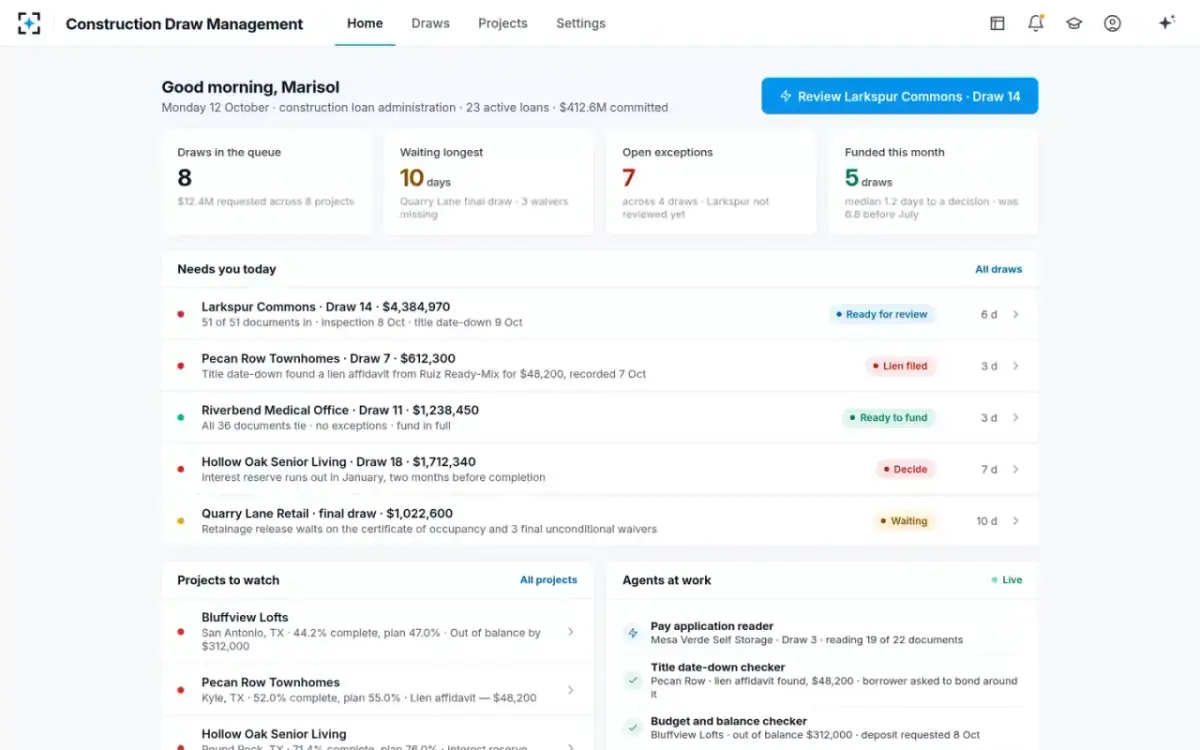
A sample case shows the sequence. On Pecan Row Townhomes, a fictional loan in the solution's sample book, the title date-down for Draw 7 found a lien affidavit for $48,200 from a ready-mix concrete supplier, recorded on 7 October. The $612,300 draw went to the administrator for a decision rather than to funding: the date-down checker stopped the recommendation, and the borrower was asked to bond around the lien before any money moved.
A lien affidavit found by the date-down, on the administrator's first screen
How do lenders protect against mechanics liens? The controls, draw by draw
Lenders protect against mechanics liens with controls that run on every advance, not just at closing. The OCC's list of effective controls starts with "segregation of duties, site inspections, lien searches before disbursement, budget monitoring, and dual approval of loan disbursements," and its disbursement section adds waivers with each draw request and a title update before each draw (OCC CRE booklet).
Seven controls that keep a construction lender ahead of mechanics liens
- A title date-down before every advance
The only check that sees liens recorded since the last draw.
- Conditional waivers for this payment
From the general contractor, each subcontractor and suppliers above the bank's threshold.
- Unconditional waivers for the last payment
Proof that last month's advance reached the people it was for.
- Statutory forms where the state has them
In Texas a waiver off the statutory form is unenforceable.
- Draws sized to inspected work
Money advanced ahead of the site is money that can be diverted.
- Retainage held to the end
The OCC describes a holdback of 10 to 20% to cover overruns or unpaid bills.
- All waivers and a final inspection before the final draw
The final payment, the OCC notes, usually waits until the mechanics lien period has run.
The date-down is the control lenders most often treat as routine, and it is the one that sees liens no waiver mentions. The date down endorsement on a construction loan covers what it finds, who orders it and what it costs.
What is a payment bond, and does title insurance cover mechanics liens?
A payment bond is a surety's promise to pay the subcontractors and suppliers if the general contractor does not, which removes their reason to lien the property. Title insurance can cover the lender against loss from construction liens, within the terms of the policy and its endorsements. The OCC names both as mitigants.
"A payment bond mitigates the risk of priority liens being recorded by insuring the payment of subcontractors and material suppliers. … Title insurance can protect the lender from losses due to fraud and construction liens."
OCC, Commercial Real Estate Lending booklet, version 2.0
Neither replaces the draw controls. The OCC notes that a bank's policy may require bonds on material projects where borrower and contractor are separate, but "a contractor related to the borrower cannot generally be bonded," which is exactly the case where diversion is easiest. Title coverage depends on the endorsement being issued for each advance, which in turn depends on the date-down being run. A lender that relies on either without the per-draw checks has insured the outcome it should be preventing.
A worked example: what one missing waiver exposes on a single draw
The cost of a missed waiver is easiest to see on one party. On the fictional Larkspur Commons Draw 14, Brightline Electric was paid $241,650 out of Draw 13 but has sent no unconditional waiver for it. Suppose the reason is the worst one: the general contractor kept the money.
Exposure on one subcontractor if last month's payment never reached it
| Step | What the lender knows | Amount with no waiver behind it |
|---|---|---|
| Draw 13 funded | Brightline's share was advanced to the general contractor. | $241,650 |
| Draw 14 requested | Brightline bills $286,400; $257,760 is due after 10% retainage. | $257,760 more if funded |
| Retainage on Brightline's line | Held by the lender, so not yet paid; progress waivers exclude it in any case. | Its full retained balance |
| If Draw 14 funds in full | Two months of Brightline's work paid to the contractor, none of it proven received. | $499,410 plus retainage |
| If the bank holds new money | Brightline's new money waits for the unconditional waiver for $241,650. | $241,650, already advanced |
The hold does not undo last month, but it stops the exposure doubling, and it turns a missing piece of paper into a question the general contractor has to answer before it receives any more money. In a state that favours the trades, that question is the difference between one month of unpaid work ranking ahead of the bank and two.
What examiners expect a construction lender to prove about liens
Examiners expect the lender to show, for each advance, that the people who did the work are being paid and that nothing has been recorded ahead of the next dollar. The OCC states the risk plainly: "A bank's failure to confirm that property taxes, property insurance premiums, and workers and suppliers are paid can threaten its collateral interests," and "failure to properly monitor construction progress and manage the disbursement of loan proceeds is a control weakness that increases the bank's credit risk" (OCC CRE booklet).
The examiner's questions then follow the controls. Is credit administration independent of the lenders who booked the loan? Does the bank require a line-item budget for each construction stage? Were liens searched before each disbursement, and was each disbursement approved by two people? State law changes how much a lapse can cost, depending on whether the trades or the construction lender rank first there, but it does not change the questions. Texas adds a requirement of its own on top: waivers that do not substantially follow its statutory forms are unenforceable, so the examiner's "were waivers obtained" becomes "were the right waivers obtained" there.
The cost of a miss: what the failures and prosecutions show
When draw controls lapse, the losses are measured in multiples of a single lien. The inspector general's review of the six Security Bank subsidiaries in Macon, Georgia, closed in July 2009 with about $807 million of estimated losses to the deposit insurance fund, found the controls that protect lien priority missing at the root.
"The Security Banks' management did not require general contractors to consistently provide invoices to support draw requests, and did not obtain lien waivers from subcontractors to illustrate that the individual or company completed the assigned project and that payment was received from the general contractor."
FDIC Office of Inspector General, Material Loss Review MLR-10-020
Money drawn before the problem surfaced, in three federal draw-fraud cases
Not every loss is a lien, and not every lien is a loss. But each of these cases ran through draw after draw before anyone stopped it, and each left unpaid trades with claims against the property. A lender in a state that favours the trades takes those claims ahead of its own collateral.
Where Construction Draw Management sits in the defence
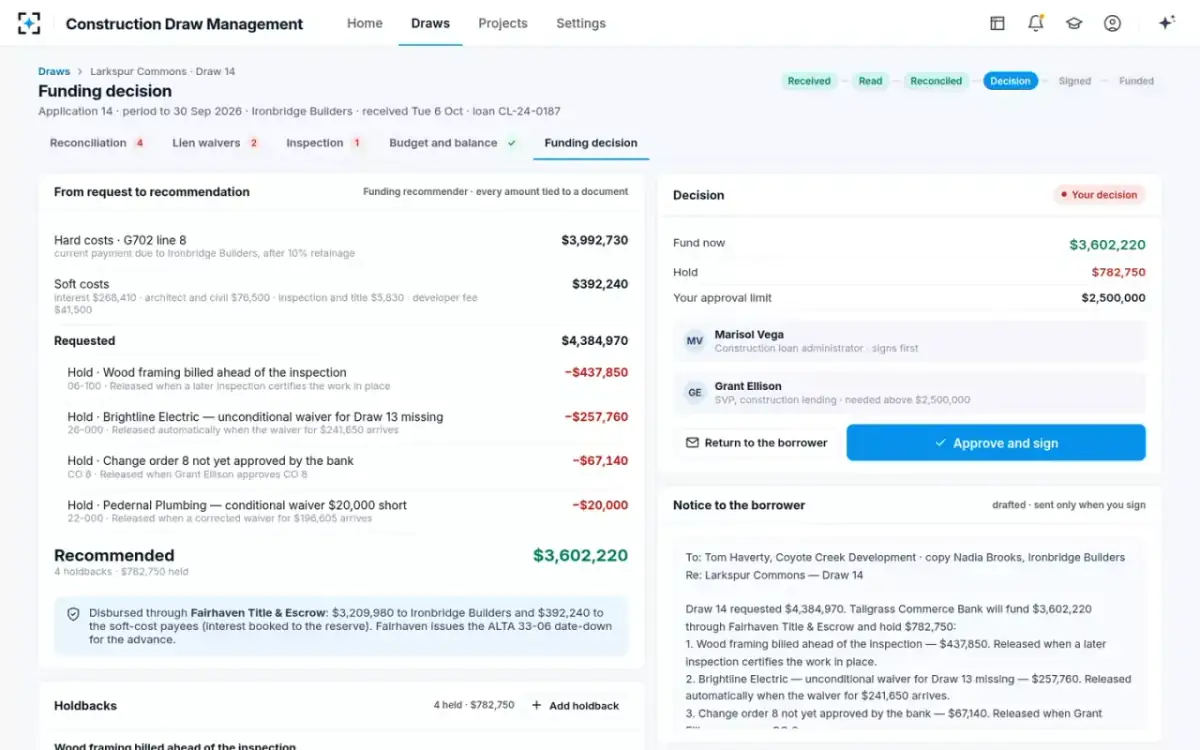
Construction Draw Management runs the per-draw controls and refuses the one shortcut that costs priority. Its title date-down checker reads the title company's search for liens, judgments and notices recorded since the last draw. Its invoice and waiver matcher holds any party's new money until the unconditional waiver for its last payment is in, and holds a short conditional at the difference. The funding recommender names the document that releases each hold, routes above the administrator's limit to a second signer, and never recommends funding past a recorded lien.
The funding decision in Construction Draw Management: each hold with its release
What it does not do is decide lien law. Whether a particular lien primes the mortgage in a particular state, and whether to bond, pay or contest it, are questions for the bank's counsel and the title company. The solution's part is to make sure no advance goes out before those questions are asked.
Questions people ask
Is a mechanics lien the same as a materialman's lien?
They are close relatives. Mechanics lien is the general term for liens securing payment for labour, materials or services that improve property; many states call the supplier's version a materialman's lien, and the FDIC manual uses both terms in the same breath.
Can a lien be filed after the building is finished?
Yes, within the period the state allows. That is why, under a standard payment plan, the OCC notes the final payment "is made only after the legally stipulated period for mechanics liens has expired," and why lenders collect final unconditional waivers before releasing retainage.
Does a lien waiver remove the priority risk?
Only for the amount and period it covers, and only if it is valid. A conditional waiver becomes effective when payment clears; an unconditional waiver for the last payment is the stronger evidence. In Texas a waiver that does not substantially follow the statutory form is unenforceable.
Do mechanics liens matter on HUD-insured construction loans?
Yes. The MAP Guide requires clear title before each advance and written notice to HUD when title is impaired by mechanics liens unresolved for more than 60 days.
Who checks for liens before each draw?
The title company runs the search and issues the date-down; the lender's construction loan administrator reads it before recommending the advance. The OCC lists "lien searches before disbursement" among the core controls for construction lending.