Front loading in construction is the practice of putting too much of the contract price on the work done early, such as site work, foundations and framing, and too little on the work done late, so the contractor is paid ahead of its real costs in the first months of the job. Every draw can look correct: the inspector certifies each early line as complete and the pay application bills each at its scheduled value. The problem surfaces at the end, when the money left in the loan is less than the cost of the work left to do. The OCC names it as a risk examiners should look for, because if a lender misses it early there will almost certainly not be enough left to finish the building after a default. Botminds' Construction Draw Management exposes it by comparing the percentage of the budget spent with the percentage of the building the inspector certifies, line by line and for the whole project, on every draw.
Same $10 million contract, two schedules of values: where the money sits
Scheduled at cost
- Early trades · 35%
- Middle trades · 40%
- Late trades · 25%
Front-loaded
- Early trades · 45%
- Middle trades · 38%
- Late trades · 17%
What is front loading in construction?
Front loading is an unbalanced schedule of values: the contractor's breakdown of the contract into lines assigns more value to early lines than they will cost, and less to late lines. Because every draw pays each line at its scheduled value times its percent complete, the contractor's cash runs ahead of its costs from the first draw. The OCC's examiner handbook defines it and states the consequence in two sentences.
"Examiners should be aware of the practice of front loading, whereby a builder deliberately overstates the cost of the work to be completed in the early stages of construction. If the bank does not detect front loading in the early stages of construction, there will almost certainly be insufficient loan funds to complete construction if there is a default."
OCC, Commercial Real Estate Lending booklet, version 2.0
Contractors give reasons for it that are not always bad faith: mobilisation costs, deposits on long-lead equipment, a need for working capital. The lender's concern is not the motive but the arithmetic. Money paid early against overvalued lines is money not available for the lines at the end.
Front loading vs overbilling: two problems that look alike
Front loading puts too much value on a line; overbilling bills a line further than the work has gone. They need different checks, and a review that catches one can miss the other completely.
Front loading and overbilling, side by side
Front loading: The schedule of values: column C of the G703.
Overbilling a line: The percent complete: column G against the site.
Front loading: At contract, before the first draw.
Overbilling a line: On any draw.
Front loading: Yes: the early lines really are complete.
Overbilling a line: No: the inspector certifies less than is billed.
Front loading: Budget review at closing; percent of budget spent against percent of building complete.
Overbilling a line: Line-by-line comparison of billed and inspected percent, with a tolerance.
Front loading: None on the sample loan: general conditions run 3.3 points ahead, inside a 10-point limit.
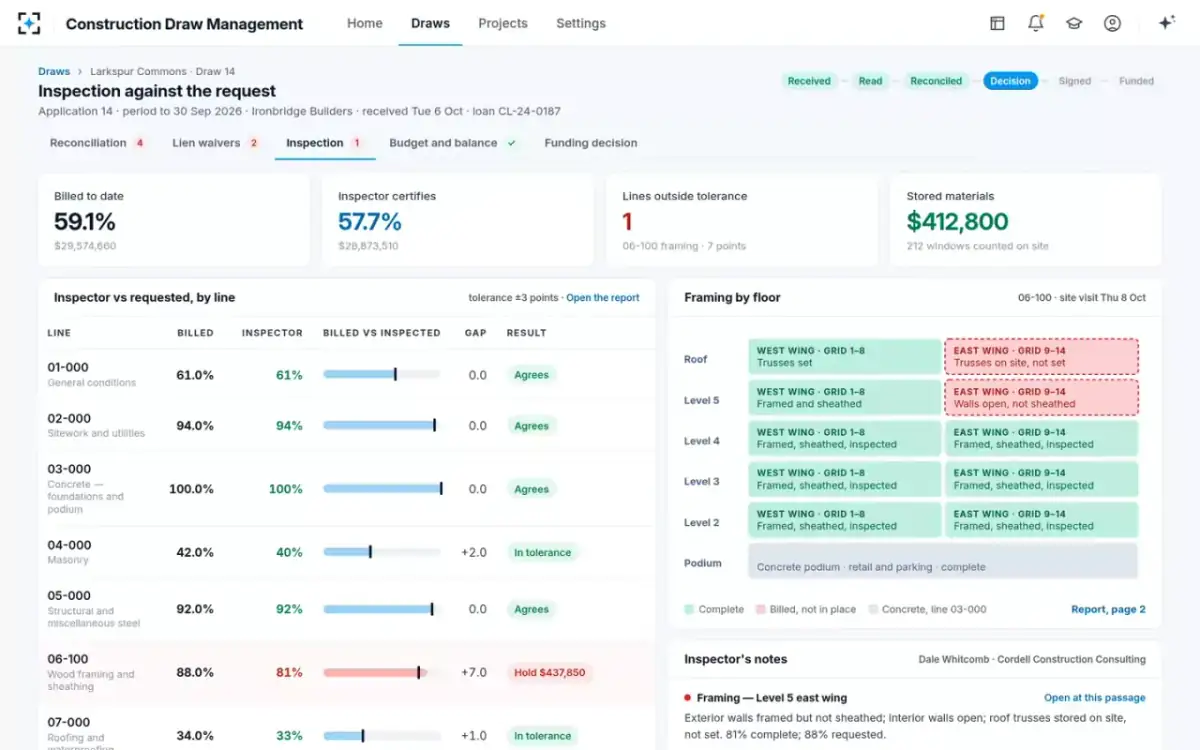
Overbilling a line: Wood framing billed 88% against 81% inspected: $486,500 ahead, held $437,850 net of retainage.
A front-loaded schedule of values, worked through to the shortfall
Take the illustration above. The real cost of the job is $3.5 million of early trades, $4.0 million of middle trades and $2.5 million of late trades. The front-loaded schedule values them at $4.5 million, $3.8 million and $1.7 million. Both total $10 million.
How front loading turns into a shortfall, step by step
| Point in the job | Calculation | Result |
|---|---|---|
| Early trades finished | Inspector certifies the early lines 100%; billed at scheduled value | $4,500,000 paid |
| Real cost of that work | Cost of early trades | $3,500,000 |
| Paid ahead of cost | $4,500,000 − $3,500,000 | $1,000,000 |
| Loan left for the rest | $10,000,000 − $4,500,000 | $5,500,000 |
| Real cost of the rest | $4,000,000 middle + $2,500,000 late | $6,500,000 |
| Shortfall if the contractor defaults now | $6,500,000 − $5,500,000 | $1,000,000 |
Nothing in that table would fail a line-by-line draw review. Every line was inspected; every line was billed at the inspected percent; the G703 footed. The $1 million appears only when the lender asks what the remaining work will really cost, which is the test the OCC sets for every draw: disbursements "commensurate with verified improvements" and a budget that "remains in balance with sufficient funds available to fund completion" (OCC CRE booklet, loan policies).
Why does front loading matter to lenders?
Front loading matters to lenders because it converts the loan's last dollars into the contractor's early profit, and the lender only finds out when it needs those dollars. If the job finishes, the contractor absorbs the imbalance and the lender may never notice. If it does not, the lender inherits a building whose remaining budget cannot buy its remaining work.
The FDIC lists the symptom among its examiners' warning signs for construction lending: "Periodic construction draws that exceed the amount needed to cover construction costs and related overhead expenses" (FDIC RMS Manual §3.2). It also bears on the contingency. The OCC says contingency allowances "usually range between 5 and 10 percent of the overall budget" and that overruns caused by "poor projections or management" should "ordinarily be covered by the borrower rather than by a draw-down on the loan amount budgeted for contingencies." A front-loaded job tends to burn contingency on what are really budget errors.
What happens when construction funds run short?
When construction funds run short, the loan is out of balance: the undisbursed loan plus any remaining equity no longer covers the cost to complete. The usual remedy is that the borrower deposits the difference before the next draw is funded; if it cannot, the lender faces a choice between advancing more money than it approved and stopping a half-built project.
The OCC warns against the quiet version of the first option on the interest line. When a budgeted interest reserve runs out, the bank may "increase, or repack, the interest reserve by extending additional debt to keep the loan current," which the OCC calls "a red flag indicating possible credit deterioration." HUD sets a numeric version of the same alarm on insured loans: the interest allocation is "over expended" when the percent spent "exceeds by 10% or more the percentage of completion" (HUD MAP Guide 4430.G, ch. 12). Both are the same comparison front loading needs: money spent against building built.
How to detect front loading: five comparisons
Front loading is detected by comparing money with progress at three levels: the schedule of values against independent cost at closing, the whole project's spend against its completion each month, and individual cost categories against the project. None of them needs special software; all of them need to be done on every draw.
Five comparisons that expose a front-loaded schedule of values
- Schedule of values against an independent cost review, before the first draw
The OCC expects a line-item budget reviewed by a qualified person; early lines well above their cost are the first sign.
- Percent of hard-cost budget billed against percent complete for the whole project
Each line can tie while the total runs ahead.
- General conditions against overall completion
A category that should track time and progress; a limit (such as 10 points ahead) catches it running early.
- Cost to complete against the undisbursed loan, by budget line, every draw
The in-balance test, on the remaining work rather than the remaining budget.
- Late-trade bids against late-trade scheduled values
If finishes, elevators or site restoration are bid above what is left for them, the money moved somewhere.
The first comparison matters most because it is the only one that can stop front loading before money moves. The scheduled values come from the contractor, and the G703's column C will reproduce them faithfully every month. A lender that accepts them at closing without a cost review has accepted the imbalance too.
Is front loading illegal?
No federal rule names front loading as an offence, and the OCC treats it as a risk for the lender to detect rather than a violation. It becomes a fraud question when a draw certifies work or costs that do not exist. The line is drawn by what the contractor certifies, not by how the schedule was priced.
The federal cases sit on the far side of that line. In Anchorage, a developer drawing on a $9.2 million construction loan for an 85-unit apartment project "submitted 12 draw requests certifying each time that certain work had been completed on the Bryn Mawr project, when actually, very little work had been done," and about $4.3 million was disbursed before he defaulted; he was sentenced to 36 months (US Attorney, D. Alaska, 2013). An independent inspection compared with each line would have shown the gap on the first of those draws; front loading, by contrast, passes inspection, which is why it needs the budget comparisons above.
A worked series of draws: the gap a front-loaded job opens
Front loading shows up as a gap between the share of the contract billed and the share of the real cost incurred, and the gap is invisible if progress is measured with the contractor's own schedule of values. Run the $10 million illustration through three draws and the problem becomes a number the lender can watch.
Three draws on the front-loaded $10 million job: billed against real progress
| Draw | Work certified in place | Billed to date (share of contract) | Real cost incurred (share of budget) |
|---|---|---|---|
| Draw 1 | Early trades 60% complete | $2,700,000 (27%) | $2,100,000 (21%), 6 points behind |
| Draw 2 | Early trades complete; middle trades 25% | $5,450,000 (54.5%) | $4,500,000 (45%), 9.5 points behind |
| Draw 3 | Middle trades 75% complete | $7,350,000 (73.5%) | $6,500,000 (65%), 8.5 points behind |
| After Draw 3 | Loan left: $2,650,000 | Cost left: $1,000,000 middle + $2,500,000 late | Short $850,000 |
The lesson is in the caption. If the lender measures percent complete by multiplying the inspector's line percentages by the contractor's scheduled values, it computes 27%, 54.5% and 73.5%, and every draw looks in balance. Only a budget the lender reviewed independently at closing, with its own cost per line, produces the right-hand column. HUD uses a 10-point gap between spending and completion as its trigger for an insured loan's interest line; a lender can apply the same kind of trigger to hard costs, but only if it has a cost basis of its own to measure against.
What inspectors general found when construction budgets ran short
When a front-loaded or overrun project runs short, the first casualty is usually the interest reserve, and failed-bank reviews show how long that can hide the problem. In the Security Bank failure, about $807 million to the deposit insurance fund, the FDIC Inspector General found that from late 2007 each of the six banks let borrowers keep using interest reserves despite problems such as a delayed or stopped project, a practice that "masked weaknesses in the ADC portfolio by showing credits as current and performing" (FDIC OIG, MLR-10-020).
The inspector general's cross-cutting review drew the general lesson: "banks frequently relied heavily on interest reserves, which can mask loans that would otherwise be reported as delinquent and erode collateral protection," and some banks did not "track, monitor, and report on the use of interest reserves" (FDIC OIG, MLR-11-010). At Appalachian Community Bank, examiners found no formal way to track interest reserves at all; the spreadsheet the bank produced for its 2008 examination showed $51.8 million of loans with $6.2 million of documented reserves, and did not capture reserves funded but not formally documented (FDIC OIG, MLR-11-001).
The connection to front loading is the sequence. Money paid early against overvalued lines leaves the late lines short; the shortfall is covered for a while by contingency and the interest reserve; the loan stays current; and the lender learns the size of the hole when both are gone. The OCC's warning that "Refunding depleted interest reserves may indicate an underperforming construction process" is the late version of the signal a spend-against-progress comparison gives on the first draws.
How Construction Draw Management's draw review sees it
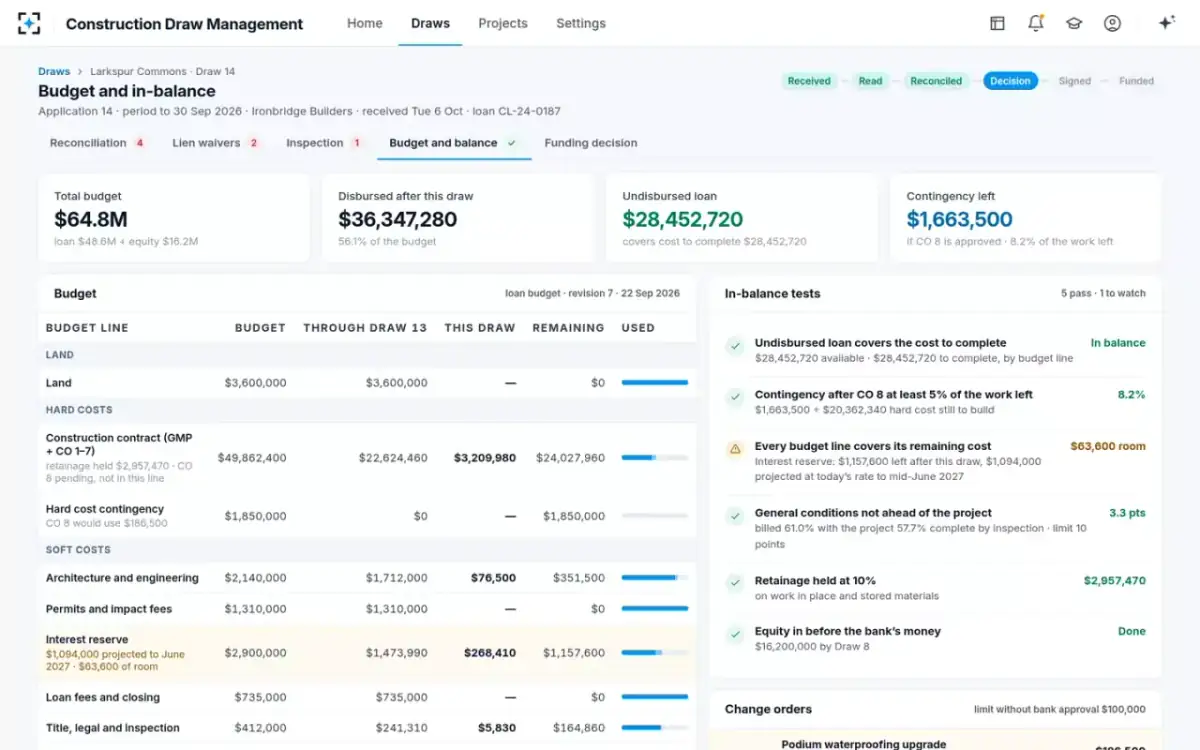
Construction Draw Management runs the line check and the project checks on every draw. The inspection reconciler compares billed with certified percent on each G703 line against the bank's tolerance, 3 points by default; the budget and balance checker compares spend with completion for the project and tests the budget for balance. On the sample draw the project is 59.1% billed against 57.7% certified, general conditions are 3.3 points ahead of the project against a 10-point limit, and the undisbursed loan of $28,452,720 covers the cost to complete.
Inspection against the request in Construction Draw Management: billed and certified, line by line
Budget and in-balance: spend against completion, contingency and the cost to complete
What the solution does not do is reprice the schedule of values. It cannot tell, from the draw package alone, that an early line was priced above its real cost; that judgement belongs to the cost review at closing and the inspector. What it does is make the comparison every month so a gap that widens draw after draw is visible early, and stop the recommendation the moment the loan falls out of balance. Seeded tests of that behaviour are described on our page on testing construction draw management software.
Questions people ask
What is a front-loaded schedule of values?
It is a breakdown of the contract price that assigns more value to early lines and less to late lines than they will actually cost. The total still equals the contract sum, so the pay application's arithmetic is unaffected.
Can an inspector catch front loading?
Not from a single visit, because front-loaded early lines really are complete when certified. An inspector or construction consultant who reviews the budget at closing can, and so can a lender that compares overall spend with overall completion every month.
How much front loading is too much?
No regulator sets a number. Lenders set their own tests, such as a limit on how far general conditions may run ahead of completion (10 points on the sample book) and a minimum contingency on remaining hard cost (5% on the sample book), and treat a project's spend running steadily ahead of completion as a warning.
Does retainage protect against front loading?
Partly. Retainage of 10% or more slows the cash the contractor collects ahead of cost, but it is released at the end and does not fix a budget whose remaining lines are too small for the remaining work.
Is front loading the same as overbilling?
No. Overbilling claims more of a line than is built and is caught by comparing billed with inspected percent. Front loading prices early lines too high, so the billing can match the inspection exactly while the budget still runs short at the end.