Construction draw management software takes a construction loan draw from the contractor's pay application to a funded advance, checking the G702 and G703, invoices, lien waivers, the inspection, the budget and the title date-down along the way; the way to choose one is to plant known errors in one of your own past draws and see which the tool finds. A demo on a vendor's clean data shows a workflow. A planted-error test shows whether the software protects the bank, because every error in it is one a regulator, an inspector general or a federal prosecutor has already described. Botminds' Construction Draw Management was built to be tested this way: six agents read the package, and every exception they raise cites the page it came from and the amount held for it.
The results quoted come from the solution's fictional sample loan, Larkspur Commons Draw 14 for $4,384,970, and two other sample loans in the same book. They show how to read a test, not how the software performed for any customer.
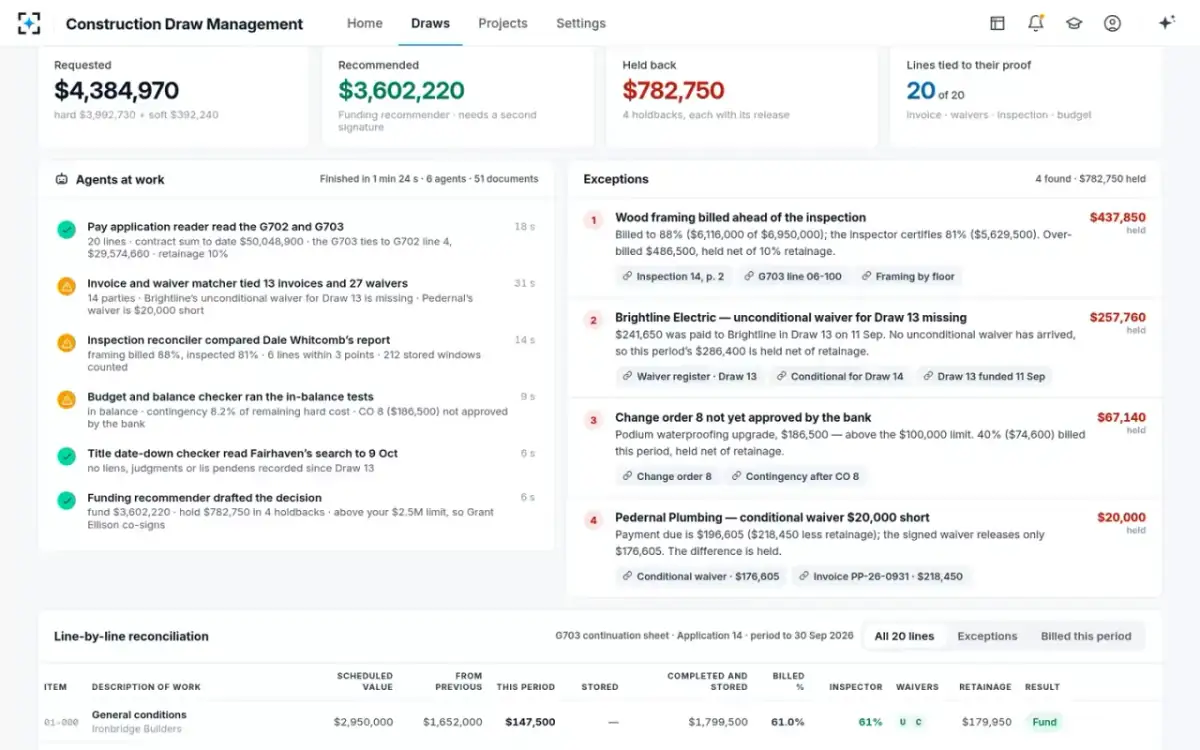
What four errors on one sample draw would have cost if funded
What is construction draw management software, and what must it prove?
Construction draw management software is the system a construction lender uses to receive, check and fund draws. Its job is set by the OCC's expectation for a lender's policy: "disbursement controls confirming construction draws are commensurate with verified improvements and that the budget remains in balance with sufficient funds available to fund completion" (OCC, Commercial Real Estate Lending booklet). Everything a tool does should trace to one of those two tests, or to the lien and title checks that protect the bank's position while it runs them.
Many products in the category are workflow tools: a portal for the borrower to upload the package, a queue, a checklist and a place to sign. Those are useful and solve the logistics. The harder half is the reading: whether line 06-100 on the G703 is ahead of the site, whether a waiver releases the amount it should. A planted-error test separates the two quickly, because a workflow tool will route a flawed draw to approval exactly as smoothly as a clean one.
The eight errors to plant, and where each comes from
Plant errors that have cost lenders money, not ones that are easy to see. Each of the eight below is described in an official source, and each needs a different document to catch.
Eight planted errors for a construction draw software test
| Planted error | Why it is in the test | What catching it requires |
|---|---|---|
| A G703 that does not tie to line 4 of the G702 | Arithmetic errors are the cheapest to catch and the most embarrassing to fund. | Recomputing every column, not reading the totals. |
| One line billed 7 points ahead of the inspector | The OCC names front loading as a draw-review risk. | Line-by-line comparison with the inspector's certified percent. |
| Last draw's unconditional waiver missing for one sub | The unconditional is the proof last month's money reached the sub. | Pairing this draw's parties with last draw's payments. |
| A conditional waiver $20,000 short of the payment due | The difference stays lienable. | Computing the payment after retainage. |
| A change order billed but not approved by the bank | An unapproved change moves money the loan agreement did not allow. | Reading the change-order log against the threshold. |
| An invoice for a cost never incurred | False costs are a recurring federal fraud pattern. | Tying each invoice to a line, a vendor and the site. |
| A lien recorded since the last draw | In some states a mechanics lien can prime the mortgage. | Reading the title date-down before funding. |
| A budget that no longer covers the cost to complete | Draws that pass their own checks can still leave the loan out of balance. | The in-balance test after every draw. |
The false-cost row comes straight from a prosecution. In 2025 a Kansas City developer was sentenced after he "executed and presented false and fraudulent draw requests to the financial institution, predicated in whole or in part upon false claims of incurred costs," totalling $652,784.34 (US Attorney, W.D. Missouri, 2025). The false-completion pattern is older: an Anchorage developer certified completed work on 12 draw requests when "very little work had been done," and about $4.3 million was disbursed before default (US Attorney, D. Alaska, 2013).
The FDIC's examiners put the general pattern on their warning-sign list: "Periodic construction draws that exceed the amount needed to cover construction costs and related overhead expenses" (FDIC RMS Manual §3.2). An overdrawn line is what most of the eight look like from the bank's side.
How to test construction draw software on your own draws
Use a draw the bank has already funded and closed, so the documents are real and nothing is at risk. Copy the package, plant the errors, and keep an answer key that a person outside the evaluation holds.
Running a planted-error test in nine steps
- Pick a funded draw with at least ten G703 lines and ten waivers
Smaller packages flatter every tool.
- Plant four to eight of the errors above
Not all of them: a reviewer who finds every planted error may be finding the ones you told them about.
- Change the amounts so the errors are not round numbers
A $20,000 shortfall is easier to spot than $19,370.
- Have the answer key held by someone outside the evaluation
The vendor and the evaluator see it only after scoring.
- Send the package as your borrowers send it
Scans, phone photos, mixed order. A tool that needs a clean upload has not been tested.
- Score catch, citation, amount and release separately
A caught error with the wrong hold amount is half a catch.
- Count false exceptions
A tool that flags everything is a tool the desk will learn to ignore.
- Time from complete package to recommendation
Measured on the same package for every tool.
- Repeat on a second draw with different errors
One draw is an anecdote.
How to score a draw review: catch, cite, hold, release
Score each planted error on four questions, because each one is a different failure. Catching an error but citing nothing leaves the administrator to redo the work; citing it but holding the wrong amount funds part of the error anyway.
A catch is four things, and a weak tool usually does only the first
Weak catch: A warning that something on line 06-100 looks high.
Full catch: Billed 88%, inspected 81%, 7 points against a 3-point tolerance.
Weak catch: No link, or a link to the whole inspection report.
Full catch: The inspector's passage on page 2 and the G703 line, one click each.
Weak catch: The line is flagged; the amount is left to the reviewer.
Full catch: $486,500 billed ahead of the site, held at $437,850 net of 10% retainage.
Weak catch: None stated.
Full catch: Released when a later inspection certifies the work in place.
Exceptions in Construction Draw Management: each with its amount, its source and its release
What errors do draw reviews miss most often?
Draw reviews most often miss the errors that need two documents read together: a waiver checked against last month's payment, or a G703 line checked against the inspector's page rather than the inspector's summary. The single-document errors, a total that does not foot or a missing signature, are usually caught by a careful person.
The FDIC Inspector General's review of the Security Bank failure names the three most consequential gaps together: no consistent invoices behind draw requests, no lien waivers from subcontractors, and inspections contracted to check only the current disbursement rather than the whole project. Each of those is a cross-document check, and each maps to a row in the test above.
Front loading is the hardest of all to catch in a single draw, because an overstated early line can still match the inspector if the schedule of values itself was inflated. How front loading works and how a draw review sees it covers the comparison that exposes it: percent of budget spent against percent of the building complete, over several draws.
How Construction Draw Management handled the sample draw
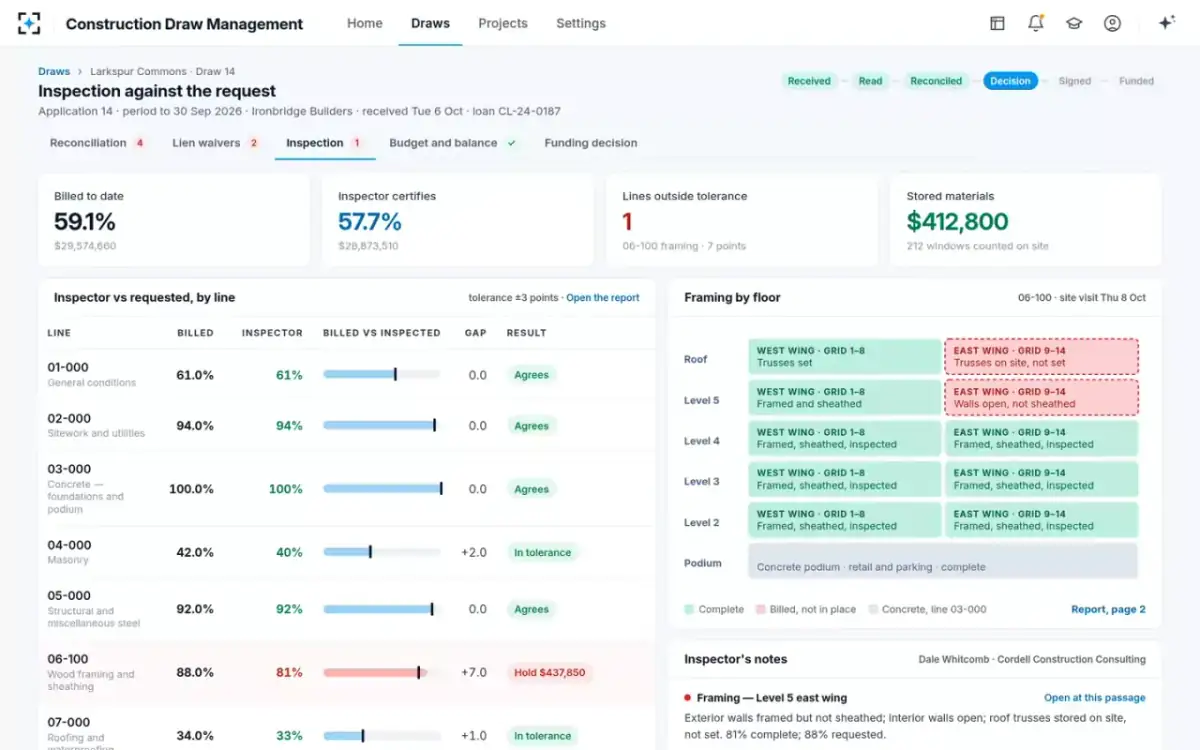
On the sample draw, the six agents each took one family of the checks above and reported as they ran. The pay application reader tied the G703's 20 lines to the G702 ($50,048,900 contract sum to date, retainage 10%). The invoice and waiver matcher tied 13 invoices and 27 waivers for 14 parties. The inspection reconciler found one line outside the 3-point tolerance and counted 212 stored windows on site. The budget and balance checker confirmed the loan in balance, and the title date-down checker found no liens since Draw 13.
Six agents at work on one draw package, each step shown as it runs
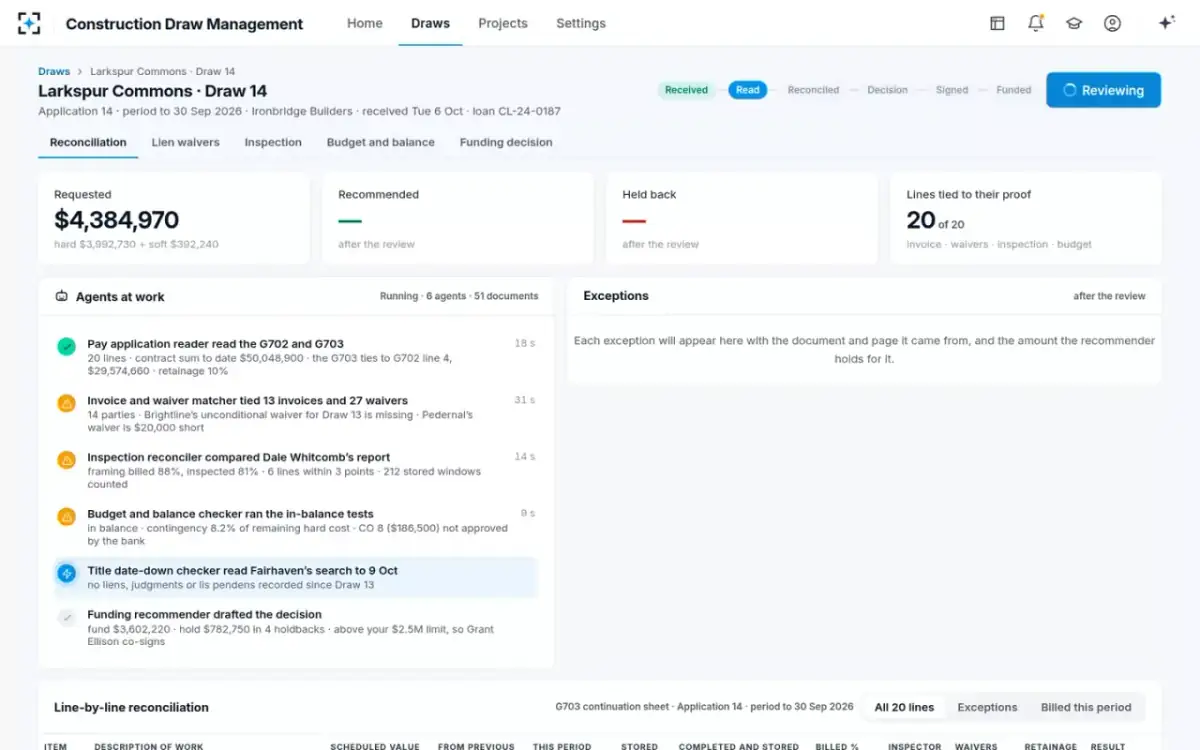
Two of the eight planted-error types did not occur on Draw 14 but did on other sample loans in the same book: the title date-down on Pecan Row Townhomes found a $48,200 lien affidavit from a concrete supplier, and Bluffview Lofts came up $312,000 out of balance. The recommender does not recommend funding past a recorded lien, and out of balance stops the recommendation outright.
Inspection against the request: one line outside the tolerance, held at the difference
Can software catch draw fraud, and does AI replace the draw inspector?
Software can catch the documentary signs of draw fraud: invoices that do not tie to a line or a vendor, waivers missing for money already paid, work billed ahead of what an independent inspector saw. It cannot see the site. A determined fraud with a cooperative inspector and forged waivers defeats any document review, which is why the OCC's controls start with segregation of duties and independent inspection.
Nor should it replace the inspector. Academic work on automated progress monitoring, such as the University of Illinois group that compares daily site photographs with the building model (RAAMAC lab, University of Illinois), is promising, but a bank's draw rests on a certified percentage from a qualified person. In the solution, that percentage is an input the agents compare with and never alter. The OCC's spring 2026 risk report describes banks adopting generative and agentic AI cautiously, in specific uses with guardrails and a person accountable for the outcome (OCC Semiannual Risk Perspective, Spring 2026), which is the shape a draw review should take.
What to look for when you buy, and where the fit ends
Buy on the planted-error score, then on fit with how the desk works. The questions that matter after the test: whether the bank's own tolerances, retainage schedule, change-order threshold and approval limits are settings rather than code; whether every exception opens its source page; whether the tool reads the bank's own draw request form as well as the AIA forms; and whether a named person signs every funding decision.
Construction Draw Management reads AIA G702 and G703 or the lender's own form, ties every line to its proof, recommends an amount with each holdback and its release, and routes above the administrator's limit to a second signer. It does not replace the inspector, the title company or the borrower portal a bank may already use, and it does not move money. The design target is every line tied to invoice, waivers and inspection before money moves, and a signed decision within a business day of a complete package. The pilot that proves those targets on a bank's own history is described on the construction loan administration software page, and the waiver agent in depth on lien waiver tracking software.
Questions people ask
How is construction draw management software different from a borrower portal?
A portal collects the package and routes it. Draw management software also reads it: recomputes the G703, ties invoices and waivers, compares the inspection and tests the budget. Many banks run both, with the portal feeding the review.
Is construction loan draw software for banks different from software for builders?
Yes. A builder's tool prepares pay applications and collects waivers from subcontractors; a bank's tool decides whether a draw can be funded. The bank's version has to answer the OCC's two tests, verified improvements and a budget in balance, for every advance.
How many planted errors are enough for a fair test?
Four to eight across two funded draws is a workable minimum. Fewer than four gives too few chances to miss; more than eight in one package starts to look unlike a real draw.
Does draw software need model risk validation?
The 2026 interagency model risk guidance (SR 26-2, OCC Bulletin 2026-13) puts generative and agentic AI outside its scope and excludes simple spreadsheet arithmetic, and the agencies have said they will ask for comment on AI separately. Banks still apply third-party risk management and their own controls, and a planted-error test is good evidence for both.
What should a draw review never do on its own?
Approve or move money, change the inspector's certified percentage, or move funds between budget lines. In Construction Draw Management those limits are built into the agents, and the administrator signs every decision.