Construction loan draws work as a series of advances, each one paying for work already in place: the general contractor submits a pay application for the period, an independent inspector certifies how much is built, the lender checks invoices, lien waivers, the title and the budget, holds back a percentage as retainage, and funds the rest, usually once a month until the building is finished. The bank does not hand over the loan amount at closing because the collateral does not exist yet; each draw buys a little more of it. The hard part is that every draw needs the same proof assembled from a dozen sources while the contractor waits for cash. Botminds' Construction Draw Management reads the whole draw package when it is complete, ties every line to its proof and recommends an amount for the lender's administrator to sign.
An illustrative 18-month construction loan: what each stretch of draws must clear
- Equity in first2 months
- Site work and slab draws2 months
- Monthly building draws, retainage held12 months
- Final draw: waivers, final inspection, certificate of occupancy2 months
How do construction loan draws work? The short version
A draw is the contractor's monthly bill, proven and paid. The OCC states the principle every commercial draw follows: whatever payment plan the bank uses, it "should be structured so that the amount of each construction draw is commensurate with improvements made as of the date of the inspection or certification provided by the bank" (OCC, Commercial Real Estate Lending booklet). Money follows the building, never leads it.
Two other rules frame every draw. The budget must stay in balance, meaning the undisbursed loan plus any remaining equity covers the cost to complete; and the bank's lien must stay first, which is what waivers and the title date-down protect. The FDIC's examiners treat the opposite as a warning sign: "Periodic construction draws that exceed the amount needed to cover construction costs and related overhead expenses" (FDIC RMS Manual §3.2).
The commercial construction loan draw process, step by step and owner by owner
A commercial draw passes through five hands before the money moves, and the order matters: the inspection and title results have to be in before the lender can recommend anything.
One commercial draw, from pay application to wire
A person decides
Contractor and borrower submitThe pay application (often AIA G702 and G703), invoices, conditional waivers for this payment, unconditional waivers for the last, change orders and the borrower's certification.
A person decides
Inspector visits the siteCertifies percent complete by line, counts stored materials and notes defects or delays.
Agent
Lender checks the packageRecomputes the pay application, ties invoices and waivers, compares the inspection, tests the budget and reads the title date-down; recommends an amount with holdbacks.
Never: Never alters a submitted figure or a certified percentage.
A person decides
Administrator and approver signThe administrator decides within her limit; above it, a lending officer co-signs.
A person decides
Title company disbursesUpdates the title for the advance and pays the contractor and soft-cost payees.
The borrower's certification is easy to overlook and carries weight. Under a progress payment plan, the OCC notes, "The borrower also certifies that the conditions of the loan agreement have been met, e.g., all requested funds are being used for the project and that suppliers and subcontractors have been paid." Certified draw requests are the statements federal prosecutors have charged as false in draw-fraud cases, and a certification that subcontractors were paid is only as good as the waivers behind it.
What documents are needed for a construction draw?
A complete construction draw package has seven kinds of document, and the contractor's clock usually starts only when the last of them arrives. Missing waivers are the most common reason a package sits incomplete.
The documents in a commercial construction draw package
| Document | Who provides it | What the lender checks |
|---|---|---|
| Pay application (G702 summary, G703 continuation sheet, or the lender's form) | General contractor, signed by the borrower | Arithmetic, the tie of the detail to the summary, retainage, change orders billed. |
| Invoices | General contractor, subcontractors, soft-cost vendors | Each billed line has a real vendor and cost. |
| Conditional lien waivers for this payment | GC, subcontractors, suppliers | Party, amount after retainage, through date, statutory form. |
| Unconditional lien waivers for the last payment | GC, subcontractors, suppliers | Last month's money reached the people it was for. |
| Inspection report | Lender's inspector or construction consultant | Percent complete by line; stored materials; notes. |
| Change orders | Contractor and owner | Approved by the bank where above the loan agreement's threshold. |
| Title date-down | Title company | No liens, judgments or notices recorded since the last draw. |
Each document has its own page in this series: pay app review for construction lenders goes through the G702 and G703 column by column, and conditional vs unconditional lien waivers explains which waiver covers which payment.
What is retainage, and how much does the lender hold?
Retainage is the share of each payment held back until the project is finished, to cover overruns and unpaid bills and to keep the contractor motivated to finish. The amounts differ by source, and the differences matter on a large loan.
Retainage held on each payment under three official descriptions
On the fictional Larkspur Commons loan in the solution's sample book, retainage is 10% throughout, and $2,957,470 was held by Draw 14. The final draw usually releases it, once the waivers and final inspection are in.
Construction draw schedule: standard payment plan or progress payment plan?
A construction draw schedule follows one of two plans, and the choice depends on the project. The OCC describes a standard payment plan, "normally used for residential and smaller commercial construction loans," which pays fixed amounts at agreed stages; for residential construction it "most commonly consists of five equal installments." A progress payment plan, "normally used for commercial projects," pays monthly for work completed, less the holdback.
A third method sits beside them. Some banks pay "on a voucher basis whereby each bill or receipt is presented and either paid or reimbursed by the lender," which the OCC says "can increase the lender's administrative control but can also increase the lender's administrative burden." Most commercial lenders use the progress plan and recover the control a voucher basis would give by checking invoices and waivers line by line.
Is flood insurance needed before the first construction draw?
Yes, for a building in a special flood hazard area, before any money is advanced for building construction. The 2022 interagency questions and answers allow a lender to defer the policy at origination, but "the lender must require the borrower to have flood insurance for the security property in place before the lender disburses funds to pay for building construction (except for funds to be used to pour the slab or perform preliminary site work, such as laying utilities, clearing brush, or the purchase and/or delivery of building materials)" (Interagency Questions and Answers Regarding Flood Insurance, 2022).
Timing makes it a practical trap. Because the NFIP has a 30-day waiting period, a lender that defers the purchase should have controls "to ensure that the borrower obtains flood insurance no later than 30 days prior to disbursement of funds." A draw schedule that does not mark the first building draw a month ahead can stop a project for want of a policy.
How long does a construction draw take?
No regulator or official survey measures how long a commercial draw takes from complete package to funding, and figures quoted online come from vendor surveys. What can be said is what sets the clock: the inspection visit (HUD requires one site visit a month on new construction), the title date-down, the arrival of the last waiver, and how long the lender's checking takes once all of it is in.
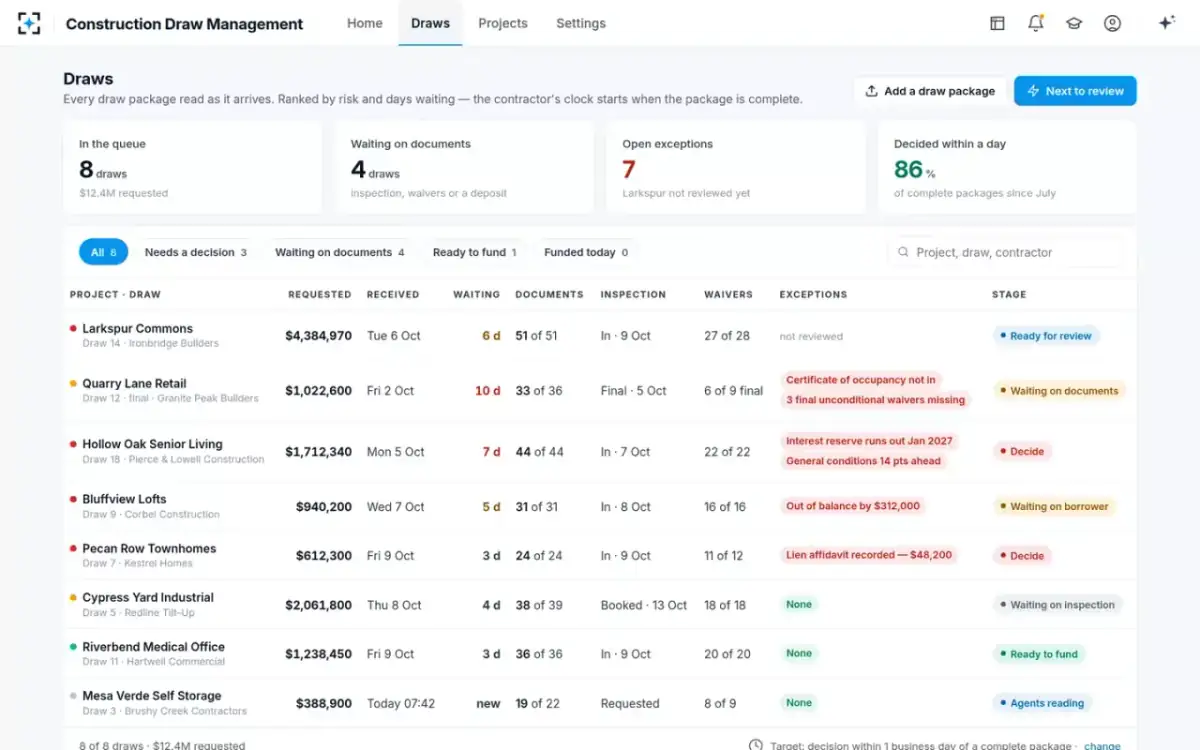
The checking is the part a lender controls. In Construction Draw Management the clock starts when the package is complete, six agents read it, and the design target is a signed decision within one business day. On the fictional sample draw, the agents read 51 documents in 1 minute 24 seconds; the rest of the day is the administrator's review and, above her limit, the second signature.
The draw queue in Construction Draw Management: every draw by risk and days waiting
Who pays the contractor on a construction loan?
The lender funds the draw, but the money usually reaches the contractor through the title company or directly from the bank, after the title is updated for the advance. On the sample draw, Fairhaven Title & Escrow receives the funds, pays the general contractor and the soft-cost payees, and issues the date-down endorsement for the advance. Paying through title ties the disbursement to the title check: no clean search, no money.
The general contractor then pays its subcontractors, and their unconditional waivers for that payment arrive with the next draw. That is the loop the lender closes each month, and the reason the date-down endorsement on each construction draw and last month's unconditional waivers are checked together.
From the request to the amount to fund: each hold with the document that releases it
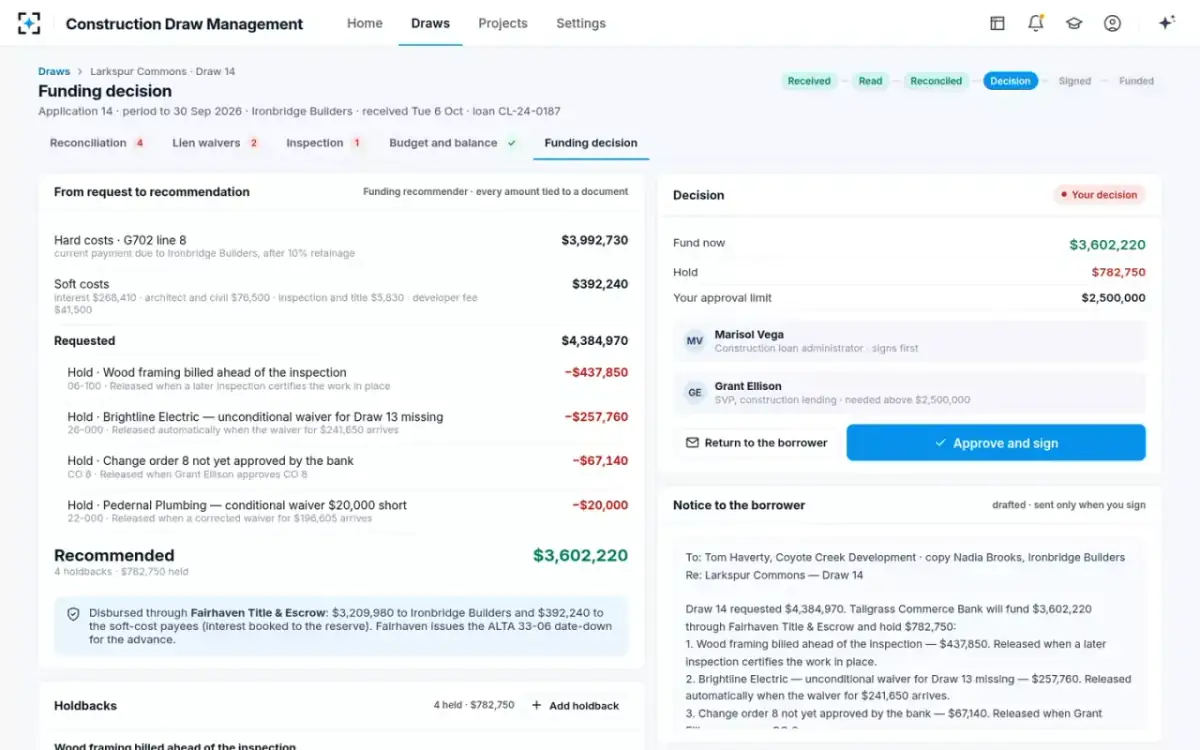
A worked draw: from the contractor's request to the amount wired
A worked draw shows how the pieces add up, because the amount a contractor asks for and the amount a lender wires are rarely the same. The fictional Larkspur Commons Draw 14 in the solution's sample book runs from the G702's current payment due to the disbursement through the title company in six steps.
One sample draw, from G702 line 8 to the money that moves
| Step | Where the figure comes from | Amount |
|---|---|---|
| Hard costs requested | G702 line 8, current payment due after 10% retainage | $3,992,730 |
| Soft costs requested | Interest $268,410, architecture and engineering $76,500, inspection and title $5,830, developer fee $41,500 | $392,240 |
| Total draw requested | Hard plus soft costs | $4,384,970 |
| Holds | Framing ahead of the inspection $437,850; missing unconditional waiver $257,760; unapproved change order $67,140; short conditional waiver $20,000 | −$782,750 |
| Recommended | Request less holds, each hold naming the document that releases it | $3,602,220 |
| Wired through the title company | To the general contractor $3,209,980 (line 8 less holds); to soft-cost payees $392,240, interest booked to the reserve | $3,602,220 |
Three things in that table are worth noticing. Retainage has already come off before the lender starts: line 8 is net of the 10% held, so the holds are computed net of retainage too. The holds are not a rejection of the draw; 82% of the request funds the same day, and each held dollar has a named release. And the interest line is real money only on paper: it moves from the interest reserve in the budget to the loan balance, which is why the reserve has to be watched against the time left to finish.
What examiners look for in a construction draw file
Examiners judge a draw by whether the file shows the controls, not by whether the project finished. The FDIC's manual describes a sound construction loan as one that "should be controlled by supervised disbursement of a predetermined sum of money," and lists the documents its examiners expect in commercial construction files: "loan agreements, takeout commitments, tri-party (buy/sell) agreements, completion or corporate bonds, and inspection or progress reports" (FDIC RMS Manual §3.2). The OCC's procedures add the controls themselves: site inspections, lien searches before disbursement, budget monitoring and dual approval.
The inspector general's reviews of failed banks show what happens when the file is thin. First Lowndes Bank in Fort Deposit, Alabama, closed on March 19, 2010 with $133.5 million of assets and an estimated loss to the deposit insurance fund of $35.3 million. Examiners had noted "Significant loan administration deficiencies" including "construction loan draws," and the inspector general found the loan policy lacked even the basic step:
"Procedures for authenticating draw requests for construction loans. Normal and customary procedures include obtaining copies of third-party vendor invoices and lien waivers and performing site inspections before funds are released."
FDIC Office of Inspector General, In-Depth Review of First Lowndes Bank, MLR-11-006
The sentence is a fair one-line summary of every draw on this page: invoices, waivers and an inspection, before the money moves. The same review found the bank's "construction inspection procedures were deficient." A bank whose draws are checked the same way every time, with the evidence kept beside the decision, has the file an examiner wants to see.
The final draw: three checks before retainage is released
The final draw is different because it releases the holdback, the lender's last leverage. The OCC lists the controls that should come first.
Before the final draw releases the retainage
- All waivers of liens or releases are in
"from the project's contractors, subcontractors, and suppliers", usually final unconditional waivers.
- The final inspection report confirms completion
That the project "is complete and meets building specifications".
- The certificate of occupancy has been issued
"from the governing building authority".
Questions people ask
How often are construction draws taken?
On commercial loans, usually monthly under a progress payment plan; the FDIC describes "monthly disbursements totaling 90 percent of the value." Residential loans on a standard plan draw at stages, most commonly five equal instalments according to the OCC.
What is a draw inspection?
A site visit by the lender's inspector or construction consultant before each draw to certify how much of each line of work is complete. The OCC says inspection reports "support disbursements typically based on percentage complete" and state whether the project is progressing as anticipated.
Does the borrower pay interest on the whole construction loan?
Interest accrues on the amount drawn, which is why the balance and the interest cost rise through construction. Many construction budgets fund that interest from an interest reserve line, which the OCC says should cover interest through completion and lease-up.
Can a draw be partly funded?
Yes, and most problem draws are. The lender funds what the proof supports and holds the rest: on the sample draw, $3,602,220 of a $4,384,970 request was recommended, with four holds each released by a named document.
What is a construction draw request form?
It is the borrower's and contractor's request for an advance, setting out the amount by construction phase and cost category with a certification that loan conditions are met. Many lenders accept the AIA G702 and G703; others use their own form, and HUD-insured loans use form HUD-92403.