Construction loan administration comes down to one duty: no construction loan dollar leaves the bank until the administrator has proven that it pays for work in place, owed to people who have been paid for the last draw, on a loan that still has enough money to finish. In practice that means reading the contractor's AIA G702 and G703 pay application, reconciling it to the inspector's percent complete, checking every lien waiver and the title company's date-down, testing the budget for balance and writing a funding recommendation for an approver. It is hard because a single draw on a mid-size project can run to fifty documents and a dozen subcontractors, and the contractor is waiting for cash the whole time. Botminds' Construction Draw Management exists to do the assembling and tying-out so the administrator spends the day on the decision.
The examples come from a fictional sample book run through the solution: Marisol Vega, an administrator with 23 construction loans and $412.6 million committed, reviewing Draw 14 on Larkspur Commons, a mixed-use project in Austin. The rules come from the OCC, HUD and the FDIC, linked where they appear.
Five seats touch every draw, and only one of them assembles the proof
Today
Logs the package, chases missing documents, ties the G703 to invoices, waivers and the inspection by hand, tests the budget and writes the recommendation.
With agents
Opens a draw already tied out line by line, with each exception and its source page, and spends the time on what to fund and what to hold.
Still theirs: The recommendation and her signature, up to her limit.
Today
Visits the site, certifies percent complete per line and counts stored materials; the report is then compared with the G703 by hand.
With agents
The certified percentages are what each line is funded on; notes such as damaged work become holdbacks with a release.
Still theirs: The percent complete. Nobody downstream edits it.
Today
Runs the date-down search since the last draw and issues the endorsement before the advance.
With agents
The search result is read against the draw the same day; a new lien stops the recommendation.
Still theirs: Clear title, and the disbursement itself where the title company funds.
Today
Co-signs draws above the administrator's limit and asks what was held and why.
With agents
Sees the request, each holdback with its reason and release, and adds the second signature.
Still theirs: Authority above the limit.
Today
Answers for draw turnaround and for any line funded ahead of the site.
With agents
Sets tolerances, limits and waiver rules once; sees progress, draws and holds across every project.
Still theirs: The policy the desk applies.
What does a construction loan administrator do? The OCC's control list, as a seat
A construction loan administrator runs the controls between a signed construction loan and each dollar advanced under it. The clearest statement of those controls is not a job board; it is the OCC's examiner handbook, which a bank's own procedures usually mirror.
"Effective controls include segregation of duties, site inspections, lien searches before disbursement, budget monitoring, and dual approval of loan disbursements."
OCC, Commercial Real Estate Lending booklet, version 2.0
Read as a list of duties, that sentence has five verbs in it. The administrator keeps the duties separate (she does not originate the loans she disburses), confirms an inspection supports the amount, confirms no lien was filed since the last advance, keeps the budget in balance, and prepares the disbursement for two approvals. Everything else on a typical posting, from the draw calendar to the borrower notice, hangs off those five.
The bank's policy states the outcome the controls must deliver. The OCC expects a construction lender's policy to include "disbursement controls confirming construction draws are commensurate with verified improvements and that the budget remains in balance with sufficient funds available to fund completion" (OCC CRE booklet, loan policies). Commensurate with verified improvements is the inspection test; in balance with funds to complete is the budget test. An administrator who can show both, line by line, for every draw, is doing the job.
Construction loan administration duties, draw by draw
The duties repeat every month on every loan, in roughly the same order. The list below gives the reason each duty exists, so the desk and the credit officers above it can see what the work protects against.
Twelve construction loan administration duties, and what each protects against
- Log the draw package and confirm it is complete
Pay application, invoices, conditional and unconditional waivers, inspection report, change orders, date-down. The contractor's clock usually starts when the package is complete.
- Recompute the G702 and G703
Every column and the tie of the continuation sheet to the summary. An arithmetic gap is a question before it is a payment.
- Tie each billed line to its invoice
The OCC lists fraudulent diversion of draws among the main threats to completion.
- Check each waiver by party, amount, through date and form
Conditional for this payment, unconditional for the last one, on the statutory form where the state has one.
- Reconcile the inspector's percent complete to the billing
A line billed ahead of the site is held at the difference until a later inspection certifies it.
- Count stored materials against the loan agreement
Where they are, who owns them, whether they are insured.
- Confirm change orders billed are approved by the bank
Above the agreement's threshold, an unapproved change order is not fundable.
- Run the in-balance test
Undisbursed loan plus any remaining equity must cover the cost to complete, budget line by budget line.
- Watch contingency and the interest reserve
Both fall faster than completion when a project is in trouble.
- Read the title date-down
No advance past a lien recorded since the last draw.
- Recommend an amount with each holdback and its release
Every dollar held names the document that frees it.
- Route for signature and notify the borrower
Within the administrator's limit she signs; above it, an officer co-signs.
The draw itself is explained step by step in how construction loan draws work; this page stays with the people. What the list makes plain is that most of the hours go into the first ten items, which are matching and arithmetic, and the last two, which are judgement, get what time is left.
Who approves construction draws? Limits, dual approval and the second signer
The administrator recommends; a person with approval authority approves, and above a set amount a second person co-signs. That is the dual approval the OCC lists, and it follows the general model of lending authority: the Labor Department's task list for loan officers reads "Approve loans within specified limits, and refer loan applications outside those limits to management for approval" (O*NET 13-2072.00). Construction disbursement works the same way, with the limit set per advance rather than per loan.
HUD makes the signature explicit for insured multifamily construction. On interim advances under the MAP Guide, "The approved Lender's construction loan administrator must sign forms HUD-92403 and HUD-92448 in the Authorized HUD Official signature block," while the initial and final advances go to HUD's Regional Production Director (HUD MAP Guide 4430.G, §12.7). On those loans the administrator is not only preparing the advance; she is signing for the government insurer.
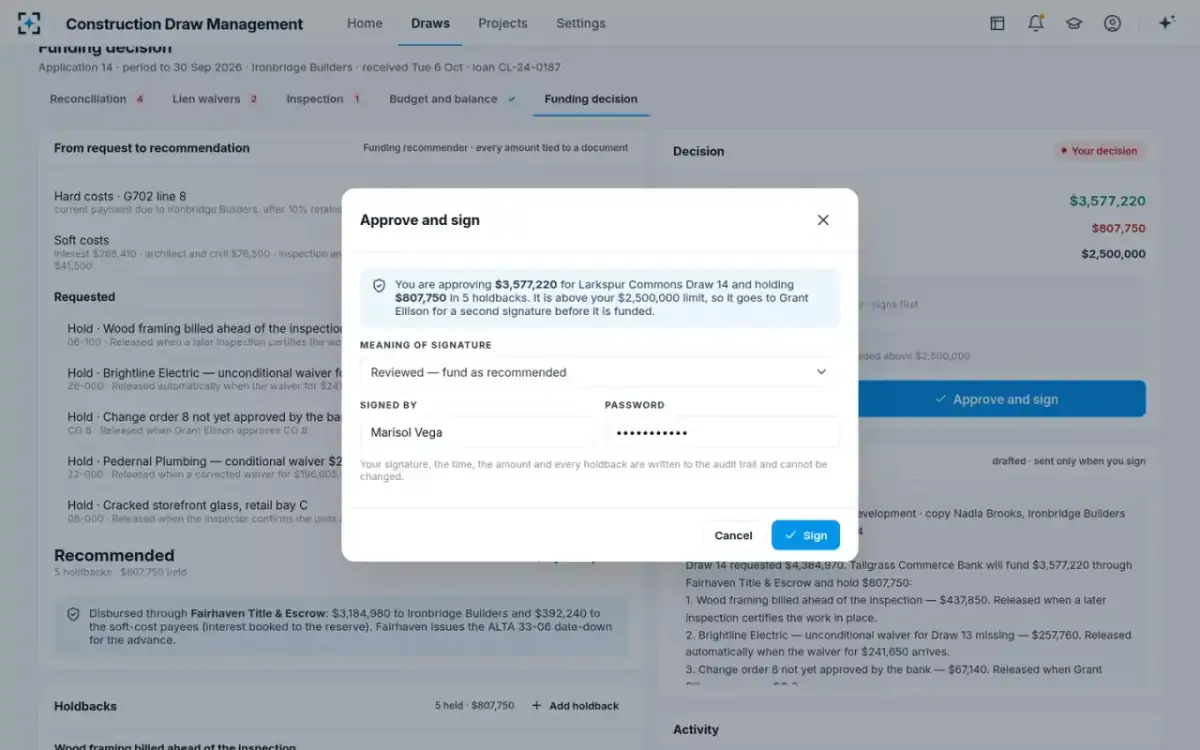
At the sample bank the limit is a setting. Marisol signs alone up to $2,500,000; Larkspur Commons Draw 14 recommends $3,577,220, so it goes to Grant Ellison, the SVP of construction lending, for a second signature before Fairhaven Title releases the money.
Approve and sign in Construction Draw Management: the second signer above the limit
What is a draw inspector, and why the administrator never edits the inspector's number?
A draw inspector is the engineer, architect or construction consultant who visits the site before each draw and certifies how much of each line of work is in place. The OCC describes the report: inspection reports "typically state compliance with plans and specifications, support disbursements typically based on percentage complete, and state whether the project is progressing as anticipated," and banks "often retain an independent construction consulting firm if they do not have the necessary in-house engineering, architectural, and construction expertise" (OCC CRE booklet, credit administration).
The labour pool is large and flat. Construction and building inspectors held about 153,900 jobs in 2025, with little or no change projected to 2035; BLS notes that "insurance companies and financial institutions also may use their services" (BLS Occupational Outlook Handbook). It has no separate occupation for lenders' draw inspectors, so nobody publishes how many there are.
The administrator's relationship with that number is fixed: she compares, she does not edit. If the G703 bills wood framing at 88% and the inspector certifies 81%, the gap is held at the difference, net of retainage, until a later inspection certifies the work. Changing the inspector's figure to make a draw tie would remove the only independent view of the site the bank has, which is why Construction Draw Management's inspection agent is barred from altering a certified percentage.
The inspector's scope matters as much as the number. In the failure of the six Security Bank subsidiaries, which cost the deposit insurance fund about $807 million, the FDIC's Inspector General found that third-party inspectors "were not contracted to review an assigned project as a whole, but rather review the current disbursement requested," so "management was unable to determine the degree of completion of an entire project" (FDIC OIG, MLR-10-020). An administrator who asks for whole-project percent complete on every line, every month, closes that gap.
Why the seat sits apart from the lenders who book the loan
Draw administration is a control, so the OCC wants it independent of origination. "Credit administration is particularly critical in construction lending and should be independent of the loan origination function when possible. If not possible, compensating controls with adequate segregation of duties should be in place" (OCC CRE booklet). The examiner's internal-control questionnaire asks the same thing directly about any construction risk department: whether it is "independent and isolated from influence by loan production and collection staff."
The practical consequence is a reporting line. Administrators in most banks report into credit administration or loan operations, not to the relationship managers whose borrowers they fund. A structure that has the administrator reporting to the lender who originated the loan describes a desk an examiner will question, however good the people in it.
Skills the seat needs, and why each one matters
The skills are less about lending than about documents, arithmetic and state law. The table pairs each with the failure it prevents.
Construction loan administrator skills, and what each prevents
| Skill | What it looks like at the desk | What it prevents |
|---|---|---|
| Reading a pay application | Recomputes the G703 columns, ties line 4 of the G702, spots retainage at the wrong rate. | Paying an arithmetic error, or a retainage release nobody approved. |
| Reading lien waivers | Knows conditional from unconditional, progress from final, and the state's statutory wording. | A waiver that does not waive: in Texas, one off the statutory form is unenforceable. |
| Reading an inspection report | Compares percent complete per line, reads the notes, counts stored materials. | Funding work that is billed but not built. |
| Budget and in-balance testing | Rolls change orders into the budget, tests contingency and the interest reserve. | A loan that runs out of money before the building is finished. |
| Title and lien law | Reads a date-down, knows when mechanics liens can prime the mortgage in the state. | Losing first position to a contractor nobody paid. |
| Saying no politely | Holds a line and tells the contractor exactly which document releases it. | Being argued into an advance the file does not support. |
Lien law is the skill most often under-weighted when the desk is staffed, and the costliest to lack. The mechanics of it are on our pages about the date-down endorsement on each draw and on lien priority.
Where the administrator's week goes, and what Construction Draw Management takes
Most of the week goes to assembling proof, not deciding. A sample Monday shows the shape: eight draws in the queue for $12.4 million, the oldest waiting ten days on three missing waivers, seven open exceptions, a lien affidavit just found on another loan by the title search, and one loan out of balance.
Monday morning: everything that needs the administrator, on one screen
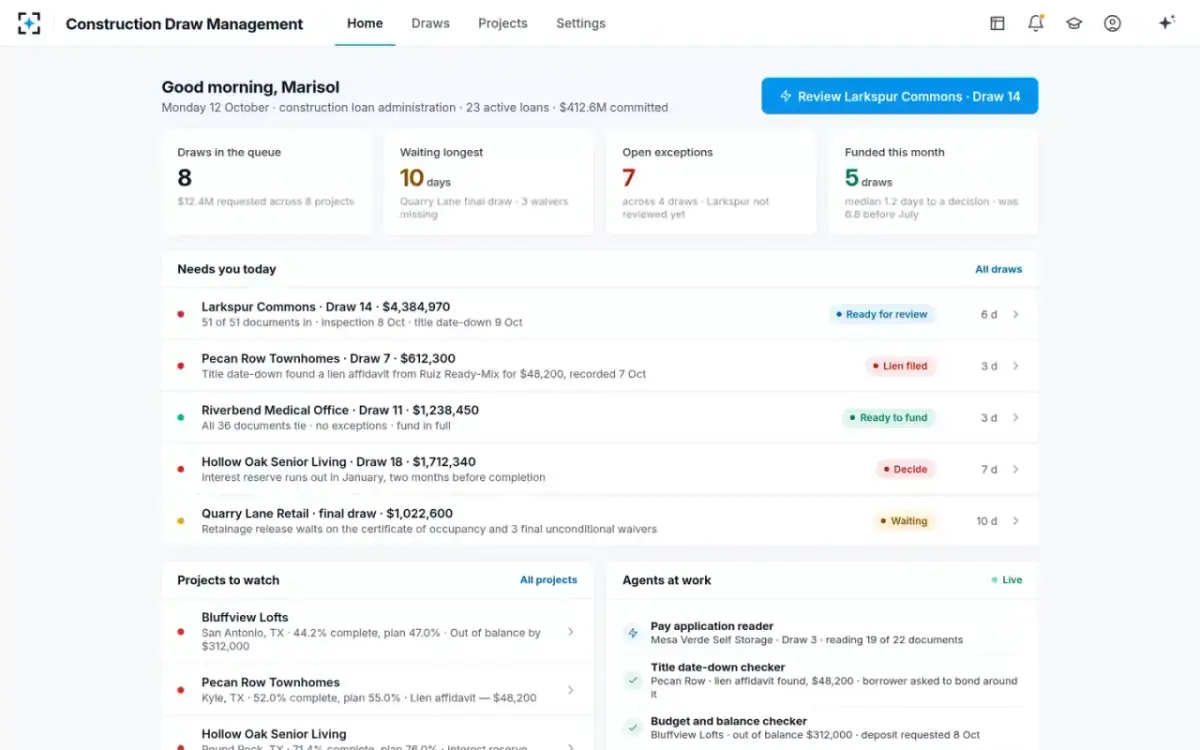
In the solution, six agents read the package the moment it is complete: a pay application reader, an invoice and waiver matcher, an inspection reconciler, a budget and balance checker, a title date-down checker and a funding recommender. On Larkspur Commons Draw 14 they read 51 documents in 1 minute 24 seconds and returned four exceptions with $782,750 held, each linked to the page it came from. The design target is every line tied to its invoice, waivers and inspection before money moves, and a signed decision within one business day of a complete package.
What stays with the administrator is what the seat is for: deciding. The agents never alter the contractor's figures or the inspector's percentages, never move money between budget lines and never approve; she does, with the meaning of her signature on the audit trail.
Why the seat is hard to staff, and how much money passes through it
The seat sits between lending and construction, and its skill mix is the scarce part: someone who has read both inspection reports and lien statutes is rarer than either an inspector or a credit analyst, which is why a bank that loses an experienced administrator feels it in the draw queue within a month.
The volume behind the seat is not small. FDIC-insured banks held $453.5 billion of construction and development loans at June 30, 2026, and community banks alone carried $83.1 billion of unfunded commitments on CRE construction, every dollar of it still to be drawn (FDIC Quarterly Banking Profile, second quarter 2026).
Questions people ask
What is the difference between a construction loan administrator and a loan officer?
The loan officer originates the loan and owns the relationship; the administrator controls disbursement after closing. The OCC wants construction credit administration "independent of the loan origination function when possible," so the two usually report to different managers.
What does a construction draw specialist do?
Draw specialist, draw coordinator and disbursement analyst are common titles for the same seat or a junior version of it. The core duties are the same: assemble the package, tie the pay application to invoices, waivers and inspection, and prepare the advance for approval.
How many loans does one administrator handle?
No regulator or official survey publishes a ratio. It depends on draw frequency, loan size and how much of the tying-out is done by hand; the fictional sample administrator in Construction Draw Management carries 23 active loans with $412.6 million committed.
Does a construction loan administrator need construction experience?
It helps more than a lending background does in the first year, because the hard calls are about what is built and who was paid. Banks that lack in-house expertise rely on an independent construction consultant for inspections, which the OCC describes as common practice.
What does a construction loan administration manager do?
The manager sets the desk's rules: inspection tolerances, retainage, minimum contingency, waiver requirements and approval limits. The manager also answers to credit and to examiners for turnaround and for any advance that went ahead of the site, which is why the OCC's examiner questionnaire asks whether the function is independent of loan production.