A date down endorsement on a construction loan is the title company's update to the lender's title insurance policy at each draw: the title company searches the public records from the last effective date to today, reports any liens, judgments or notices recorded in between, and, if the search is clean, endorses the policy so the new advance is insured with the same priority as the original loan. Without it, the lender knows the state of title on the day the mortgage was recorded and nothing since. The OCC expects the update with every draw, and in states where mechanics liens can take priority over the bank's lien it is the control that stands between a routine advance and a junior position. Botminds' Construction Draw Management reads the date-down for every draw and never recommends funding past a lien recorded since the last one.
Draw day: where the date-down sits between the package and the money
A person decides
Administrator requests the date-downFrom the title company, as soon as the draw package is complete, so the search covers the period since the last advance.
A person decides
Title company searchesPublic records from the last effective date: mechanics lien affidavits, judgments, tax liens, lis pendens, new deeds or mortgages.
Agent
Search read against the drawAnything recorded since the last draw stops the recommendation and names what must clear it.
Never: Never recommends funding past a recorded lien.
A person decides
Approval and disbursementWith a clean search, the draw is approved; the title company issues the endorsement for the advance and disburses.
What is a date down endorsement?
A date down endorsement is a title insurance endorsement that moves the effective date of an existing policy forward, so coverage reaches a later date than the policy's original one. Before issuing it the title company examines everything recorded against the property since the last effective date and lists any new matters as exceptions. On a construction loan it is issued for each advance, which is why title officers call it the construction date-down and lenders often say simply "the date-down".
The form and price are set state by state. In Texas, where the Department of Insurance promulgates title forms and rates, the down date endorsement is Form T-3, and the department's 2024 order raised its premium "to $100 for nonresidential construction projects" while it "remains $50 for residential construction projects," effective with the Basic Manual from November 1, 2024 (Texas Department of Insurance, order 2024-8851).
Does each construction draw need a title update?
Yes. The OCC's description of construction disbursement is direct, and it ties the requirement to the reason for it.
"The lender's title policy should be updated with each draw. The title company confirms that there are no outstanding liens on the project. Mechanics liens, or liens filed by parties who have supplied labor or materials to improve the property, are the most common form of lien. In some jurisdictions, mechanics liens can take priority over the bank lien. In such jurisdictions, it is important for the lender to update the title policy with each draw."
OCC, Commercial Real Estate Lending booklet, version 2.0
HUD's insured multifamily programme turns the expectation into a duty. The lender's role on each advance includes "Ensure clear title before advancing the approved disbursement," and it must "Notify HUD in writing when clear title does not exist or is impaired by reason of mechanics liens unresolved for more than 60 days or other impairments appearing since initial endorsement" (HUD MAP Guide 4430.G, §12.7.2). The OCC lists "lien searches before disbursement" among the core controls for any construction lender, insured or not.
What does a date down find?
A date down finds anything recorded against the property since the last search. On a construction loan the usual findings are the ones that compete with the lender for the collateral or signal trouble with the borrower.
What a construction date-down can turn up, and what each means for the draw
| Finding | What it usually means | What the lender does before funding |
|---|---|---|
| Mechanics or materialman's lien affidavit | A contractor, sub or supplier says it was not paid. | Stops the advance until the lien is released, bonded or otherwise cleared under the loan agreement. |
| Judgment against the borrower | A creditor won in court; it may attach to the property. | Assesses priority and the borrower's condition; often a default under the loan. |
| Tax lien | Property or other taxes unpaid. | Requires payment; the OCC notes delinquent taxes can create a lien on the collateral. |
| Lis pendens | A lawsuit affecting title to the property is pending. | Counsel review before any further advance. |
| New deed, mortgage or easement | Ownership or encumbrances changed without the lender's consent. | Usually a default; nothing funds until it is explained. |
| Nothing | A clean search. | The endorsement issues and the advance is insured. |
The mechanics lien is the finding the date-down exists for, and it is the one no other document in the draw package will show. A subcontractor that files a lien does not send the lender a waiver saying so; the first the bank hears of it is the title company's search.
The date-down nobody orders: why it gets skipped, and what that costs
The date-down is easy to treat as routine because it is cheap, nearly always clean, and arrives last, when the contractor is already waiting. Those three facts are exactly why it gets skipped or read late: a busy desk funds the draw on a clean search from the month before, or on the promise that the title company will flag anything.
What a construction date-down costs, against what one can find
The cost of skipping it shows up in failed-bank reviews as a pattern rather than a line item. In the Security Bank failure, which cost the deposit insurance fund about $807 million, the inspector general found no lien waivers from subcontractors and inspections that looked only at each current disbursement (FDIC OIG, MLR-10-020). Where waivers are missing, the date-down is the last control that can catch an unpaid trade before the next advance, and the FDIC warns examiners that "The construction lender may not be in the preferred position indicated by documents in the file" (FDIC RMS Manual §3.2).
Who orders a date down, and who pays for it?
The lender's construction loan administrator orders the date-down from the title company that issued the loan policy, usually as soon as the draw package is complete; the endorsement is issued to the lender because it is the lender's policy being extended. The cost is normally a project cost: on the fictional Larkspur Commons loan in the solution's sample book, title, legal and inspection fees are a soft-cost line in the budget, drawn like any other cost.
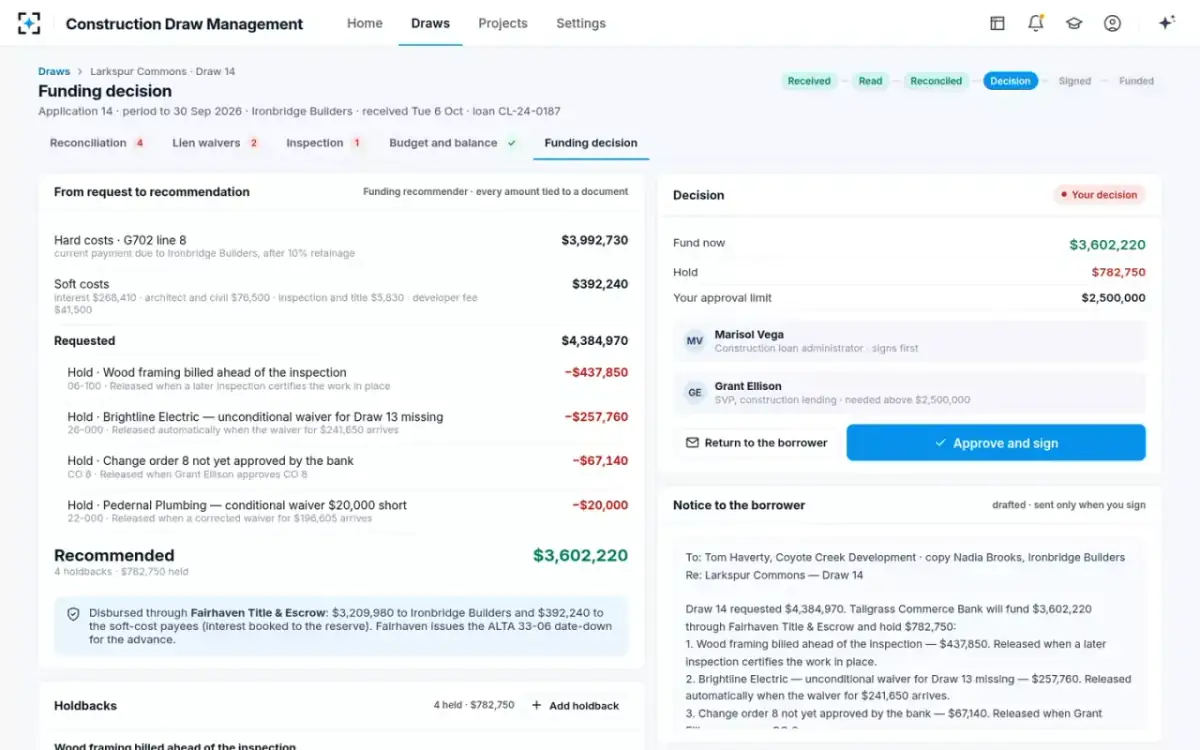
Many lenders disburse through the title company for the same reason. On the sample draw, Fairhaven Title & Escrow receives the funds, pays the general contractor and soft-cost payees, and issues the date-down for the advance, so the money cannot move before the search has been read.
Funding through the title company in Construction Draw Management: the date-down for the advance
What happens if a date down shows a lien?
If the date-down shows a lien, the advance stops until the lien is resolved under the loan agreement, typically by the borrower paying the claimant and obtaining a release, bonding around the lien, or the title company insuring over it on terms the lender accepts. Funding first and resolving later risks putting the new money behind the lien in states that let it prime.
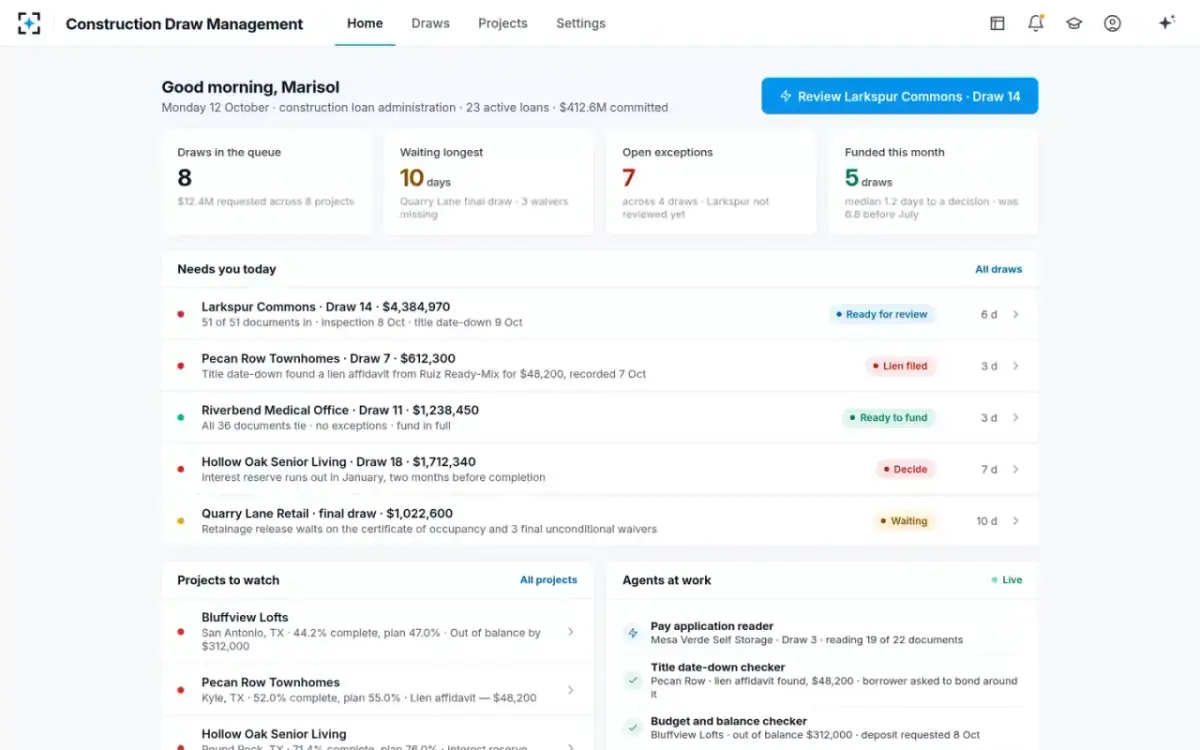
The sample book has a live example. The date-down for Pecan Row Townhomes Draw 7 found a lien affidavit for $48,200 from a ready-mix concrete supplier, recorded on 7 October. The title date-down checker stopped the recommendation on the $612,300 draw, and the borrower was asked to bond around the lien before any money moved. A HUD-insured lender in the same position would also have to notify HUD if the lien remained unresolved for more than 60 days.
A lien found by the date-down, on the administrator's home screen
The search window: why the dates matter more than the result
A date-down is only as good as the window it covers: from the effective date of the last endorsement to a date close enough to funding that nothing can be recorded unseen in between. A clean result for the wrong window is a clean result about the past.
One draw's search window, worked on the sample book
| Date | What happened | Why it matters to the window |
|---|---|---|
| 11 Sep | Larkspur Commons Draw 13 funded; its date-down covers title to that advance. | The start of the next search. |
| 6 Oct | Draw 14 package received, 51 documents. | The administrator requests the new date-down now, not when the review ends. |
| 7 Oct | On another sample loan, Pecan Row, a supplier records a $48,200 lien affidavit. | Exactly the kind of filing a stale search would miss. |
| 9 Oct | Fairhaven's Draw 14 search runs to this date: no liens, judgments or lis pendens. | The end of the searched window. |
| Funding day | Endorsement issued for the advance and funds disbursed through the title company. | Any days between 9 Oct and funding are covered only if the title company brings the search down again at disbursement. |
Two habits keep the window honest. The first is to request the search the day the package is complete, so the review and the search run in parallel and the search date is recent when the decision is signed. The second is to fund through the title company, so the endorsement and the money move together. A bank that funds directly a week after a search has created a week the policy does not see.
What examiners and inspectors general look for before funds are released
Examiners look for the title check as one of several controls that have to be complete before money moves, and for evidence that someone other than the loan's originator ordered and reviewed them. The OCC's examination procedures ask whether policies "provide for clear separation of origination and servicing functions (e.g., ordering, performing, and reviewing related due diligence.)", and its list of effective controls puts "lien searches before disbursement" beside site inspections and dual approval (OCC CRE booklet).
Failed-bank reviews show the cost when those pre-funding steps are not written down. At First Lowndes Bank in Fort Deposit, Alabama, closed in March 2010 with an estimated $35.3 million loss to the deposit insurance fund, the inspector general found the loan policy had no procedure for authenticating construction draw requests, and noted that normal practice is to collect vendor invoices and lien waivers and inspect the site before funds are released; examiners had also found the bank's construction inspection procedures deficient (FDIC OIG, MLR-11-006). The date-down belongs on the same list: a step written into the procedure, done before funding on every draw, with the result kept in the file.
A date-down checklist for every construction draw
The search is only useful if it is current, complete and read before the money moves. The checks below are the ones a desk can apply on every draw.
Six checks on the date-down before any construction advance
- The search runs from the last effective date to within a day or two of funding
A search from last month covers nothing that matters this month.
- It covers the whole legal description, including any added parcels
Phased projects add land; the search must follow it.
- Every new matter is read, not just the summary line
An affidavit listed as a "notice" can still be a lien claim.
- Liens are compared with the waiver list
A lien from a party that sent a waiver is a red flag about the waiver.
- The endorsement is issued for the actual amount advanced
Including any holdbacks released later.
- The final draw waits for a final search
After final waivers, before retainage is released.
How Construction Draw Management reads the date-down
In Construction Draw Management, "title date-down with every draw" is a setting, switched on by default: no advance without a clean search since the last draw. The title date-down checker reads the title company's report for liens, judgments and notices recorded since the previous draw, and its one fixed limit is that it never recommends funding past a recorded lien. A finding stops the recommendation and appears on the administrator's home screen with the amount and the claimant.
The check runs beside the waiver check because each catches what the other misses: waivers show who says they were paid, and the date-down shows who says they were not. The full sequence of a draw is set out in how construction loan draws work, and the priority question behind it in does a mechanics lien take priority over a mortgage.
Questions people ask
What does title date down mean?
It means bringing the title search and the title policy's effective date forward to a later date. On a construction loan it is done for each draw, so each advance is insured and any lien recorded since the last draw is found before funding.
Is a date down the same as a title update?
Closely. A title update or bring-down is the search itself; the date down endorsement is the policy change issued once the search is clean. Lenders use the terms loosely, but only the endorsement extends the insurance.
How long does a construction date-down take?
No official source measures it; it depends on the county's recording backlog and the title company. Lenders usually request it as soon as the package is complete so that it is not the last thing the contractor waits for.
Do HUD construction loans require a date-down?
HUD requires the lender to ensure clear title before advancing each approved disbursement and to notify HUD in writing when mechanics liens remain unresolved for more than 60 days. Title updates at each advance are how lenders meet that duty.
What does a date down cost in Texas?
The Texas Department of Insurance sets the premium for the T-3 down date endorsement on construction projects: $100 for nonresidential and $50 for residential projects, under the Basic Manual as amended from November 1, 2024.