Who regulates collection agencies? Four layers of rule reach them at once: the Fair Debt Collection Practices Act, written out in operational detail by the Consumer Financial Protection Bureau as Regulation F; the CFPB’s own supervision of the larger collectors; federal enforcement by the CFPB, the Federal Trade Commission and the prudential banking agencies; and state licensing and state collection statutes. There is a fifth party none of those four lets off: the lender that placed the accounts, which answers to its own supervisor for what its agencies did. Botminds’ Collection Agency Management is built for that last position — it reads every call recording, remittance file, complaint and audit answer the agencies send, grades each agency weekly, and keeps the evidence behind every grade where a person can open it.
This guide is written for the compliance officer or vendor-risk manager who has to put that structure on paper for an examiner. Rules and regulators are cited to their own sources. The worked examples are a fictional sample lender, Bellmere Bank, and six invented agencies, as the solution shows them.
The scale the rules are answering
207,800
debt collection complaints to the CFPB in 2024, approximately — seven percent of all complaints it received that year
51%
of complaints about communication tactics were about frequent or repeated calls
$10M
in annual receipts from consumer debt collection brings a non-bank collector inside CFPB supervision
Who regulates collection agencies?
No single regulator owns a collection agency the way a chartering authority owns a bank. An agency is reached by a federal statute, a federal rule, at least one federal supervisor or enforcer depending on its size and conduct, and the licensing law of every state whose residents it calls. The practical answer to the question is therefore a list, and the useful follow-up is which of those bodies will ever look at this particular agency — and who will be asked about it first.
Four layers of rule, and the party that answers for all of them
1
The statute and its rule
Congress, written out by the CFPB
The Fair Debt Collection Practices Act, implemented in detail by Regulation F — disclosures, call frequency, validation, electronic contact, retention.
2
Federal supervision
The CFPB
Examinations of the larger non-bank collectors, and of the largest banks for their own collection activity. Supervisory findings land before any court does.
3
Federal enforcement
The CFPB, the FTC and the prudential agencies
Cases under the FDCPA, the prohibition on unfair, deceptive or abusive acts and practices, and the FTC Act.
4
The states
State licensing boards and attorneys general
Licensing, bonding, state collection statutes and state unfair-practice law, none of it displaced by the federal rule where it gives more protection.
And the lender that placed the accounts
Supervised by its own banking agency, answerable for the work whoever performs it, and the address a complaint about a placed account arrives at.
Which legal act regulates collection agencies, and what Regulation F added to it
The Fair Debt Collection Practices Act of 1977 is the statute, and the CFPB’s own 2025 report to Congress puts its standing plainly: “The FDCPA, however, is the primary federal law that governs the conduct of debt collectors” (CFPB, FDCPA annual report, November 2025). The Act prohibits harassment, false or misleading representations, and unfair practices, and gives the consumer a right to dispute an alleged debt. It is also short, old and written for letters and landlines.
Regulation F is what happened when the CFPB turned those prohibitions into operating rules. Published in the Federal Register on 30 November 2020 and codified at 12 CFR part 1006, it did four things that changed how an agency actually works: it set a numerical presumption for how often a collector may telephone a person about one debt; it specified what a validation notice must contain, down to an itemization date and the amount owed on it; it wrote rules for email and text messages and for leaving a limited-content voicemail; and it required that records evidencing compliance, including call recordings where a collector makes them, be kept for three years.
The same report lists the other statutes that reach the same call: the Telephone Consumer Protection Act for the dialling, the Fair Credit Reporting Act for what is furnished to the bureaus, the prohibition on unfair, deceptive or abusive acts and practices, the FTC Act, and “various state statutes”. A lender that maps only the FDCPA onto its agency contracts has mapped about half of the exposure.
Does the CFPB supervise collection agencies?
Yes, but not all of them. The CFPB writes the rule for every collector and supervises the larger ones directly: “Under the CFPB’s larger participant rule for the consumer debt collection market, the CFPB has supervisory authority over certain non-bank entities with more than $10 million in annual receipts from consumer debt collection activities” (CFPB, FDCPA annual report, November 2025). Receipts from collecting medical bills and commercial debt are generally left out of that calculation.
Supervision is not the same as enforcement, and the difference matters when a lender is choosing which signal to watch. A supervised collector is examined on a cycle, and findings are resolved through the examination; they rarely become public in a form naming the firm. Enforcement is the public half, and it is not the CFPB’s alone. The report sets out who else may bring a case: “While the CFPB is authorized by the FDCPA to bring enforcement actions against any person subject to the Act, the statute also provides other agencies enforcement authority for certain subsets of market participants” — among them the Federal Reserve Board, the FDIC, the OCC, the National Credit Union Administration, the Departments of Transportation and Agriculture, and the FTC.
Who actually uses that authority varies year to year. The CFPB records that in 2024 the FTC was the only agency to announce public enforcement actions against harmful debt collection activity under the FDCPA, and that no other federal agency with FDCPA authority, including the CFPB itself, brought or resolved a public action that year. For a lender, the lesson is not that the risk fell. It is that public enforcement is a lagging and intermittent signal, and a panel cannot be monitored by reading press releases.
Where the states come in, and what Regulation F does not displace
Collection agency licensing is state law. Which states require a licence, what bond they ask for, whether a licence is needed to call into the state as well as to operate from it, and whether collection law firms are treated differently are all questions answered state by state — and they are the questions a lender’s own onboarding has to answer for every state its accounts come from.
Federal law is explicit that it leaves that intact. Regulation F provides that neither the Act nor the rule excuses anyone from complying with a state’s debt collection laws, except where a state law is inconsistent with them and then only to that extent — and then narrows inconsistency almost to nothing: “a State law is not inconsistent with the Act … if the protection such law affords any consumer is greater than the protection provided by the Act” (12 CFR 1006.104).
Read that the way a vendor-risk committee should read it. The federal rule is a floor. A panel operating nationally is working under the strictest applicable rule in each state, not under Regulation F, and an agency’s compliance programme is only as good as its weakest state. It also means a lender cannot satisfy itself with a federal checklist: licence status by state, and its expiry, is a monitoring item like any other.
Each layer of rule: who enforces it, what it binds, and what the lender should be able to produce
| The rule | Who enforces it | What it binds | What the lender keeps as evidence |
|---|---|---|---|
| FDCPA, as implemented by Regulation F | CFPB, FTC and the prudential banking agencies; plus a private right of action | The agency and the collection law firm, from the first communication | Call recordings read against the disclosures and the call-frequency presumption, with the timestamp of each finding |
| CFPB supervision of larger participants | CFPB examiners | Non-bank collectors above $10 million in annual collection receipts | The agency’s examination history as disclosed in diligence, and its answers to the lender’s own audit |
| Prohibition on unfair, deceptive or abusive acts and practices | CFPB; the FTC Act equivalent for firms in its jurisdiction | Conduct the FDCPA does not name, and the lender’s own first-party collection | Complaint themes by agency, and what changed after each one |
| State licensing and state collection statutes | State licensing boards and attorneys general | Where the agency may operate and whom it may call | A licence register by state with expiry dates, checked before each placement |
| Interagency guidance on third-party relationships | Federal Reserve, FDIC and OCC, through supervision of the lender | The lender — not the agency | Due diligence, contract terms, monitoring results, issues escalated and what was done about them |
What the banking agencies expect of the lender that places the accounts
Two statements of expectation sit behind almost every examination question a lender will face about its agencies, and they say nearly the same thing from two directions.
The CFPB’s is about the relationship itself: the Bureau “expects supervised banks and nonbanks to oversee their business relationships with service providers in a manner that ensures compliance with Federal consumer financial law, which is designed to protect the interests of consumers and avoid consumer harm”, and adds that its supervisory and enforcement work “will closely reflect this orientation and emphasis” (CFPB Compliance Bulletin 2016-02, Service Providers).
The prudential agencies’ is about the whole life cycle of a third-party relationship, from planning and due diligence through contract terms, monitoring and termination, with the depth of each step scaled to the risk of the activity. Their joint 2023 guidance is not a rule — supervisory guidance does not have the force of law — but it is the structure examiners use, and a programme that cannot be described in its terms is hard to defend.
The duty that does not move
Every layer above ends at the same place. The banking agencies’ joint guidance states it as a principle: relying on a third party leaves a bank’s own obligations undiminished, to be met as fully as if the bank did the work in-house (Interagency Guidance on Third-Party Relationships, June 2023). The CFPB states it as a consequence: a provider that does not know the legal requirements, does not work to apply them carefully, or runs weak internal controls can harm consumers and expose both itself and the firm that hired it to liability (CFPB Compliance Bulletin 2016-02, Service Providers).
That shared exposure is why the question “who regulates collection agencies” is the wrong one for a lender to stop at. The right one is “who will ask me about this agency, and what will I hand them”. Outsourcing the collection work does not outsource the answer, and a complaint about a placed account arrives at the bank whichever agency made the call. What the line between the two positions actually is, and when an account crosses it, is set out in first-party versus third-party collections.
What oversight has to mean before an examiner will call it oversight
The CFPB’s bulletin does not leave “oversee” as a sentiment. It lists what the steps should include, and the list converts cleanly into five questions a lender ought to be able to answer today, not at the next annual review.
Five questions from the CFPB’s own list of steps
- Did our diligence verify that this agency understands and can comply — or did it verify that it exists?
The bulletin asks for thorough due diligence to verify that the service provider understands and is capable of complying with Federal consumer financial law. A completed questionnaire is not verification; a reviewed policy, a training record and a tested control are.
- Have we read their policies, procedures, internal controls and training materials?
Named in the bulletin, and the hardest to satisfy honestly, because it means reading the script a collector actually works from — including the version issued last month.
- Does the contract set clear compliance expectations and enforceable consequences?
Clear expectations about compliance, with appropriate and enforceable consequences for violating compliance-related responsibilities. A contract that lets the lender audit but never pause or recall has expectations without consequences.
- Do we have internal controls and ongoing monitoring, or a quarterly report?
Ongoing monitoring means knowing in days, not quarters, whether the agency is complying — which is a question about how much evidence is actually read.
- When monitoring finds something, do we act promptly and fully, including ending the relationship where appropriate?
The last step is the one examiners test with a single question: show me the issue you found, and show me what changed afterwards.
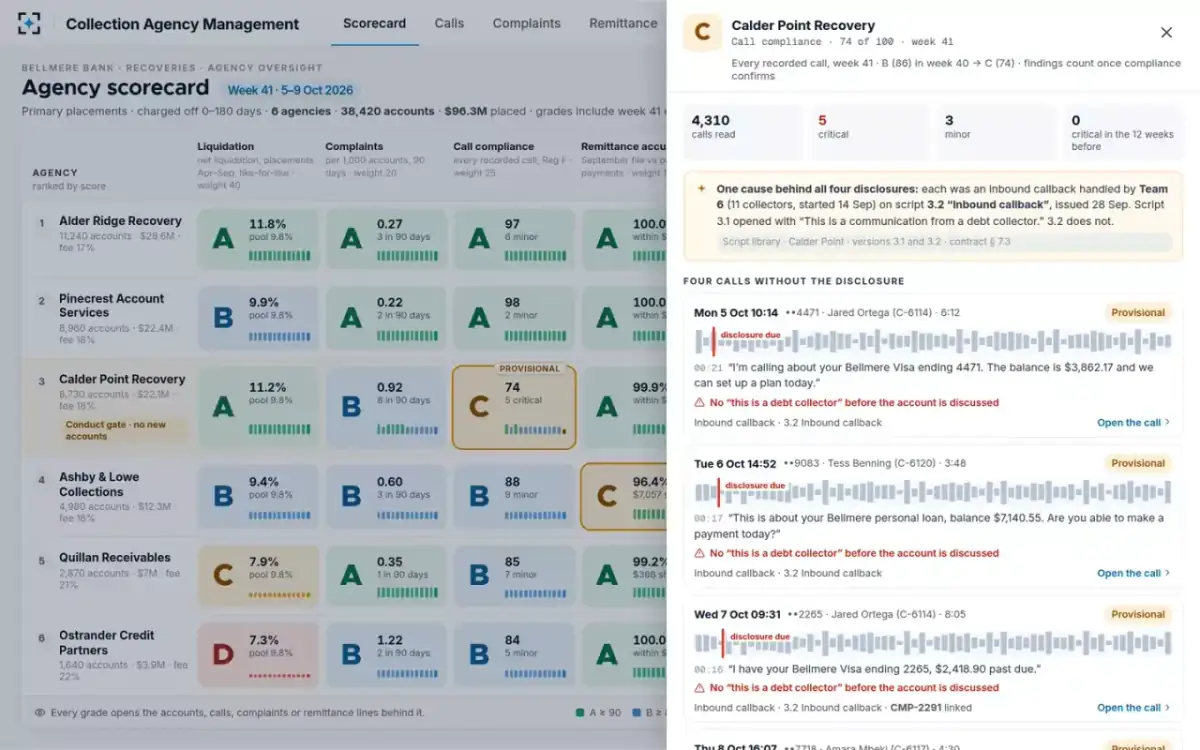
The fourth question is where most programmes quietly fail. Reading two hundred calls a month out of twenty thousand is a sampling plan, not monitoring, and it cannot find the thing that makes a finding actionable: the common cause. Four missed disclosures look like four collectors having a bad week until the evidence shows all four on one team, working one version of one script.
A grade that opens onto the calls behind it
What a lender should be able to produce in a week, not a quarter
An examination question about a third party is almost always a request for a document. The useful test of an oversight programme is therefore how long it takes to produce four of them, and whether they agree with each other.
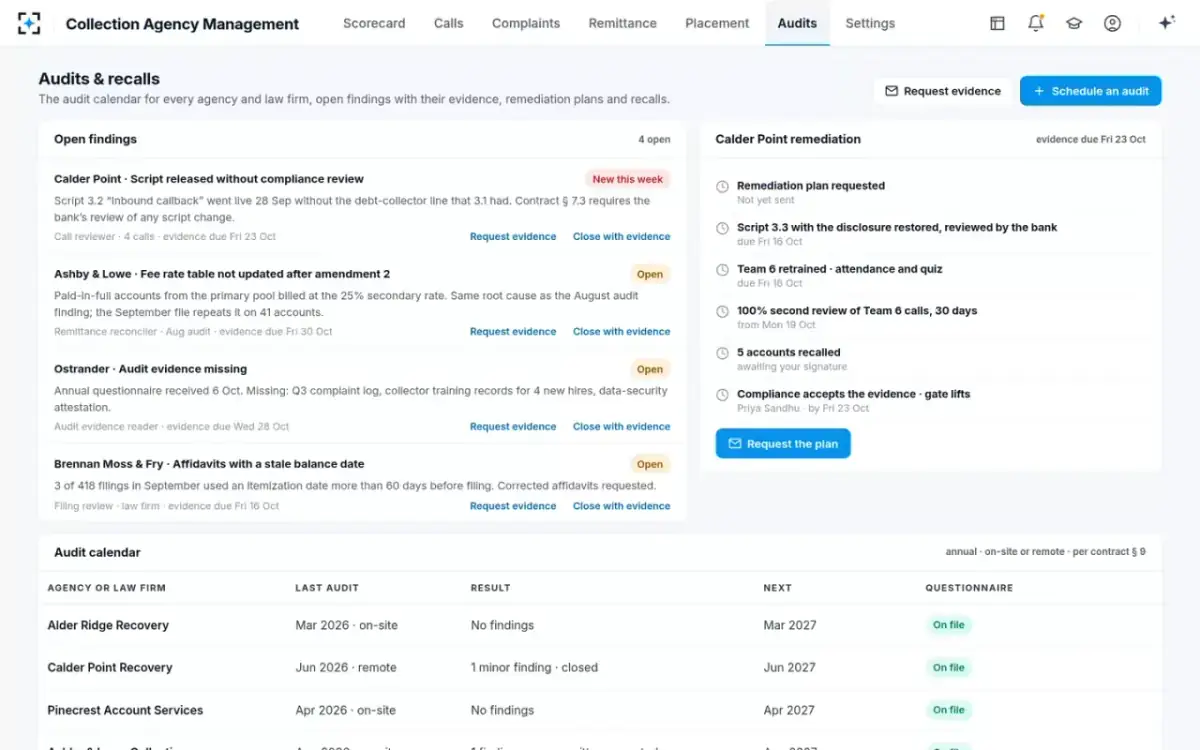
The first is the evidence log: what each agency sent, when it arrived, and what was read. Missing evidence is itself a finding, and an agency that is late with call recordings twice in a quarter is telling you something. The second is the finding trail: each issue, the call or the file it came from, who confirmed it, and what the agency did afterwards. The third is the money: each remittance line tied to a posted payment and the contract fee rate, with every variance explained. The fourth is the decision trail: what the lender did with what it found — placements moved, accounts recalled, an agency paused — and who signed each one.
At the fictional sample bank those four come out of one weekly run. Every recorded call from six agencies is read for the disclosures and the limits in Regulation F, 21,860 of them in the week shown; every remittance line is tied to a posted payment; each complaint is linked to the account, the agency and the call behind it; and the audit calendar covers the law firms on the same terms as the agencies. Each of the four graded measures — liquidation, complaints, call compliance and remittance accuracy — is banded A at 90 or above, B at 80, C at 70 and D below that, and every letter opens onto the evidence that produced it. How those grades should be built so that two agencies are measured on the same paper is the subject of measuring agencies on the same paper, and the diligence that has to come first is in how to choose a collection agency.
Audits, findings and the remediation a lender can show
Four layers of rule reach a collection agency, and the one that reaches the lender runs through all of them. To see what a week of agency evidence looks like when it has been read rather than filed, start from Collection Agency Management.
Questions people ask
Do collection agencies need a state licence?
In many states, yes, and the requirement is set state by state: some licence the agency, some also require a surety bond, some reach agencies that only call into the state from elsewhere, and some treat collection law firms separately. Regulation F expressly leaves state debt collection law in place and treats a state law as consistent whenever it protects the consumer more than the federal rule does, so licensing is never answered federally. A lender placing nationally should hold a licence register by state with expiry dates and check it before each placement.
What happens if a collection agency breaks the law?
Several things can happen at once, and they move at different speeds. The consumer may bring a private action under the FDCPA. A state regulator may act on the licence. A federal agency may examine or, less often, bring a public case — in 2024 the FTC was the only agency to announce public FDCPA enforcement actions. And the lender that placed the account will hear about it from its own supervisor, which is why many consequences arrive as a supervisory question long before they arrive as a case.
Is the bank liable for what its collection agency does?
The agency is liable for its own conduct under the FDCPA, and the lender is answerable for the relationship. The banking agencies’ joint guidance states that a banking organisation’s use of third parties does not diminish its responsibility, and the CFPB’s bulletin notes that while due diligence is no shield against liability for a service provider’s actions, it can reduce the risk of violations for which the bank may be liable. In practice the lender rarely escapes the conversation, whatever the legal allocation.
What are collection agencies allowed to do?
Call, write, email and text within the limits of Regulation F; ask for payment; offer arrangements; and report the debt to a credit bureau once they have first contacted the consumer and waited. They must identify themselves as debt collectors, provide validation information at the start, stop collection on a written dispute until they verify the debt, and keep within the call-frequency presumption of seven calls in seven days about one debt. What they may not do is harass, mislead, threaten action they cannot take, or discuss the debt with third parties outside the narrow exceptions the rule allows.
Does the CFPB regulate debt collectors that work for banks?
The CFPB’s Regulation F applies to the collector whoever its client is. Whether the CFPB also supervises that collector depends on its size under the larger participant rule, and whether it supervises the bank depends on the bank’s own size and charter. Where the CFPB is not the bank’s primary federal regulator it refers complaints about it to the prudential regulator, so a complaint does not disappear because the Bureau is not the supervisor.
How often should a lender audit a collection agency?
There is no prescribed interval. The banking agencies’ guidance asks for monitoring commensurate with the risk and complexity of the relationship, with more comprehensive or frequent monitoring where a third party supports higher-risk activities — and consumer collection on a bank’s own borrowers is squarely that. In practice many programmes run an annual on-site or remote audit on top of continuous monitoring; the audit tests the controls, and the monitoring is what finds a problem between audits.