How to choose a collection agency comes down to one discipline: prefer every question whose answer arrives as a document you can read later, and distrust every answer that arrives only as a claim. References, a rate card and a tour of a call floor tell a buyer little that can be tested after the contract is signed. Recording retention, remittance detail, complaint notification, audit rights and recall rights can all be tested in the first month — and the first month is the point of the exercise, because that is when a lender finds out whether the evidence arrives in the form the answer promised. Botminds’ Collection Agency Management is built for exactly that month and every month after it: it reads every recorded call, ties every remittance line to a posted payment and the contract fee, links each complaint to the call behind it, and grades every agency weekly on what it finds.
The worked examples come from a fictional sample lender, Bellmere Bank, with six invented agencies on one panel, as the solution shows them. The supervisory expectations quoted are real and linked.
How to choose a collection agency
Start by writing down what you are buying. A primary placement programme for recent charge-offs on a consumer book is a different purchase from a secondary programme on three-year-old paper, and a suit-placement relationship with a collection law firm is different again. The agency that is best at one may be mediocre at another, and a single scorecard applied across all three will mislead.
Then size the panel before you shortlist. One agency is simplest to oversee and gives you no comparison and no alternative when something goes wrong. Six gives you both, and six times the oversight. Many programmes land between three and six for a reason: enough to run a real comparison and to move volume quickly, few enough that every agency gets a placement large enough to measure.
Only then does diligence start, and the prudential agencies are blunt about what it is not: past experience with a firm, or what the bank already knows about it, does not stand in for due diligence, which has to be fitted to the specific work the firm will do (Interagency Guidance on Third-Party Relationships, June 2023). An incumbent you have used for ten years gets the same questionnaire as the newcomer, scoped to the work you are about to place.
And be honest about what diligence buys. The CFPB is explicit that diligence is no shield against liability for what a service provider does, though it can lower the risk that the provider commits violations the bank may be liable for (CFPB Compliance Bulletin 2016-02, Service Providers). Diligence lowers the chance of a problem. Only monitoring finds the one that happens anyway, and the duty behind that monitoring never leaves the lender.
What questions to ask a collection agency before you place anything
The twelve below are chosen on a single test: each has an answer that can be produced as a document, and each of those documents is something you will want again in month one.
Twelve questions whose answers arrive as evidence
- What share of calls do you record, and how long do you keep them?
Ask for the retention policy and a sample export in the format you would receive nightly. Regulation F already requires a collector that records calls to keep each recording for three years.
- Show us the script a collector reads on an inbound callback.
Not the training deck: the live script, with its version number and issue date, and the change history for the last year.
- How is a script change approved, and who at our end sees it?
The answer you want is a clause giving you review before use. The evidence is the last three change notices.
- How do you control call frequency across campaigns?
Ask for the dialler configuration and the control that stops attempts breaching the seven-in-seven presumption when two campaigns touch one consumer.
- What does a remittance file look like, line by line?
A real file with a real month in it: account, payment date, amount, fee rate applied, placement stage. A summary file cannot be reconciled.
- How quickly do you tell us about a complaint, and in what form?
A named notification window and a format that carries the account, the call and the date, so complaints can be matched to the conversation behind them.
- Which states are you licensed in, and when does each licence expire?
A register, not an assurance. Licensing is state law, and an expiry is an operational risk you own once you place.
- What is your attrition and training position on the team that will work our accounts?
Headcount, start dates and the training record for the specific team. A new team is a known risk point: in the sample week, all four missed disclosures came from a team that had started three weeks earlier.
- Who are your subcontractors, and what do they touch?
Letter vendors, dialler platforms, skip-tracing providers and offshore sites — each one is a party your accounts reach.
- What capacity can you take from us, and what happens at the ceiling?
A monthly account and balance cap you both agree, so growth never quietly outruns staffing.
- Show us your last two internal audit or examination summaries.
Redacted is fine. A refusal is itself information, and it should be recorded as a limitation of the diligence.
- What will you not do?
Suit, credit reporting, settlements below a floor, contact with third parties: the exclusions you want written down before anyone is tempted.
What should a collection agency contract include?
A placement contract has two jobs: it sets the commercial terms, and it manufactures the evidence the lender will be asked for. The second job is the one that gets neglected, and it is the one that cannot be fixed afterwards — a clause that does not exist produces no file.
Contract clause, the evidence it produces, and who reads it
| The clause | The evidence it produces | Who reads it, and how often |
|---|---|---|
| Call recording and delivery | Every recorded call, delivered nightly by secure transfer, with collector, team and campaign identifiers | Call review, continuously; the compliance manager on every critical finding |
| Script review before use | A change notice for every script version, with its issue date | The compliance manager, on each change — and the audit trail when a finding traces to a version |
| Remittance detail and timing | A line-level file by a named business day each month, with the fee rate applied to each payment | The reconciler, monthly, against posted payments and the contract rate |
| Complaint notification | Notice of every complaint within a named window, carrying the account and the call | The complaint linker and the compliance manager, as they arrive |
| Audit rights | An annual on-site or remote audit on notice, with a defined evidence list | The vendor auditor, annually, against the contract |
| Recall rights | Any account back on a named notice period, with the fee tail settled | The agency manager, whenever a finding or a strategy change requires it |
| Capacity ceiling | An agreed monthly cap in accounts and balance | The allocator every month, before shares are set |
| Consequences | A pause on new placements, a correction deadline, an offset right, and termination for cause | The head of recoveries, when monitoring finds something |
Two clauses are worth arguing hardest for. The first is script review before use, because a disclosure failure can trace to a script version rather than to one collector, and then it repeats on every call that script reaches. The second is a correction mechanism on remittances — a tolerance, a deadline for a corrected file and an offset right — because without it a stale fee rate becomes a negotiation rather than an arithmetic error. What those fee terms should say in detail is in how much a collection agency charges.
Write the ending while everyone is friendly. The agencies’ guidance lists what to think about at termination: options for transitioning the work, the time and resources a transition needs while still managing legal, regulatory and customer impacts, the costs and fees of terminating, and the risks around data retention and destruction and system access after the relationship ends. A contract that says how accounts come home, how fast, and what happens to the recordings and the data is a contract you can act on in a bad week.
One agency or a panel: what champion–challenger actually buys
Champion–challenger means keeping a reference performer and giving a share of comparable accounts to a challenger, then moving volume on the result. In collections it buys three things that a single-agency arrangement cannot: a control group, a credible threat, and an immediate alternative if conduct goes wrong at the champion.
It only works if the comparison is real. The challenger must receive accounts matched to the champion’s on vintage, balance band, state and contact data, or the test measures the allocation rather than the agency — the trap set out in measuring agencies on the same paper. The challenger must get enough volume to produce a number that means something; a thousand accounts will move on a handful of settlements. And the result must be allowed to change the allocation, which means the shares have to be a setting rather than a tradition.
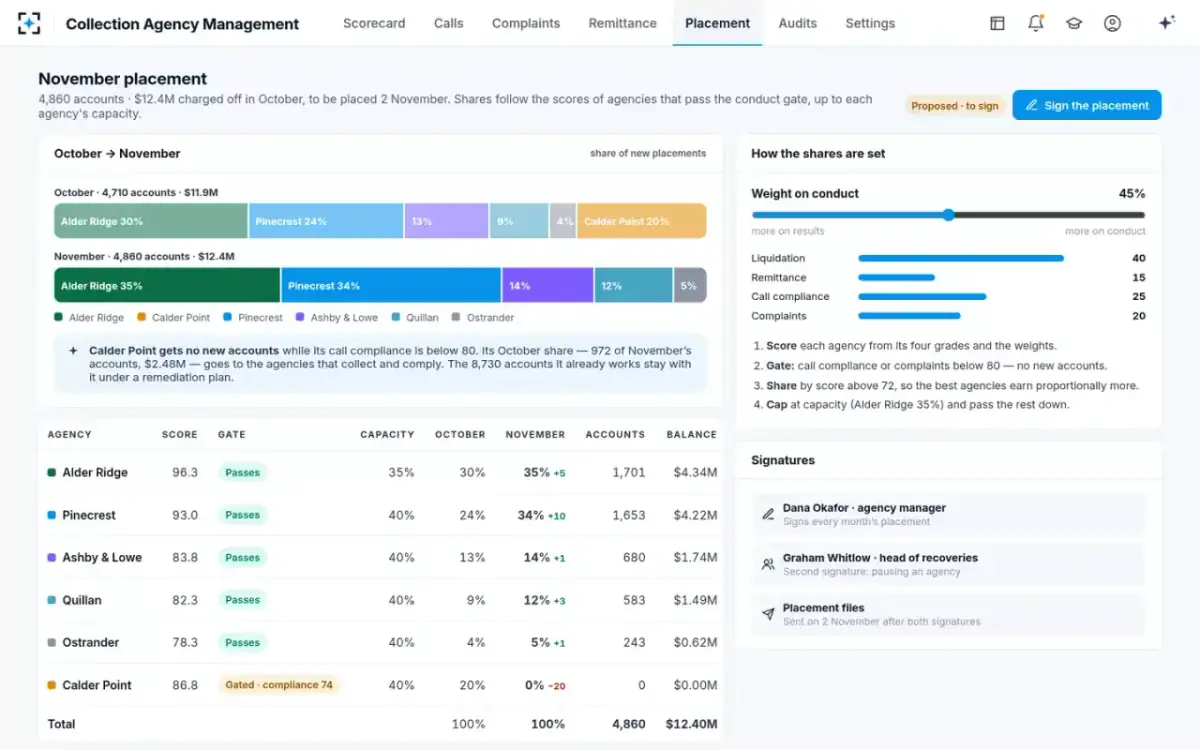
On the fictional sample panel the allocation is scored from four graded measures and then constrained: each agency has a capacity ceiling it cannot be pushed past, and an agency whose call compliance or complaints fall below 80 receives no new accounts until remediation evidence is accepted. In the week shown that moved 972 accounts and $2.48 million away from one agency — not because it collected badly, but because it was holding critical conduct findings while liquidating at 11.2% against the pool’s 9.8%.
The first placement: small, stratified, and matched
The purpose of a first placement is not recovery. It is to find out whether this agency’s files, systems and people do what the contract says, while the amount of money at risk is small and the number of consumers affected is smaller.
Make it small enough to recall without a conversation and large enough to measure — big enough that liquidation at three months is not one settlement, and that a week of calls contains enough conversations to review properly. Stratify it the same way you stratify every other placement, so the cohort is comparable from day one. Match it to a cohort already placed with an incumbent, same vintage and same bands. And place it with the same file, the same fields and the same frequency you intend to use permanently, because half the problems of month one are data problems, not collection problems.
The first ninety days of a new agency, and what each stage has to produce
- Diligence and contract30 days
- Test placement14 days
- First grading and audit response21 days
- First allocation decision25 days
The first month of oversight, week by week
Month one is a series of small tests, each of which can be run against evidence the contract now requires.
Week one — does the file arrive, and is it readable? Call recordings nightly, in the agreed format, with the collector, team and campaign identifiers populated. A recording that arrives without the identifiers is a finding: it means a later disclosure failure cannot be traced to a cause. Read the first week’s calls in full rather than sampling them; this is the week to find out what the scripts actually say in a collector’s mouth.
Week two — does the complaint route work? Test the notification path. Check that a complaint arriving at the bank can be matched to an account and to a call on the agency’s side, with timestamps that line up. A complaint you cannot tie to a conversation is a complaint you cannot investigate.
Week three — does the remittance reconcile? The first file is the one to take apart line by line: every line matched to a payment posted on the lender’s own side or confirmed by the lockbox, every fee recomputed from the contract and its amendments, and then the reverse check — every payment the lender can see that the file does not contain.
Week four — does remediation happen on a date? Raise whatever month one found, however small, and require the fix with an evidence date. The purpose is to test the loop, not to punish: an agency that produces a dated remediation plan and the evidence behind it in week four will do it again in month eleven.
Where a month of agency oversight goes, by hand — and the part that does not have to
What evidence to require every month, and in what form
Four files, every month, in a format that can be reconciled rather than read. Call recordings and dialler logs, nightly, with identifiers. A line-level remittance and activity report by a named business day, carrying the fee rate applied to each payment. A complaint log, including complaints the agency received directly and resolved. And an exceptions report: accounts the agency could not work, disputes received, bankruptcies and deceased notifications, hardship claims.
Two requirements about form matter more than the content. The file must carry the keys that let it be joined to the lender’s own data — the account number, the placement identifier, the payment date — because a report that cannot be joined can only be believed. And retention has to be agreed in the contract rather than assumed: Regulation F already requires a collector to keep records evidencing compliance from the start of collection activity until three years after its last activity on the debt, and to keep each call recording for three years after the call (12 CFR 1006.100), but a lender that may need a recording in year four should say so in the contract.
Then decide who reads what. Evidence nobody reads is a cost with no control attached, and that is the honest reason many oversight programmes sample: a person cannot listen to twenty thousand calls. On the sample panel all 21,860 of a week’s recorded calls are read against the disclosures and limits in Regulation F, with 37 sent to a person and five of those critical — and a critical finding stays provisional until the compliance manager confirms it from the call itself.
Who signs what, once the evidence is in
Today
Argues placement shares each quarter from a spreadsheet, and hears about an agency problem when the complaint lands a month after the call.
With agents
Reviews an allocation already built from the grades, and signs it; recalls up to 50 accounts on their own authority.
Still theirs: The signature on every month’s placement file
Today
Receives a score from a sample of calls, then goes looking for the call behind it.
With agents
Opens the call at the second the disclosure was due, beside the two script versions, and confirms or dismisses the finding.
Still theirs: Confirming every critical finding from the call itself
Today
Hears about an agency pause after the decision has been taken.
With agents
Co-signs with the calls, the liquidation estimate and the recall cost in front of them.
Still theirs: The second signature on a pause, or a recall of more than 50 accounts
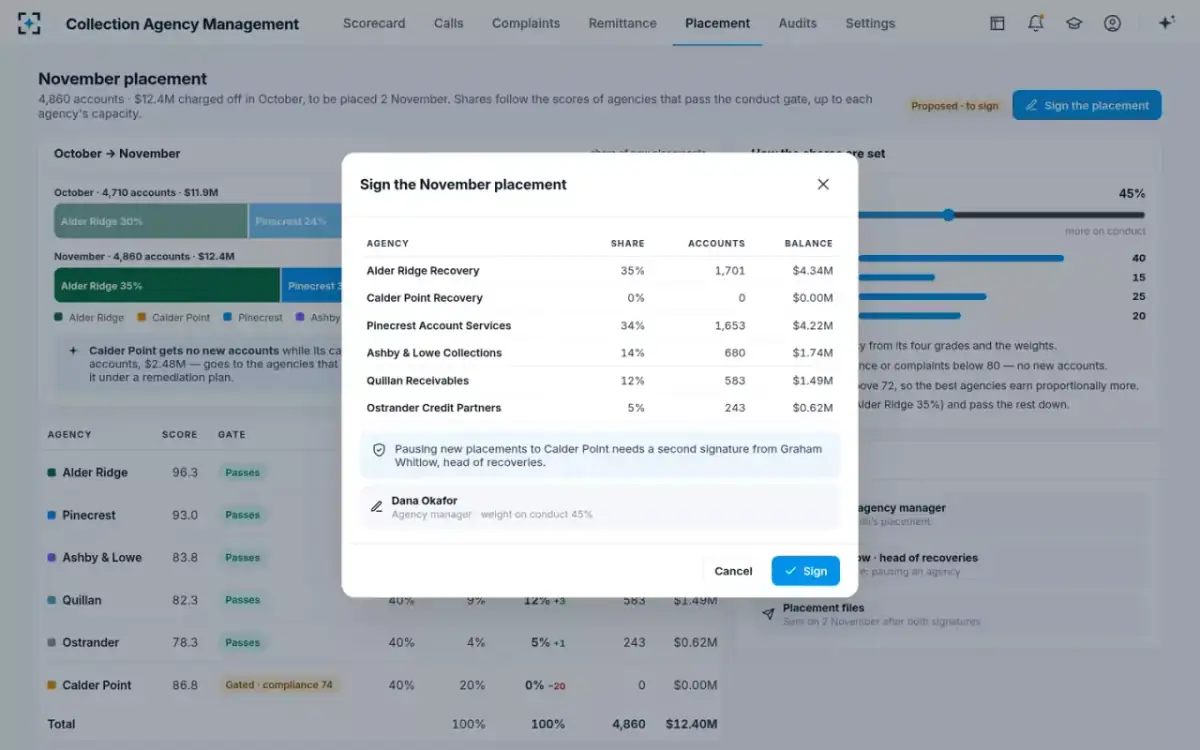
The placement signed, with a pause going for a second signature
When to pause, recall or leave
These are three different decisions and they are easily collapsed into one, in either wrong direction — a lender either does nothing because a full recall looks too expensive, or recalls everything because a finding feels serious. Separating them is most of the skill.
Pause new placements when conduct is the problem and the existing paper is being worked properly. It is reversible, it costs the agency immediately, and it costs the lender almost nothing: the accounts go to the other agencies this month. Recall specific accounts when those accounts have been harmed — the consumers who were called without the disclosure, the account that received eight attempts in seven days. Recall the book, or leave, when the failure is systemic, when remediation has not produced evidence by the date it was due, or when the relationship cannot be monitored at all.
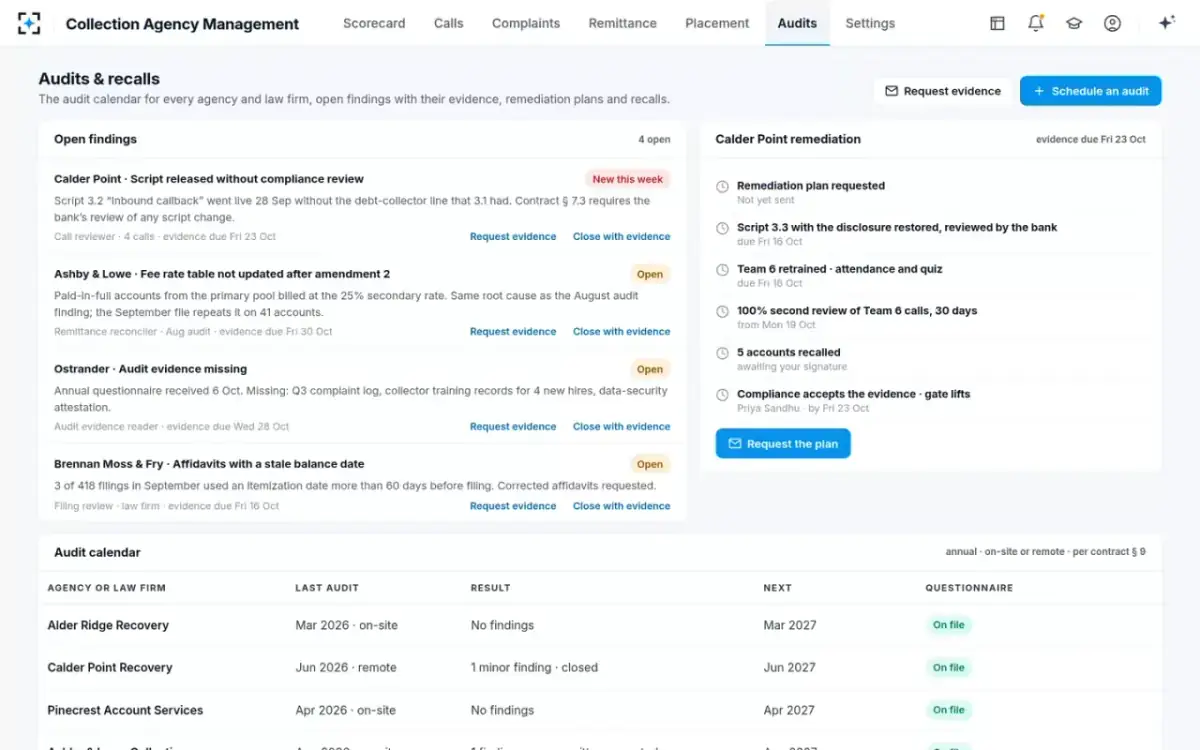
Price the third one before taking it. On the sample panel, a full recall from an agency holding 8,730 accounts and $22.1 million was estimated to give up about $410,000 of expected recoveries and would have restarted 8,730 consumers with a new collector. The bank paused new business, recalled the five accounts touched by findings, and set a dated remediation plan instead — a script line restored, a named team retrained, every one of its calls second-reviewed for 30 days, with evidence due on a stated Friday.
November’s allocation, built from the grades and held inside capacity
Leaving well is its own competence. Agree in advance how accounts come home, over how long, what happens to payment arrangements already made with consumers, who answers a consumer who calls the old agency, and what is done with the recordings and the data. The guidance asks a bank to think about exactly that — transition options, the time and cost of moving the work, and the data retention, destruction and access risks that survive the end of the relationship — and the time to think about it is while the relationship is still working.
Audit findings, the remediation tracker, and the calendar behind both
Choose on evidence, contract for evidence, and then read it. To see a first month of agency oversight run end to end on one week’s calls, files and complaints, start from Collection Agency Management.
Questions people ask
How many collection agencies should a lender use?
Enough to compare and to move volume, few enough to oversee properly — in practice often three to six for a consumer charge-off programme. One agency leaves no benchmark and no alternative when conduct goes wrong. A dozen fragments the placements so far that no cohort is large enough to produce a meaningful liquidation figure, and multiplies the monthly evidence a team has to read. The constraint that should decide the number is oversight capacity, not procurement preference.
What is champion–challenger in collections?
Keeping an established agency as the champion and giving a matched share of comparable accounts to a challenger, then moving volume according to the result. It only measures the agencies if the two cohorts match on vintage, balance band, state and contact data, and if the challenger’s share is large enough for its liquidation rate to be stable. Run with unmatched allocations, it measures the allocation.
How do you onboard a collection agency?
Treat it as a data project with a legal wrapper. Agree the placement file layout and the return file layouts; test them with a small matched placement; confirm that recordings arrive nightly with collector, team and campaign identifiers; check that a complaint can be tied to a call; reconcile the first remittance line by line; and finish the month with a dated remediation of whatever you found. If any one of those fails, it fails cheaply in month one.
What evidence should an agency send every month?
Call recordings and dialler logs, nightly; a line-level remittance and activity report by an agreed business day, showing the fee rate applied to each payment; a complaint log including complaints resolved directly with the consumer; and an exceptions report covering disputes, bankruptcies, deceased notifications and hardship. All of it keyed so it can be joined to the lender’s own records — a report that cannot be joined can only be believed.
When should you fire a collection agency?
When the failure is systemic rather than isolated, when a dated remediation plan has not produced its evidence, or when the relationship cannot be monitored — no usable recordings, no joinable remittance detail, no complaint notification. Before you act, separate the decisions: pausing new placements is cheap and reversible, recalling specific harmed accounts is narrow and fast, and recalling the whole book has a price in forgone recoveries that should be estimated before the inventory is pulled.
Does a collection agency need to be audited every year?
Nothing prescribes an interval, but the banking agencies expect monitoring commensurate with the risk of the activity, and consumer collection on a lender’s own borrowers sits at the higher end of that. Many programmes run an annual on-site or remote audit on contractual notice — ten days on the fictional sample panel — on top of continuous monitoring. The audit tests whether the controls exist; the monitoring is what finds the problem between audits.