Collection agency compliance standards are the conduct duties a lender holds an outside agency to — what it must say when it calls, when it may call, how often, whom it may discuss the debt with, what notice it must send, and what evidence it must keep — written so that each duty can be tested and the test can fail. Many agency standards stop halfway. They name the duty, a monthly report says the agency is compliant, and nobody can say which calls were checked or what would have counted as a breach. The hard half is the test: turning a sentence of Regulation F into a question you can put to this week's recordings and get a wrong answer from. Botminds' Collection Agency Management reads every recorded call from every agency on the panel each week, marks each duty as met or missed at the second it happened, and grades the agency on what it finds.
The worked examples here come from one week of a fictional sample panel inside the solution: Bellmere Bank, 38,420 charged-off accounts with six agencies, and week 41's evidence. The bank, the agencies, the law firms and the people are invented sample data, not a customer's results. The rules and the examination findings are quoted from the regulator's own pages, linked where they appear.
What are the compliance standards for collection agencies?
There is no single document called "collection agency compliance standards". In practice the phrase covers three layers that a lender has to hold in one hand. The first is the Fair Debt Collection Practices Act and its implementing rule, Regulation F at 12 CFR part 1006, which binds the agency directly. The second is state licensing law and the state analogues of the FDCPA, which can be stricter than the federal floor. The third is the lender's own contract — what the agency promised about scripts, training, call recording, complaint handover, data security, subcontracting and audit rights.
The first layer is where a test is easiest to write, because it is specific. Regulation F does not ask an agency to be fair; it names sentences that must be spoken, hours that must be avoided and counts that must not be exceeded. That specificity is what makes a test possible. A standard that reads "the agency will treat consumers with respect" cannot fail. A standard that reads "on every call, the debt-collector disclosure is spoken before the account or balance is discussed" fails the moment one call does not, and the recording proves which one.
Writing the standards this way also changes who can answer for them. A duty with a test has an owner, a frequency, an evidence source and a result; a duty without one has only a policy document. That is the difference between an oversight desk that can tell an examiner what it checked last week and one that can only say what it expects. Who holds the lender to this, and under which authority, is set out in who regulates collection agencies.
What Regulation F requires of a collection agency, duty by duty
Six duties carry most of the conduct risk on a consumer collection panel, and each of them can be written as a question about a single call or a single account. The table below pairs each with the rule it comes from, the test the lender should be running, and the evidence the test runs on. Nothing in it needs the agency's cooperation beyond sending the files its contract already requires.
Six conduct duties, and a test for each that can fail this week
| The duty | Where it is written | The test that can fail | The evidence it runs on |
|---|---|---|---|
| Say you are a debt collector | 12 CFR 1006.18(e)(1)–(2) | Was the disclosure spoken before the account or the balance was discussed? On a later call, was the communication identified as coming from a debt collector at all? | The recording and its transcript, timestamped, plus the script version in force that day |
| Do not discuss the debt with the wrong person | 12 CFR 1006.6(d)(1) | Was the person on the line verified as the consumer before any part of the debt was mentioned? | The recording, and the account’s contact history |
| Do not call at an inconvenient hour | 12 CFR 1006.6(b)(1)(i) | Was any attempt placed before 8:00 a.m. or after 9:00 p.m. in the consumer’s own time zone, or after the consumer said the time was bad? | The dialer log with the consumer’s time zone, and the recording where one exists |
| Stay inside the call-frequency presumption | 12 CFR 1006.14(b)(2)(i) | Did any account take more than seven attempts in seven days, or an attempt within seven days of a conversation about that debt? | The dialer log, counted per account and per debt |
| Send the validation notice in time | 12 CFR 1006.34(a)(1) | Was validation information given in the first communication, or sent within five days of it? | The letter file or the first call’s recording, against the first-contact date |
| Do not report the debt before contact | 12 CFR 1006.30(a)(1) | Was the account furnished to a credit bureau before the agency spoke to the consumer, or mailed and waited? | The furnishing file, against the contact history |
Two of those duties deserve their exact words, because it is easy to test the wrong half of them. On disclosure, the rule separates the first contact from every one after it: the initial communication has to say that the collector is attempting to collect a debt and that any information obtained will be used for that purpose, and each later communication has to say that it comes from a debt collector (12 CFR 1006.18(e)). A test that only listens to first calls misses the larger population by an order of magnitude — and inbound callbacks, where the consumer dials in, are later communications too.
On call frequency, the seven-in-seven figure is not a limit but a presumption, and it has a second limb agency policies can omit. A collector is presumed to comply only if it calls a person about a debt no more than seven times in seven consecutive days, and not at all in the seven days after a telephone conversation with that person about the debt (1006.14(b)(2)(i)). So an eighth attempt is not automatically unlawful, and a second attempt three days after a conversation is outside the presumption even though the count is low. A test that counts only attempts per week will pass calls the regulation does not protect.
Inconvenient hours work the same way. The 8:00 a.m. to 9:00 p.m. window is itself a presumption, and it holds only while the collector knows of nothing that points the other way (1006.6(b)(1)(i)). Once a consumer has said a time or place is bad, the window stops helping: the call that matters is the one placed at 11 a.m. to a person who said last Tuesday that they cannot talk at work.
How do you audit a collection agency without taking its word?
An agency audit that asks questions gets answers; an audit that asks for documents gets evidence. The interagency guidance on third-party relationships names, among the factors a bank considers in ongoing monitoring, "the third party's ongoing compliance with applicable laws and regulations and its performance as measured against contractual obligations" (Interagency Guidance on Third-Party Relationships, June 2023). Both halves of that sentence are measurements, and neither can be taken from a questionnaire alone: compliance is measured on communications, and performance against the contract is measured on files.
So the questionnaire has to be written to produce artefacts. Each question names the document that must accompany the answer, and an answer without its document is itself a finding — an open item with a date, not a blank. The eight below are ones that can change a lender's view of an agency, roughly in the order they are useful.
An audit questionnaire that produces documents, not assurances
- Every script in use in the period, with its issue date
Not the approved library — the versions actually loaded, per team. A script change is one way a disclosure fault spreads across many calls at once.
- The roster of collectors who touched our accounts, with start dates and training records
A cluster of findings on one team with recent start dates is a training question, not a conduct question, and it is answered differently.
- The complete call recording index for our accounts for the period
Count it against the dialer log. The gap between calls placed and recordings delivered is the part of the month nobody reviewed.
- The dialer configuration and attempt caps, as configured, with change history
Attempt limits are a setting. Ask what it was set to, who can change it, and what it was before.
- Every complaint received directly by the agency about our accounts
Complaints that reach the agency and not the lender are the ones the lender’s own count misses. Ask for them with their dates and outcomes.
- The validation notice template and a sample of sent notices with send dates
Test the five-day clock against the first-contact date on real accounts, not against the procedure.
- Subcontractors and offshore sites used on our work, with their own audit results
A clean agency with an unexamined subcontractor is an unexamined panel.
- The agency’s own quality-review results for our accounts, with the sample and the failures
Compare their pass rate with yours on the same calls. A large gap is a finding about the review, not the calls.
The second half of an audit is the part programmes often fail to schedule: re-testing the remediation. A finding closed on the agency's assurance that a script was fixed is a finding closed on a promise. The test is cheap — read the next week's calls from the same team on the same script and see whether the line is there. In the sample week that is exactly what happens: script 3.3 restores the disclosure, the team is retrained, and every call from that team gets a second review for thirty days with the evidence due on a named date.
Sampling: what a 5% review says about the 95% you did not hear
Many agency oversight programmes review a sample of calls, because a person can only listen to so many. The sample is not wrong; what is wrong is reading a clean sample as a clean month. A sample tells you about a rate, and conduct faults do not arrive as rates. They arrive as four calls on one script, or eleven collectors who started on the same Monday.
The arithmetic is unforgiving and worth doing once. If a fault sits in four calls out of a week's 21,860, a random 5% review has about a 18.5% chance of containing even one of them; a 25% review, about 68.4%. Raise the fault to ten calls and a 5% review still misses it three times in five.
The chance a review contains at least one of the faulty calls
Two things follow. First, if the standard is to be tested rather than estimated, every recorded call has to be read, which is the practical reason an agency oversight desk reaches for software at all. Second, a sample is still worth keeping for the thing it is good at: a person listening to twenty calls hears tone, pressure and the pauses a transcript flattens. The sample is for judgement; the full read is for coverage. Setting the share is a decision, not a default — in the solution it is a setting offering every recorded call, a 25% sample or a 5% sample, and the choice is saved as a new version of the rules with the date it took effect.
What CFPB examiners have found at debt collectors
The most useful list of tests an oversight desk can own is the list of things examiners have actually found, because those are the failures that survive a compliance programme. The CFPB's 2025 annual report on the FDCPA summarises examinations completed in 2023 and reported in 2024, and the findings cluster in five places: a missing or late validation notice, false or misleading representations, communication at inconvenient times, harassing conduct, and failure to stop using a medium after the consumer asked.
The misrepresentation findings read more like operations faults than misconduct, which is why they can go unnoticed on a panel. Examiners found collectors leaving out the required disclosures in letters and calls, and others using names other than their true company name — and the remedy the report records is the same in both cases.
In response to these findings, the debt collectors will cease using incorrect names and update all call scripts and written correspondence to use their true company names.
CFPB, Fair Debt Collection Practices Act annual report, November 2025
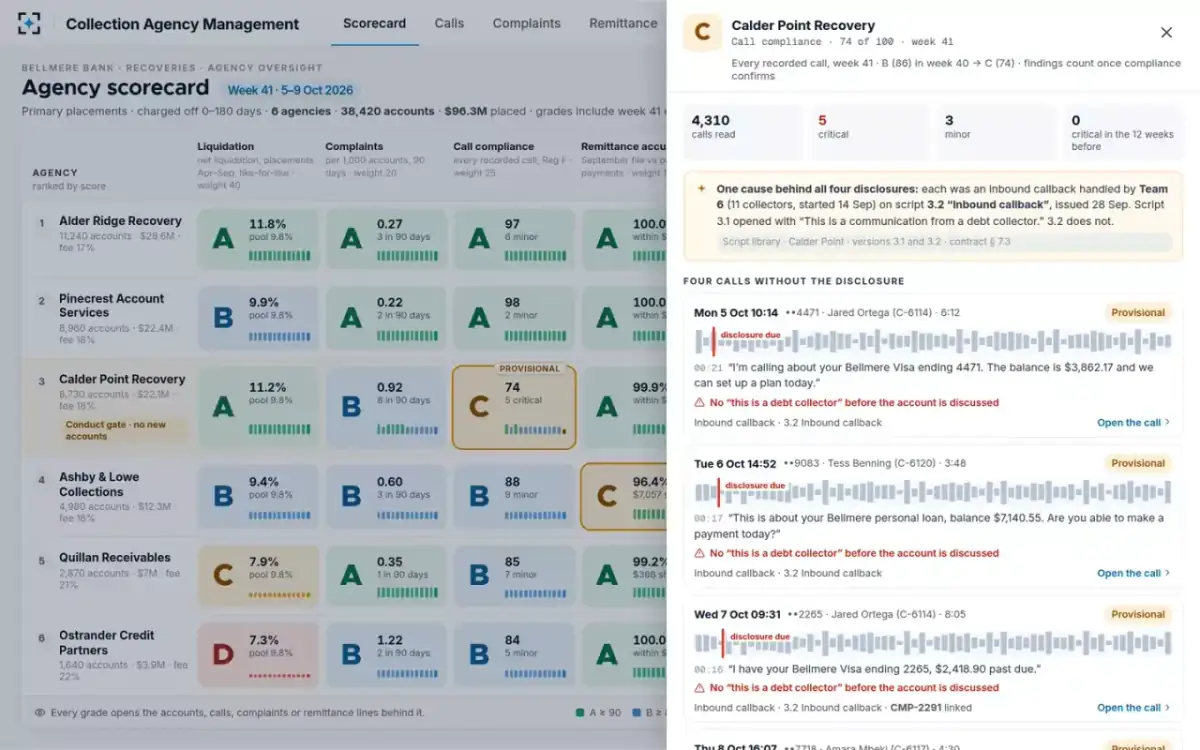
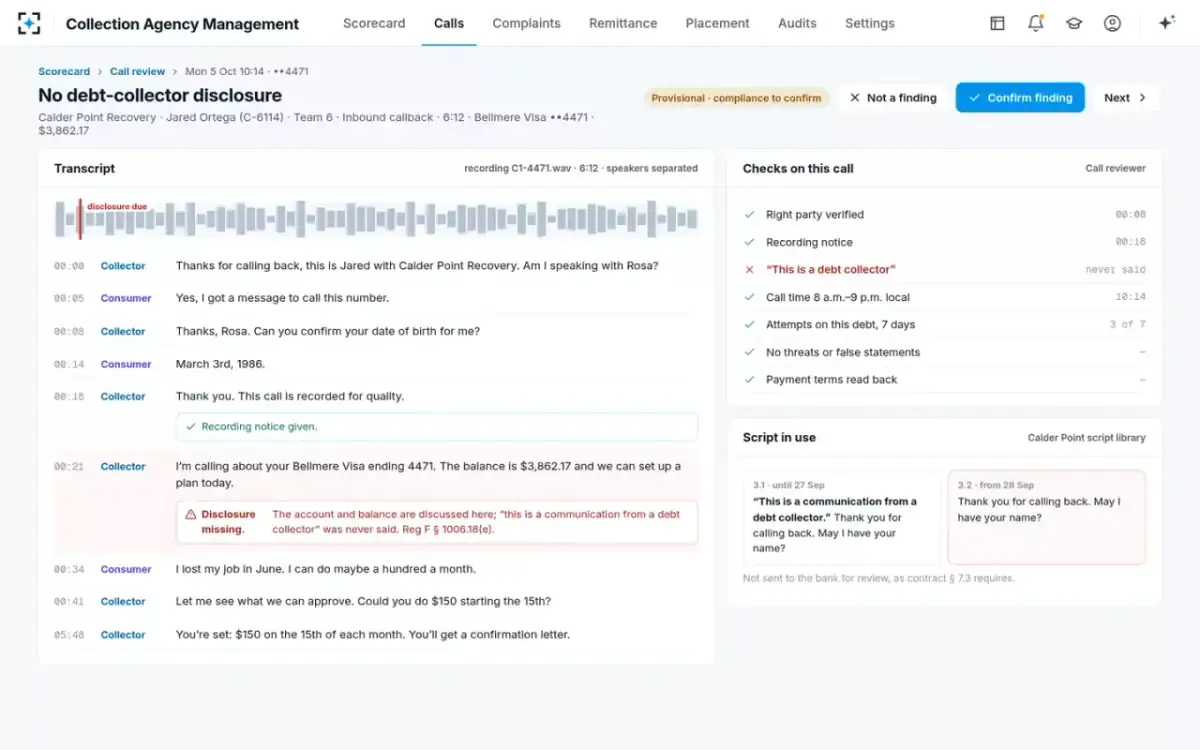
Read that remedy backwards and it is a test. For the missing disclosures, too, the report says the collectors will update their written communications and call scripts. If the fix for a disclosure failure is to update the call scripts, then the script version is a variable that determines compliance, and an oversight programme that does not hold every script version with its issue date cannot explain its own findings. The sample week in the solution turns on exactly this: four inbound callbacks that never said "this is a debt collector" before the account was discussed, all on one script issued on 28 September, where the previous version had opened with the line.
The inconvenient-time finding is the one that most clearly cannot be tested from a dialer log. Examiners found several calls in which the consumer told the agent plainly that the time or place was inconvenient and the agent kept the conversation going past the follow-up questions the rule allows — including, in the report's examples, consumers who said they were at work, driving, or at church without a wallet. Every one of those calls was placed inside the lawful window. The breach is in what was said afterwards, which means the test has to read the conversation.
The harassment finding sets the same trap in the opposite direction. The report describes collectors who placed over a hundred calls to consumers who had asked them to stop; the frequency was within the seven-in-seven presumption, so the collectors were entitled to it, but examiners found the volume after an explicit request overcame the presumption. A standard built only on the attempt count would have passed those accounts.
One grade, opened onto the calls behind it
The evidence an agency must keep, and for how long
A test is only as good as the evidence it can be run on next year, and Regulation F fixes both the period and the one case that surprises people. The general rule keeps evidence of compliance from the start of collection activity on a debt until three years after the collector's last collection activity on it. The special rule is flatter and stricter: a collector that records its collection calls must keep each recording for three years from the date of the call (12 CFR 1006.100).
Three consequences matter for oversight. The three-year clock on a recording runs from the call, not from the end of collection, so recordings age out of a panel on a rolling basis while accounts are still open. The duty attaches to the agency, not the lender, which means a lender that does not take delivery of the recordings is relying on a vendor to hold its own evidence — and on still being a customer when it needs them. And the duty is conditional on recording at all: an agency that records some channels and not others has a lawful gap in the evidence, and the contract, not the regulation, is where that gap gets closed.
That is the clause to read before buying anything. Nightly delivery of the recordings into the lender's own store converts a vendor's retention duty into the lender's own evidence, which is what lets the lender re-run a test on a period after the relationship has ended. What to ask for in writing is set out in how to choose a collection agency.
Grading conduct: four measures, four bands, one threshold
Tests produce findings; findings have to become a number, or they become a filing cabinet. The sample panel grades every agency weekly on four measures — net liquidation on like-for-like placements, complaints per 1,000 accounts over ninety days, call compliance across every recorded call, and remittance accuracy against posted payments and the contract fee — each scored out of 100, with bands at A for 90 and above, B for 80, C for 70, and D below 70. The weights are a setting; the sample bank uses 40 on liquidation, 25 on call compliance, 20 on complaints and 15 on remittance accuracy.
The threshold is what stops a good collector buying its way past bad conduct. If call compliance or complaints fall below 80, the agency gets no new accounts next month whatever its liquidation, until remediation evidence has been accepted. A weighted score alone cannot do that job, because weights trade: at 40 points for liquidation and 25 for call conduct, an agency with a strong enough liquidation score can absorb two grades of conduct and still rank above a clean competitor. A panel that pays for liquidation and grades mostly on liquidation has written that trade into its own scorecard. A threshold is the correction, and it is the part of the design that has to be a hard stop rather than a number.
The complaints measure needs one more decision: what counts as a complaint. The CFPB's own figures show how much of the picture sits in how a complaint ends rather than how many arrive. Of the debt collection complaints it sent to companies for 2024, companies closed 67% with an explanation, 27% with non-monetary relief and 0.2% with monetary relief; 2% drew an administrative response, 2% were still pending as of 3 March 2025, and for 2% the company gave no timely response.
How companies closed 2024’s debt collection complaints
Two of those bands are tests in themselves. "No timely response" is a conduct measure a lender can run without reading a single call, and "still pending" names the accounts where the clock is running. A complaints score that counts only volume treats an agency that answers everything in a week the same as one that lets its cases run late.
A finding is not a fact until a person confirms it
Any system that reads calls at this volume will raise findings that are wrong — a disclosure spoken over a crosstalk, a verification the transcript mangled, a time zone mapped from a stale address. That is not an argument for reading fewer calls; it is an argument for a rule about what a raised finding may do before a person has looked at it.
In the sample panel the rule is narrow and worth copying. A critical finding is provisional until the collections compliance manager opens the call and confirms it. While it is provisional it counts for one purpose only — holding back new placements — and for nothing else: not the published grade, not the fee, not a notice to the agency. Criticals reach a person within one business day, which is a setting.
One week of call review, from the files arriving to the grade moving
- Evidence arrives21,860 calls
- Every call read37 to a person
- Criticals raised5 critical
- A person confirms1 business day
- Grade moves, placement signedtwo letters
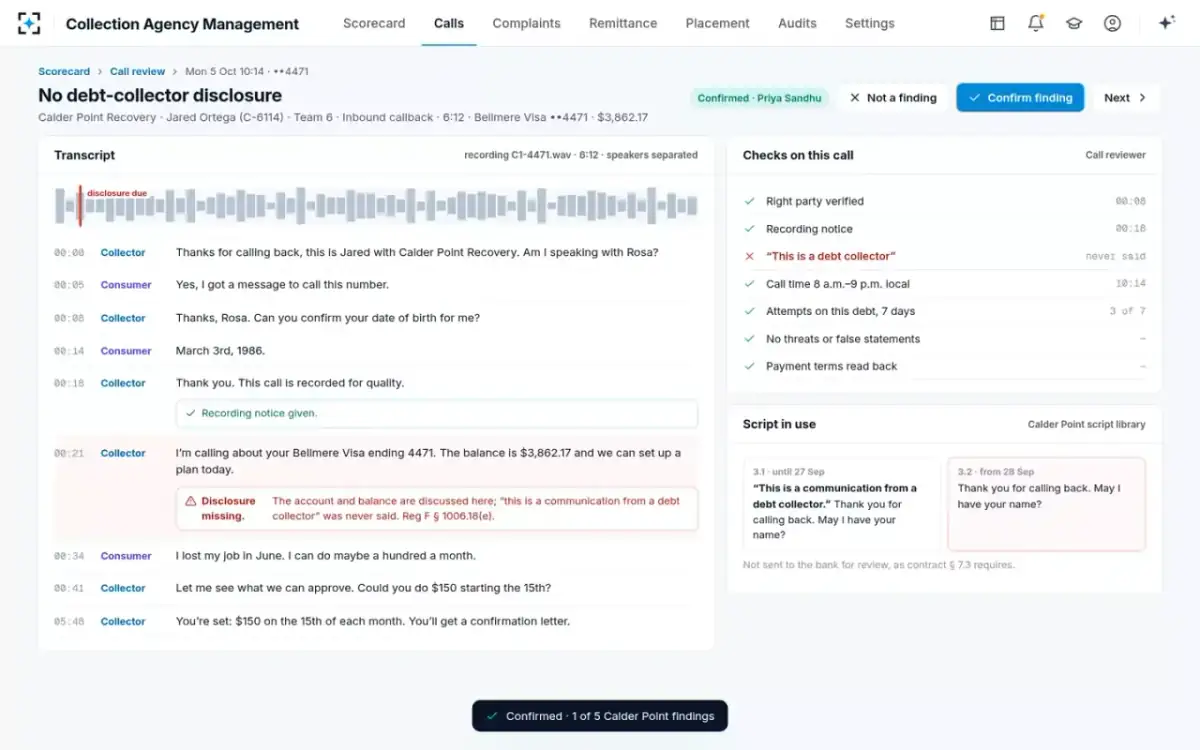
Confirmation is also what makes the finding usable later. A confirmed finding carries the name of the person who confirmed it, the call it was confirmed from and the second in that call — which is the form an examiner, an arbitrator or the agency's own counsel can argue with. An unconfirmed count is a number with no author.
The call itself, at the second the disclosure was due
Confirmed, with a name on it
What one week of testing produced on the sample panel
21,860
recorded calls read, from all six agencies
37
calls sent to a person for a decision
5critical
findings, all at one agency, each waiting for a person to confirm it from the call
4calls
traced to one cause: a callback script issued without the disclosure line
What the standards cannot reach is worth saying plainly. Conduct tests grade how an agency collects, not whether suing was the right answer — the duties change again at a suit placement, which is the subject of collection agency versus law firm. And a test is not an accuracy claim: what to demand of software that says it reads every call is set out in AI vendor management software. To see the duties, the findings and the confirmations on one panel, start from Collection Agency Management.
Questions people ask
How many agency calls should you review?
As many as you can read, and the arithmetic says that is more than a sample. A fault sitting in four calls out of a week's 21,860 has roughly a one-in-five chance of appearing in a random 5% review and about a two-in-three chance in a 25% one. Keep a small human sample for tone and pressure, which a transcript flattens, and read the rest for coverage.
What is a call monitoring scorecard?
A list of the duties checked on each call, with a pass or fail and the timestamp for each, rolled up to a score for the collector, the team and the agency. A useful one scores duties that have a rule behind them — the disclosure, right-party verification, call time, attempts, prohibited statements — and keeps soft quality measures such as tone on a separate line, so a courtesy score never cancels a conduct failure.
What do CFPB examiners look for in debt collection?
Its 2025 annual report describes examinations finding five things: validation notices not provided within five days of the first communication, false or misleading representations including use of a name other than the collector's true one, communication at times or places known to be inconvenient, harassing conduct, and continued use of a medium after the consumer asked the collector to stop. Several of them can only be tested by reading the communication itself.
How long must a collection agency keep call recordings?
Three years from the date of the call, under 12 CFR 1006.100(b), where the agency records calls at all. The general evidence-retention duty is different: it runs until three years after the last collection activity on the debt. Because the recording clock starts at the call, recordings age out while accounts are still being worked, which is the argument for taking delivery of them nightly rather than relying on the agency's copy.
What is a critical compliance finding?
A failure of a duty that has a rule behind it and a consumer on the other end of it — a missing debt-collector disclosure, the debt discussed with someone who was never verified, a call outside the hours after the consumer said the time was bad, attempts beyond the seven-in-seven presumption. The distinction that matters operationally is not the severity label but the consequence: on the sample panel a critical reaches a named person within one business day and holds back new placements while it is unconfirmed.
Can a lender be held responsible for its agency's conduct?
The CFPB's service-provider guidance says that entering a relationship with a service provider leaves the bank fully responsible for complying with federal consumer financial law and avoiding consumer harm, and that depending on the circumstances legal responsibility may lie with the lender as well as the agency. It also notes that due diligence does not shield a lender from liability, though it can reduce the risk of violations. That is why the tests matter more than the attestations.