Collections vendor management is the work of a lender whose collectors belong to someone else, and it is not the in-house desk most descriptions of a collections manager assume: a team of collectors, a dialer, a monthly target, a hiring plan. The title is often the same and the work is not. This seat spends its week reading other people's evidence — call recordings, remittance files, complaints, audit answers — and its output is not a collected dollar but a decision: which agency gets next month's accounts, and which conduct stops it. Botminds' Collection Agency Management is the system that seat works in, grading every agency and law firm weekly and opening each grade onto the evidence behind it.
What follows sets out the seat's mandate: its duties, its decision rights, the skills it needs and how it is staffed. The worked examples come from a fictional sample panel inside the solution — Bellmere Bank, six agencies, a law-firm network and one week of their files. The bank, the agencies, the firms and the people are invented sample data, not a customer's results.
The agency oversight desk's mandate, in one paragraph
The short form, for the top of the desk's charter: the collections manager, agency oversight, is accountable for the performance and conduct of the external collection agencies and law firms that work the bank's charged-off accounts. They grade each firm weekly on results and conduct against the contract, open every grade onto the evidence behind it, set and sign next month's placement allocation, recall accounts where the evidence requires it, and hold the remediation of every finding to a date. They do not manage collectors and they do not collect.
That last sentence is the one that changes who should sit in the seat. A manager of collectors succeeds by coaching, staffing and incentive design. A manager of agencies succeeds by reading, testing and deciding — and by being willing to move money away from a firm that performs well on the number the desk is judged by. Those are different temperaments, and a lender that does not say which one the seat needs tends to staff it with the wrong one.
The same job title, two different jobs
Collections manager, in-house: Employees the manager hires, trains, schedules and coaches.
Collections manager, agency oversight: Employees of other companies the manager has never met and cannot direct.
Collections manager, in-house: Staffing, queueing, scripts, incentives and contact strategy.
Collections manager, agency oversight: Where next month’s accounts go, which accounts come back, and which findings must be remediated by when.
Collections manager, in-house: Dashboards and a quality sample of the team’s own calls.
Collections manager, agency oversight: Everything the firms send: recordings, dialer logs, remittance and activity files, complaints, audit answers and contracts.
Collections manager, in-house: Coach the collector, change the script, retrain the team.
Collections manager, agency oversight: Raise a finding, require evidence of the fix, re-test it, and hold back placements until it clears.
Collections manager, in-house: Dollars per collector hour, which hides how they were collected.
Collections manager, agency oversight: Liquidation by agency, which hides that the agencies were given different paper.
Collections manager, in-house: The manager, through the team.
Collections manager, agency oversight: The manager, the compliance officer, the vendor-risk function and ultimately the bank — the agency’s failure is the bank’s to answer for.
What does a collections manager do when the collectors are not yours?
The duties divide into four, and they are worth writing as four because they carry different evidence and different approvers. The desk measures results, tests conduct, reconciles money, and allocates work. Everything else is reporting.
Measuring results means comparing agencies on the same paper, which is harder than it sounds and is a common place for an oversight programme to be quietly wrong: an agency handed older, lower-balance, previously worked accounts will show worse liquidation than one handed fresh paper, and no amount of weighting fixes a comparison that was never like-for-like. That problem is worked through in charge-off recovery rate.
Testing conduct means turning the rules into tests that can fail on this week's calls, rather than collecting attestations that they did not; the test sheet is in collection agency compliance standards. Reconciling money means tying every remittance line to a posted payment and the contract fee rate, and explaining each variance rather than accepting a net figure. Allocating work means proposing, defending and signing the share of next month's placements each firm receives.
What the seat does not do is equally worth writing into its mandate, because people from in-house desks assume otherwise. It does not set contact strategy, write scripts, or own the dialer. It does not answer consumer complaints, though it reads every one. It does not negotiate the contract alone — procurement and legal own that — but it owns every clause that produces evidence, and it should be in the room when those clauses are written.
The five seats around one agency panel
On a panel of any size the work is not one job. It is a small group with distinct decision rights, and an organisation chart that collapses them into one person tends to collapse the separation that makes the oversight credible — the person who raises a conduct finding should not be the person whose bonus depends on the recovery number.
Five seats, one panel, and what each one decides
Today
Finds out an agency went wrong when the complaint lands, a month after the call, and argues placement shares every quarter.
With agents
Sees every firm graded each Monday on four measures, and signs a placement proposal that already follows the grades.
Still theirs: Signing the monthly placement, and recalling up to fifty accounts.
Today
Gets a score from a call sample and has to go and find the call it came from.
With agents
Opens the call at the second the duty was due, beside the script version in force that day, and confirms or dismisses the finding.
Still theirs: Confirming every critical finding from the call itself.
Today
Spends half an audit asking agencies for files they already sent to someone else at the bank.
With agents
Works from a log of what each firm sent and what has been read, with the gaps already raised as open items.
Still theirs: Opening and closing audit findings, and the audit calendar.
Today
Is asked for the cost of a recall after inventory has already been pulled, and builds the number by hand.
With agents
Prices a recall before it happens: liquidation on like-for-like placements, and the recoveries a full recall would give up.
Still theirs: The placement model, the strata and the capacity caps.
Today
Hears about an agency pause after the decision has been made.
With agents
Co-signs a pause or a recall of more than fifty accounts, with the calls and the numbers in front of them.
Still theirs: The second signature, and the relationship with each firm’s principals.
Two separations are worth defending in any structure. The person who confirms a conduct finding should not report to the person whose placement proposal the finding would block. And the second signature on a pause or a large recall should sit above both, because that decision trades money for conduct and ought to be made by someone who owns both numbers.
What the desk reads in a week
The volume is the part most descriptions of the seat leave out. On the sample panel one week brings 21,860 recorded calls across six agencies, six monthly remittance files, three new complaints and two audit responses — and that is a mid-sized panel, not a large one. Reading a 5% sample of the calls is still more than a person can do carefully in a week.
The interagency guidance on third-party relationships says the quiet part about resourcing plainly: effective monitoring needs enough staff, with the expertise, the authority and the accountability to carry out the full range of ongoing monitoring (Interagency Guidance on Third-Party Relationships, June 2023). Expertise, authority and accountability are three separate asks. A desk with expertise and no authority produces findings nobody acts on; a desk with authority and no capacity produces assurances nobody tested.
A Monday morning's reading, before anything has been graded
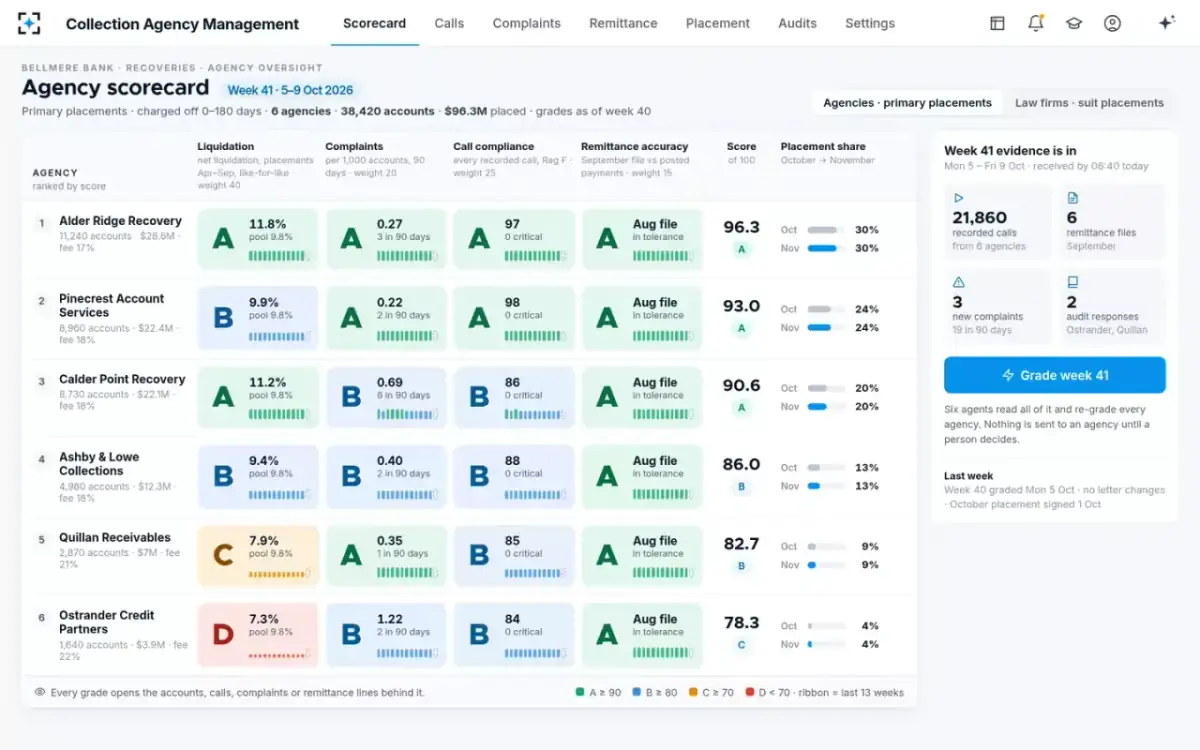
A Monday on the oversight desk
- Read the in-traywhat arrived
- Grade the weekfour measures
- Confirm the criticalsfrom the call
- Price the recallwhat it costs
- Sign and co-signtwo names
What the desk decides, and what needs a second name
A mandate that lists duties without decision rights is a description of homework. The table below is the version worth writing down: each duty with the evidence it is done from, the decision it produces and the signature it needs. It is also, not coincidentally, an audit trail — if an examiner asks what the desk is accountable for, this is the answer.
Duty, the evidence it is done from, the decision, and who signs
| Duty | Evidence read | Decision produced | Who signs |
|---|---|---|---|
| Grade each firm weekly | Liquidation on like-for-like placements, every recorded call, complaints over ninety days, remittance against posted payments | A letter grade per measure, with the week’s movement and what caused it | Agency manager, on the published grade |
| Confirm conduct findings | The call itself, its timestamps and the script version in force that day | Confirmed or dismissed, with the second in the call it was confirmed from | Collections compliance manager, personally |
| Reconcile remittances | The remittance file, the posted payments and the contract fee schedule with its amendments | A variance explained line by line, and a correction requested or offset proposed | Agency manager, on any offset |
| Set next month’s placement | The grades, the conduct threshold, capacity caps and the strata | The share of next month’s accounts each firm receives, and the accounts that move | Agency manager |
| Pause a firm, or recall at scale | The confirmed findings, the open audit items and the recoveries a recall would give up | New placements stopped, or more than fifty accounts recalled | Agency manager and head of recoveries |
| Close an audit finding | The remediation evidence the contract requires, and a re-test on later files | Closed, or kept open with a new date | Vendor auditor |
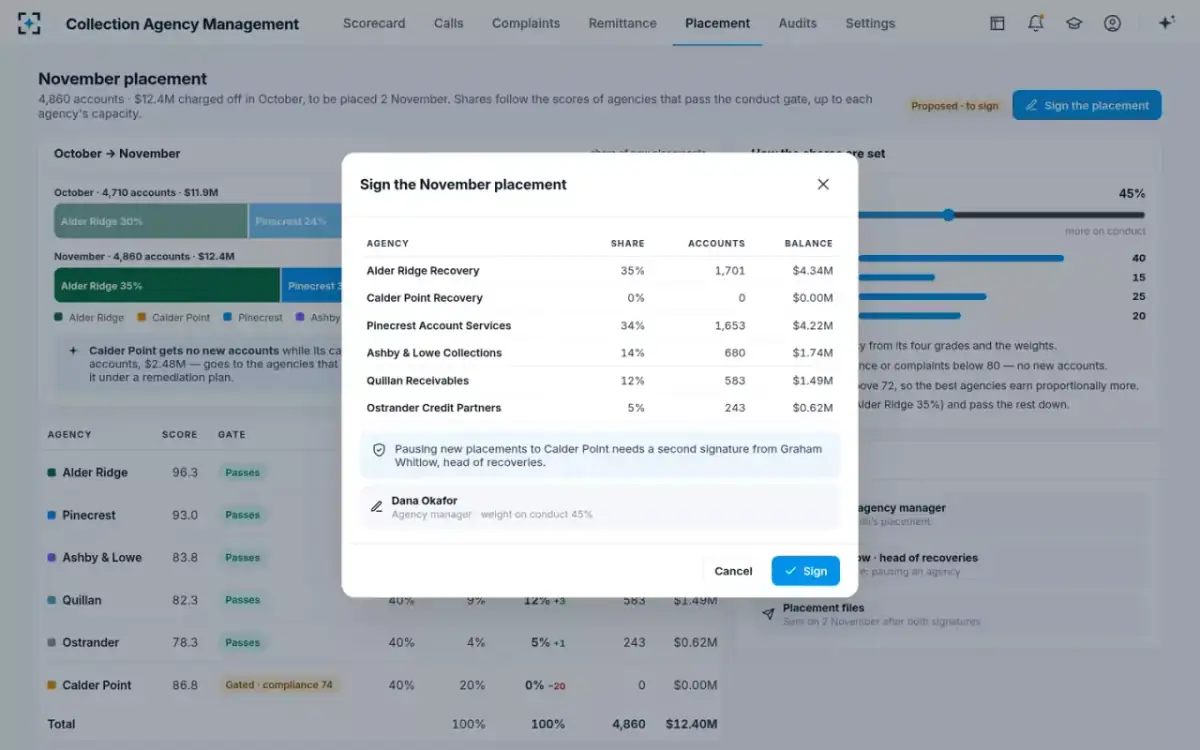
The second-signature rule is the one most worth copying. Pausing a firm costs money that is reasonably certain in exchange for conduct risk that is not, and that trade should never be one person's call — particularly not the person who will be asked next quarter why recoveries fell. On the sample panel, pausing an agency or recalling more than fifty accounts requires the head of recoveries alongside the agency manager, and the placement files do not go out until both names are on them.
The decision, with both names on it
What skills does a vendor oversight manager need?
The skills that matter are not the ones an in-house collections desk needs. Five carry the work.
The first is reading evidence against a rule. Most of the week is spent asking whether a specific thing that happened matches a specific sentence in a regulation or a contract — not whether it felt acceptable. The second is contract literacy of a particular kind: not drafting, but knowing which clause produces which artefact, and noticing when a clause promises a report rather than the underlying file.
The third is comparison discipline. Agencies will always argue that their paper was worse, and sometimes they will be right; a manager who cannot construct a like-for-like comparison will either be bullied by the argument or ignore a true one. The fourth is the willingness to be unpopular on a schedule — to pause the firm that collects best this quarter because the calls say so. The fifth is plain writing, because the output of the desk is findings and recommendations that other people act on months later.
The CFPB's service-provider guidance reads, if you take it as a specification for the desk, as a list of what this function has to be capable of: verifying by due diligence that the firm understands and can comply with federal consumer financial law; reading its policies, procedures, internal controls and training materials; getting clear compliance expectations and enforceable consequences into the contract; running internal controls and ongoing monitoring; and acting promptly on what the monitoring finds, up to ending the relationship. The last item is the one that needs authority rather than skill, which is why it belongs in the mandate as a decision right and not as a competency.
Eight questions that test whether the desk can do the work
- Walk through the last conduct finding the desk raised, from the evidence to the remediation.
Listen for a specific artefact — a call, a letter, a file — and a date the fix was re-tested. A desk that describes a scorecard has not done it.
- How does the desk tell whether agency A really outperformed agency B?
The good answer starts by asking what paper each was given, by vintage, balance band and prior placement history, before any rate is compared.
- What happens if the best-collecting firm fails a conduct test in the same month?
There is no clever answer. There is an answer that names who decides, what evidence goes with it, and what the firm is told and when.
- Which clause in an agency contract does the desk read first, and why?
Recall rights, audit rights and the evidence-delivery obligations are all defensible answers. "The fee schedule" is an answer about a different job.
- How does the desk reconcile a remittance file it thinks is short?
Listen for tying lines to posted payments and to the fee rate in force under the right amendment — not for a net variance accepted within a tolerance.
- What is in a complaint that a complaint count cannot tell you?
The account, the call behind it and the collector. A desk that has linked complaints to calls will say so immediately.
- When did the desk last change its mind about a firm, and what changed it?
The seat requires being persuadable by evidence in both directions. A desk that has never upgraded a firm is as concerning as one that has never paused one.
- How is a paused firm explained to the head of recoveries?
This is the writing test. The answer should fit in a paragraph and contain a number, a rule and a date.
Why the oversight desk grows as the collecting seat shrinks
BLS projects employment of bill and account collectors to fall about 10% between 2025 and 2035, roughly 16,700 jobs, and attributes the decline to technology rather than to less debt: better software and automated calling are expected to let each collector handle more accounts, so the same collections work needs fewer employees (Occupational Outlook Handbook). Fewer collectors handling more accounts each is, from a lender's side of the glass, a description of rising conduct risk per head and an argument for the oversight seat to grow even as the collecting seat shrinks.
It also changes what the oversight desk is reading. An agency running more accounts per collector leans harder on dialers, templates and scripts — and script and dialer faults are systematic rather than individual. One bad script does not produce one bad call; it produces every call that team made that week, which is exactly the failure a sample is worst at catching.
How the desk is staffed as the panel grows
There is no published ratio for this, and anyone who quotes one is guessing. What can be said is what the work scales with, which is a more useful thing to put in a staffing case. Grading scales with the number of firms, not the number of accounts: six agencies need six comparisons whether the panel holds 38,000 accounts or 380,000. Reading scales with the volume of evidence — calls, remittance lines, complaints — and so does the time to confirm findings, because confirmation is a person watching a specific minute of a specific call.
Audit work scales with the contract calendar and with how many firms are new, since a first-year firm takes more evidence than a fifth-year one. Allocation scales with how often placement is set: a monthly cycle is roughly three times the work of a quarterly one, and is worth it only if the grades move enough between months to change the answer.
Where the leverage sits is on the reading, which is the one input that grows fastest and is least suited to a person. The practical staffing case for an oversight desk is usually not "hire more people to listen to more calls" but "read all of them, and keep the people for the judgement" — confirming findings, arguing with firms, writing the recommendation and signing. What the reading can and cannot be trusted with is set out in AI vendor management software.
One retention duty shapes the staffing question from underneath. Where an agency records calls it must keep each recording for three years from the date of the call (12 CFR 1006.100). A lender that takes delivery of those recordings can re-read a period later with a bigger team or a better tool; a lender that leaves them at the agency has a window that closes. Building the desk around evidence it holds itself is what makes next year's review possible. To see the grades, the evidence and the signatures on one panel, start from Collection Agency Management.
Questions people ask
What is the difference between a collections manager and an agency manager?
A collections manager usually runs collectors the company employs; an agency manager runs the relationship with firms that employ their own. The second job has no coaching, no scheduling and no dialer, and in exchange it has three things the first does not: a contract, an audit right and the power to move next month's accounts. Some banks give both roles the same title, which is how the second seat ends up staffed by people trained for the first.
Who signs off on collection placements?
In a well-separated structure the agency manager signs the monthly allocation and small recalls, and a second signature — the head of recoveries, say, or the chief risk officer — is required for anything that pauses a firm or recalls accounts at scale. The point of the second name is that pausing a firm trades certain money for uncertain risk, so it should not be decided by the person measured on the money alone.
What does a collections compliance manager do?
They own the conduct half of the panel: the tests that are run on calls and letters, the findings those tests raise, and the confirmation of each serious one from the evidence itself rather than from a score. On the sample panel a critical finding stays provisional until this person opens the call and confirms it, and while it is provisional it does one thing only — holds back new placements to that firm.
What does a vendor auditor do?
They run the periodic examination of each firm against its contract: policies, procedures, training, call recording, complaint handling, data security and subcontracting, plus the remediation of anything found before. The work that distinguishes a good one is unglamorous — keeping a log of what each firm sent and what has actually been read, so that the gaps are visible as open items rather than as silence.
How big should an agency oversight team be?
Nobody publishes a ratio, and the answer is that it depends on what scales. Grading scales with the number of firms, reading with the volume of evidence, audit work with the contract calendar and the number of new firms, and allocation with how often placement is reset. The supervisory expectation is stated as a capability rather than a headcount: sufficient staffing with the necessary expertise, authority and accountability to perform ongoing monitoring.
Why do fewer collectors mean more oversight work?
Because conduct risk concentrates. BLS projects employment of bill and account collectors to fall about 10% between 2025 and 2035 — roughly 16,700 jobs — and attributes the decline to software and automated calling letting fewer collectors handle more accounts. The oversight side of the same market carries the other half of the story: more accounts per collector concentrates conduct risk in scripts and dialer settings, which is work that lands on the lender's desk rather than the agency's.