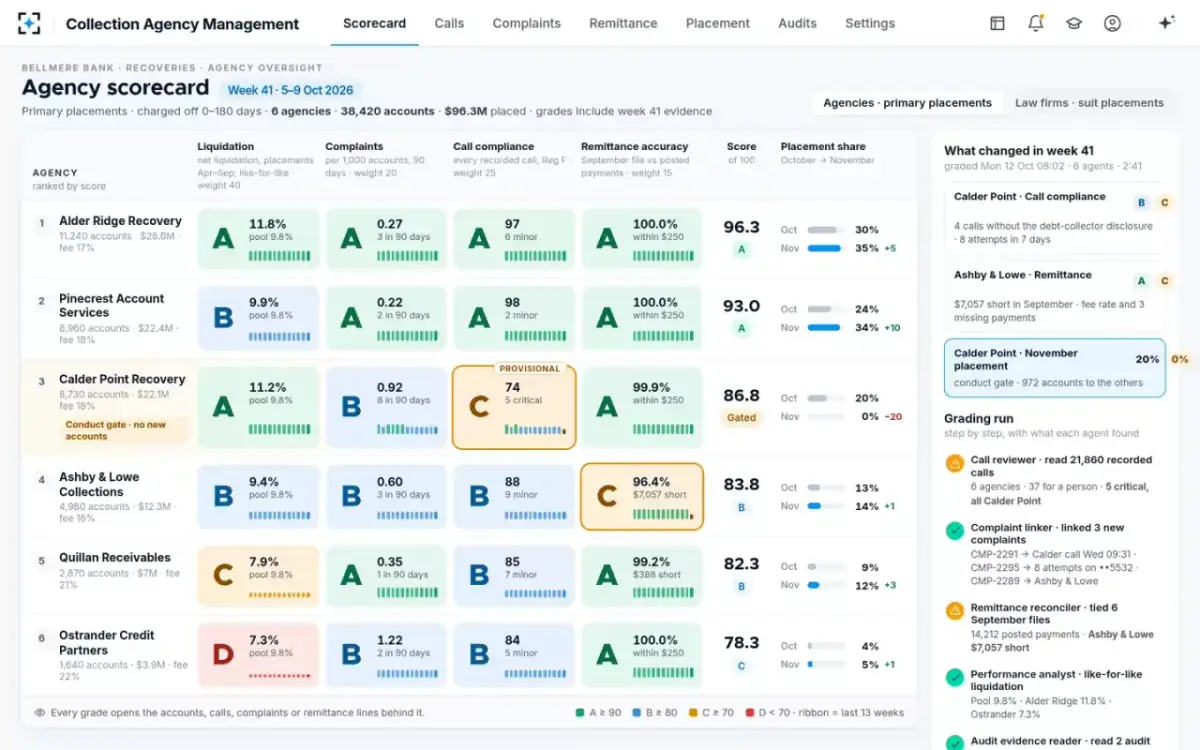
The difference between a collection agency and a collection law firm is not effort or seniority; it is the forum. An agency persuades, and its product is a payment or a promise to pay. A law firm can compel, and its product is a document filed with a court in the lender's name. That changes what can go wrong. An agency's risk lives in what a collector said on a call and can usually be corrected on the next call. A firm's risk lives in what a pleading or an affidavit asserted, and once it is filed it is on a public docket, enforceable against a consumer who may never appear. Botminds' Collection Agency Management grades both on one panel — agencies on primary placements, law firms on suit placements — because the measures differ while the obligation to oversee does not.
The sample panel used here is fictional: Bellmere Bank, six agencies and a law-firm network, and one week of their evidence inside the solution. The bank, the firms, the agencies and the people are invented sample data, not a customer's results. The research and the rules come from the regulators and courts linked where they appear.
Four numbers worth knowing before the first suit placement
81%
of 336 New York City collection cases brought by the 26 most litigious debt buyers initially ended in default judgment, in a study the FTC cited
6items
the FTC said a debt collection complaint should contain, from the original creditor to the breakdown of the amount
5dates
Regulation F allows as the itemization date — and only one of them can be right for a given file
1986
the year Congress repealed the FDCPA exemption for attorneys, putting collection firms inside the Act
Collection agency vs law firm: the difference that matters
Both are debt collectors. Both work on contingency, usually. Both can be sued under the same statute. The practical distinction is what each one can produce that the other cannot, and that distinction runs through every part of the relationship: the fee, the file, the oversight and the way a mistake is undone.
Agency placement and suit placement, side by side
Agency placement: Contact and persuasion: calls, letters, payment arrangements and settlements on accounts the lender still owns.
Suit placement: A legal claim, prosecuted in the lender’s name, with a judgment and the enforcement rights that follow it as the intended outcome.
Agency placement: A contingency rate on what is collected, commonly tiered by age and type of paper, with a different rate for secondary placements.
Suit placement: A contingency rate plus court costs and service fees advanced on each file — money that is spent whether or not anything is recovered.
Agency placement: Balance, contact details, charge-off date, payment history and any dispute or bankruptcy flag.
Suit placement: All of that, plus the documents that prove the claim: statements, the charge-off statement, the terms, and the chain of title on purchased paper.
Agency placement: In conduct: what was said, when the call was placed, how many attempts, and whether the required disclosures were made.
Suit placement: In assertion: what the pleading and the affidavit stated as fact, and whether the person who signed knew it.
Agency placement: Stop the calls, correct the account, answer the complaint, recall the file. Usually reversible within days.
Suit placement: Move to vacate, dismiss, or satisfy a judgment already entered — slower, public, and sometimes not within the lender’s gift at all.
Agency placement: The regulator, through complaints and examinations of the collector and the lender.
Suit placement: All of that, and a court that can sanction the filing, plus a docket anyone can read.
The last two rows are the ones that should decide how much oversight a suit placement gets. A conduct failure at an agency is embarrassing and expensive; a defective filing is a matter the lender may be unable to retract on its own timetable, because a court, a consumer's attorney and a public docket are now involved. The conduct standards that govern the first are set out in collection agency compliance standards; this page is about what changes when the work moves to a court.
Is a law firm a debt collector under the FDCPA?
Yes — and the question is settled rather than arguable. The FDCPA originally exempted attorneys collecting debts for clients. "In 1986, however, Congress repealed this exemption in its entirety, without creating a narrower, litigation-related, exemption to fill the void," the Supreme Court explained in Heintz v. Jenkins, holding plainly that "the Act does apply to lawyers engaged in litigation" (514 U.S. 291 (1995)). A firm that regularly collects consumer debts owed to another is inside the statute whether it writes letters, makes calls or files complaints.
Regulation F carries that through with one narrow accommodation, and the shape of it is instructive. The disclosure duties — telling the consumer in the first communication that this is an attempt to collect a debt, and in every later one that the communication is from a debt collector — do not apply to a court filing: "Disclosures under paragraphs (e)(1) and (2) of this section are not required in a formal pleading made in connection with a legal action" (12 CFR 1006.18(e)(3)). Everything a firm does that is not a formal pleading — the demand letter before suit, the phone call about a payment plan, the email about a settlement — carries the full disclosure duty, exactly as an agency's would.
For an oversight desk the practical reading is that a law firm does not get a lighter conduct test. It gets the same conduct test on everything outside the courtroom, plus a second set of tests on the filings. Both have to run, and the firm's own letterhead is not a reason to skip the first.
When should a debt go to a collection law firm?
Suit is a cost decision before it is a recovery decision, because the costs are spent up front and the recovery is not. Filing fees, service of process and, in many states, an affidavit that has to be prepared properly all come out of the lender's pocket at the start. A sensible placement rule therefore has a floor, an evidence condition and a set of exclusions, in that order.
The floor is the balance below which the expected recovery cannot carry the cost of suing, computed on the lender's own liquidation experience rather than a rule of thumb. Comparing that experience across firms on the same paper is its own problem; it is worked through in charge-off recovery rate.
The evidence condition is that the file can prove the claim today, not that someone believes it could. The exclusions are the accounts that must never go, and one of them is a rule, not a preference: a debt collector "must not sell, transfer for consideration, or place for collection a debt if the debt collector knows or should know that the debt has been paid or settled or discharged in bankruptcy" (12 CFR 1006.30(b)(1)). The phrase that does the work is "or should know". A lender whose bankruptcy and settlement flags are stale at the moment of placement does not escape the rule by not looking.
What a file must hold before it is placed for suit
- The account agreement and the terms in force at default
Not the current terms. The version that governed the account when it defaulted is the one a court will be asked about.
- Statements covering the period relied on
Enough to show how the balance was reached, and at minimum the statement nearest the itemization date the filing will use.
- The charge-off statement and date
The date the balance stopped moving, matched to the figure on the lender’s own books.
- A complete payment and credit history since the itemization date
A payment discovered after filing is one way an amount in a pleading turns out to be wrong.
- Chain of title, if the paper was ever bought or sold
The bill of sale and the assignment for each transfer, with the account identifiable in the schedule — not a general assignment of a portfolio.
- A current bankruptcy, deceased and settlement check, timestamped at placement
The rule is about what the collector should know, so the check has to be dated at the moment of placement, not at the last refresh.
- The statute of limitations position for the governing state, with the date it runs from
The FTC found that few complaints state the date of default or the limitation period, and some judges said a court should not raise the point itself.
- Dispute and validation history, including anything the agency received
A dispute that arrived at the agency and never reached the lender becomes a defence the firm did not know about.
What a suit placement adds to the file
Everything the lender already does for an agency placement still happens: the account is selected, the file is sent, the balance is agreed, the conduct is monitored. On top of that a suit adds four steps, and the lender's exposure changes at each one.
What a suit adds, and where the lender’s exposure moves
- Pleading in the lender’s namewhat is asserted
- Service of the summonswhether they knew
- Affidavit and judgmentwho swore to it
- Enforcementfunds moved
Each step produces a document, and each document is a thing an oversight desk can ask for and test. The pleading can be read against the six items the FTC said a complaint should contain. Service can be tested against the address the lender itself holds. The affidavit can be read against the itemization date and the payment history. Enforcement can be tested against whether the funds taken were exempt. None of that requires legal expertise beyond knowing what to compare with what.
What goes wrong in debt collection lawsuits
The FTC's staff report on debt collection litigation remains a detailed public account of the failure modes, and its central finding is uncomfortable for anyone who assumes the court is a check on the claim. "Very few consumers defend or otherwise participate in debt collection litigation, resulting in courts entering default judgment against them," the Commission wrote, recommending that states take steps to ensure consumers receive adequate notice and that the cost of participating is not prohibitive (Repairing a Broken System, July 2010). In a study the report cites, 81% of 336 New York City cases brought by the 26 most litigious debt buyers initially ended in default judgment.
That is the condition under which everything else goes wrong. If almost nobody appears, then no one raises the defects, and the defects compound quietly. The report groups them in a way that maps cleanly onto an oversight programme.
The first is notice. The report describes litigation alleging "over 100,000 instances of faulty service in New York State which resulted in default judgments against consumers". A lender cannot supervise a process server directly, but it can compare the address served with the address on its own file, which is a test that costs nothing and catches the systemic version of the problem.
The second is a complaint too thin to answer. "Complaints often do not contain sufficient information to allow consumers in their answers to admit or deny the allegations and assert affirmative defenses," the Commission found, and recommended that states require debt collection complaints to include "(1) the name of the original creditor and the last four digits of the original account number; (2) the date of default or charge-off and the amount due at that time; (3) the name of the current owner of the debt; (4) the total amount currently owed on the debt; (5) the total amount owed broken down by principal, interest, and fees; and (6) the relevant terms of the underlying credit contract, if the contract itself is not attached".
Whatever a particular state requires, that list is a ready-made test sheet. Pull ten of your firm's filings a month and check the six items. A filing that cannot state the breakdown of principal, interest and fees is telling you something about the data the firm was given, which is to say about the lender's own file.
The third is time-barred debt, and the FTC's description of the mechanism is the part worth remembering: "If consumers do not defend, there is no one to raise the defense that the debt is time-barred," and some judges at its roundtables said it would be improper for a court to consider an affirmative defence no party had raised. As a result, the Commission concluded, some courts appear to be granting default judgments on time-barred debt. The limitation period is therefore a control the lender has to run before placement, because nothing downstream is reliably going to run it.
Affidavits, itemization dates and the chain of title
An affidavit of debt is a sworn statement, usually from someone at the lender or the debt owner, that the account exists, that the amount is owed and that the deponent has knowledge of the records. It is the document that turns a file into a judgment when nobody appears, which is why a defect in it matters so much.
The defect need not be dishonesty; staleness is enough. Regulation F gave the industry a precise vocabulary for the date an amount is stated as of. The itemization date is whichever of five reference dates the collector can establish the amount of the debt on — the last statement date, the charge-off date, the last payment date, the transaction date or the judgment date (12 CFR 1006.34(b)(3)). The amount in the validation notice, and the itemization of interest, fees, payments and credits since, are all anchored to whichever one the collector chose.
The five itemization dates, and what a stale one does to a filing
The dateThe last statement date
What the rule says it isThe date of the last periodic statement, account statement or invoice a creditor gave the consumer.
What it costs if it is wrongUsually the freshest of the five, and the one a consumer can check against their own post. It moves if the creditor issued a later statement nobody passed on.
The dateThe charge-off date
What the rule says it isThe date the debt was charged off.
What it costs if it is wrongA natural choice on recovery paper, because it is the date the balance stopped moving. It is also the date the lender’s own system is most likely to hold correctly.
The dateThe last payment date
What the rule says it isThe date the last payment was applied to the debt.
What it costs if it is wrongThe most dangerous to pick late: a payment found after the notice went out changes the amount owed on the stated date, and with it the itemization in the filing.
The dateThe transaction date
What the rule says it isThe date of the transaction that gave rise to the debt.
What it costs if it is wrongRare on revolving paper and often unavailable on a purchased portfolio. If a firm has used it, ask what evidence it is reading.
The dateThe judgment date
What the rule says it isThe date of a final court judgment that determines the amount owed.
What it costs if it is wrongOnly available after judgment, so it cannot be the date in the first filing. Seeing it in a pre-judgment notice is a defect in itself.
A stale itemization date is a quiet defect with loud consequences. The validation notice told the consumer the amount as of a date; the affidavit swears to an amount as of a date; the pleading states a total. If a payment posted between those dates, or if the firm used the charge-off date while the lender's notice used the last statement date, the three documents disagree, and the disagreement is on the record in a case the consumer is statistically unlikely to attend. On the sample panel that is one of the named law-firm findings: affidavits filed with a stale itemization date, raised against the firm the same way a missing disclosure is raised against an agency.
Chain of title is the same problem one level up, and it is why some courts treat purchased paper differently. The FTC noted that "New York City requires debt buyers to present special affidavits showing the chain of title to obtain a judgment", with the rationale that "if debt buyers sue to collect, the debts at issue have changed hands more often and are older than other debts". A lender suing on its own originations has a shorter chain to prove; a lender that bought the paper, or sold it and took it back, has to be able to produce each assignment with the account identifiable in the schedule.
There is a historical note here that should reassure anyone doing this work. The FTC recommended in 2010 that Congress require collectors to include the date of default in the validation notice, so that the information would be available when an action was filed. Regulation F arrived with the itemization date and a required itemization of what has accrued since — not the date of default as such, but a fixed reference date, which can be the charge-off date, with the amount owed on it. Something close to the control the Commission asked for now exists in the rule; the remaining job is to test that filings honour it.
Overseeing a law-firm network on the same scorecard
A lender that runs both an agency panel and a law-firm network does not need two oversight programmes. It needs one, with different inputs on the firm side. The interagency guidance on third-party relationships is agnostic about the vendor's profession and specific about the intensity: monitoring should match the risk and complexity of the relationship, and a relationship that supports higher-risk or critical activities calls for monitoring that is more thorough or more frequent (Interagency Guidance on Third-Party Relationships, June 2023). Suing a consumer in the lender's name is, by any reading of that sentence, the higher-risk activity.
Overseeing a firm instead of an agency: what changes, line by line
| What the desk does | On an agency | On a law firm |
|---|---|---|
| What it reads | Call recordings, dialer logs, letters, remittance files and complaints. | Filings and affidavits, service returns, dockets and dispositions, settlement and judgment paperwork, and the firm’s pre-suit letters and calls. |
| What it grades | Liquidation on like-for-like placements, call conduct, complaints and remittance accuracy. | The same four, with conduct measured on pre-suit contact, and a fifth: the quality of what was filed — completeness, the itemization date, and the accuracy of the amount sworn to. |
| What a critical finding looks like | A call where the debt was discussed without the disclosure, or attempts beyond the presumption. | An affidavit sworn on a stale itemization date, a filing missing the amount breakdown, or service at an address the lender’s own file contradicts. |
| What it can recall | Any account, usually on short notice under the contract. | Accounts not yet filed, freely. Filed accounts need a dismissal, which is the firm’s act and the court’s, not a file transfer. |
| What the audit covers | Scripts, training, call recording, complaint handover, data security and subcontracting. | All of that, plus filing standards, who may sign an affidavit and on what knowledge, the service vendors used, and the handling of consumers who do appear. |
| What the remedy is | Pause new placements, retrain, recall the touched accounts, re-review for a period. | The same, and a review of open filed cases — because a defect found this week may already be sitting on a docket. |
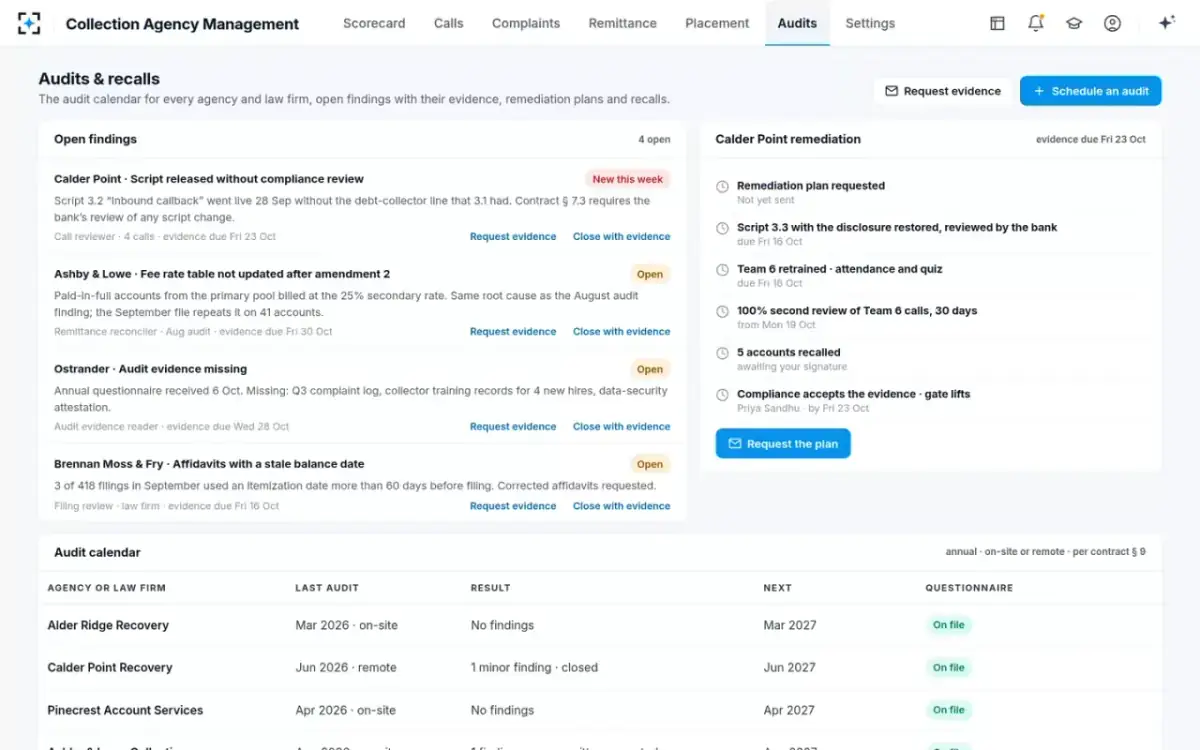
Agencies and law firms on one audit calendar
One scorecard, with a switch to suit placements
The costs that only appear after judgment
The arithmetic that justifies a suit placement is usually written on the day of filing and never revisited. Four costs arrive later, and all four are knowable in advance.
The first is enforcement that fails. A judgment is a right to try to collect, not money; if the consumer has no attachable wages or accounts, the court costs and service fees were spent for an asset that may sit unenforced for years. The second is enforcement that succeeds against the wrong funds. The FTC listed "improperly garnishing exempt funds from bank accounts" among the practices raising substantial consumer protection concerns, and exemption rules are state law a lender cannot delegate its interest in.
The third is the case that is defended. Roundtable participants told the Commission that collectors, particularly debt buyers, "are not ready to proceed to trial when consumers appear to defend", and that because consumers appear so rarely, some collectors may decide not to incur the cost of being ready. The resulting continuances and dismissals without prejudice are a cost the lender pays in time and in the quality of its own claim.
The fourth is the judgment that is vacated. A judgment set aside for defective service or a defective affidavit does not merely reverse the recovery; it puts the lender's name on a vacated order and sometimes on a counterclaim. This is the cost that makes a filing-quality measure worth carrying on the scorecard even though it is harder to compute than liquidation.
None of this argues against suing. It argues for the same thing the conduct standards argue for on the agency side: a measure, an evidence source and a person who signs. What that looks like as a system, and what to ask for when buying one, is set out in collection agency management software. To see agencies and firms graded together on one panel, start from Collection Agency Management.
Questions people ask
How should a lender check its law firms' affidavits?
Sample them every month and tie each one back to the lender's own file: the amount sworn to should match the itemization date used in the validation notice and the payment history since it, and the signer's role should match the firm's stated policy on who may swear and on what knowledge. An affidavit is what lets a court enter judgment when the consumer does not appear, which in the FTC's evidence is most of the time, so its accuracy is doing work no adversary is doing. A mismatch found in the sample is a finding against the firm, raised and remediated like any other.
What information must a debt collection complaint contain?
That is set by each state's rules, and the FTC found that complaints often do not contain enough for a consumer to admit, deny or raise a defence. Its recommendation — a useful test sheet whatever your state requires — is the original creditor's name and the last four digits of the original account number, the date of default or charge-off and the amount then due, the current owner, the total now owed, that total broken down by principal, interest and fees, and the relevant contract terms if the contract is not attached.
Can a law firm charge a contingency fee like an agency?
Commonly yes, and that is the usual structure on consumer recovery work, but the economics differ in one respect a lender has to budget for: court costs and service fees are advanced per file and are spent whether or not anything is recovered. Some networks bill those at cost and some add a handling charge, so the effective rate on a suit placement is not comparable with an agency's contingency rate unless the costs are counted on the same line.
Does the debt-collector disclosure apply to court filings?
No, and only there. Regulation F states that the initial and subsequent communication disclosures "are not required in a formal pleading made in connection with a legal action". Everything else the firm does — the pre-suit demand letter, calls about a payment plan, settlement correspondence — carries the disclosure duty in full, which is why a law firm's non-court contact belongs in the same call and letter review as an agency's.
Can an account be recalled once a suit has been filed?
Not in the way an agency placement is recalled. Before filing, an account can be pulled back like any other. After filing, ending the case requires a dismissal, which is an act of the firm and the court, takes time, and may carry conditions. That asymmetry is the reason a suit placement deserves a tighter pre-placement check than a primary placement: the cheap moment to catch a problem is the only moment that is cheap.
Why do so many debt collection cases end in default judgment?
Because consumers rarely appear. The FTC found that very few consumers defend or otherwise participate, with courts entering default judgment against them as a result, and it pointed at two causes it thought states could address: notice that does not reach people, and the cost of participating. In one study the report cites, 81% of 336 New York City cases brought by the most litigious debt buyers initially ended that way. For a lender the consequence is that the court will not usually catch a defect in your filing, so your own review has to.