First-party collections is the original creditor collecting its own debt with its own staff and its own name on the call. Third-party collections is an outside agency collecting that same debt for the creditor. The difference is legal, not organisational: the day a lender places a charged-off account with an agency, the person on the phone becomes a debt collector under the Fair Debt Collection Practices Act as written out in Regulation F, and the borrower gains disclosure, validation and call-frequency protections that the lender’s own collectors never triggered. What does not change is who answers for the work. Botminds’ Collection Agency Management reads every call recording, remittance file, complaint and audit answer the outside agencies send, grades each agency weekly on results and conduct, and proposes where next month’s accounts should go.
The worked examples below come from a fictional sample lender as it runs through the solution: Bellmere Bank, whose primary pool of 38,420 charged-off accounts and $96.3 million sits with six agencies. The bank, the agencies, the law firms and the people are invented sample data. The rules are not, and each is linked where it appears.
What is third-party collections?
Third-party collections is debt collection performed by someone other than the creditor the debt is owed to — an agency, a collection law firm, or a servicer acting for the owner of the account. The creditor keeps the debt on its own books and instructs the third party to work it, usually for a percentage of whatever comes back. Nothing about the borrower’s obligation changes. What changes is who is allowed to say what, how often they may call, and what they must put in writing before they can take the first payment.
The term matters because federal law draws its line in the same place. Regulation F defines a creditor as “any person who offers or extends credit creating a debt or to whom a debt is owed”, and then takes the definition away from anyone standing in for that creditor: “The term creditor does not, however, include any person to the extent that such person receives an assignment or transfer of a debt in default solely to facilitate collection of the debt for another” (12 CFR 1006.2). An agency holding a placement file is exactly that person.
What moves to the agency at placement, and what never leaves the lender
Moves to the agency
The calls and the letters
An outside collector dials, writes and answers. The lender no longer chooses the words.
The conversation with the borrower
Payment arrangements, disputes and hardship claims are first heard by someone the lender does not employ.
The daily handling of the account
Attempts, promises, broken promises and notes live on the agency’s own system until its file arrives.
A share of every dollar
A contingency fee is taken from what is collected, so the lender nets less than the payment the borrower made.
Stays with the lender
Ownership of the debt
Placement is an instruction to collect, not a sale. The lender is still the creditor and can take the account back.
The borrower relationship
The name on the statement, the deposit account down the hall and the next application are all still the lender’s.
The complaint
It arrives at the bank, through the regulator’s portal or in the post, whoever made the call it is about.
The answer to the examiner
Supervisors ask the lender what it required, what it monitored and what it did when it found something.
The difference between first-party and third-party collections, in one line
One line will do: in first-party collections the caller is the creditor, and in third-party collections the caller is collecting for the creditor. Everything practitioners argue about follows from that sentence rather than from the organisation chart.
It is why an outsourced early-stage call centre that collects under the lender’s own name, before charge-off, is usually described as first-party work even though the people are not the lender’s employees — and why the label is a poor guide to the law. The safe question is never “is this team first party?” but “does the Act’s definition of a debt collector reach whoever is making this call?” A vendor dialling pre-charge-off accounts in the lender’s name may still be a debt collector if debt collection is the principal purpose of its business, unless one of the rule’s exclusions applies — for example, debts that were not yet in default when the vendor took them on. The label is a commercial description; the definition is the test.
Who is a debt collector under Regulation F?
The rule is explicit, and it is wider than many placement discussions assume. Regulation F treats as a debt collector anyone who uses the mail or any other means of interstate commerce in a business whose principal purpose is collecting debts, and anyone who regularly collects or tries to collect, directly or indirectly, debts owed or said to be owed to someone else (12 CFR 1006.2(i)(1)). The same paragraph pulls in a creditor that collects its own debts under a different name suggesting a third party is involved.
Two phrases carry the weight. “Principal purpose of which is the collection of debts” catches the agency whatever it is called, and “regularly collects … debts owed or due … to another” catches the firm whose main business is something else — a law firm, for instance — when collecting for others is a regular part of it. Neither phrase depends on whether the account is charged off, how old it is, or what the lender calls the programme.
The practical consequence for a lender is that the rules attach to the agency the moment it starts work, not after a settling-in period. A script that was lawful for the bank’s own collectors can be unlawful in the agency’s mouth on day one. Which rules those are, and who enforces each of them, is the subject of who regulates collection agencies and what the lender still owes.
What changes for the borrower the day an account is placed
Three protections start working at placement, and all three leave evidence a lender can ask for.
The disclosure. An outside collector must say, in its first communication, that it is attempting to collect a debt and that any information obtained will be used for that purpose — and after that, Regulation F requires every later communication with the consumer to say that it comes from a debt collector (12 CFR 1006.18(e)). It is the simplest obligation in the whole rule and, because it is a line in a script, the easiest to lose when the script is revised.
Validation. The borrower must be given the validation information either in that first communication or in a notice sent within five days of it, and then gets a validation period that runs for 30 days after the notice is received; a collector may assume receipt five business days after sending (12 CFR 1006.34). Inside that period a written dispute stops collection until the collector sends verification. None of this exists while the lender is calling its own borrower.
A call-frequency line. The rule sets a presumption of compliance at no more than seven telephone calls to a person about a particular debt in seven consecutive days, and none within seven days of actually speaking to them. It also sets the presumption the other way: a collector that calls a person about a particular debt more often than either of those limits is presumed to have broken the rule against harassing calls (12 CFR 1006.14(b)(2)). A dialler campaign set up for in-house use can break it without anyone choosing to.
There is a fourth change the borrower will not notice until later. An outside collector must not report the debt to a credit bureau until it has first spoken to the consumer or posted or sent a message and waited a reasonable period for a notice of undeliverability (12 CFR 1006.30(a)(1)). The rule exists because the first a consumer hears of some placed debts used to be the credit file.
One placed account: the rule’s clock, and what the sample file actually did
- Notice5 days
- Receipt+5 bus. days
- Validation period30 days
- Held in-house35 days
- Placed and worked19 days to the complaint
- Recall5 bus. days
Placing, selling and suing: three different moves with three different exits
“Sending it to collections” covers three decisions that behave nothing alike. Placement is a service arrangement the lender can end. A sale is a transfer of ownership it cannot. Referring the account to a collection law firm for suit is a placement with a court at the end of it, and with a second set of obligations that attach to pleadings rather than to calls.
Place, sell or sue: who owns the debt, how the outside party is paid, and what the lender can still undo
| The move | Who owns the debt afterwards | How the outside party is paid | What the lender can undo — and must still watch |
|---|---|---|---|
| Placement with an agency | The lender. The agency holds a file and an instruction, nothing more. | A contingency percentage of what it collects, usually rising at each later placement stage. | Everything: accounts can be recalled on notice. The lender watches conduct, remittances and complaints for as long as the paper is out. |
| Sale to a debt buyer | The buyer, outright, from the sale date. | Nothing. The buyer paid a price for the portfolio and keeps what it collects. | Almost nothing after settlement, beyond repurchase rights for accounts sold in error. What the lender still owns is the quality of the data it sold and the promises in the sale agreement. |
| Referral to a collection law firm | The lender, as with any placement. | A contingency fee, sometimes with court costs advanced and reimbursed. | The referral can be withdrawn before suit; afterwards there is a case with a court’s timetable. The lender watches affidavits and pleadings as closely as calls. |
The exits differ because the ownership does. This is also why the economics are not comparable: a sale produces one certain price today, a placement produces an uncertain stream net of fees over a year or more, and the only honest way to compare them is on what reaches the lender. Measuring that stream fairly is harder than it looks, and what a charge-off recovery rate really measures sets out the traps. When a case needs a court rather than a phone, the choice between an agency and a law firm turns on a different set of facts again.
What the lender keeps, whoever makes the call
The principle that governs the whole arrangement is not in Regulation F. It is in the supervisory guidance the Federal Reserve, the FDIC and the OCC issued jointly in June 2023, which tells a banking organisation that using third parties leaves its own obligations exactly where they were — it must meet them to the same extent as if the work were performed in-house (Interagency Guidance on Third-Party Relationships). Placement moves the work. It does not move the duty, and the standards an agency has to be tested against are the lender’s to set and to check.
In practice that means the lender is the one holding a file when the complaint arrives, the one an examiner asks for evidence, and the one whose name is on the dispute. It is also the one that pays twice for a bad month: once in the fee on money collected badly, and again in the remediation.
The same call, made by two people
A collector the lender employs: Identifies the bank. No federal debt-collector disclosure is triggered by the call itself.
A collector at a placed agency: Must say it is attempting to collect a debt in the first communication, and that the communication is from a debt collector in every one after it.
A collector the lender employs: Works from the bank’s own statement history.
A collector at a placed agency: Must provide validation information in the first communication or within five days, including the itemization date and the amount on it.
A collector the lender employs: Handled under the bank’s own complaint and billing-error procedures.
A collector at a placed agency: Inside the validation period, collection stops until the collector sends verification of the debt.
A collector the lender employs: Governed by the bank’s policy and state law.
A collector at a placed agency: Seven calls in seven days about one debt, and none for seven days after a conversation, is the presumption of compliance.
A collector the lender employs: The bank furnishes as the creditor.
A collector at a placed agency: Must not furnish until it has spoken to the consumer, or written and waited a reasonable period.
A collector the lender employs: The bank.
A collector at a placed agency: The agency — and the bank.
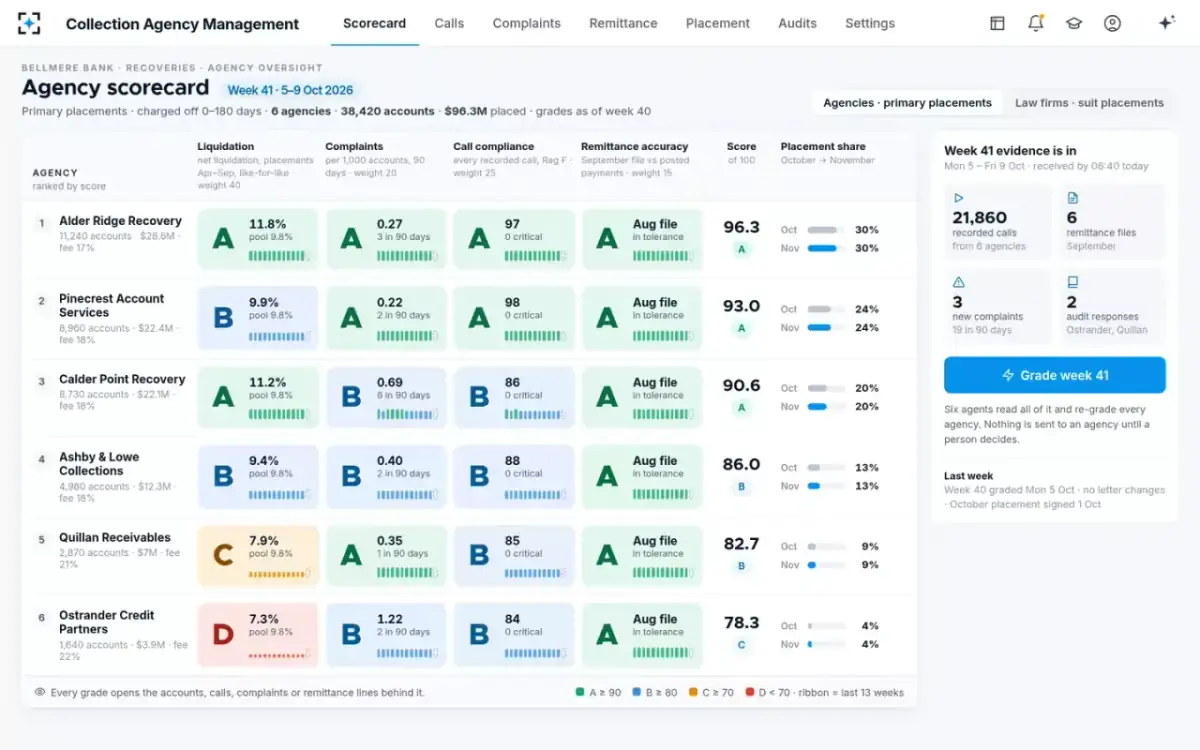
A week of evidence arriving from six outside agencies, before anyone has read it
Recall: the account that comes back
Because placement is an instruction rather than a sale, the lender can take the account back. Recall rights are a contract term, not a statutory one, so the notice period and the limits are whatever was negotiated — in the sample bank’s contracts, any account can be recalled on five business days’ notice under clause 5.1.
The reason a lender recalls is usually one of four: a conduct finding on the account, a borrower in a hardship or bankruptcy process the agency should not be working, a data error that means the account should never have gone out, or a decision to move the whole placement elsewhere. The first three are single accounts. The fourth is a strategic move with a price, because accounts in flight are part-worked, and pulling them discards the contact work already done.
That price is the part most teams underestimate. In the sample week, one agency’s conduct findings prompted the question directly: five accounts touched by findings were recalled, and the other 8,730 stayed where they were, because a full recall would have given up roughly $410,000 of expected recoveries. Deciding to pause new business while leaving the existing paper in place is a different decision from a recall, and worth keeping separate in a policy.
Recall is also where approvals belong. At the sample bank the agency manager can recall up to 50 accounts alone; more than that, or a pause on new placements, needs the head of recoveries to co-sign.
What a lender has to be able to see once the calls are someone else’s
After placement, the lender’s knowledge of its own borrowers is second-hand. It arrives as files: call recordings and dialler logs overnight, remittance and activity reports monthly, complaints through the regulator’s portal and the post, audit answers once a year. Each of those is evidence of what happened; none of them is oversight until someone reads it against the rules and the contract.
The gap is one of volume. Six agencies working a pool of 38,420 accounts generated 21,860 recorded calls in a single week at the sample bank. A sample of two hundred calls a month is a statement about the lender’s capacity, not about the agency’s conduct, and it cannot find the thing that matters most — the common cause. Four missed disclosures spread across four thousand calls look like four mistakes until you notice they share a team and a script version.
So the test of post-placement oversight is not whether a report exists. It is whether a lender can answer, in the same week, three questions: what did every agency actually say to our borrowers, did the money they collected arrive in full and at the contracted rate, and does next month’s allocation reflect either answer. In the solution those are one weekly run: every recorded call read, every remittance line tied to a posted payment and a contract fee, and a placement proposal that moves accounts toward the agencies that both collect and comply.
Next month’s placement, proposed from the grades rather than from last month’s shares
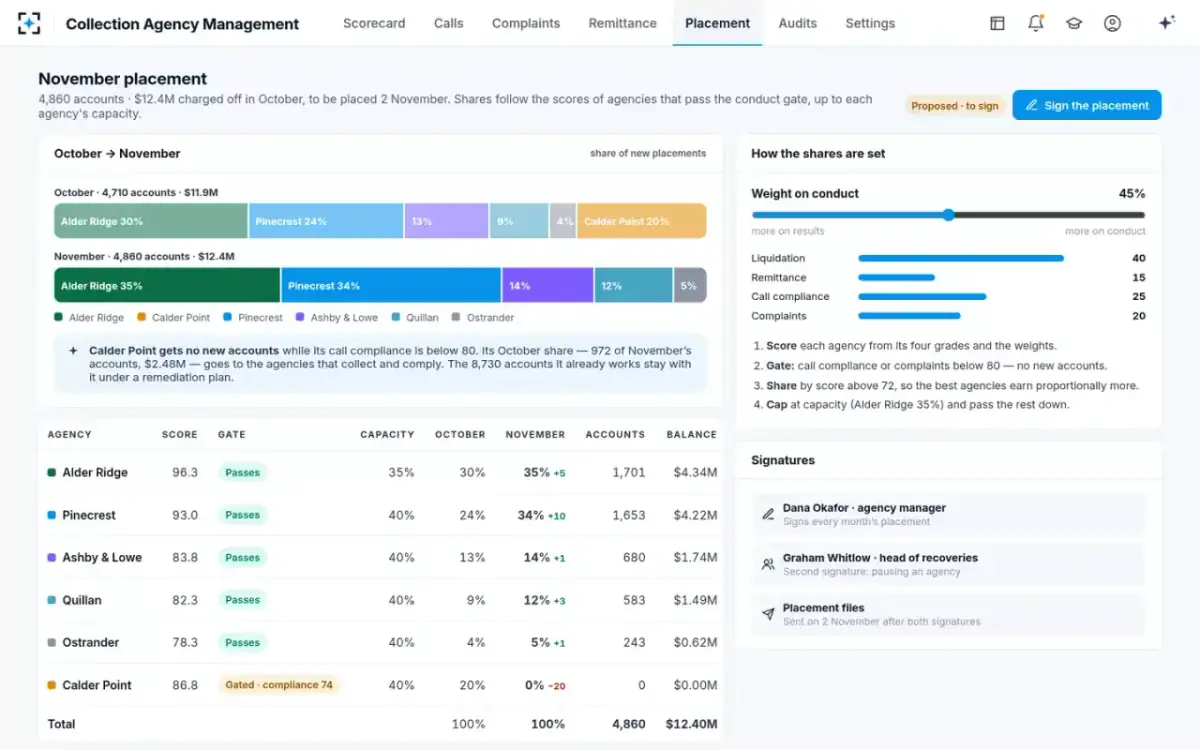
Placement is the point at which a lender stops watching its own work and starts watching someone else’s. The borrower gets more protection, the lender gets less visibility, and the duty sits exactly where it was. To see what the weekly reading of that evidence looks like, start from Collection Agency Management.
Questions people ask
When does an account become third party?
On the day it is placed with an outside party that collects for the creditor — not at charge-off, and not at any particular age. Charge-off and placement often happen within weeks of each other, which is why they are confused, but they are separate events: charge-off is an accounting decision by the lender, and placement is a commercial instruction to someone else. The borrower’s protections under Regulation F follow the placement, not the write-off.
Does the FDCPA apply to the original creditor?
Generally not, when the creditor collects its own debt in its own name: the Act is aimed at people collecting debts owed to another, and Regulation F’s definition of creditor excludes someone who takes an assignment of a defaulted debt only in order to collect it for someone else. That exclusion is narrow, though. A creditor can lose it by using a different name to suggest a third party is involved, and state law and the prohibition on unfair, deceptive or abusive acts or practices still apply to a first-party collection department.
What is the difference between placing and selling a debt?
Placing keeps the debt on the lender’s books and pays the agency a percentage of what it collects; the lender can recall the account. Selling transfers ownership to a buyer for a price paid up front; the lender cannot recall it, and the buyer keeps everything it collects. The two are often compared on headline numbers that are not comparable — one is a certain price today, the other an uncertain net stream over a year or more.
Can a lender recall an account from a collection agency?
Yes, if the contract says so, and almost all placement contracts do. What varies is the notice period, whether fees are still owed on payments already arranged, and whether a bulk recall triggers a different term from a single-account recall. In the fictional sample bank’s contracts, any account can be recalled on five business days’ notice, and a recall of more than 50 accounts needs a second signature.
Is a collection law firm a third-party collector?
Usually yes. Regulation F reaches anyone who regularly collects debts owed to another, directly or indirectly, and a firm whose practice includes collection work for creditors is squarely inside that. Some obligations are shaped differently in litigation — the debt-collector disclosure is not required in a formal pleading, for instance — but the firm is a debt collector while it is sending letters and taking calls.
Does placing accounts with an agency reduce the lender’s compliance risk?
No. It changes who performs the work and adds a set of federal obligations that did not apply before, while leaving the lender answerable for the outcome. The banking agencies’ 2023 joint guidance is explicit that using third parties leaves a banking organisation’s own responsibilities untouched, and a complaint about a placed account still arrives at the lender.