Collection agency management software, searched by a lender, means the system used to place charged-off accounts with outside collection agencies and law firms and to oversee what those firms then do: results, conduct, complaints, remittances and audits. Searched by an agency, the same phrase means something else entirely — the platform an agency runs its own business on, with its own dialer, its own collector desktop and its own client reporting. Both products exist, both are good at what they do, and many of the feature lists a lender is shown belong to the second. Botminds' Collection Agency Management is the first kind: it grades every agency and law firm weekly on four measures, opens each grade onto the calls, files and complaints behind it, and proposes next month's placement from the grades for a person to sign.
This page is the requirements document for that buy. It sets out what the lender-side product has to do, how to test each requirement on your own files rather than the seller's, what belongs in the contract with the agencies, and what data you need before any of it can run. The worked figures come from one week of a fictional sample panel inside the solution — Bellmere Bank, six agencies, 38,420 charged-off accounts worth $96.3 million — and are sample data, not a customer's measured results.
One month on the sample panel, in the numbers a buyer cares about
$12.4M
charged off in October — 4,860 accounts to be placed on 2 November
972accounts
moved away from one agency by the conduct threshold, to firms that collect and comply
$7,057
short in one agency’s September remittance file, found before it was paid
41accounts
billed at the secondary fee rate instead of the primary rate the amendment set
What is collection agency management software?
For a lender, it is the system that holds the placement relationship end to end: which accounts went to which firm and when, what each firm collected and remitted, how each firm behaved while collecting, what consumers complained about, what the last audit found, and what share of next month's accounts each firm should get as a result. It sits between the bank's recovery accounting and the firms' own systems, and its job is to turn what the firms send into a judgement the bank can defend.
The reason this is a product rather than a spreadsheet is the evidence volume and the fact that the four questions it answers have different units. Liquidation is measured on cohorts of accounts. Conduct is measured on individual calls. Complaints are measured per thousand accounts over a trailing window. Remittance accuracy is measured per line against a contract rate. Putting all four on one page, with each one openable onto the thing it was computed from, is the whole product.
The supervisory framing is proportional rather than prescriptive, which is useful when writing the business case. The CFPB's service-provider guidance lets the depth and formality of a risk-management programme scale with the service — its size, scope, complexity, importance and potential for consumer harm — and with how well the provider has complied with federal consumer financial law so far (Compliance Bulletin 2016-02). Consumer collections scores high on importance and on potential for consumer harm, which is why a panel of six agencies attracts more machinery than a panel of six print vendors.
Two products share this phrase — make sure you are buying the second
The quickest way to tell which product you are being shown is to ask who the user is in the demo. If the person on screen is a collector working an account, or a supervisor staffing a queue, it is the agency's product. If the person on screen is reading what an agency sent and deciding where next month's accounts go, it is the lender's.
Two products, one phrase, feature by feature
Software for the agency: The collector desktop: the account, the script, the next action, the payment form.
Software for the lender that places: The panel: every firm graded this week, what moved, and what needs a person.
Software for the agency: Core. Campaigns, pacing, attempt rules, list management.
Software for the lender that places: Not present. The dialer log is read as evidence, not operated.
Software for the agency: Takes them, posts them, builds the remittance file.
Software for the lender that places: Reconciles the remittance file against payments already posted and the contract fee rate.
Software for the agency: Scripts, consent and attempt rules applied before a call is made.
Software for the lender that places: Tests applied after the fact, to every recorded call, against the rules and the contract.
Software for the agency: Client reporting outward: what this agency achieved for each client.
Software for the lender that places: Comparative inward: what every firm achieved on like-for-like paper.
Software for the agency: Which account to work next, and how.
Software for the lender that places: Which firm gets next month’s accounts, which accounts come back, and which conduct stops both.
Software for the agency: The agency’s own operations and IT.
Software for the lender that places: Recoveries, vendor risk or operations at the lender or credit union.
One implication is worth stating because it surprises buyers. An agency's own platform, however good, will show you that agency's work. It cannot grade six firms on the same paper, because it has only the paper that firm was given. Comparison across the panel is not a feature an agency product is missing; it is one it cannot have.
What should collection agency management software do?
Nine requirements carry the lender-side buy. Each one is written below with the reason it exists and the test to run in a demo — on your own month of files, not the seller's. A vendor that will not run the second column on your data has answered the question.
Requirement, why it exists, and how to test it in a demo
| Requirement | Why it exists | How to test it, on your own files |
|---|---|---|
| Read every recorded call, not a sample | Conduct faults arrive in clusters — one script, one team — and a sample of a few percent will usually miss a cluster of four. | Hand over one month of recordings and the matching dialer log. Compare calls placed with calls read, per agency. Ask what happens to unusable audio. |
| Open every grade onto its evidence | A grade you cannot open is an opinion. The agency will dispute it, and you will have nothing to show. | Click a letter grade. You should land on the calls, lines or complaints behind it, with timestamps — in one step, not a report request. |
| Compare agencies on like-for-like paper | Agencies are given different vintages, balances and prior-placement histories; an unadjusted ranking ranks the paper. | Ask to see the strata. Then ask what happens to the ranking when one agency’s mix is corrected. |
| Reconcile remittances line by line | Fee errors and missing payments are often found at audit, months later, and can be systematic rather than one-off. | Give it a month you have already reconciled by hand, including one file you know was short, and compare the variance lists. |
| Hold the contract as amended | A fee variance cannot be computed against a fee schedule that ignores amendment 2, and panels often run on amended terms. | Load a contract with two amendments and ask which rate applies to a paid-in-full account from the primary pool. |
| Link complaints to the account and the call | A complaint count says something went wrong; the account and the call say what, who and which script. | Hand over ten complaints with no account numbers and see how many are matched, and what evidence each match shows. |
| Propose placement from the grades, and stop at conduct | Placement shares otherwise persist by habit, and conduct has no consequence until the annual review. | Change one agency’s conduct score below the threshold and watch what the proposal does, and what it says it did. |
| Require signatures before anything leaves | Placement and pauses are decisions with costs; software should propose them and never send them. | Try to send a placement file without a signature. The right answer is that you cannot. |
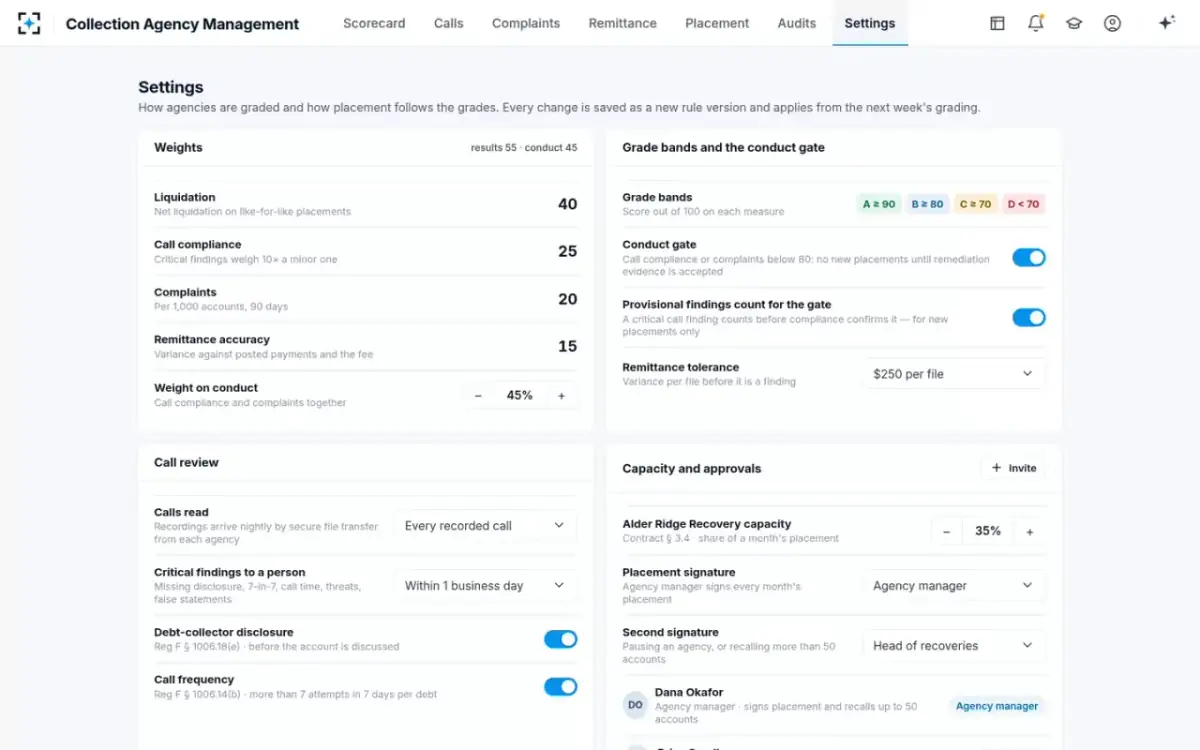
| Keep the rules as settings, with versions | Weights, bands, thresholds and approvers change, and last quarter’s grades have to stay explainable under last quarter’s rules. | Change a weight and ask what happens to the grades already published, and where the previous rule version is kept. |
How do you measure collection agency performance?
Often badly, and for one reason: the agencies were not given the same paper. Net liquidation — dollars collected after fees, over dollars placed — is the right numerator and denominator, but comparing it across firms is only meaningful within a stratum. Age at placement, balance band, product, state, whether the account has been worked before and by whom, and whether the consumer has ever been contacted can all move recovery more than agency skill does.
So the measurement that matters is a like-for-like one: build strata, place a comparable mix into each firm, and compare within the strata rather than across the panel. That has a second benefit, which is that it makes a champion–challenger test possible at all — if next month's allocation moves accounts between firms, the only way to read the result is to have placed comparable accounts on both sides. The arithmetic and the traps are worked through in charge-off recovery rate.
Conduct, complaints and remittance accuracy do not have this problem in the same way, but they have their own. Complaints need a denominator and a window — per thousand accounts placed, over ninety days — or a large firm always looks worse than a small one. Conduct needs full coverage or the score is a sampling artefact. Remittance accuracy needs the contract as amended, or every variance is attributed to the wrong cause.
The scorecard: four measures, and what each one has to open onto
The sample panel grades each firm out of 100 on four measures and bands the result: A at 90 and above, B at 80, C at 70, D below. The weights are a setting; the sample bank runs liquidation at 40, call compliance at 25, complaints at 20 and remittance accuracy at 15 — which is 55 points on results and 45 on conduct.
What makes a scorecard worth having is not the arithmetic but the fifth column: what each letter opens onto. Liquidation opens onto the cohorts and the strata. Call compliance opens onto the calls, with the timestamp and the script version. Complaints open onto the complaint, the account and the call behind it. Remittance accuracy opens onto the lines, the posted payments and the fee rate applied. A grade that opens onto a report rather than evidence will not survive its first argument with an agency.
Six firms, four measures, thirteen weeks of movement
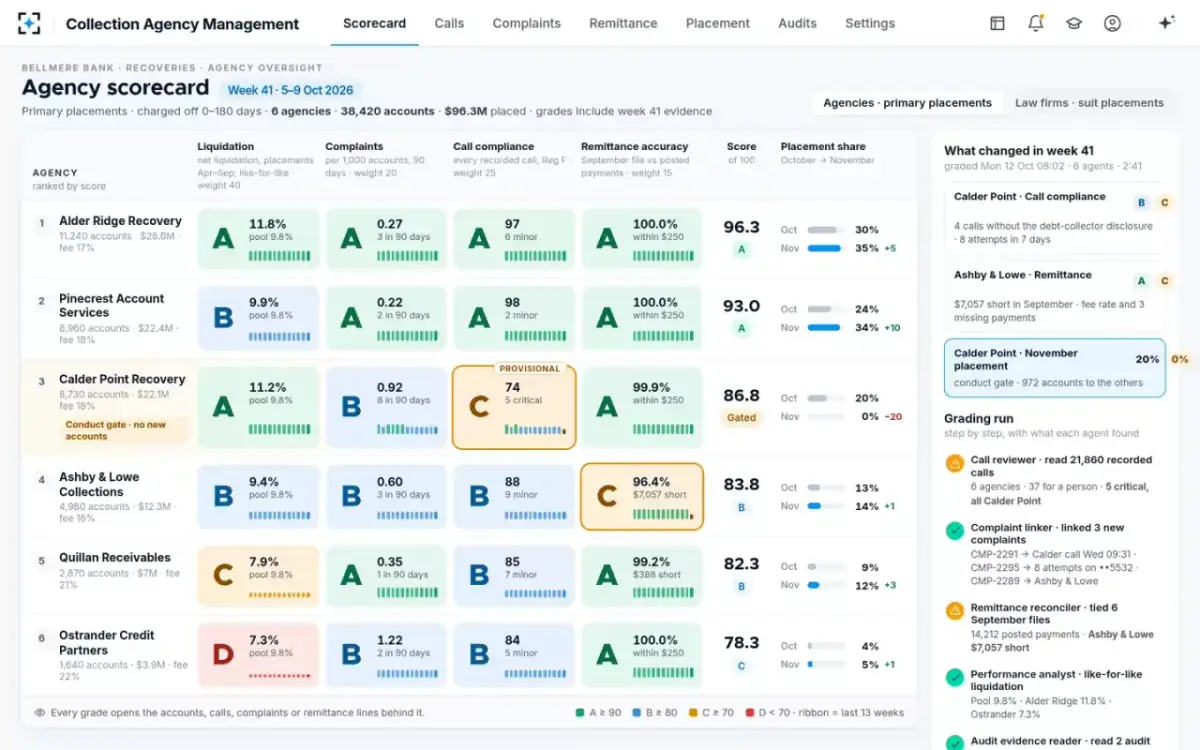
The provisional marking is a small design decision with large consequences, and it is worth putting on a requirements list. A conduct finding that has not yet been confirmed by a person should be visible, should hold back new placements, and should not yet move a published grade or a fee. The reasoning, and the tests behind each conduct measure, are in collection agency compliance standards.
Remittance reconciliation, and what a tolerance is for
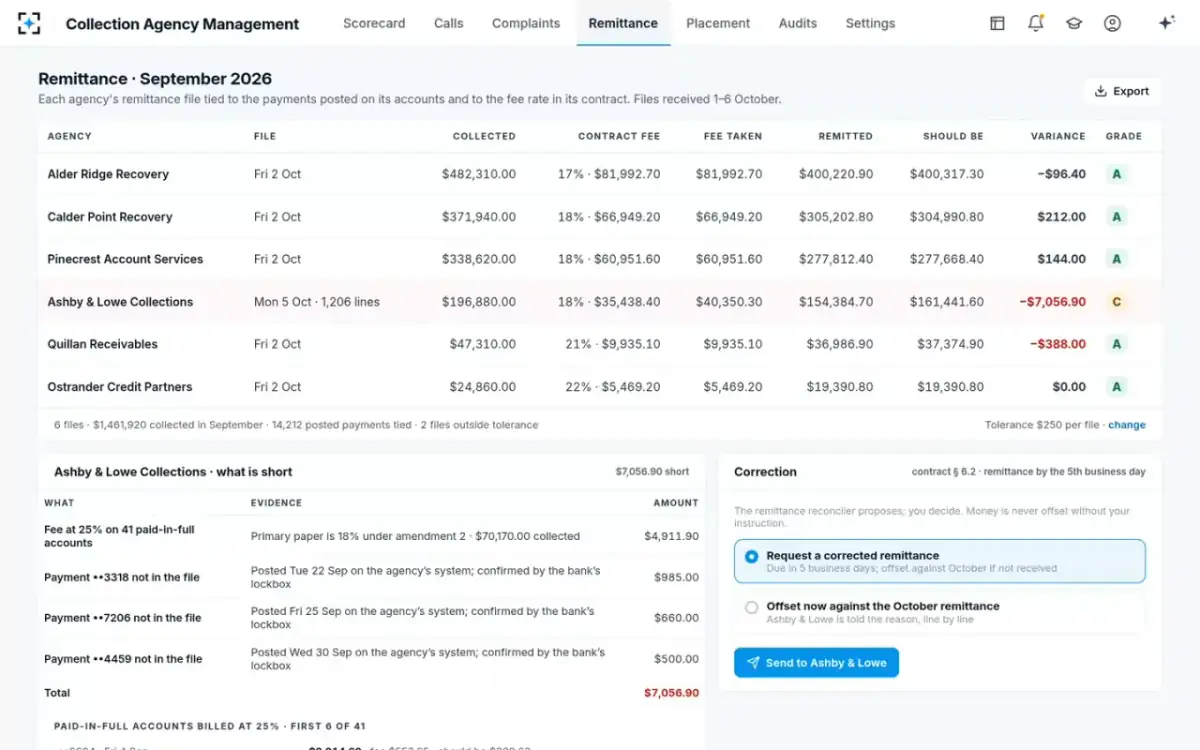
Remittance reconciliation is the least glamorous requirement and the one whose results are easiest to count in money. The work is to tie every line of the firm's file to a payment the bank's own posting shows, and to check the fee taken against the rate the contract — as amended — puts on that pool. Both halves fail in practice: payments collected and not remitted, and the right payments billed at the wrong rate.
On the sample panel one September file was $7,056.90 short, from two causes at once. Forty-one paid-in-full accounts from the primary pool were billed at the 25% secondary rate rather than the 18% the second amendment set, which is $4,911.90 on $70,170 collected. Three payments that the agency's own system and the bank's lockbox both show were collected never appeared on the file at all. Neither error is dramatic; both are systematic, which means they repeat every month until someone names them.
A tolerance is where buyers go wrong. A per-file tolerance — the sample panel uses $250 — exists so that rounding and timing differences do not generate a dispute every month. It is not a threshold below which errors are acceptable. The distinction matters in the design: a file inside tolerance should still show its variance lines, because four months of $200 differences in the same direction is a pattern, and a system that discards them cannot see it.
Every line tied to a payment and a contract rate
Placement that follows the grades, and the rule that overrides them
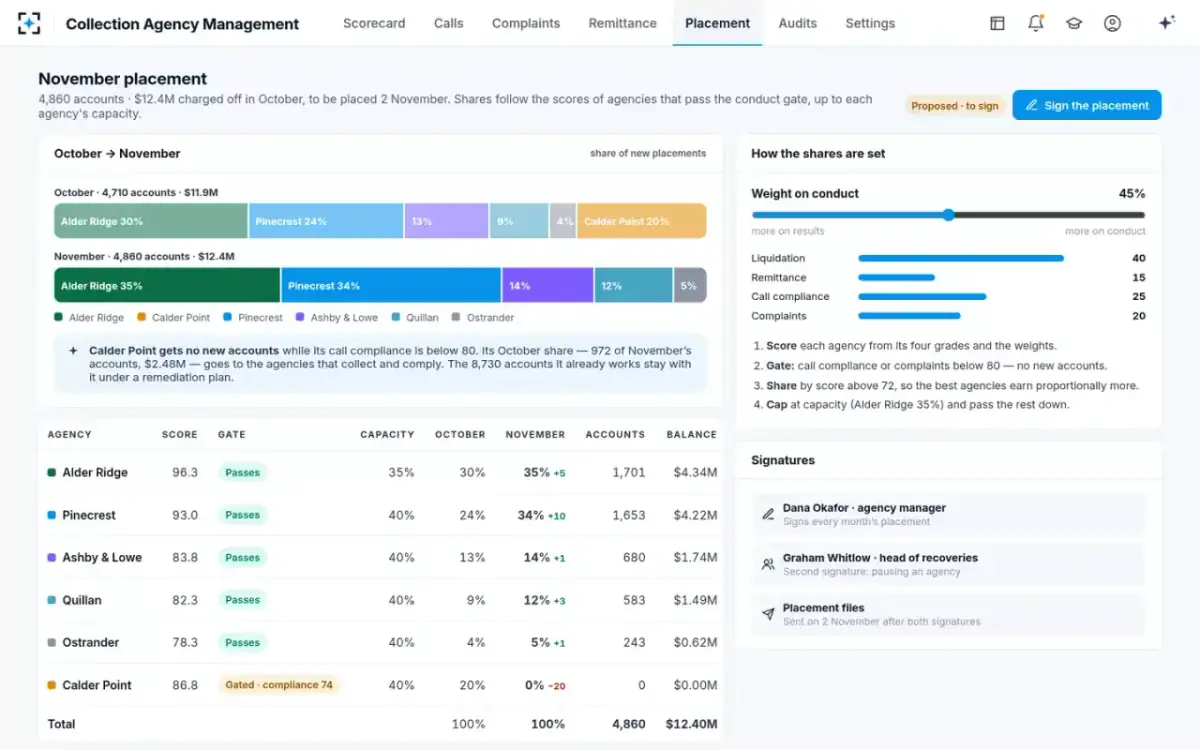
Many panels reset placement shares by spreadsheet and by habit, so the same firms get the same shares whatever the quarter showed. The lender-side product's distinctive job is to propose next month's allocation from the grades, show the accounts that move, and then stop until a person signs.
Two constraints have to sit above the score. The first is capacity: a firm that has agreed a 35% ceiling cannot absorb 48% however well it is performing, and a proposal that ignores the ceiling is a proposal to breach the contract. The second is conduct. On the sample panel, call compliance or complaints below 80 means no new accounts next month regardless of liquidation, until remediation evidence has been accepted — which is how 972 accounts moved away from one of the panel's two best collectors in November.
That override is the part of the design to argue about before buying, because it is the part that costs money in the short run. The case for it is that the alternative — a single weighted score — always lets results buy off conduct at some exchange rate, and the exchange rate is rarely one anyone would defend if it were written down as a sentence.
The rules as settings, with a version each time they change
November's placement, and what the conduct rule moved
What to ask a vendor, and what to ask for in writing
Two lists, and the second is the one most buyers forget. The first is what you ask the software vendor; the second is what has to be in the contracts with the agencies themselves, because no oversight system can read evidence its lender is not entitled to receive.
What to ask for in writing — from the software vendor, and from each agency
- From the vendor: the coverage number on your own month
Recordings read against calls placed, per agency, for a month you supply. A percentage without a denominator is not an answer.
- From the vendor: what a person must do, listed
Which decisions are reserved to a named human, and what the system does when someone tries to bypass one.
- From the vendor: where the rules live and how they are versioned
Weights, bands, thresholds, tolerances and approvers as settings with a history, so last quarter’s grades stay explainable under last quarter’s rules.
- From the vendor: what leaves your environment
Whether audio or transcripts go anywhere else, who can play a recording, what is logged when they do, and what the contract says about training on your files.
- From each agency: nightly delivery of call recordings and dialer logs
The agency must keep each recording for three years from the call; delivery turns its retention duty into evidence you hold and can re-read later.
- From each agency: the remittance file in a fixed layout, with the fee rate shown per line
A net figure cannot be reconciled. Ask for the rate applied on every line, not a schedule you have to infer.
- From each agency: complaints received directly, within a fixed number of days
Complaints that reach the agency and never the lender are invisible to your own count and are often the earliest signal.
- From each agency: script versions with issue dates, and the collector roster
Without these a cluster of findings cannot be traced to its cause, and the remediation cannot be re-tested.
- From each agency: audit rights with named evidence and a deadline
An audit right that does not name the artefacts produces a questionnaire. Name the files, and the days within which they must arrive.
- From each agency: recall rights, with notice period and account limits
What you can pull back, how fast, and what it costs — agreed before the week you need it rather than during it.
The supervisory guidance makes the same point from the monitoring side, listing among the factors a bank considers "relevant audits, testing results, and other reports that address whether the third party remains capable of managing risks and meeting contractual obligations and regulatory requirements" (Interagency Guidance on Third-Party Relationships, June 2023). Each of those is a document someone has to be obliged to produce. The same guidance treats termination as a normal part of the lifecycle — a relationship may end on breach, or on "the third party's failure to comply with applicable laws or regulations" — which is a reminder that the exit terms belong in the first contract, not the last conversation. How to run the selection itself is set out in how to choose a collection agency.
What you have to bring before any of it runs
Six inputs make the system work, and a lender that cannot supply them is buying a dashboard. Placement and recall files say which accounts went where and when. Call recordings and dialer logs are the conduct evidence. Remittance and activity reports are reconciled against the bank's own payment postings and lockbox. Complaints come from every channel, including those that arrive at the agency. Audit questionnaires and their evidence come on the contract calendar. And the agency contracts with their fee schedules, amendments, capacity caps, recall rights and audit rights are what the other five are judged against.
There is a seventh input nobody lists, and it is where implementations stall: the bank's own data quality on the accounts it places. The most common consumer complaint in debt collection is not about conduct at all. "In 2024, the most common issue was attempts to collect debt not owed," the CFPB reported, noting that this has been the predominant issue selected by consumers since it began accepting debt collection complaints in 2013, and that most consumers who say the debt is not owed report that it is not their debt — 60 percent of them (FDCPA annual report, November 2025).
That is a placement-file problem before it is an agency problem. Accounts placed after a settlement, after a payment that had not posted, after a bankruptcy notice or against the wrong person generate complaints no amount of agency conduct can prevent. The cheapest control in the whole programme is a check at the moment of placement rather than at the last refresh.
Where an oversight month goes on a six-agency panel
The days that come back are not the point of the purchase, but they do decide where the people go. A month that spends five days listening to a sample and four reconciling spreadsheets has little left for the work only a person can do: confirming findings from the call, arguing them with the firm, and deciding what next month's allocation should be. What the reading can be trusted with, and what it must never do, is set out in AI vendor management software. To see the scorecard, the evidence and the signatures on one panel, start from Collection Agency Management.
Questions people ask
What is the difference between agency software and agency oversight software?
Agency software runs the collection business: the dialer, the collector desktop, payment taking and client reporting. Agency oversight software runs the lender's side of the same relationship: placement and recall, the grading of every firm on results and conduct, remittance reconciliation, complaint linking and audit tracking. The tell in a demo is who is on screen — a collector working an account, or an analyst reading what six firms sent.
What does a collection agency scorecard include?
At minimum four measures: net liquidation on like-for-like placements, complaints per thousand accounts over a trailing window, call compliance across the calls actually reviewed, and remittance accuracy against posted payments and the contract fee rate. What makes it usable is that each letter opens onto its evidence — the cohorts, the calls with timestamps, the complaint and its account, the remittance lines — and that the rules behind the score are settings with a version history.
How do you reconcile an agency remittance?
Tie each line to a payment your own posting shows, then check the fee taken against the rate the contract as amended puts on that pool, then look for payments you posted that are not on the file at all. The two failures are different: a wrong rate is an error in the agency's configuration, and a missing payment is a gap between collection and remittance. A per-file tolerance should suppress a dispute, not the variance lines — several small differences in one direction is the pattern you are looking for.
What should you ask a collection agency management software vendor?
Ask for the coverage number on your own month of recordings against your own dialer log. Ask which decisions are reserved to a named person and what happens when someone tries to bypass one. Ask where the weights, bands and thresholds live, and what happens to already-published grades when one changes. Ask what leaves your environment and what is logged when a recording is played. Run every answer on your files rather than the demonstration data.
Can software decide to move placements on its own?
It should not, and a product that offers to is solving the wrong problem. Moving placements and pausing a firm are decisions with costs, and the value of the system is that the proposal arrives with its reasoning and its evidence attached. On the sample panel the allocator proposes, the agency manager signs, and pausing a firm or recalling more than fifty accounts needs a second signature from the head of recoveries before any file is sent.
Do you need this if you use only one agency?
The comparison half of the product is wasted on a single firm, but the evidence half is not — you still owe the oversight, and one agency's calls are as many calls. What changes is the lever. With one firm you cannot move placements as a consequence, so the levers are remediation deadlines, recall and, eventually, termination; the supervisory guidance treats failure to comply with applicable laws as a normal ground for ending a relationship. If the panel will stay at one firm, buy for the conduct testing and the reconciliation, and expect the placement allocation to sit idle.